
John has been dealing with chest congestion on and off for the past few months. I do not need to give a complete medical history, but there is a good chance that he had some kind of pneumonia earlier this winter. So when he started cough again, we decided that maybe it would be a good idea to stop by urgent care before we boarded the ship.
Urgent care is readily available in New York though a number of small clinics. We went to the City MD facility down by Penn Station. I figured on a Saturday it would not be too busy and he was seen right away. The PA was quite pleasant and happy to prescribe an antibiotic and a cough medication. It was right next door to a CVS where the pleasant pharmacy tech filled it right away. Coming from Ashland where Rite Aid can take a week to do even a routine refill, this seemed astonishing.
It was about noon when our medical adventures were done, and after we left the pharmacy, we walked into a nearby hotel that looked like it might have an interesting Art Deco lobby.
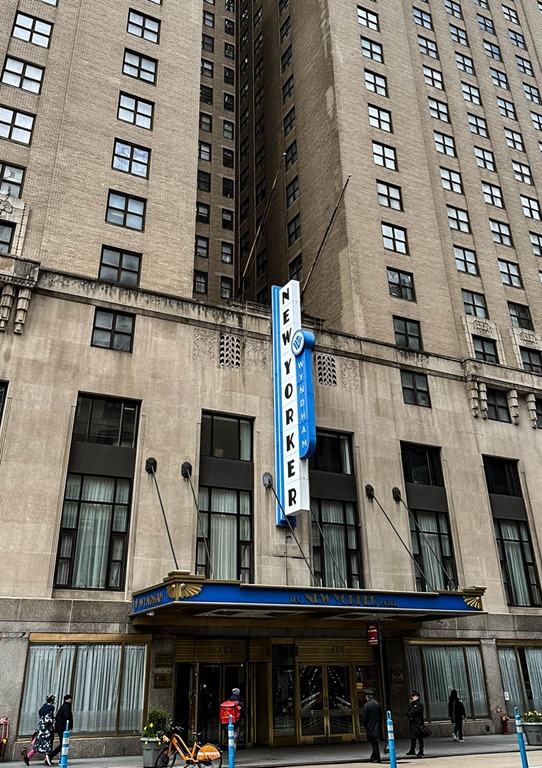
The interior decoration was not sadly that interesting – I wondered if it had once been more elaborate – but we spotted what looked like a classic New York diner through a door on the far side of the lobby. We walked in to just take a peek, but they seated us before we even had time to protest that we really were not all that hungry.
The décor of the café was fun.
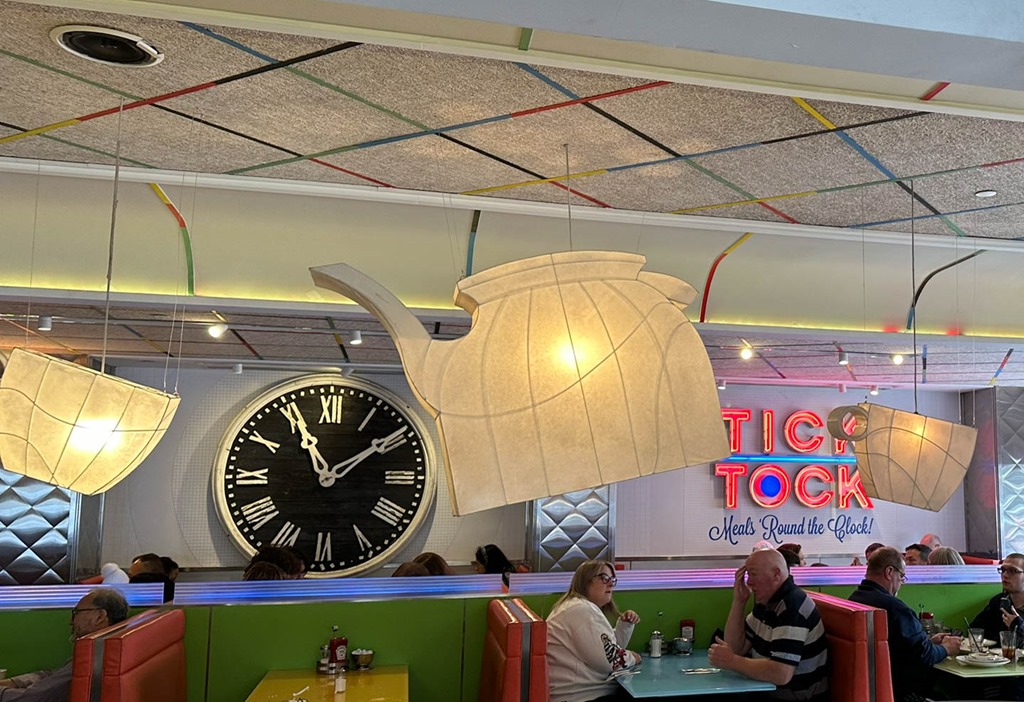
The food was not particularly good, though it was served in near record time.
We grabbed a cab to go to the Hudson Theatre on 44th Street. Almost all the New York cabs support the Curb app. This allows you to electronically hail a cab, just as you would book an Uber, though we have not needed to use that. More helpful to us is that it provides an electronic record of the cab route and an automatic way to pay the fare. This eliminates the frequent issues we used to have with cabs where they would only take cash and somehow could not make change.
Merrily We Roll Along was first staged in 1981. The story itself was an update of a play of the same name by George Kaufman and Moss Hart. That play was the story of a Richard Niles, a playwright who had abandoned his early idealism to write silly light comedies for the Broadway stage. The story was told in reverse order with the first scenes set in 1934 and the last ones just before the First World War. Sondheim, collaborating with George Furth on the book, changed the main character from a playwright to a composer named Franklin Shepard. As in the Kaufman and Hart play, the main characters had two friends, here Charley Kringis, Franklin’s lyricist and dramatic collaborator, and Mary Flynn, a novelist who later sells out to become a drama critic. Shepard, the most important of the three, turns his back on writing agit-prop leftist drama, to writing hit Broadway musicals and then directing movies. And again, just as Kaufman and Hart did, the story is told in reverse order, here beginning in 1980 and ending in 1958.
Unlike most of Sondheim’s shows, Merrily We Roll Along was not a success with either critics or audiences. Sondheim and various directors have reworked parts of the show over the years. This production continues that effort to make this show work. I liked the set, particularly the way that the orchestra was placed in a penthouse above the stage.


The part of Franklin is played in this production by Jonathan Groff, the actor who made such a splash by playing George III in Hamilton. He is perfect for the part in every way, not least because he looked so much like Gavin Newsome. That made it so believable that he would cheat on his wife and screw over his friends. The part of Charley was given to Daniel Radcliffe who gave an acceptable performance, but he was clearly outclassed in every way by the other actors.

After the play, we took a cab back to the hotel. There was a German restaurant right down the street, and going to a south German style beer hall seemed like, well, it’s just not something you can find in a Medford strip mall.
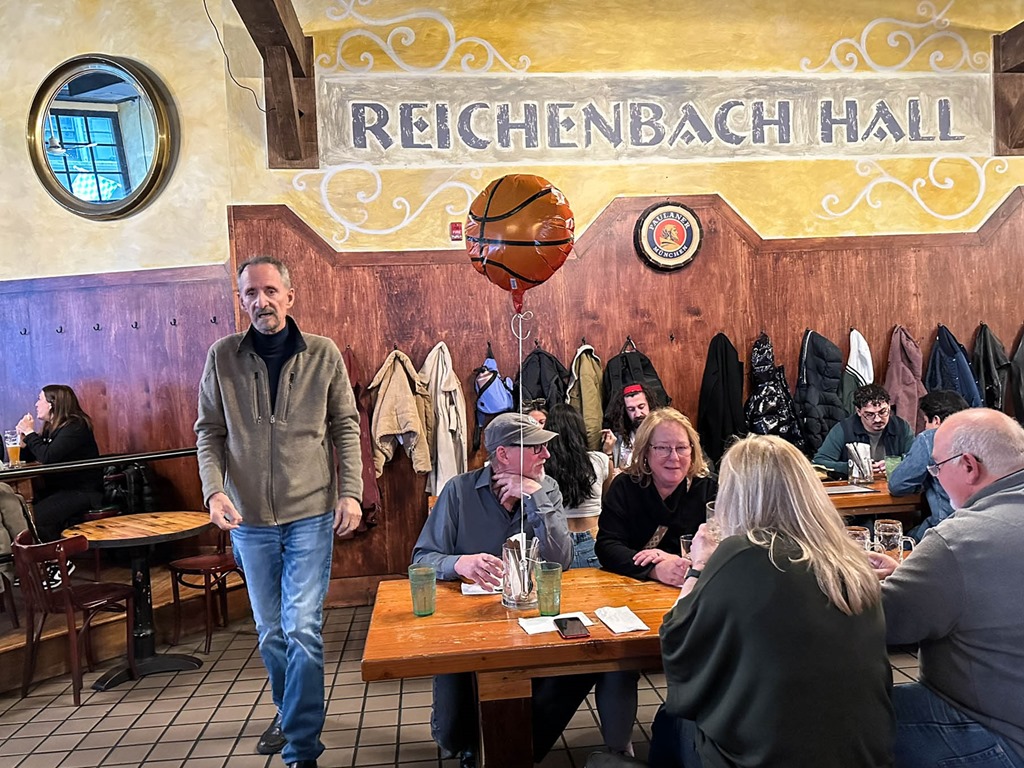
Reichenbach Hall caters, I think, to large parties of people in their twenties and thirties who like to drink a lot. At one point we saw two giant skis brought out with large water glasses attached to them. I somehow think that the water glasses were probably filled with Jägermeister. Two groups of people lined up each behind a glass. At a signal the skis were flipped and the teams competed to see who could guzzle the liquor the fastest.
John and I shared a mixed bratwurst plate and a salad. Both were quite good.
In the evening we returned to the theater district to see Lempicka, a new musical about the notorious socialite and Art Deco artist Tamara de Lempicka. Even if the name is not familiar, you have probably seen her work.
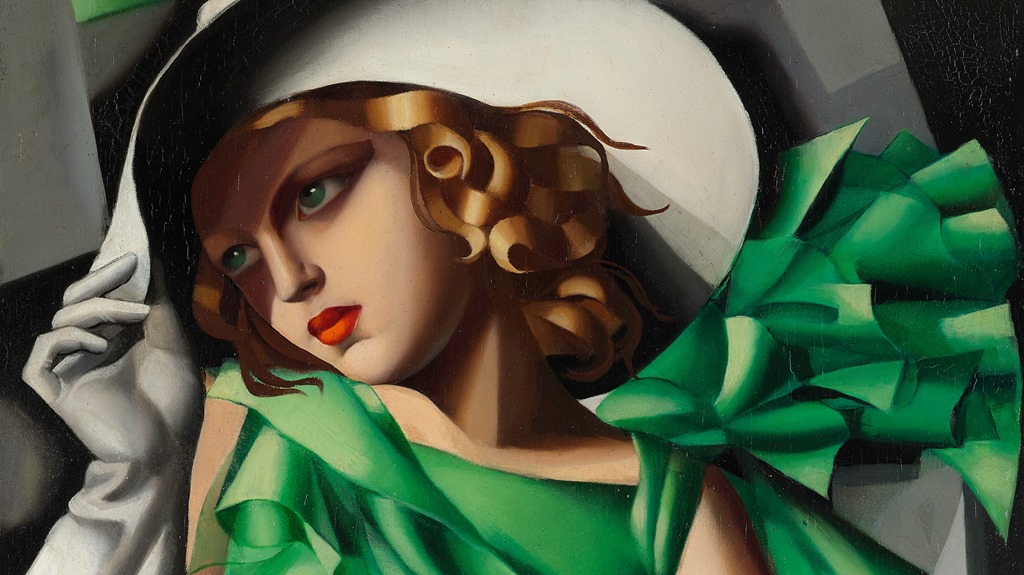
Many years ago John and I saw a show about her at the American Legion Hall in Hollywood about her relationship with the Italian aristocrat and poet Gabriele D’Annunzio. That episode of her life was not covered in this production which instead focused on her relationship with women. Lempicka definitely had a number of lesbian relationships, but the effort in this show to recast her as a kind of queer heroine seemed somewhat forced.

The show, which had been workshopped in Williamstown and La Jolla, had a lot of energy. Sadly, it did not have any memorable tunes.
By the time Lempicka was over it was past eleven, way too late for these two seniors. We found a cab and made our way back to our digs on 37th Street.
 Traveling Johns