
When I woke up this morning and stepped out on my balcony, the weather was definitely warmer. It was not quite like being in the Caribbean; it was more like being in Santa Barbara in June. The water had turned from a dark blue to a lovely light blue, the kind that indicates a shallow sandy bottom. I knew we were approaching Bermuda. A ship pulled up beside us, one of those guide boats that help big ships like ours come into port.

We soon passed by an old fort, one of those places which had once had dozens of cannons ready to fire at any hostile ship that came near. I knew we were coming into a place called the Royal Naval Dockyards, and it made sense to me that there would be fortifications if this had been used by the British Navy.
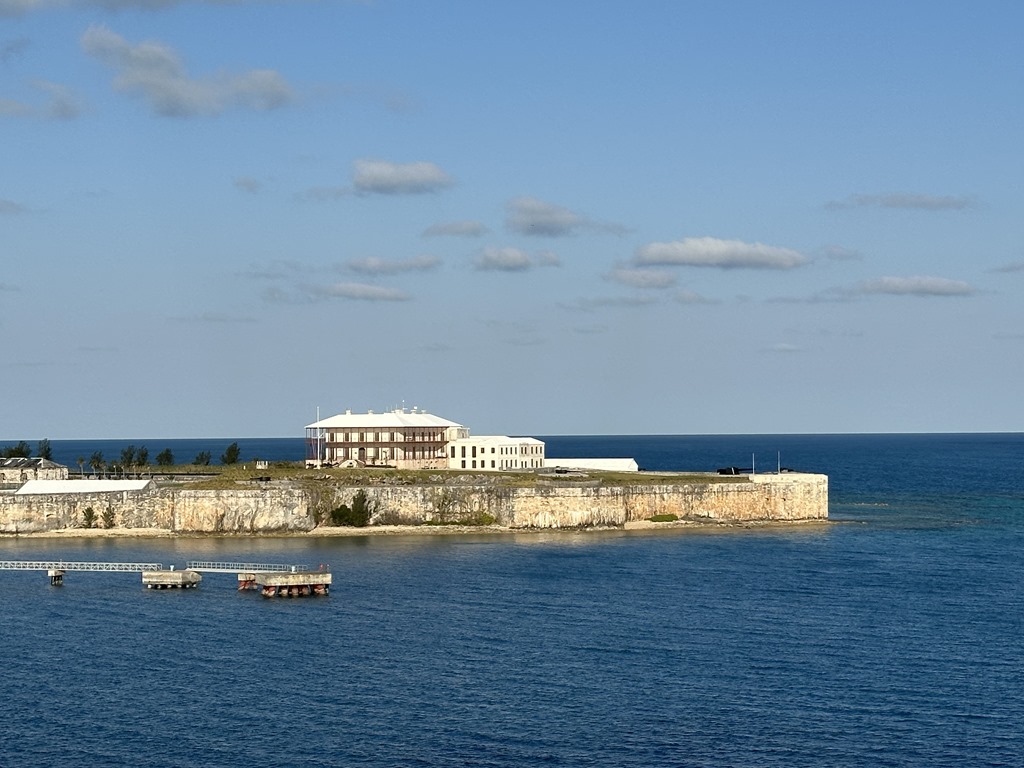
I had first heard about Bermuda when I was quite young. My Auntie Ev worked for the Howatt Insurance Agency in Springfield, Massachusetts. Every winter, Mr. Howatt, a man I never met but always assumed looked like the rich guy on Gilligan’s Island, would spend a few weeks in Bermuda, and while he was gone my aunt was in charge of the business. I assumed Bermuda must be a place of great elegance and sophistication for Mr. Howatt to spend so much of his time there.
I knew Bermuda would not live up to my childhood illusions, but I still wanted to see as much as I could of this island that had held such fascination for me when I was young. I looked over the various offerings and booked a tour through Viator with a firm called Bermudaful. As soon as the ship docked, John and I made our way to the gangway, and then using the map that Bermudaful had sent with my electronic ticket, I went to the meeting place indicated. Our minibus and guide were nowhere to be found. I started to have flashbacks of a similar screwup in Peru. I called Viator, and they in turn called Bermudaful. Happily, I was immediately contacted by the tour operator and told exactly where to find the guide. I was relieved!
There were about ten or so people in our group. Our guide was a rather portly bearded guy named Mark. He was a good guide. His family had lived in Bermuda for several generations, and he seemed to know just about everything about the island. I learned a lot from him.

Bermuda appears to be an island when you look at it on a map, but a closer inspection shows it to be an archipelago. There are in fact 181 islands in the chain. The main island, also called Bermuda, is the largest, it is is connected by bridges to eight other islands. The islands are in part the remnants of ancient volcanoes with extensive limestone formations created by calcium-secreting algae. There are coral reefs, especially around the northern part of Bermuda. Although it rains regularly, Bermuda has no lakes or rivers. As a result, the islands were uninhabited when European first discovered it in the 16th century.
The Portuguese were probably the first to set foot in Bermuda. The Spanish also checked it out, and the islands take their names from the Spanish explorer Juan de Bermúdez. Neither group thought Bermuda worth claiming for their respective crowns. The British settled Bermuda by accident. The Sea Venture, a ship sent to relieve the Jamestown colony and replenish its supplies, was blown off course by a storm. The captain, fearing the complete loss of life and property, ran the ship aground on the reef. When other British ships came by months later, they carried news of the situation and Jamestown and the Sea Venture’s passengers decided to stay in Bermuda rather than to continue to Virginia. From that point on, Bermuda became an English colony. There was some attempt to raise tobacco in the early days, but it was vastly inferior to that produced in Virginia. As a result, the plantation system never took root in Bermuda. Following the War of 1812, the British Navy made Bermuda its North Atlantic headquarters, and it remained that until the 1950s.
Our tour began in Dockyard. On the map above, it sticks out like a scorpion’s tail. This is the area that serve the Royal Navy for nearly two hundred years, and the buildings began to fall into disrepair as soon as the English departed. In recent years, however, the harbor carefully dredged for battleships proved to be perfect for much even larger vessels, cruise ships. The buildings have been restored and repurposed to included museums, restaurants, and many stores selling all manner of things to tourists. Some cruise passengers spend their whole time here. We did not. After a brief overview and introduction, Mark took us on the road to Saint George.
We passed the British cemetery as we were leaving the dockyards.
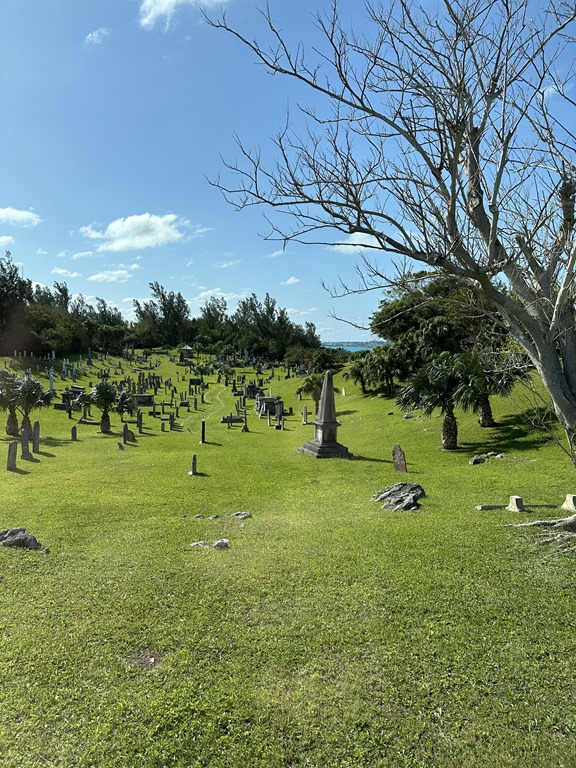
Mark explained to us that most of the dead in this graveyard died from Yellow Fever, not in battle.
We continued on toward Saint George. Mark kept up his informative and often amusing patter. At one point we passed a house painted at least a half dozen different colors. He sighed. “That one belongs to my Aunt Patty. She couldn’t decide what colors she wanted so she used all of them.” Sadly we were going too fast for me to get a good picture.
After about a half hour of driving we stopped at a beach. Bermuda has a number of lovely beaches. They are particularly famous for the flecks of pink in the sand the sand, the crumbled exoskeletons of some kind of coral.

Saint George is the original settlement on the island, and it is beautifully preserved. Mark told us that it is a UNESCO World Heritage Site, an honor I think is bestowed too frequently but is probably deserved here. He showed us Saint Peter’s, an Anglican church which is the oldest Protestant congregation in North America.
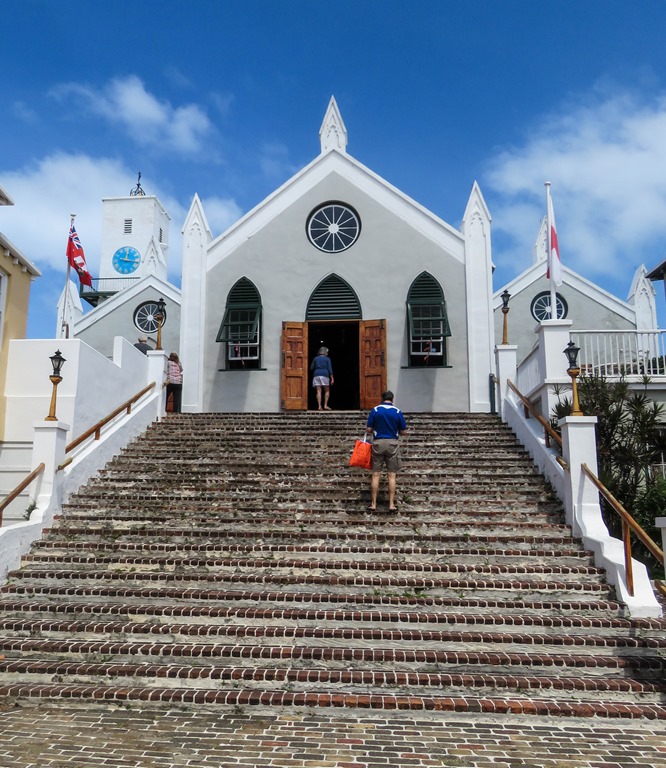
Mark noted that while the Anglican church has a quasi-established status in Bermuda, relatively few Bermudans are Anglican. The African Methodist Episcopal church is the largest denomination on the island, and the Roman Catholic Church is the second biggest.
Most of the buildings in the center of Saint George are cafes or gifts shops, though there are a few signs that there is a real community here. The coral-colored town hall cannot be missed.
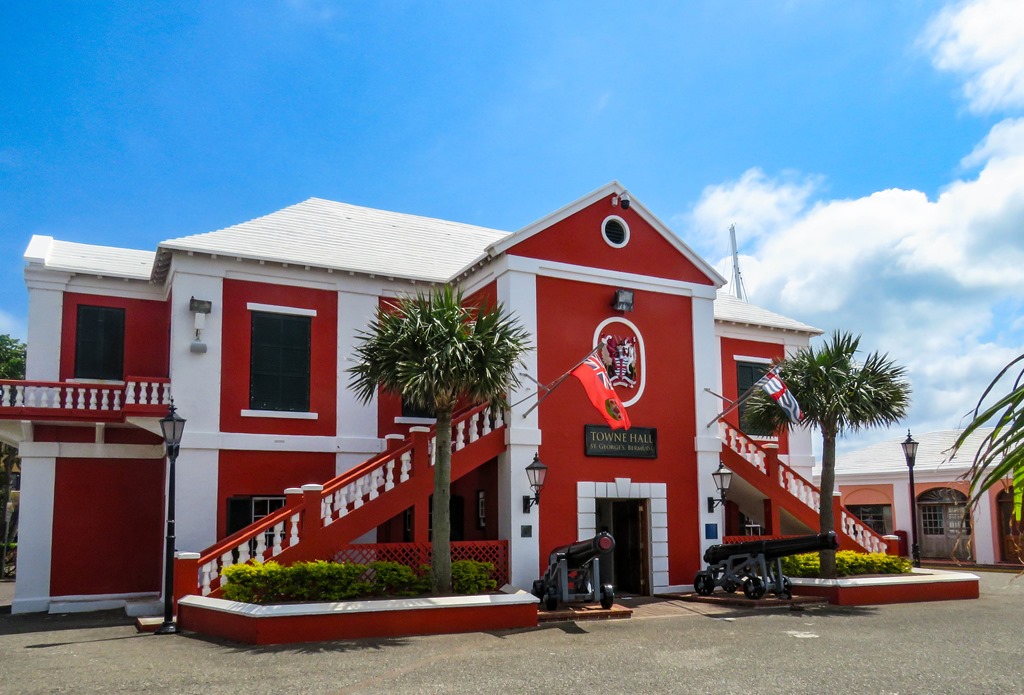

John and I had lunch at a small café. After that, we just wandered about. We admired some of the colonial buildings, all painted in bright colors.
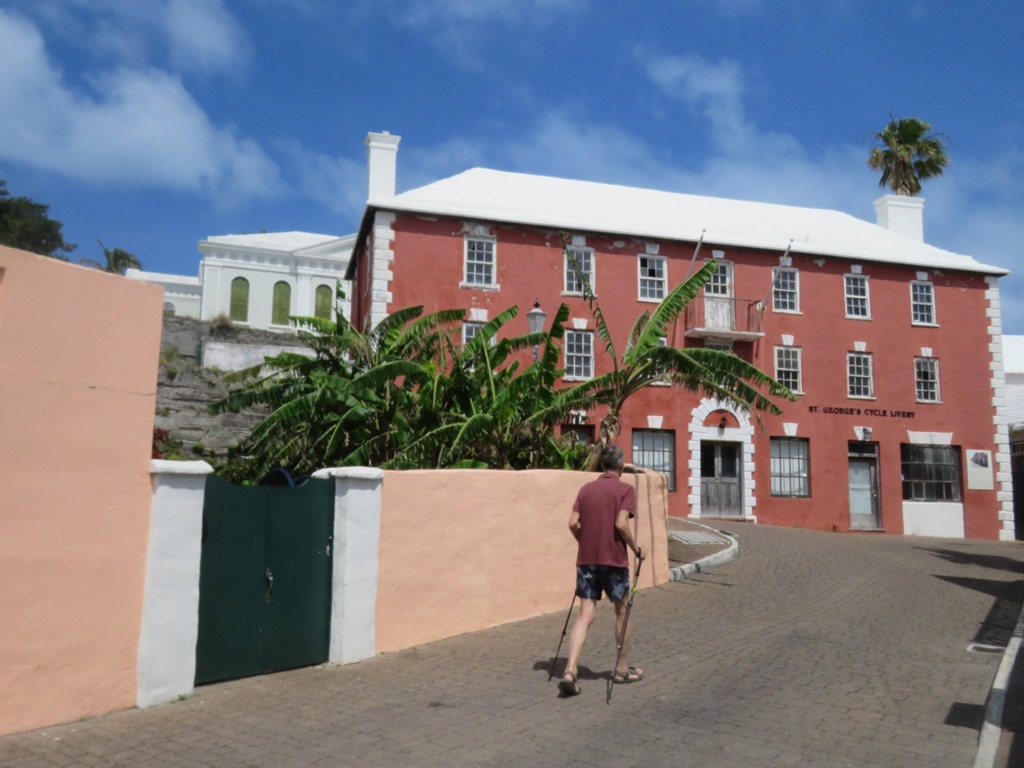
I notice a small sign for a small alley. There was nothing special down there.

I wondered if “Old Maid” was some kind of euphemism for a prostitute. It’s hard to imagine any community filled with sailors where there was not a ready supply of hired female company.
From Saint George, we drove on to the capital, Hamilton. My guess is that at least half the population of Bermuda lives here. Most of Hamilton is not particularly charming, though Front Street along the waterfront is cute.

Hamilton is the commercial hub of Bermuda, and the main business here is reinsurance. For reasons that were not completely clear to me, Bermuda is now the center of the international reinsurance industry. I am sure that that favorable tax rates and a favorable regulatory environment are probably the key to it.
Our final stop for the day was the Gibbs Hill lighthouse. Because of the reefs surrounding Bermuda, it has been the source of many shipwrecks over the centuries. The lighthouse was important to protecting shipping. It’s attractive enough as lighthouse go.
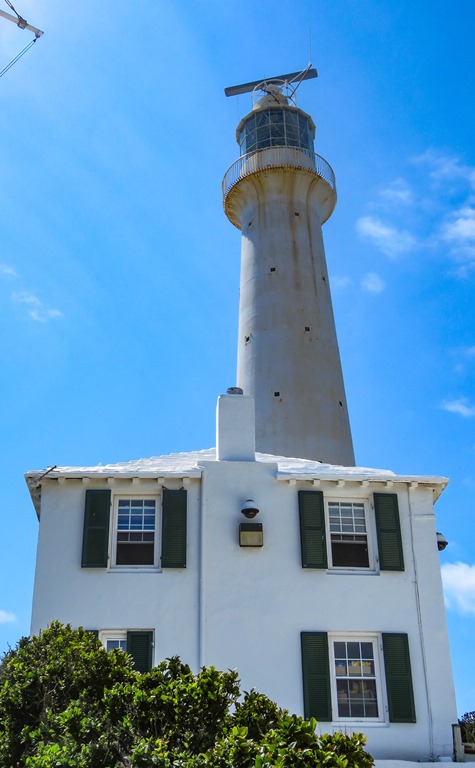
And it does give a view of the rest of the island. John admired the cluster of islands in the Great Sound. These obviously have some of the most expensive real estate in Bermuda.
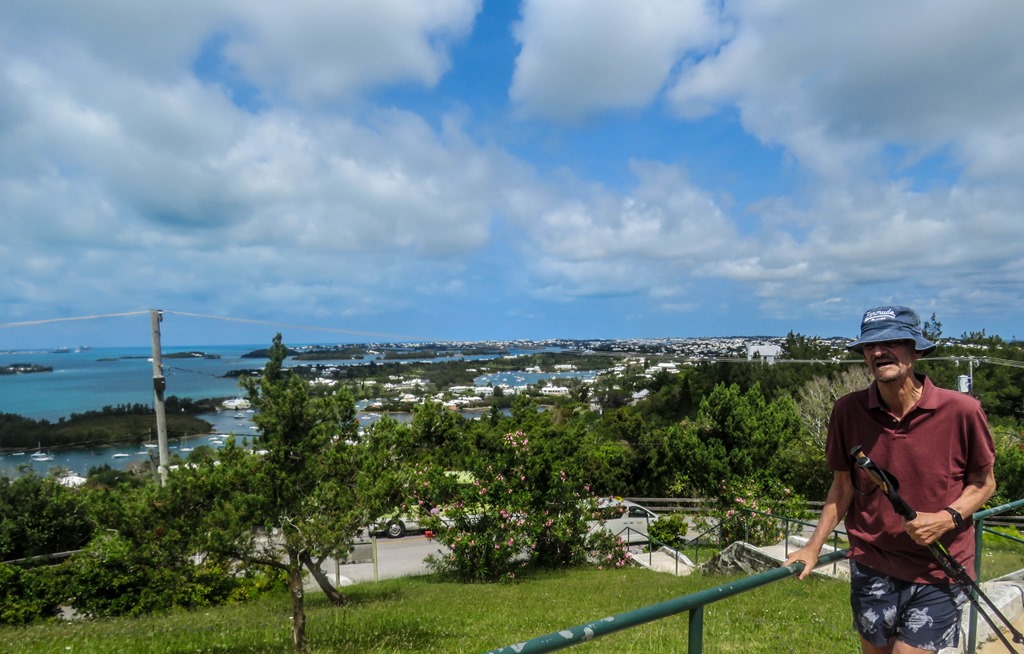
You can also see the Fairmont Hotel from here.
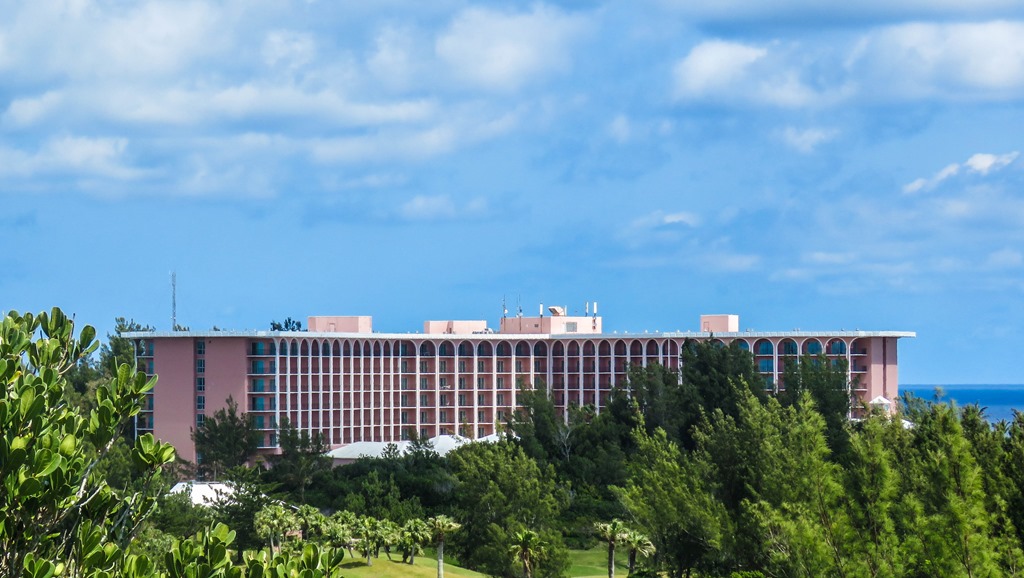
This was the largest hotel in Bermuda, and it was the most fashionable place to stay in Bermuda during its tourism heyday in the 1960s. Mr. and Mrs. Howatt might have stayed there! It changed ownership just before the COVID lockdown, and when the pandemic began all the staff was dismissed. It has not yet reopened.
After a short drive we were back at the Royal Naval Dockyard. We all thanked Mark profusely for giving us such an overview of Bermuda. It does not seem quite as romantic as it did when I was a child, but real places with real people are always more interesting than fantasies.
We have four sea days ahead of us as we head towards the Azores. I’ll post some pictures of the ship soon.
 Traveling Johns