
Today I took a “Behind the Scenes” tour of the working areas of the ship. It was really fascinating. We visited five different areas of the ship, but for security reasons were were prohibited from taking pictures in two of them.
After some initial orientation, we began in the food service area. With so many guests and crew to feed, you can imagine how huge this is. The executive chef began by giving us an orientation.
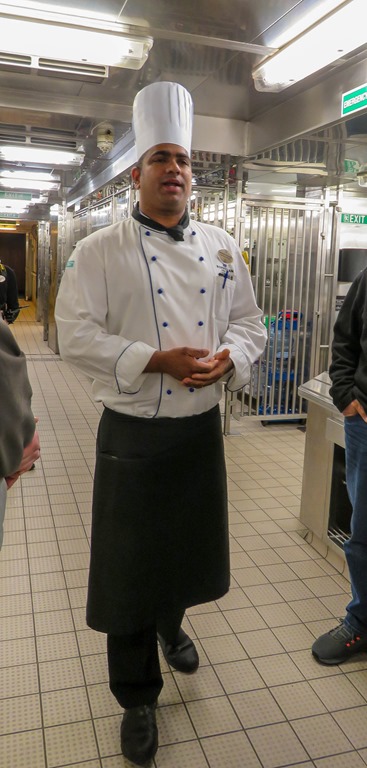
On our last vessel the head of food services was also Indian. It is interesting to see how certain nationalities gravitate to certain positions. He went over the different sections within the department. We were standing right by a kitchen that was devoted primarily to room service requests.

Most of the work on baking breads and pastries are done during the night, the chef explained, but there was a cook working on some cake decoration right next to us. I guessed this was perhaps a special request for somebody’s birthday or anniversary.

On the floor below, there were enormous refrigerators. This one was devoted only to meat. There were others, equally large, for fish and poultry.
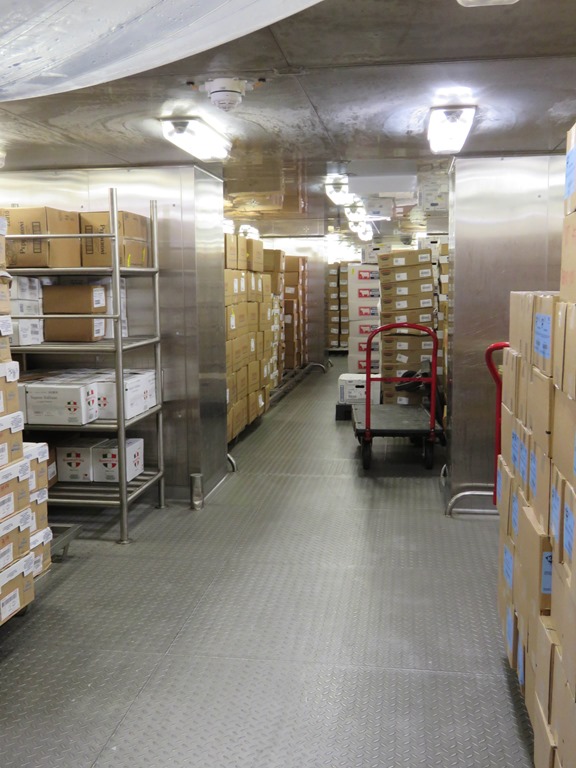
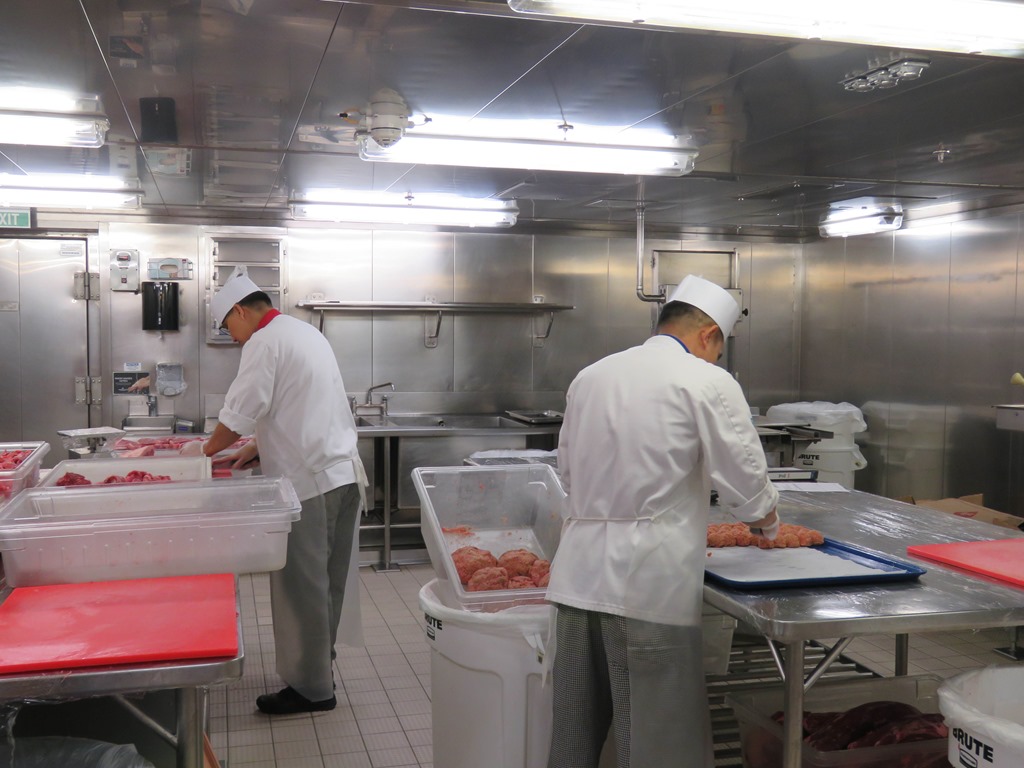
Near the meat freezer was the butcher’s. There are large refrigerators here where the meat thaws before it is carved.
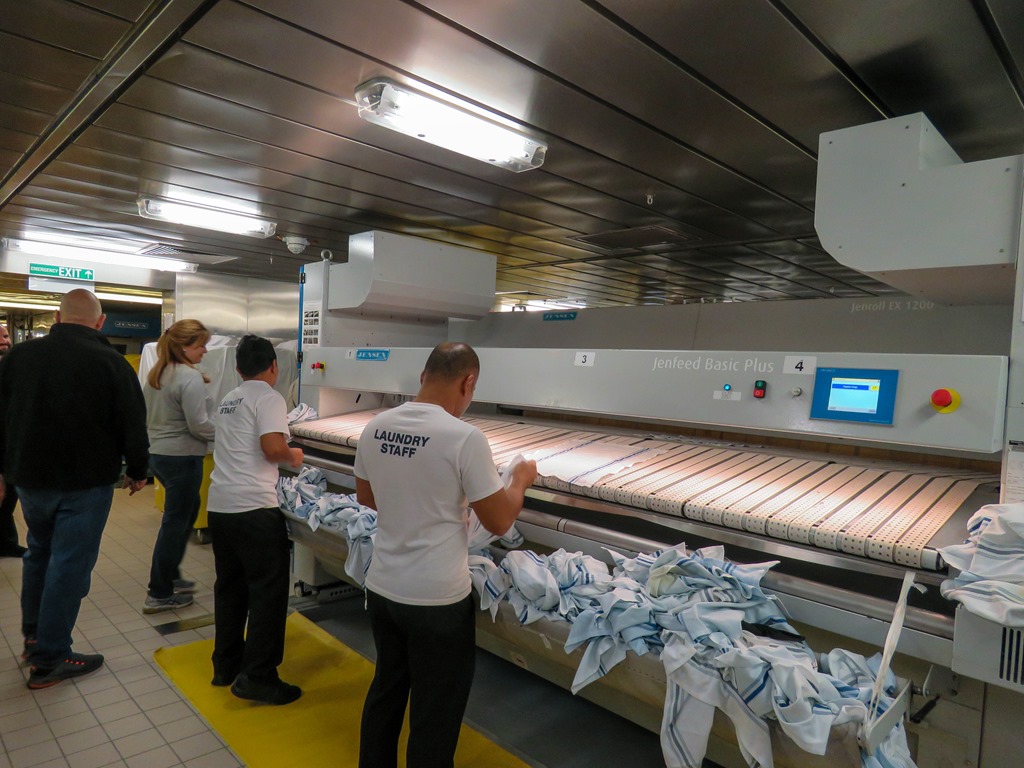
The next area we visited was the laundry. Like the food service area, this was huge. Our introduction was provided by the head of this department.

He was funny. He started by telling us all he was from “South Philly…you know, the south Philippines.” He showed us some of the specialized equipment they have. The main washing machine was impossible to photograph, but it was amazing. It had 23 different compartments and the laundry moved from one to the other as if on a conveyer belt. The washer processed roughly 60 pounds of laundry every minute. Contrast that with my LG machine that takes an hour to do a few shirts.
After washing, it is time to dry. There’s a huge dryer that is mostly used for towels. For other items, there are special dryers. For example, this one was for sheets. You just attach two ends of the sheet to the holder. It snaps the sheet open, then presses it, and best of all, on the other side it comes out neatly folded!

There is a similar device for napkins.
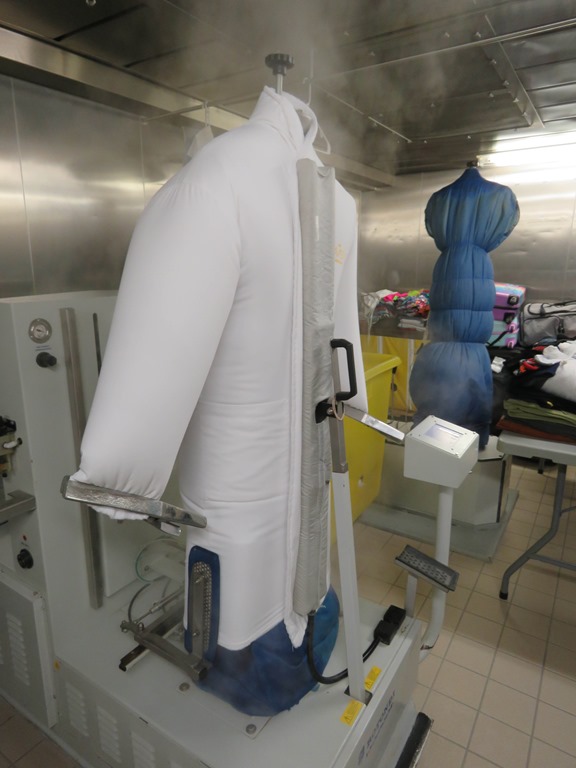
And this one was my favorite. It is for dresses and robes. Just put the item over the mannequin, snap the ends of the sleeves shut, and a blast of steam makes the wrinkles disappear.
On our way to the engine room, Samid, our Brazilian guide, went over work routines and conditions.
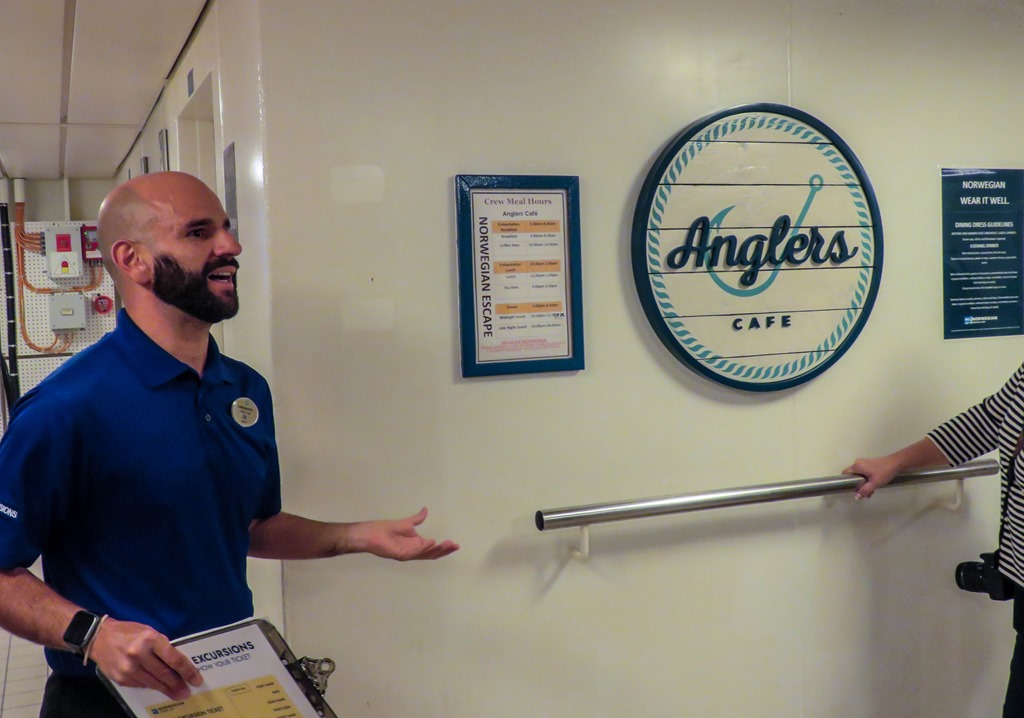
The ship’s crew work 8 hours a day, excluding time for breaks and meals. They occasionally work overtime. They work seven days of a week. A few share quarters, but most have small individual cabins with shared bathroom. Contracts are generally for either four or eight months. Typically crew members have either two or four months between assignments. Norwegian flies them to their initial embarkation point and from their final disembarkation point home. There is no obligation once a contract ends, but most crew members are happy to sign up again and again as it is a good way to save substantial money to send to their families.
Our next stop was the engine control room. We were not allowed to take pictures here. But really there was not that much to see. The control room is covered in large computer screens, each the size of a 58 inch televisions. These report on the functioning of every major mechanical system on the ship. Ship engineers monitor them 24 hours a day, although any major issue will be automatically flagged by the computer system.
The heart of the vessel consists of five boilers that generate electricity. Four are working at all times; one is a backup in case of a failure. They are fueled by heavy oil which is solid when placed on the ship and has to be heated before it can be burned. The ship uses reverse osmosis to turn seawater into fresh water. About 100 gallons a minute are purified. There is a sewage treatment system that transforms waste water into potable water. However, even though the water is now clean it is discharged back into the ocean. Waste is burned, but scrubbers remove most of the contaminants before they reach the atmosphere.
After the engine room, we went to the theater. We met with the stage manager. Normally we would have looked at the stage, but a Q and A session with members of Choir of Man was going on at the time. So instead we went to the dressing room, normally off-limits on tours.
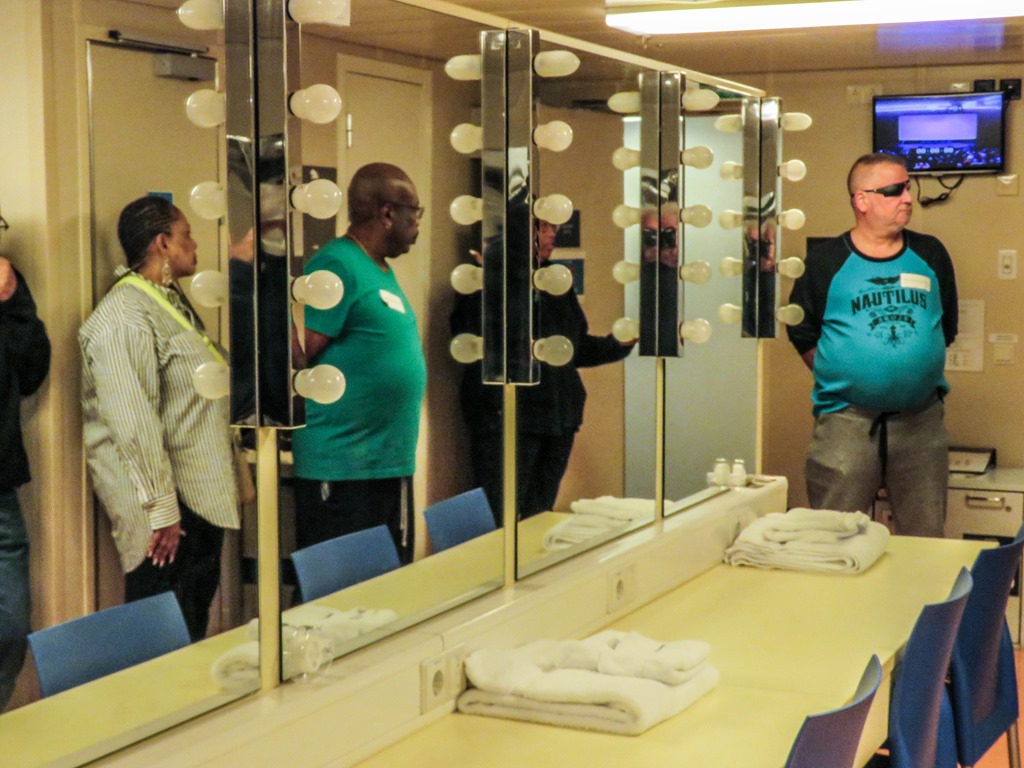
We were not supposed to take pictures here to protect the privacy of the actors, but the stage manager let it pass and nobody from security was there. It seemed like a dumb rule. There’s not that much interesting about costumes hanging on a rack.
About 20 techs work in the various theaters and nightclubs around the ship. They mostly keep the lighting and audio systems working properly. But all work together when needed to put up or break down a theatrical set.
Our final stop was the bridge. The head of security, a tall and quite handsome Indian guy, showed up again and he definitely made sure that no pictures were taken of any of the equipment or personnel. But again, there was not a whole lot. The bridge was a spacious place with, as you would expect, a perfect view of the ocean. But it was all computer screens. Much of the steering of the ship is done by an autopilot program. When necessary to switch to manual control, tiny joysticks are used instead of the traditional wheel.
I was really happy I did the tour, and I had a renewed sense of appreciation for all that the crew does for us behind the scenes.
 Traveling Johns