
We pulled into Barcelona this morning just around dawn. Most people can hear the name of this Catalan city without breaking into song. But John and I are not among them, so we immediately started singing “Where you going? Barcelona. Oh.” This is what happens when you’ve seen every Sondheim show.
On a cruise like this, you have two options given the limited time. One, you can opt for a superficial tour that checks off all the major highlights in the city or region. Or, two, you can find deeply explore one particular site or topic. We chose the latter course here in Barcelona, choosing to spend the whole day looking at the two most famous works of the Catalan architect Antoni Gaudí.
When we showed up at the tour office this morning, John was in his wheelchair. This caused some immediate consternation with the guides. I assured them that John could walk, but that he found it difficult to stay standing in place and had some problems with stairs. We were told that there were many, many stairs in Park Güell, our first stop, and maybe that he would just have to stay in place while the rest of the group did the tour. I said that we would do our best to keep up with the group. And then something curious happened. Our guide came over and said that he had thought of a way to do the tour which would involve some ramps, but only one short flight of stairs, and he thought that I was strong enough to push John. This was a welcome vote of confidence after the taxi driver in Ibiza, so I thanked him, and we went off.
I have to say our guide was absolutely great. He gave his name as Joseph, though it was probably Josep in Catalan.
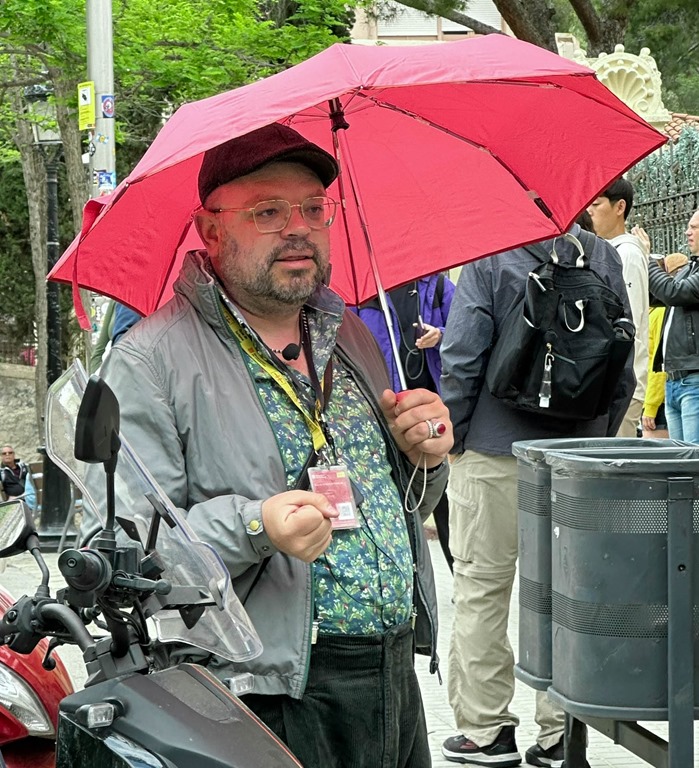
We walked over to the entrance of Park Güell from the tour office. Joseph gave us some background about the park.
Towards the end of the nineteenth century, as the remnants of the Spanish empire began to slip from the control of the Spanish crown, many Spaniards who had made their fortunes in places like Cuba or the Philippines, returned to their ancestral homes. This included the Güell family. Eusebi Güell was possibly the richest man in Barcelona with an enormous fortune made as a textile manufacturer. However, the Catalan nobility regarded Güell and his wife as vulgar nouveau riches. Those ancient families also loathed almost every modern trend particularly “modernisme,” the Catalan expression of the art nouveau style. So, it was only natural that haut bourgeois families like the Güells adopted the trends that the aristocrats had rejected.
Eusebi Güell met Atoni Gaudí in Paris at the 1878 Exhibition. Gaudí was up-and-coming designer and architect. Güell was impressed by his talent and began giving him a number of commissions including one to build a house for the family on their estate in the Serra de Collserola, a range of hills, somewhat reminiscent of the Santa Monica Mountains, to the north and west of Barcelona. The house is still standing, though it has been converted into an exclusive primary school.

As one of the wealthiest men in Europe, Güell may have been drawn to this isolated location because he felt it was safer for his wife and ten children. But apparently his wife Francesca, born to a rich Milanese merchant family, was not happy with such a lonely life. She insisted on driving herself into town to meet with her friends, even though it was not legal at that time in Spain for women to drive. Gaudí created a kind of garage for her car, and since she did not like to back up, he created it as a circular space. Here is John standing there.
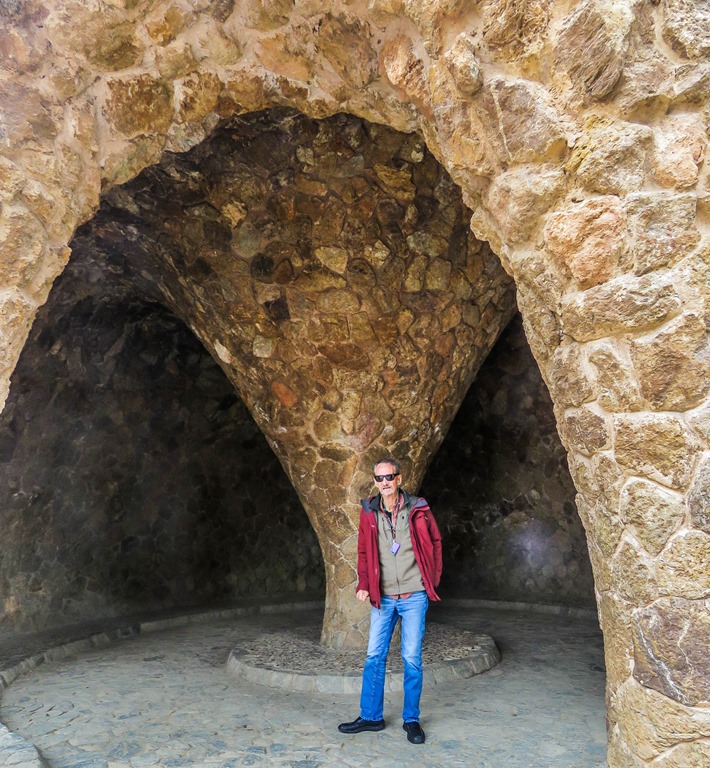
So to keep his wife and children happy, and perhaps to make even more money, Güell hit upon a scheme to subdivide his vast estate into a community for other wealthy Barcelona families like his. He hired Gaudí for the project.
Gaudí faced a number of obstacles. He had to level much of the hillside to create the sixty buildable lots, one of the biggest engineering projects in the history of Barcelona. To attract new buyers, he built an impressive, yet whimsical entry way with two gate houses. Here is one of them.

The lack of an adequate water supply for these homes was also a serious problem. Gaudí decided to create a central cistern to collect rainwater and to distribute it to the homes and for landscaping. He created a building modeled on the Temple of Apollo at Delphi.
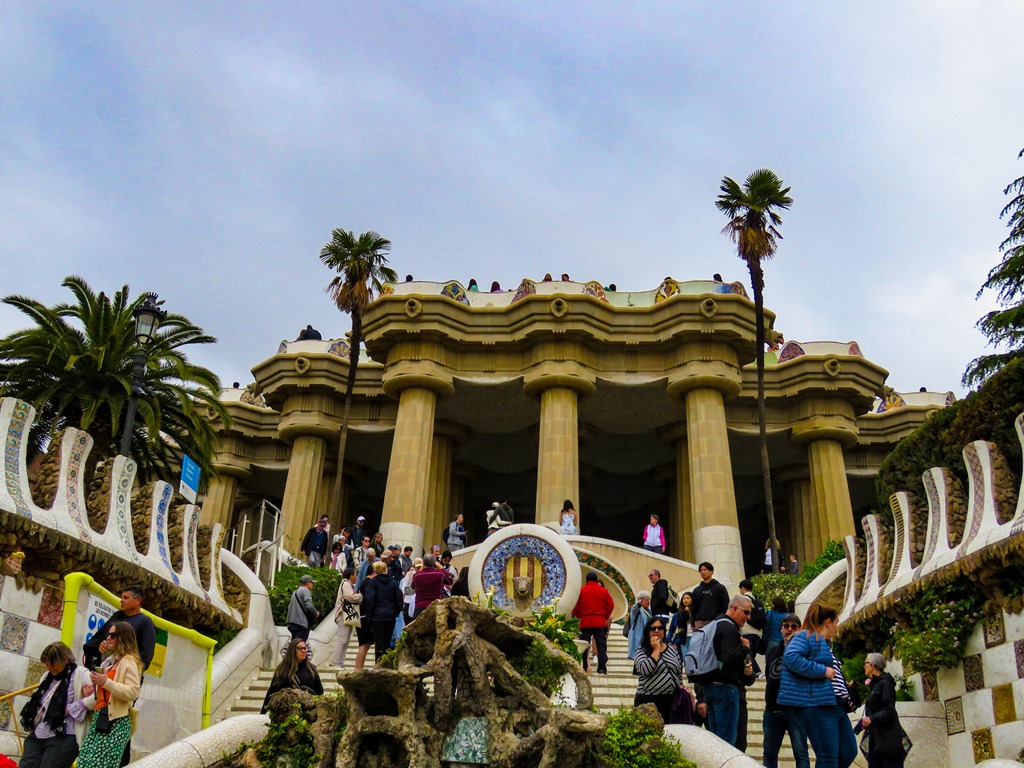
The enormous cistern was below the building. There interior of this temple was designed as a farmer’s market so that the wives and servants would not have to leave the community to do basic shopping.

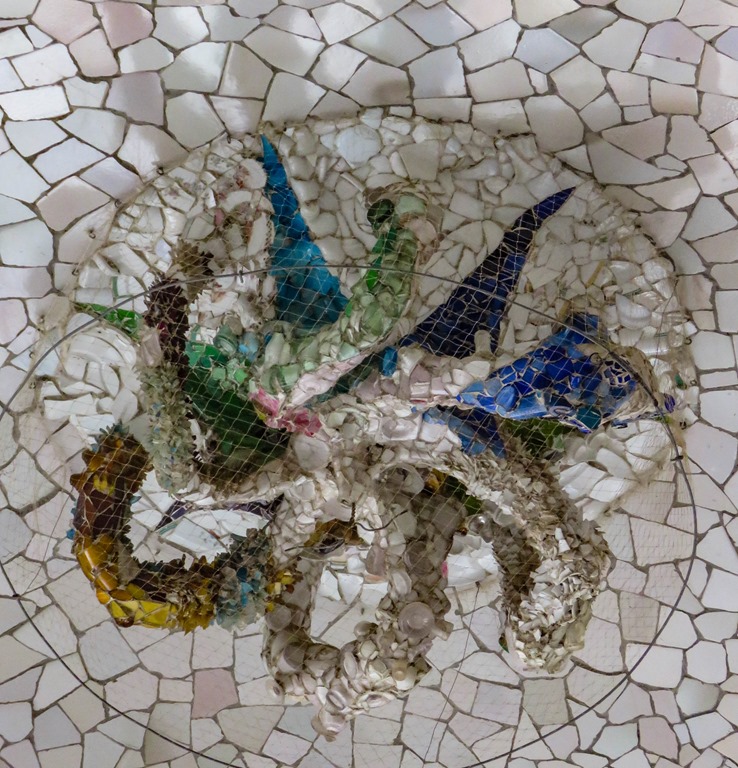
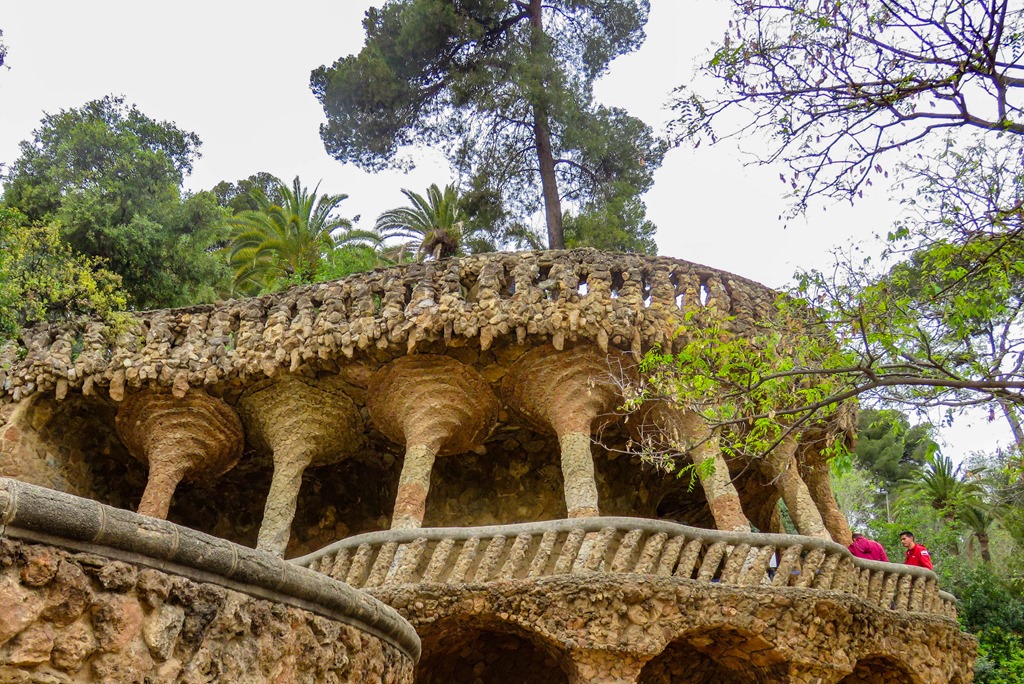
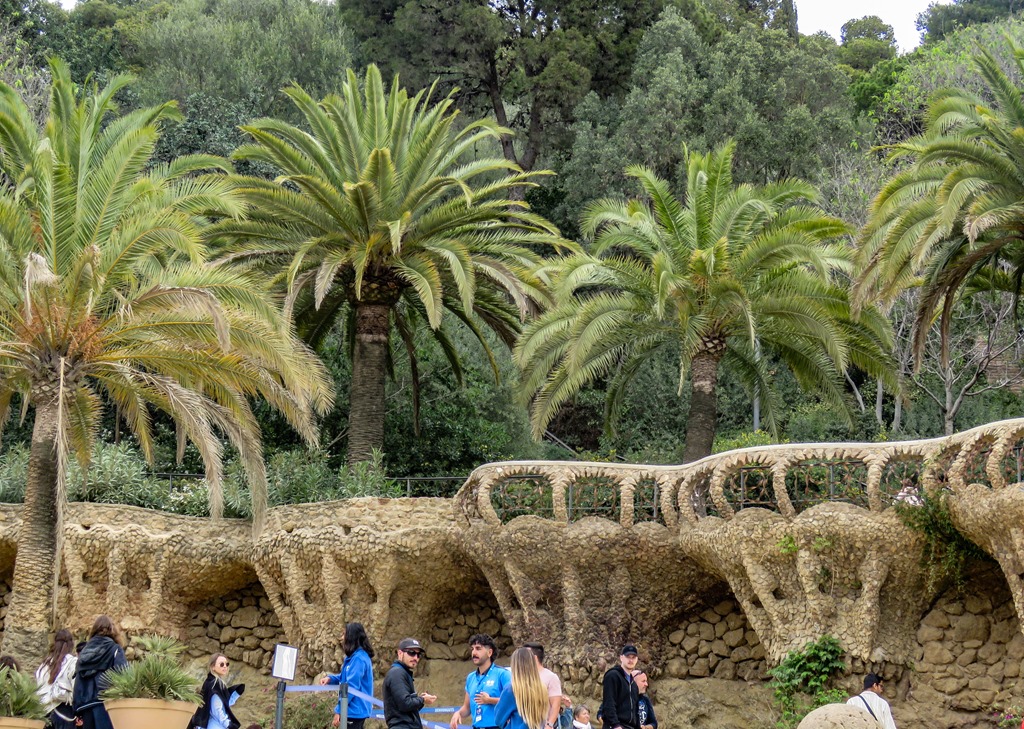
These columns not only support a roof, but each also contain pipes to funnel the water from above into the area below. And since Gaudí could not resist decoration, the ceilings of this area are filled with fanciful bits of decoration, often devised from the detritus from other construction sites.
The rooftop area is enormous and open. The grates to collect the water are covered with a meter of sand dredge from the bay. The open space was intended as a playground and as a concert space. Along the edges, Gaudí created undulating tile-covered benches. It was hard to get a picture of them with all the tourists. After waiting a while, John found a seat. Notice the superb view of Barcelona and the sea that these benches offer.
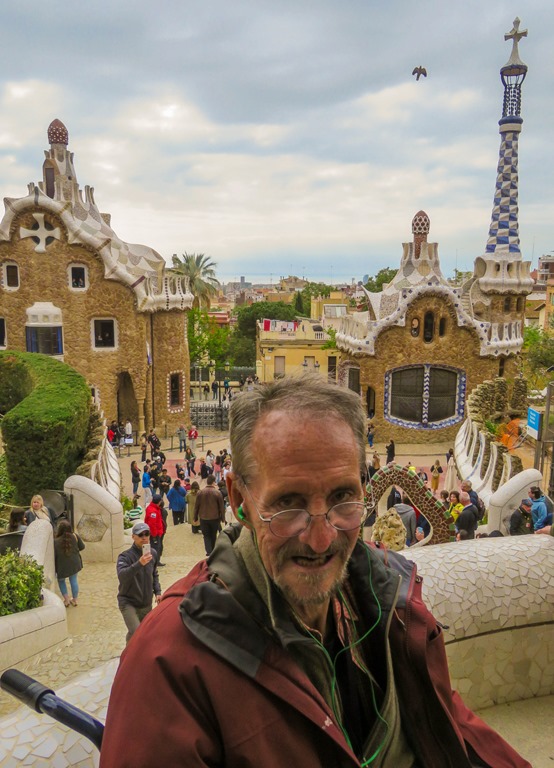
Despite all Gaudí’s artistic brilliance, the project was a complete failure. After 10 years, only two plots had been sold, one of them to Güell’s lawyer who may have just bought it to make sure he kept his best client. Most people apparently felt that it was just too far away, too isolated. So Güell decided to turn it into a park and donate it to the City of Barcelona.
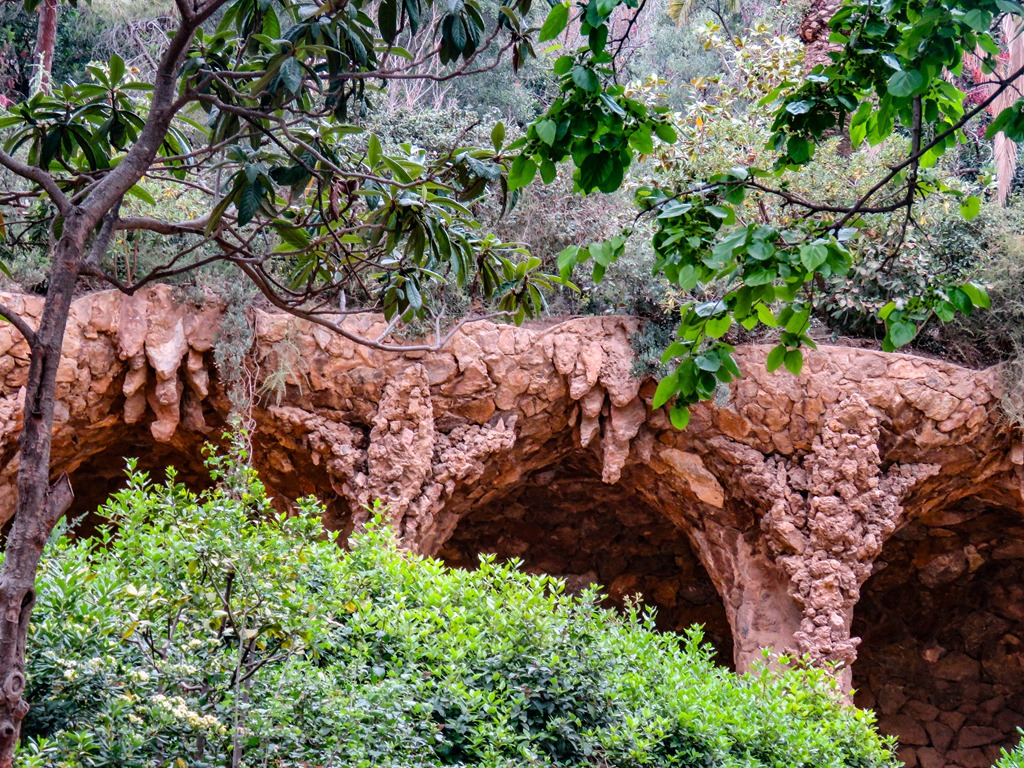
Today it is the most popular open space in a city filled with charming open spaces. The gardens are nicely maintained. I was delighted to be able to name about half of them as the climate is so similar to Los Angeles. But the real attraction in these gardens is Guadi’s whimsical hardscape.
Many years before he was hired to work on Park Güell, Gaudí had another commission, one that would become his life’s work and his greatest obsession. The residents of a new, working-class neighborhood in Barcelona petitioned the archbishop for a parish church. He replied that he had no funds for this and suggested that they form an association to build it themselves. They formed the Asociación Espiritual de Devotos de San José and began raising funds. They hired Francisco de Paula del Villar, a respected local architect who planned a traditional neo-Gothic structure. But shortly after work commenced, del Villar withdrew from the project, and Gaudí was hired to continue it.
Gaudí was a devout Catholic, and his religious and political leanings were conservative even if his artistic sense was not. He devised a radically different new plan for the church, one that would look different from any other church in the world. And he definitely achieved this.
It’s hard to get a good picture of Sagrada Familia on the crowded streets of central Barcelona. So here is a stock image.
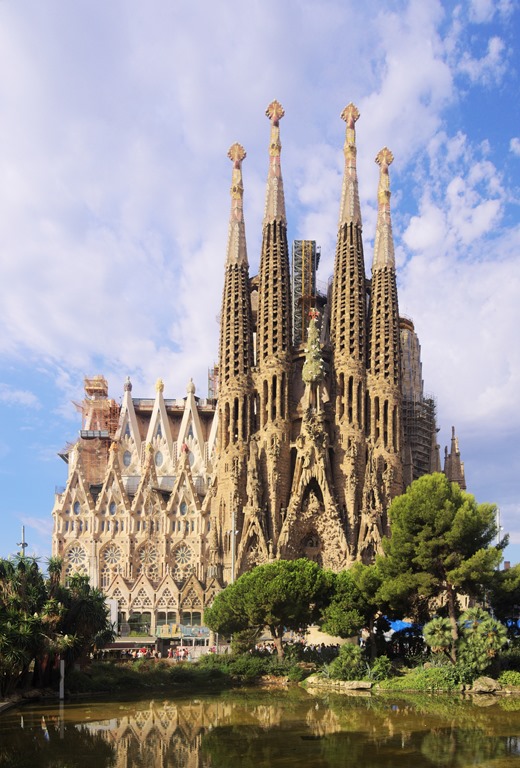
Much of the crypt had already been done when Gaudí look over, and there are still elements of the original neo-gothic style that can be seen. Gaudí decided to start work on the north transept and the choir. Probably for that reason, the tours start in this location.
The façade of the north transept focuses on the birth of Jesus and his life with his family in Nazareth. The statuary is somewhat traditional, though elements of Gaudí’s later, more abstract style can be seen. Here is a depiction of the slaughter of the Holy Innocents.
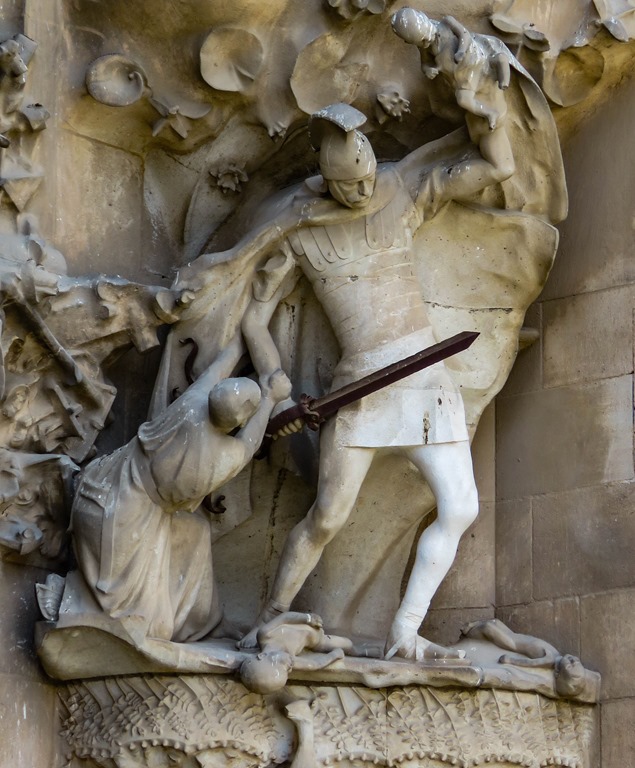
It was so crowded with tour groups in this area that John and I lost sight of Joseph many times, though we could hear him talking on our headsets. We finally went into the interior of the church.
In contrast to the exuberant exterior, the interior of Sagrada Familia is simple, even start at times. There are only a couple statues, and neither are that large. The windows are all abstract color collages. Here is the apse.
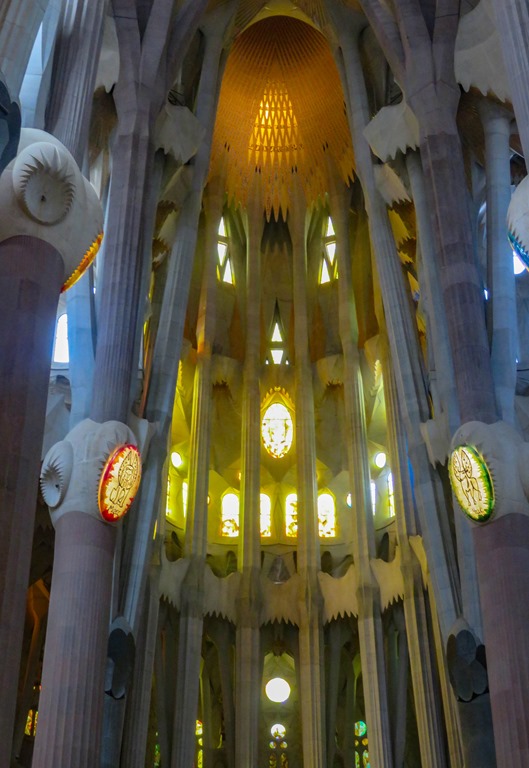
The baldachin over the altar looks to be a new creation, and I think Gaudí would have done something better. Both John and I thought it seemed vaguely like something from the New Orleans section of Disneyland.
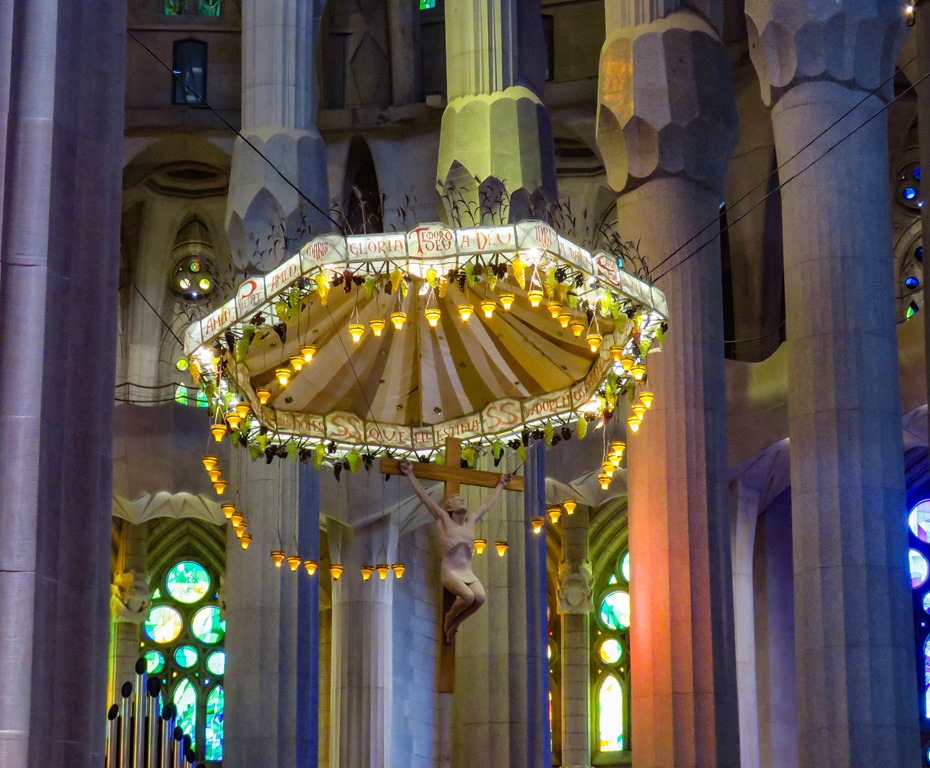
Here is the interior of the north transept.
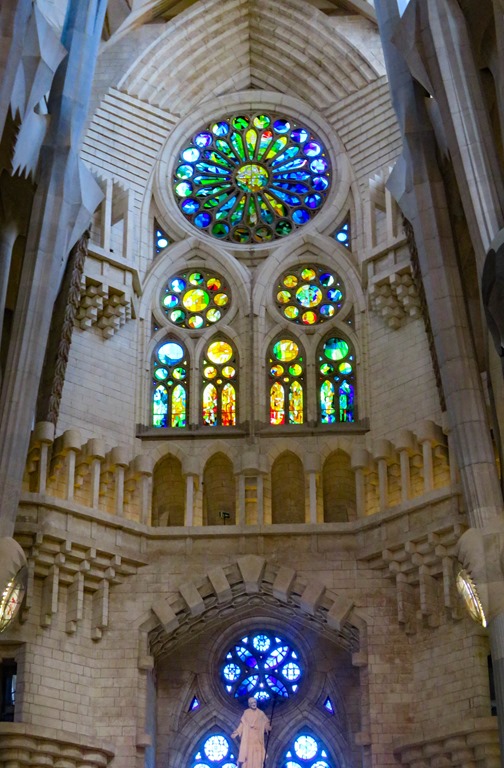
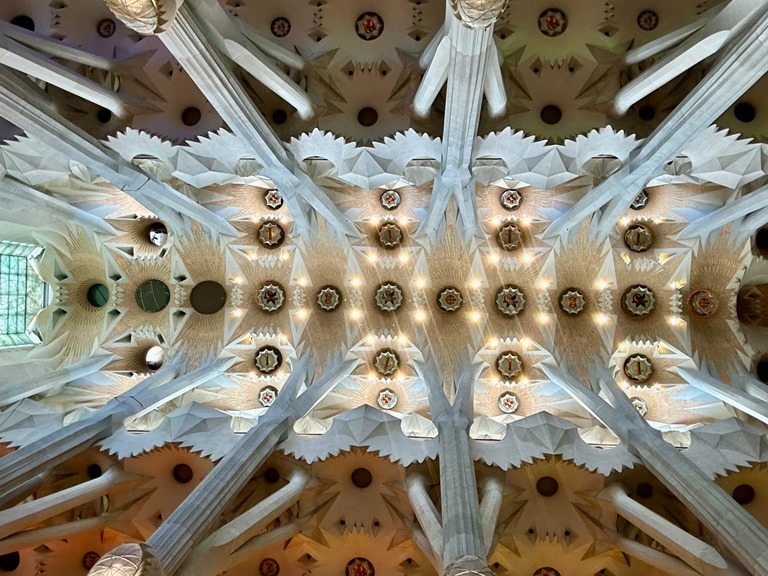
Probably my favorite part of the interior is the ceiling.
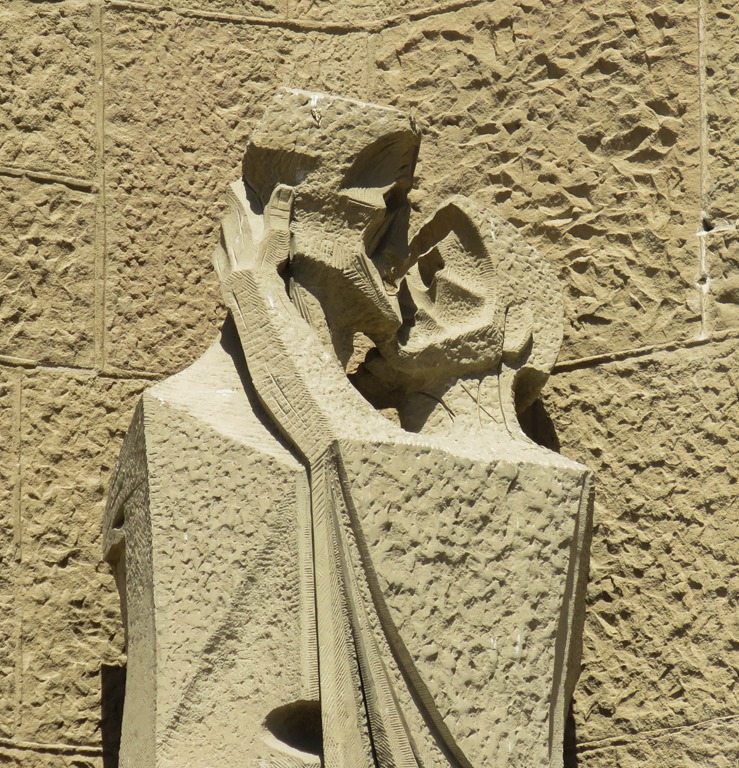
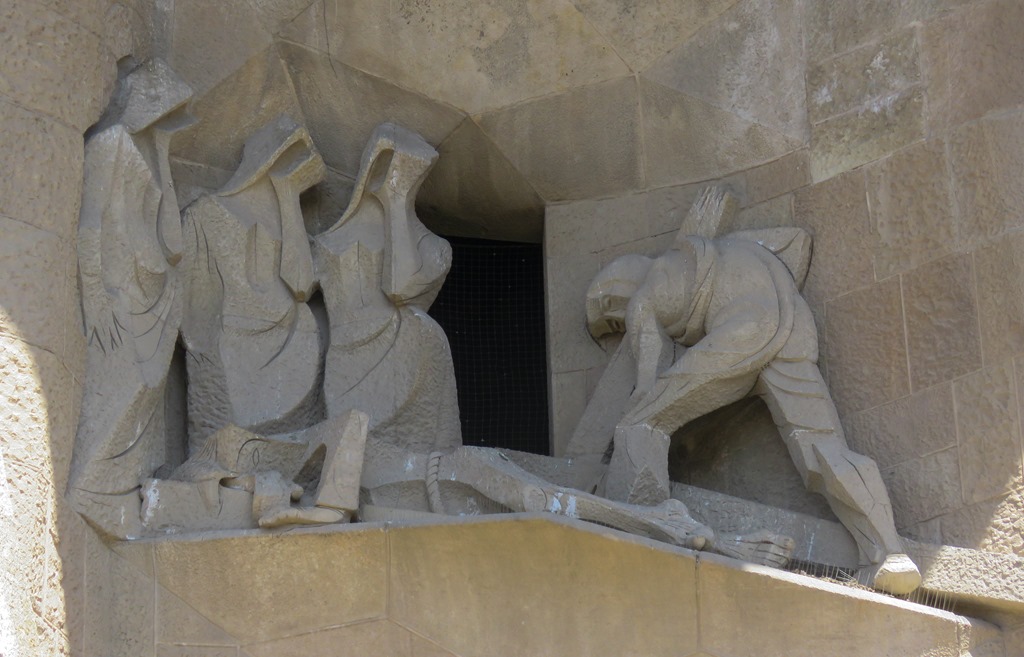
Gaudí died in 1926. Very little of the church had been completed by that time, and some of his plans for the church were destroyed by an anarchist group during the Civil War. Subsequent architects have relied on notes and sketches to try to complete the work. The east facade—for some reason the church traditional east-west orientation of churches is reversed here—is among the least completed. The plans call for extending it another 100 meters or so but there are apartment buildings on the land there and many of the owners refuse to sell. The south façade, dealing with the death of Christ, has recently been finished. The style of the statuary here is far more abstract than those on the north side. Here is the betrayal by Judas,
and here is the deposition from the cross.
By the end of tour, I felt I had really learned a lot about Gaudí and had an appreciation for his genius. I gave our guide a generous tip and we took a cab back to the ship, a little tired, but definitely smarter.
 Traveling Johns