
The ship docked this morning in the city of Livorno. Many of the passengers disembarked quite early, some just a few minutes after six, to board busses that would take them to Florence and Siena. John and I have spent a fair amount of time in Tuscany, and the idea of trying to see the highlights of those Renaissance cities in a couple of hours seemed ludicrous. Instead, I chose an “on your own” trip to two places we had never been, Lucca and Pisa.
From the port we boarded a shuttle to the central square of Livorno. There was quite a crowd of our fellow cruise passengers already there waiting. We had a few anxious minutes before a person appeared with a big sign with “Lucca & Pisa” written on it. Usually people are quite deferential when they see John in a wheelchair, but much of this group was hell bent on getting the best seats on the bus that they could. No matter—we made it and took the seats in the very back where John could stretch his legs into the aisle.
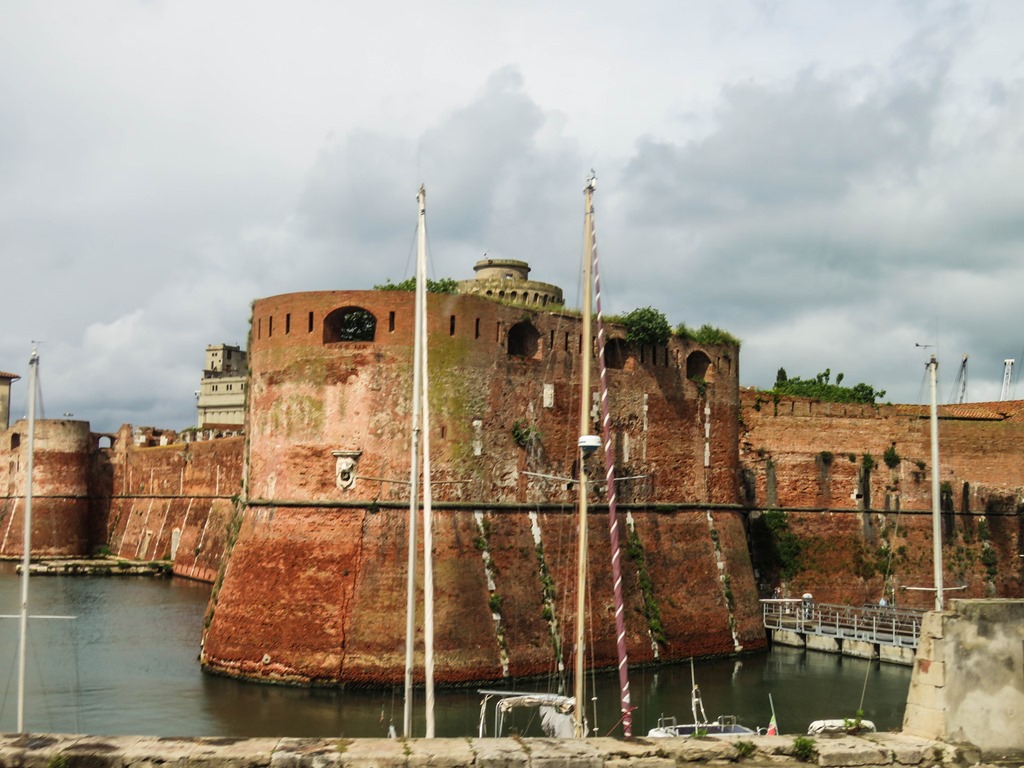
As we left Livorno, we saw some remnants of the city walls. The Florentines, particularly Lorenzo di Medici, established Livorno as the port of Florence. As such, it needed to be fortified.
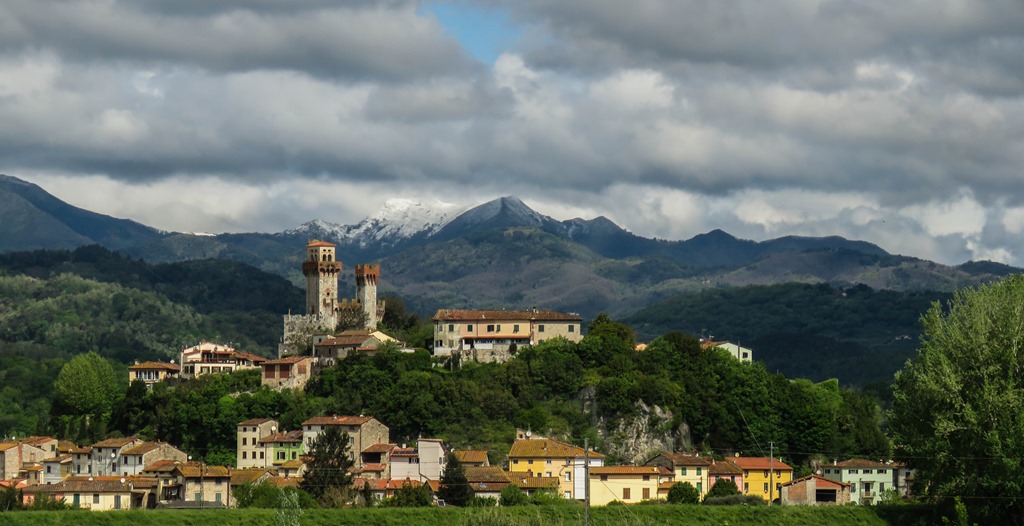
On the way, we saw some of the Apuan Alps. The mountains are not much higher than the Oregon coast ranges, but this early in the spring many were still covered in snow.

The mountains contain rich deposits of fine marble: Carrara, which sits at the foot of the Apuan range, provided all the marble used by Michelangelo and the other great Renaissance sculptors.
We also saw some of the smaller Tuscan towns.
After about 45 minutes on the road, we arrived a Lucca. One of the things that Lucca is famous for is that it has perhaps the best-preserved fortifications of any Italian town. Sadly, city walls, no matter now impressive when you see them in person, do not photograph well. I discarded a half dozen pictures of bricks!
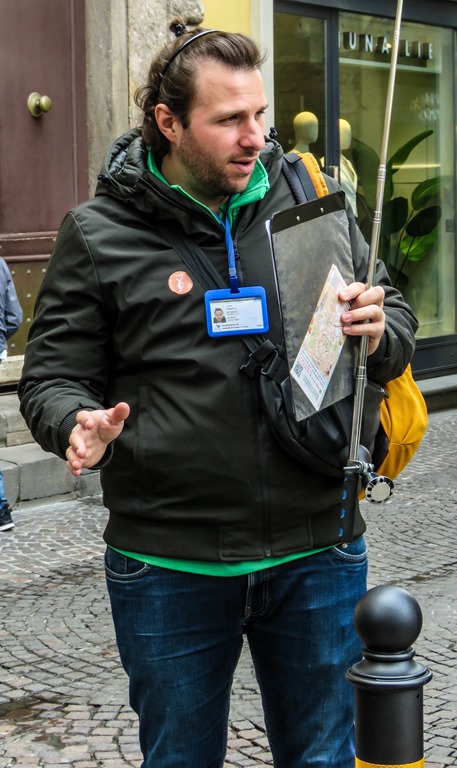
As we left the bus, we were given a choice. We had three hours to explore on our own with a map, or we could go with the guide for five euros more. We seldom turn down a guide, and I think we made the best choice. Our guide was Francisco—“Kiko” is the Italian diminutive—and he had been born and raised in Tuscany.
Besides its well-preserved city walls, now a pedestrian promenade, Lucca is known as “The City of a Hundred and One Churches.” I would probably have been happy to visit them all, but fortunately for John our guide only took us to the three most important. We first went to the basilica of San Frediano. It is one of the oldest of the churches, and it is famously mostly for the Byzantine-influenced mosaics on its façade.

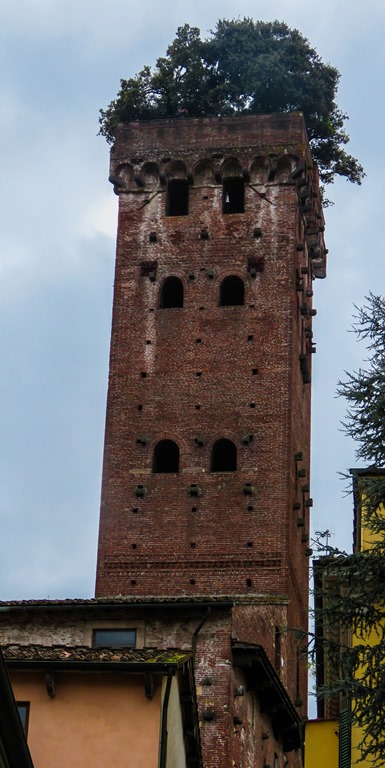
We admired it from the small piazza in front of the basilica, but did not go in. We also passed by one of the last remaining merchant towers. Much like American corporations in the twentieth century, who declared their importance by the height of their headquarters, Tuscan merchants built vertical warehouses with the height deemed to be a measure of their wealth. In Lucca, the town set limits to this by decreeing that no tower could be higher than the campanili of the duomo. The Guinigi family skirted this rule by build theirs as high as the bell tower and then planting trees to make it ever taller!
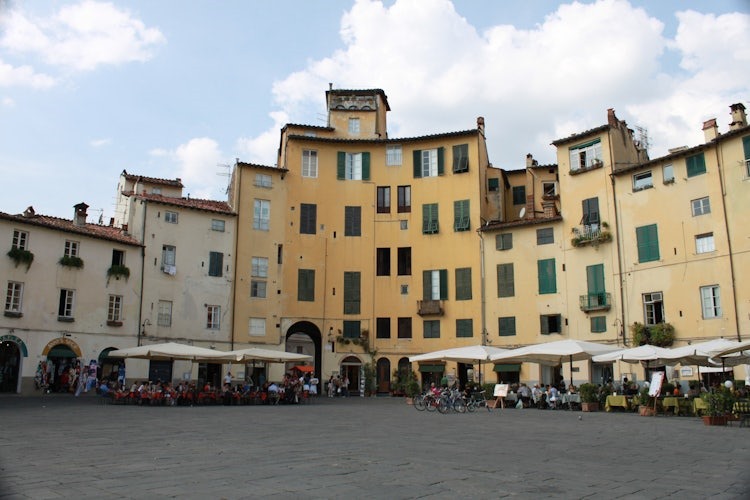
Lucca is also famous for its “amphitheater.” This is not a Roman ruin but a circular square, reminiscent of the the Circus in Bath. It was raining off and on while we were in Lucca, and fairly early in the day, so none of the cafes had tables spread our and Kiko was rushing us through to try to keep us as dry as possible. I did not get a good photograph, so here is a stock image.
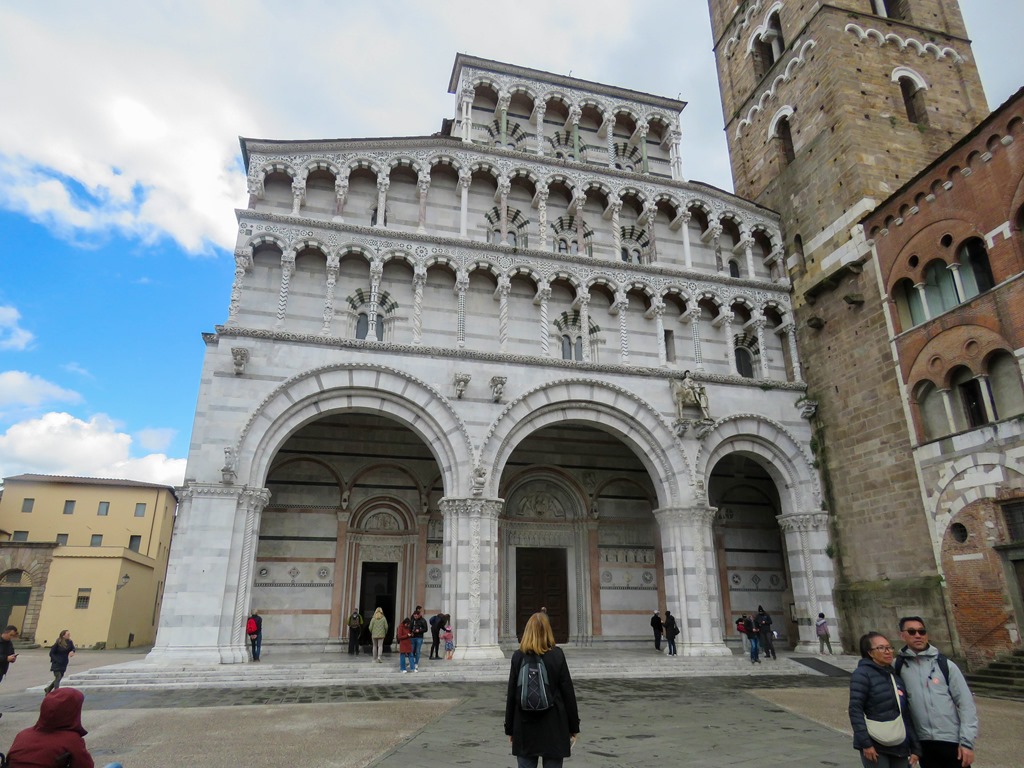
We arrived at the Cathedral of San Martino. It is covered in Carrara marble.
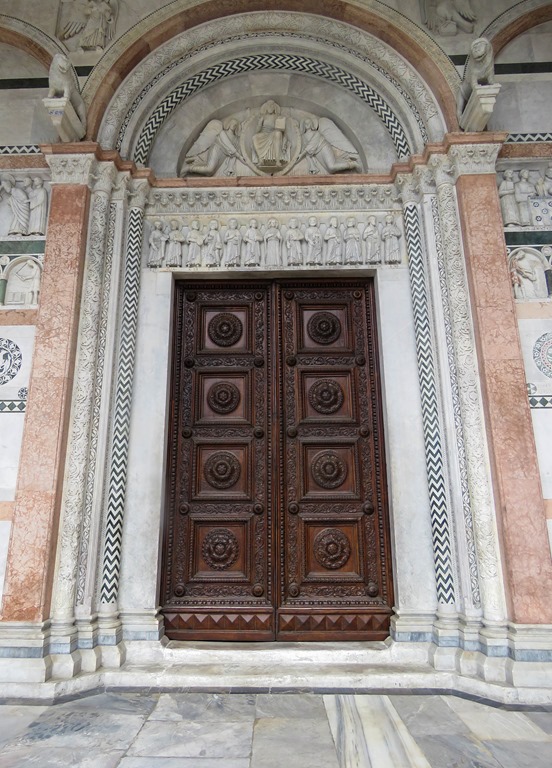
The portals are exquisitely carved.
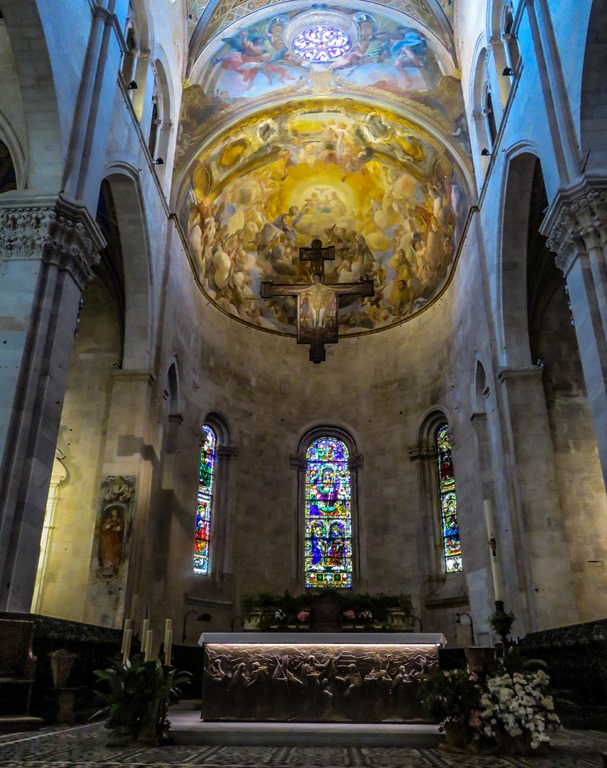
And the interior is stunning.
Larger Italian churches have two organs facing each other in the nave, the “epistle organ” on the south side and the “gospel organ” on the north. Those in San Martino have quite handsome cases.

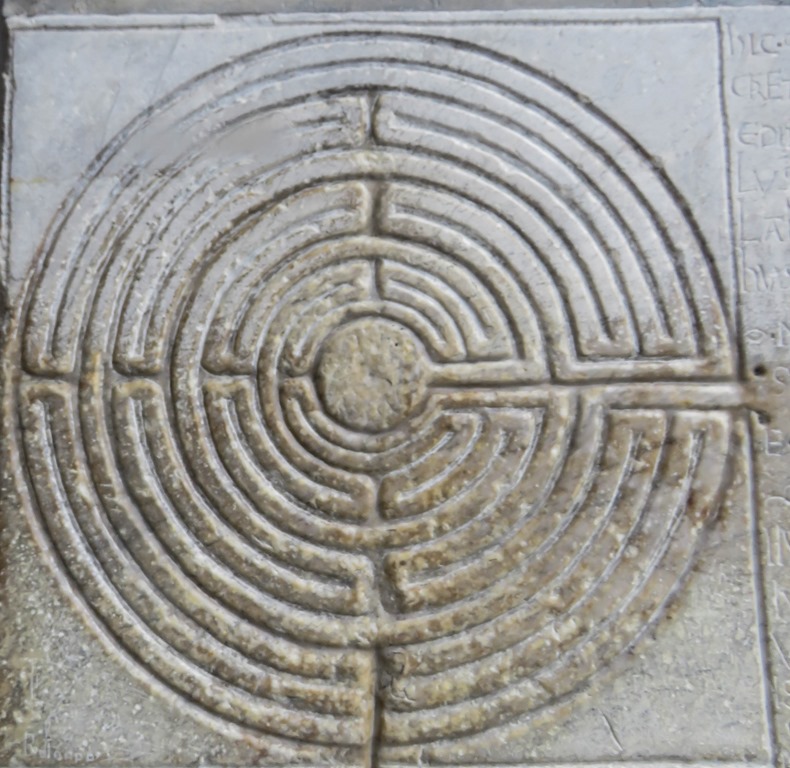
Labyrinths were popular in the middle ages. San Martino has a miniature one on the portico. You walk this labyrinth with your finger.
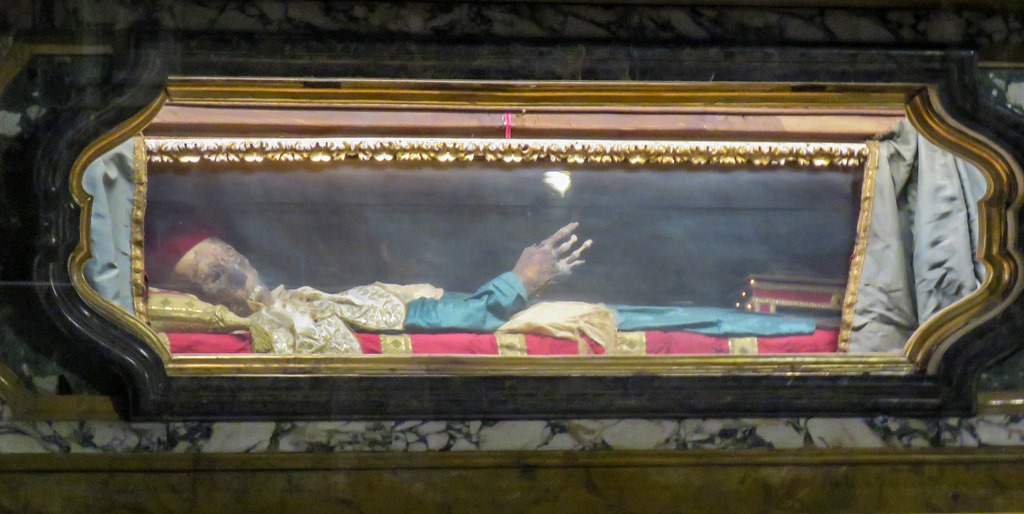
Kiko took to one final church, San Davino. Reading some of the interpretive material, I learned that Saint Davin was wealthy Armenian who donated all his wealth to the poor and embarked on a pilgrimage to Santiago de Compostela. He never made it. He became ill and finally died in Lucca. But before he died, he impressed the locals with his sanctity. After his death, he developed a significant cult, and a church was built in his honor.
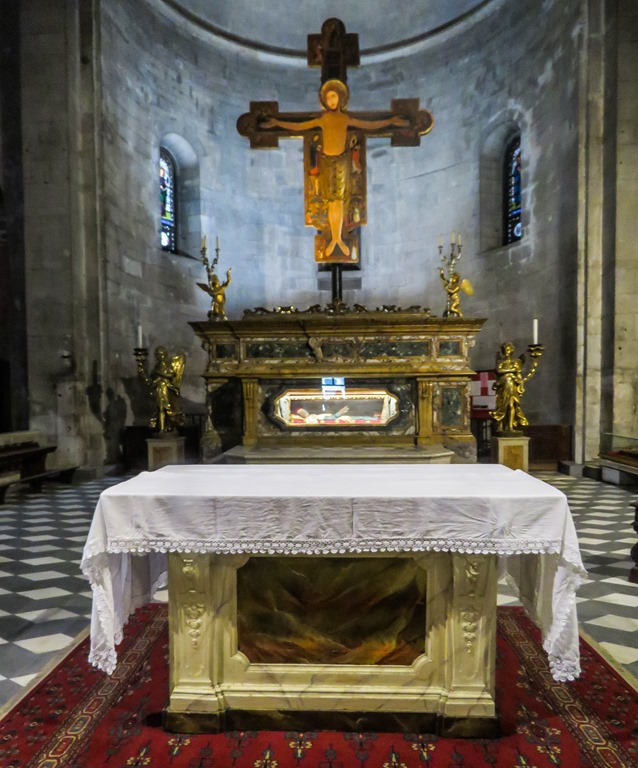
His relics on a display here, and for this reason the Luccans dislike having noisy tourists thronging the church.
By this time, the skies had opened up. We still had about an hour more before we had to go to the bus, and Kiko asked us if we were interested in lunch. The group readily agreed, and he arranged tables for us in a charming trattoria.
After this, we boarded the bus and headed to our second stop of the day, Pisa. This was not an easy stop for John and me. The busses have to park almost a kilometer from the entrance to the Piazza dei Miracoli, the entrance to the duomo and the tower. The route was difficult to do with a wheelchair. There were busy streets to cross. The pavement was in poor condition with pot holes and railroad tracks. Once we were close, there was a hellish scene of stall filled with the most hideous souvenirs imaginable. Aggressive hawkers, mostly African, rushed up and shoved watches and turquoise jewelry in our faces.
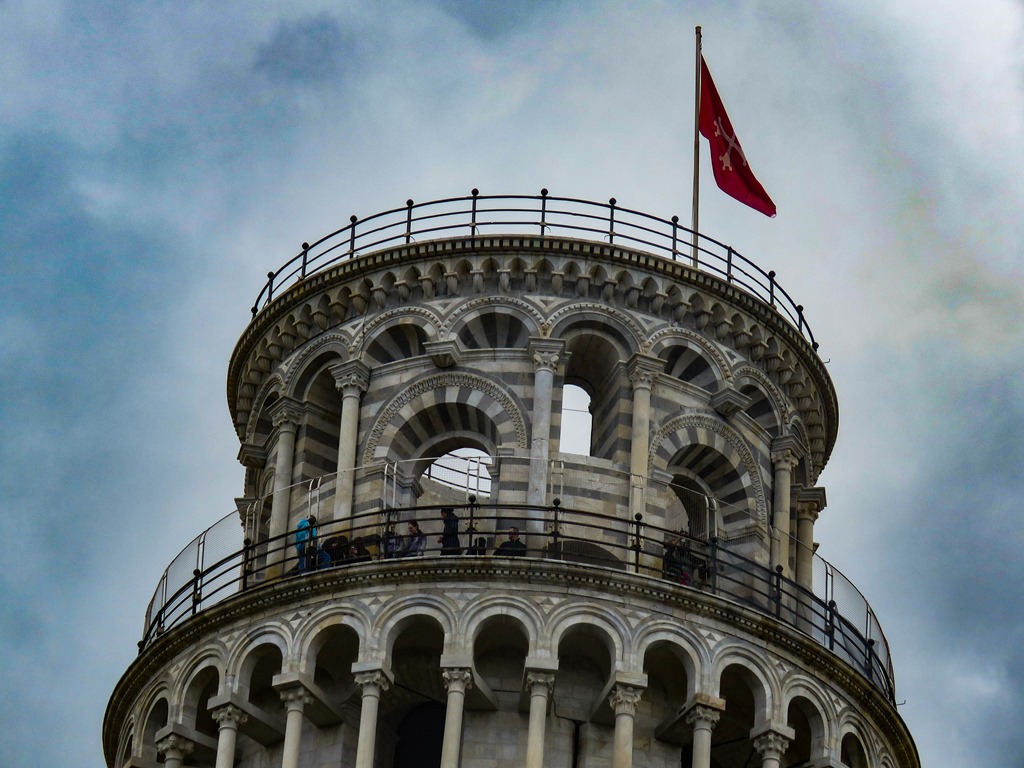
Once inside the walls, things were a little calmer. The tower is a little bit like Niagara Falls: you have seen it so often and for long that that you do not expect to be impressed, but somehow…well, it’s impressive.
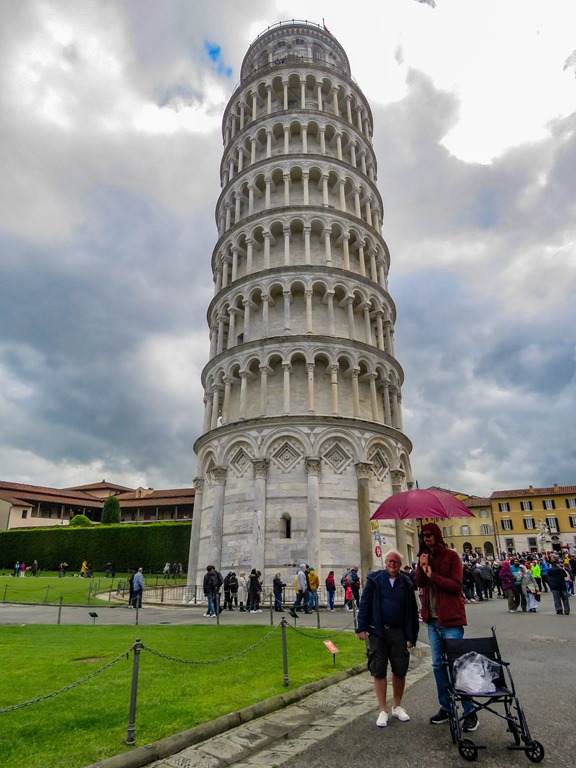
You can buy a ticket and walk to the top. Twenty years ago I would have done that. John hates heights, so it had no appeal to him even if I could have climbed it.
The cathedral is deceptively small from the front.
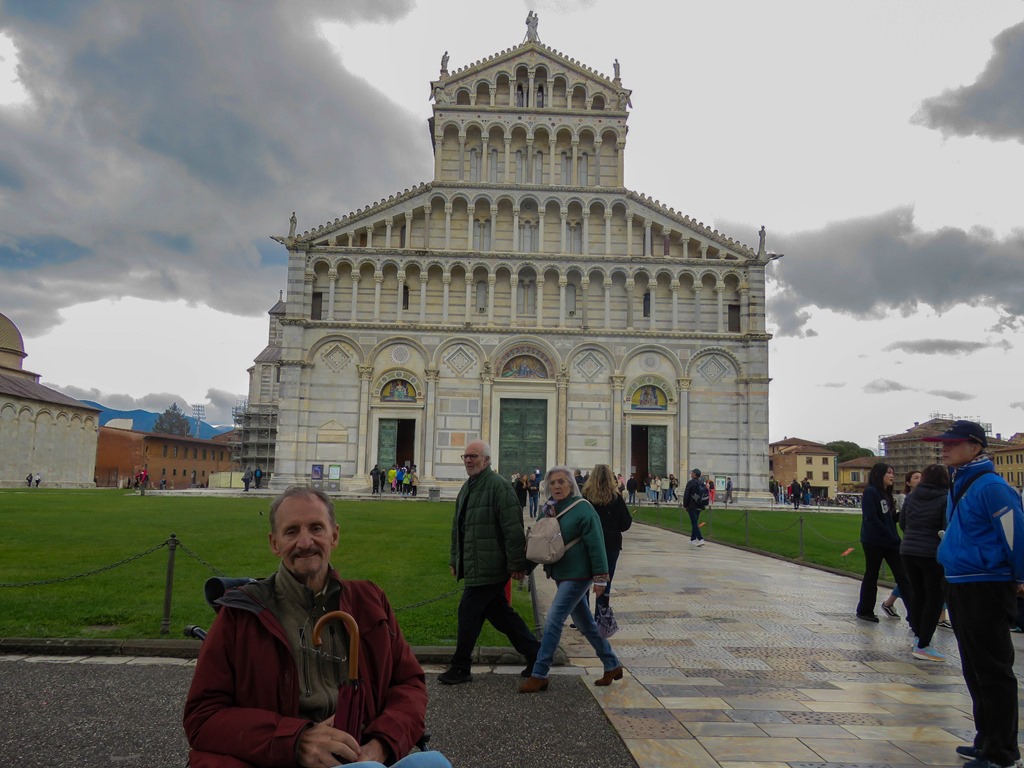
Only for the sides or the back do you get a sense of how truly massive it is.

The interior is magnificently decorated.

Despite the crowds, I would have liked to have explored the church and seen a bit more of Pisa. But it took us so long to make it to the cathedral from the parking lot that we really had barely any time at all.
We were a few minutes late to meet our group at the gate of the Piazza dei Miracoli. We had been warned that they would not wait, and indeed Kiko and the group had left without us. We went back through the hellish scene of trinkets and hawkers on the way back to the bus. As we were stuck at a railroad crossing, I had a call from the tour agency telling us that the bus was leaving without us, but that we could catch a ride back with another tour group who would be expecting us.
When we finally returned to the ship, we discovered that John’s phone had been stolen from him at some point in the day. We will have to wait until we return to Oregon to get him a new phone. I did have loss and theft insurance on this one. But it was a sour ending to what had otherwise been a generally nice day.
 Traveling Johns