
Yesterday morning, John was feeling a little better but looking a little worse. He was not bleeding any more, but he now had bruising all over his face, particularly under his eyes. His nose was still bandaged up, and the gauze underneath the bandages was caked with dried blood. No surprise, he did not want to go down to breakfast, and I brought him some food to the room.
I packed up, and one of the bellhops helped bring the luggage down to the lobby. I should have taken a picture of the slightly ridiculous outfits that these young men were wearing—green blazers, bowler hats, and tartan slacks cut too high. They seemed to accept these absurd costumes gracefully and went ahead to simply helping the guests in any way that they could. When the Bolt came to take us to the Avis office, they happily put all the things in the back for me.
I have never rented a car outside the United States where there was not some problem either at the beginning or at the end. And sure enough, even though I had arranged the rental in advance through Expedia, when we arrived at the rental office on Liberdade there were problems. First of all, there was a huge line of people already waiting, and the line was barely moving. We waited, and waited, and waited some more. Finally, I was called up to the desk, an hour after the time I was supposed to pick up the car. I had reserved a mid-sized SUV because John needs a vehicle with plenty of legroom. And, of course, when I was presented with my keys, I did not have a midsized SUV. No, the only vehicle “in my class” was a BMW roadster. And the rental agent knew damned well that there was no way that I could fit three suitcases and a wheelchair in the trunk of that car. And in the passenger seat of that vehicle, John would have been sitting with his knees just under his chin. Of course, I could upgrade. They had a full-size SUV, a monster plug-in hybrid Volvo. And it was, of course, three times more expensive. I went ahead and took it. Did I really have a choice?
Our plan for the day was to drive south to the Algarve. This is Portugal’s southern coast. It is on the Atlantic, not the Mediterranean, but the sea is calmer and the water is warmer than it is on the west coast of Portugal. Our tuk tuk driver is Lisbon had suggested that we take the old national roads instead of the modern highways. The older roads would take us through many small towns and we would get a feel for Portuguese rural life. I decided to take his advice.
I wish it were possible to take pictures and drive at the same time. Once we were out of the Lisbon area, the scenery became quite pretty indeed. We went through many towns with clusters of whitewashed houses with red tile roofs. The countryside was gently undulating. We saw orchards and vineyards, pastures green with the spring grass and dotted with wildflowers, ewes with lambs following behind, cattle languidly gazing at the passing traffic. At one point I pulled off the road so we could take a call from California, and I saw this stunning beach.
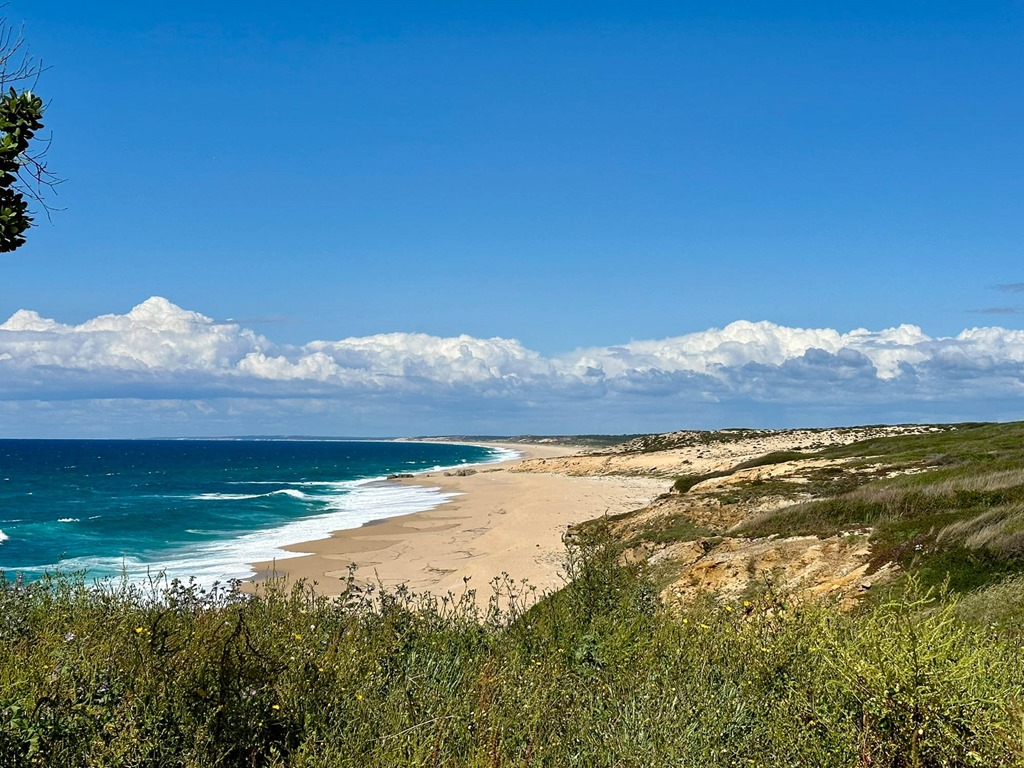
There was a small café right there, so we had a late lunch.
We continued on another hour until we found our destination for the next two nights, the town of Salema. Highly recommended by a couple guidebooks, Salema is one of the smaller towns in the Algarve. When John and I had spent three weeks in Seville in 1989 studying Spanish, we had taken one of our weekends and explored a bit of the Algarve. It did not seem as congested as Spain’s coast, but I recalled quite a few condominium developments, all, I am sure, built for British or German retirees. A smaller town appealed. And Salema proved to be just that, a charming cluster of houses and small hotels right on a lovely beach.
Our hotel, the Vila Mar, is a modern building right on the beach. It is not particularly attractive. But the views from our balcony were exceptional.
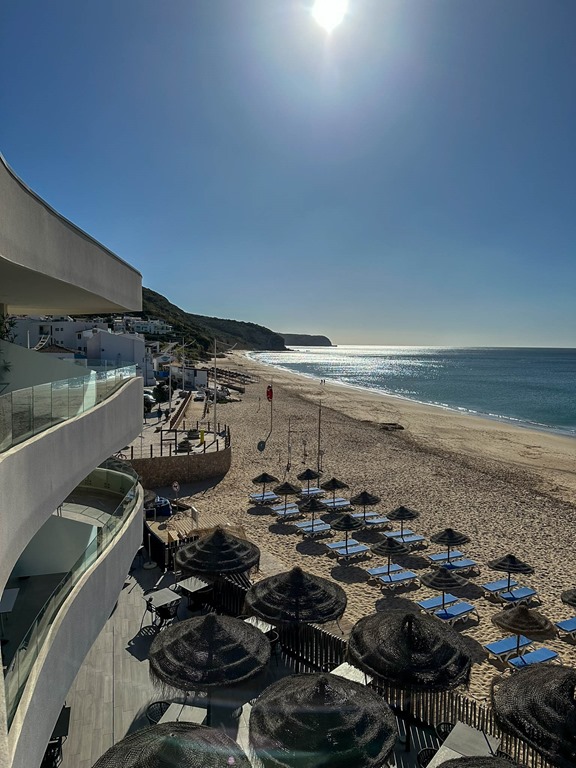
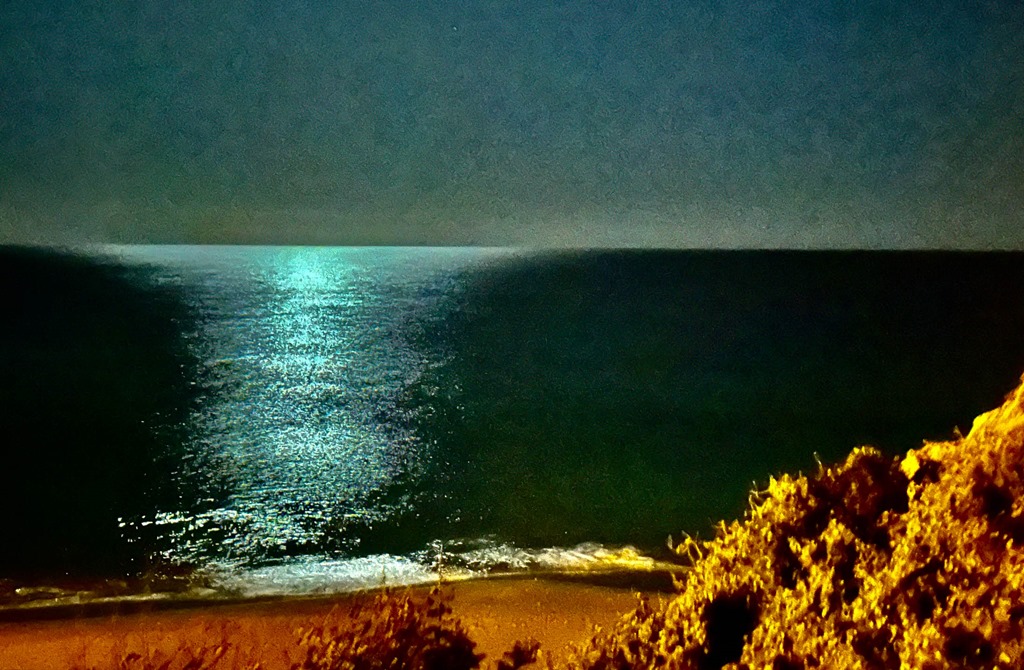
I particularly liked it at night when the moonlight reflected off the still water.
This morning, John announced that he wanted to go to see Lagos. We had some laundry to do, and I found a place in Lagos that did wash and fold. I figured we would drop it off today and pick it up tomorrow as we left for Evora.
Lagos was cuter than I remembered it. The old town some remaining fortifications, and the behind the walls there is a maze of narrow cobblestone streets opening up to small squares.
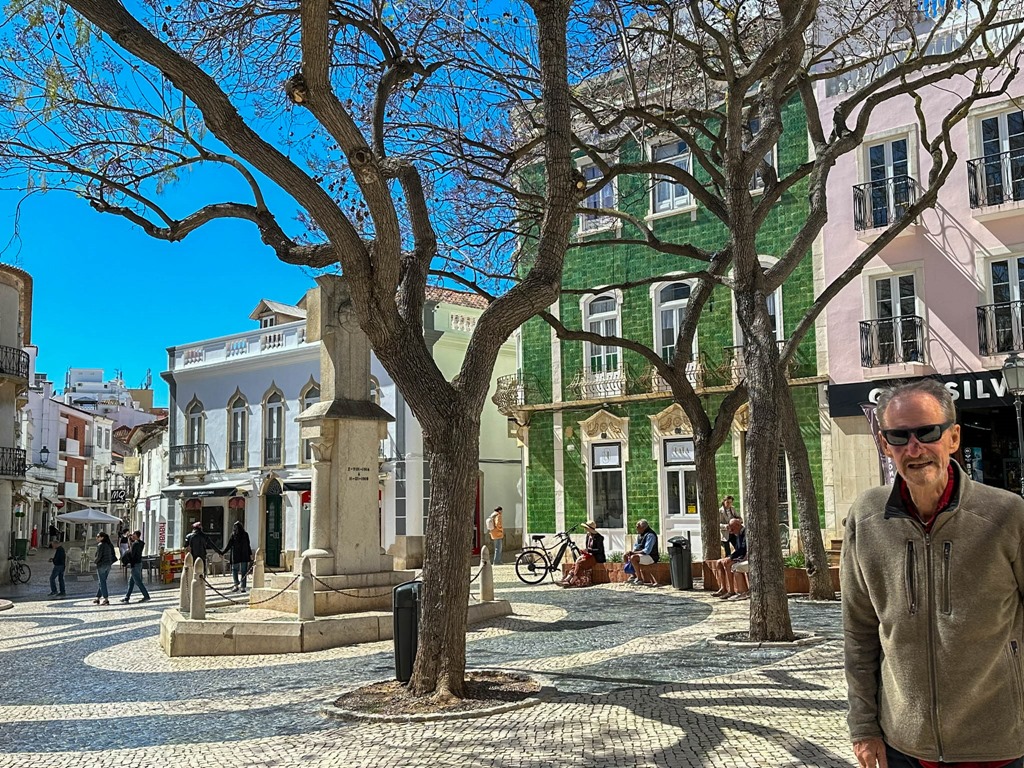
All the shops and restaurants cater to tourists, but they were not a tacky as they could have been. John finds walking on the uneven pavement a little scary, and riding on them in a wheelchair is absolute misery. So, we did not stay in Lagos all that long. On our way out we stopped by a little church whose only interesting feature was this baptistry with a distinct Moorish influence.

John slept for much of the afternoon, but in the early evening he was ready to go somewhere. So, we headed towards Cabo de São Vicente, Cape Saint Vincent, at the far tip of southwest Portugal. The Romans called this point “the end of the known world.”
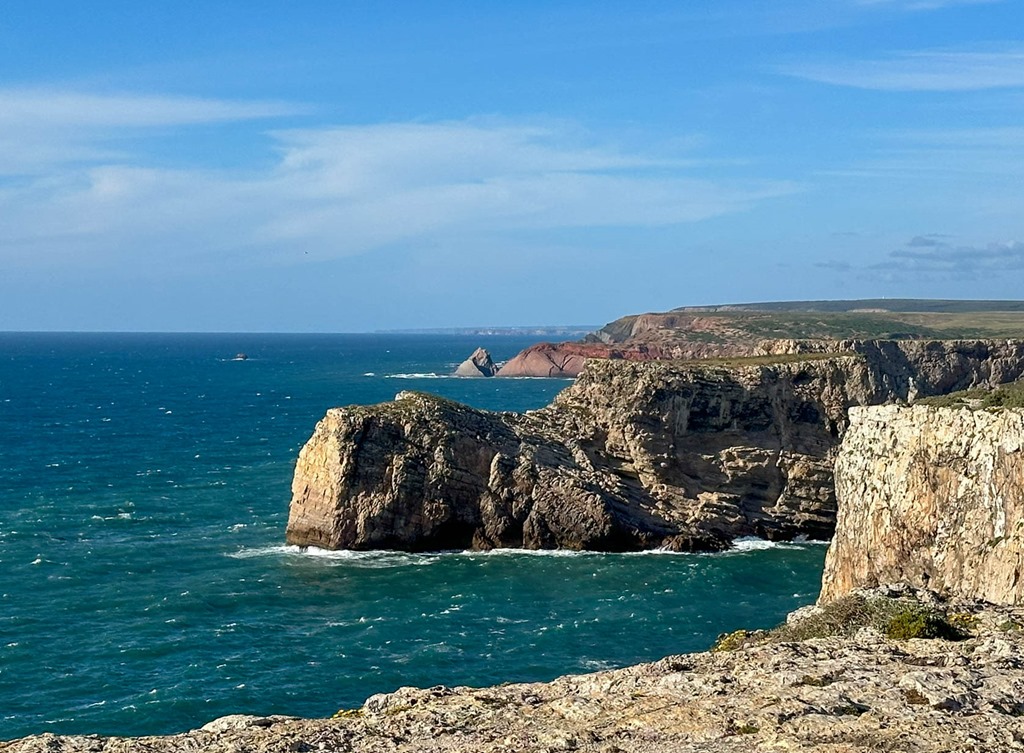
It was here that King Henry the Navigator established his sailing school that launched the age of European discoveries. That buildings are long gone, replaced by an eighteenth-century fort.

The fort had just closed by the time we arrived, and the wind was intense and almost bitingly cold. We pushed on a bit further north towards the lighthouse. Along the way we stopped to look at some smaller fortifications.
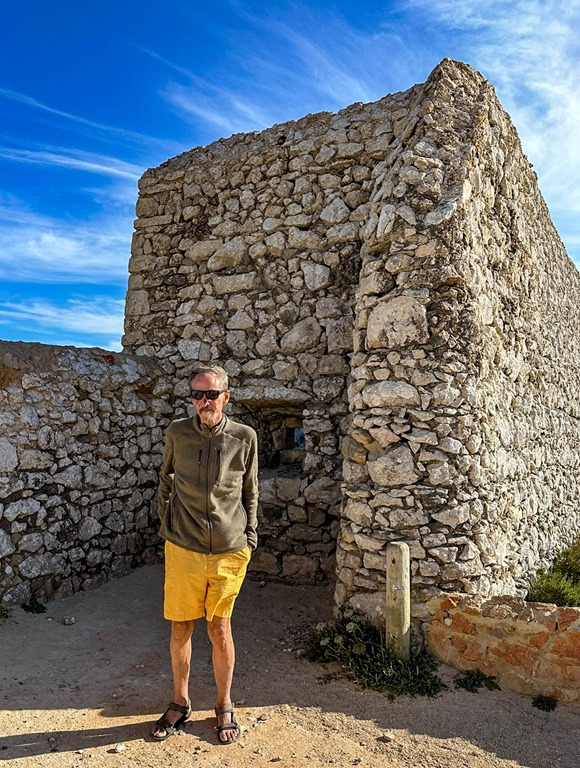
The lighthouse was also closed, but that was not a big disappointment. We drove through the small city of Sagres, but it seemed almost deserted. Just by the fort we had noticed a restaurant that looked a little better than the average tourist fare. We were the only customers there, but we had a nice meal.
Tomorrow, we leave Salema to head back north to the historic city of Evora.
 Traveling Johns