
Looking back on the past couple days, we have done a number of different things. Yet there is one thing that links all these different activities—in each place I had a sense that things were a little off, a little weird.
We had a long drive, much longer than I had initially planned, from Salema to Évora. I decided at the last minute to add a couple of stops along the way as John does not like endless hours in the car. It was not too far out of the way to go by Parque Natural do Vale do Guadiana. The guidebooks spoke about the dramatic scenery as the Guadiana River cuts its way through the dry scrub of the highlands of southeast Portugal. In the summer, this area often has some of the highest temperatures in Europe. But the weather yesterday was anything except summery. It was raining on and off for most of the route and by the time we arrived at the park it was raining torrentially. So we simply passed on the park and kept driving.
We did make our second stop, the Paço Ducal de Vila Viçosa. I did not know much about this place other than one of my guidebooks had called it a “must see.” We pulled up to find this Palladian palazzo in a small village.

I unpacked the wheelchair and John had a bumpy ride over the cobblestones to the main entrance. I went to the small ticket counter. A man there told me, in perfect English, that a tour was about to begin, but that it was going to be in Portuguese and we could not visit the galleries on our own. I agreed and we joined the group as they went up the stairs to the second floor.
The guide rattled away quickly in Portuguese. If you understand Spanish, you can usually get the gist of what is written in Portuguese. But the cognates are pronounced so differently that I had no idea what she was saying. Portuguese has a seemingly endless number of “sh”, “zh”, “ch”, and “j” sounds. Spoken quickly, as the guide did, it always reminds me of air escaping from a bicycle tire.
I just looked around as she talked and snapped a picture.
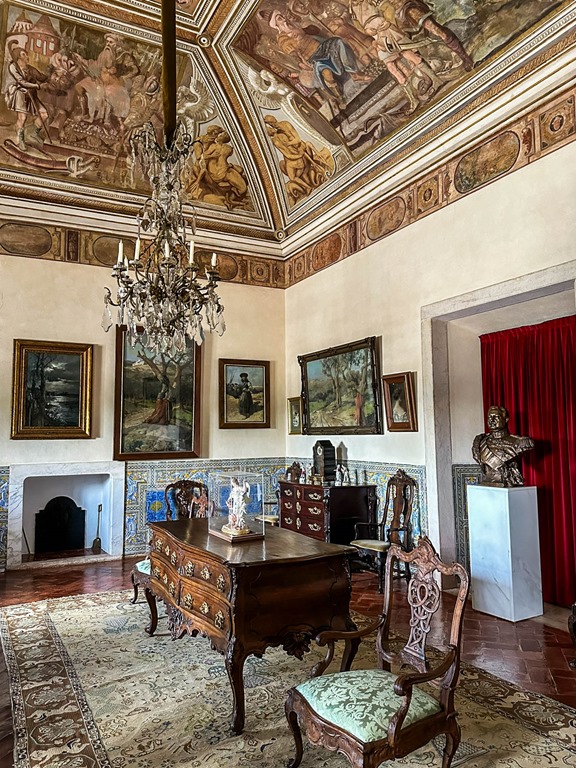
Big mistake! Another woman rushed up to me and told me sternly that no photos were allowed. Not simply no flash, like in the Vatican museums, but no photos at all. I was afraid for a moment she was going to seize my iPhone.
As we went from room to room, I noticed something else odd. Not only were we not allowed to take pictures, but clearly questions were not welcome, either. The guide was discussing the furnishings of the room—I assume that was what she was talking about—with a solemnity that seemed odd for what seemed to me to be pretty mediocre pieces from the seventeenth and eighteenth centuries. When the tour was concluded after a visit to the kitchen, which did, I must admit, have a truly staggering number of copper pots, people departed as quietly as if it had been the end of the Good Friday Liturgy.
Only later, thanks to a little research, did I get some background on all of this. The Paço Ducal de Vila Viçosa is the family home of the Dukes of Braganza. In 1581, the Spanish Hapsburgs successfully claimed the throne of Portugal and united the two countries under the crown of Spain. But in 1640 the Portuguese rebelled and won independence. The Duke of Braganza and his successors became the Portuguese royal family. Some of Portugal’s most celebrated monarch were from the Braganza dynasty. But dissatisfaction with the monarchy grew throughout the nineteenth century, particularly as Portugal began to lose control of Brazil and its many of its colonies in Africa and Asia. In 1908, the King of Portugal and his son, the heir apparent, were assassinated in Lisbon. A younger son became King Manuel II, but he fled to London after the 1910 Revolution.
Not all the Braganzas were content to accept the Portuguese Republic, and the current Duke is quite serious about his claim to be the rightful King of Portugal. All European countries have a small number of monarchists. Were the guides true believers in this Braganza fantasy? Or were they just paid to act is if they took it seriously? What about my fellow tourists? Did they support a renewed Portuguese monarchy? Or were they just curious about the building?
We drove on about another hour until we came to our hotel on the outskirts of Évora. I found our accommodation, as I usually do, on Booking. It had the odd name of the eCork Hotel, but it sounded really interesting. As we approached the hotel, the “cork” part of this was obvious. We were driving through several acres of cork trees. We stopped to take a look. We could see the bare boughs where the bark had been scraped away to become wine stoppers.

The “e” part, I learned at the reception, was its aim to be an “eco” resort. I am not sure what exactly makes something an “eco” resort, but it usually means that it aspires to charge the guests as much as possible. And yet…the place was not that expensive.
When we saw our room, I figured out that this “eco” stuff was at best a work in progress. Our “suite” was a cinderblock building, once painted bright white, but now stained and chipped. The interior was furnished with a some odd furniture that looked like they had been unloaded from IKEA at some ninety-percent-off sale. The closets and bathroom were a kind of cheap bead board. I’d seen nicer showers in a KOA.
And yet…parts of the resort were truly upscale. There was a spa and a well-equipped fitness center. There was a very fine restaurant, though John and I only saw one other customer there.

Just like the Braganza palace, it was all a little weird.
This morning, after an superb breakfast in the eCork restaurant where we again were the only customers, we packed up and headed to the town of Évora. A sign on the outskirts of the city proclaimed it to be a UNESCO World Heritage Site. I have grown a little cynical about this honor, but in this case it seemed deserved. It is an amazing little town.
Sadly, John was not feeling his best and the rainy weather seemed to put him off.

As it started to sprinkle, I cursed myself for not bringing the umbrella from the car. John pointed to a church at the end of the square and we went in to stay dry.

It was a fairly drab and dull bit of eighteenth century architecture and ecclesiastical furnishing. Except this altar piece dedicated to Saint Michael caught my eye

particularly with depictions of a bishop
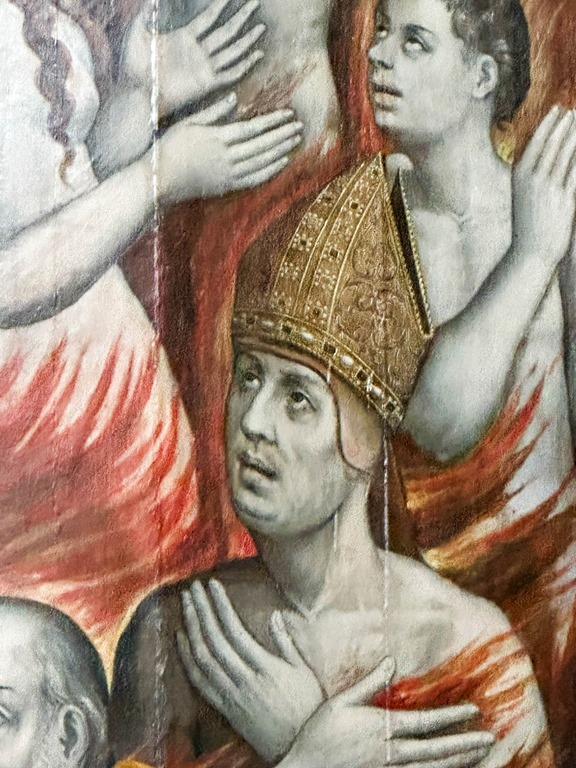
and even a pope in hell!

That is a little weird, too.
By this time, the rain was over and we even had some blue sky. With the sun out, John’s mood grew sunnier too. We pushed on to look at the cathedral whose treasury is considered the real treasure of this town. But there was a long line and a lot of steps involved and I just did not want to push it. So we walked on a couple blocks until we came to the ruins of the Roman temple of the goddess Diana.
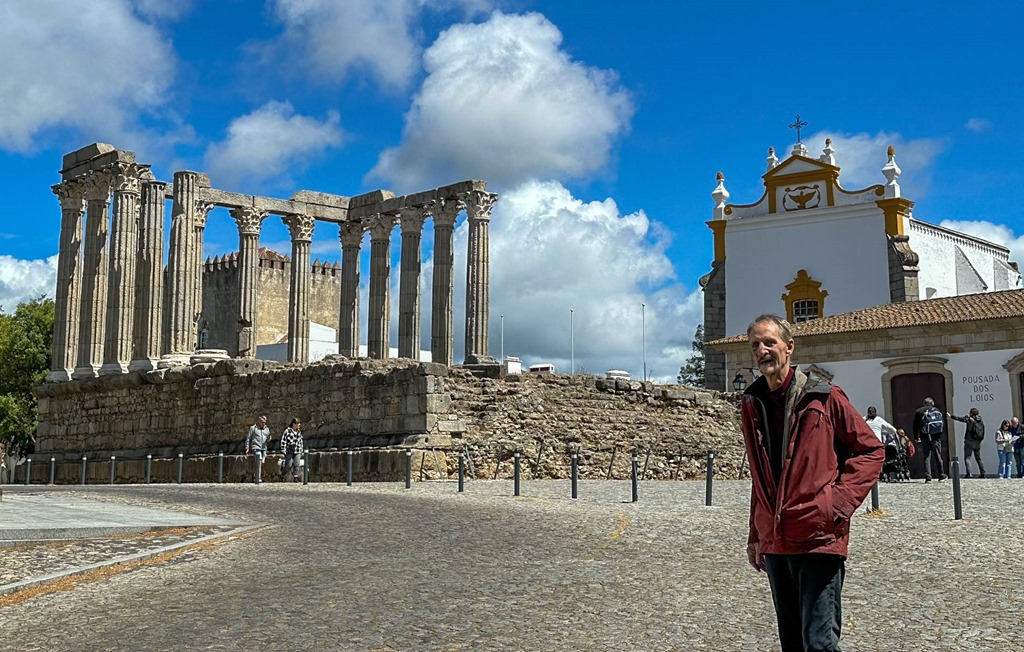
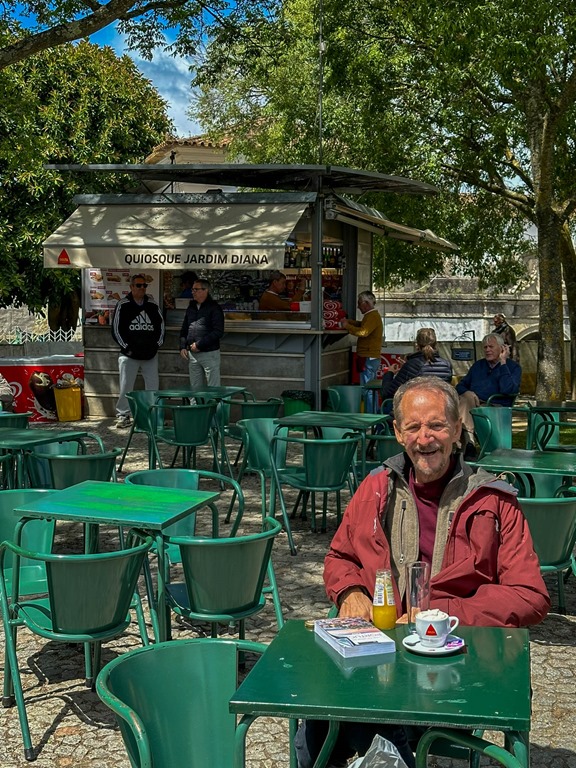
There was a coffee kiosk nearby and we stopped to get a cup.
Our next destination was the coastal city of Nazaré. But that was almost three hours away, and I wanted some kind of stop along the way. There were a couple very famous monasteries that all the guidebooks told me were “must sees.” But even I had reached the point where I did not want to see another golden reredos with the Virgin ascending into heaven. So, almost as an aside one of the books mentioned the Bacalhôa Buddha Eden, the Buddha Eden Garden. It was on the way. I had plants. There was a train to whisk us around. Google, plot me a course!
This is a truly weird place. It bills itself as the largest Asian garden in Europe. But what exactly is an makes this an “Asian” garden? Mainly the hundreds or reproductions of classic sculptures found in east Asia and the Indian subcontinent.

While such statues in their original sites were objects of devotion within a shared cultural context, here they are simply decorative kitsch. So, why are they here? Why was this built?
The official answer is quite high-minded. The gardens were created by José Manuel Rodrigues Berardo, a wealthy philanthopist and art collector, who was outraged by the Taliban’s destruction of the Bamiyan Buddha statues and wished to create peaceful spot celebrating the diversity of cultures and fostering international harmony. But when you look more closely at the man who paid for all this, well, things are a little murkier.
Joe Berardo, as he prefers to be called, grew up in Madeira. He left school at the age of 13 to work in a winery. When he was 18, he emigrated to South Africa. He started a successful wine business there, and soon diversified into gold and diamond mining. He had close connections to to Pik Botha, the apartheid-era South African foreign minister. With the advent of international sanctions against the South African regime in the 1986, the 42 year old Berardo returned to Portugal, now possibly the wealthiest man in the country. Berardo was a controversial figure Portuguese business, often operating much as Carl Icahn did in the United States, buying underperforming companies cheaply and then selling their assets at a profit. Much of his money was then invested in art. While Berardo portrayed himself as a great art collector, he actually used his art as collateral, possibly inflating its value, to obtain loans for other business ventures.
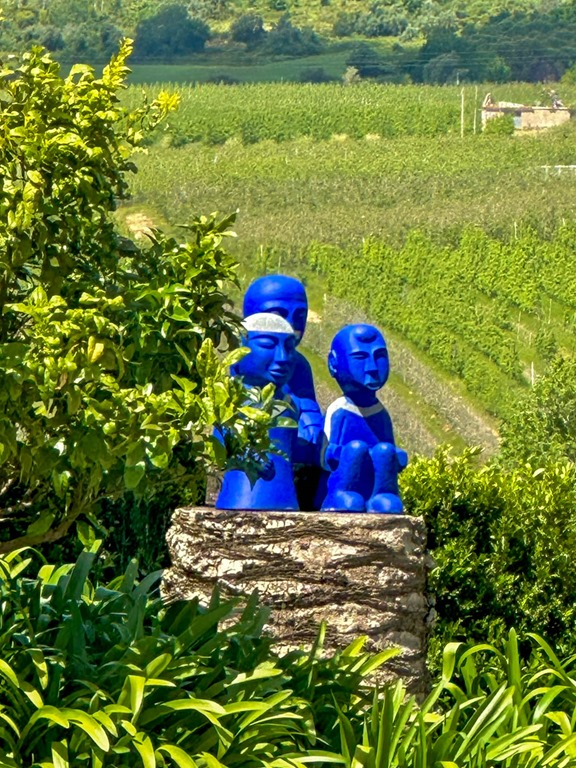
So, it is hard to escape the cynical feeling that this is just another one of Berardo’s business ventures, and that the Buddha statues are not a tribute to the ancient cultures of the Hindu Kush but a clever way to extract tribute from tourists. After all, what exactly do the Qin Dynasty terracotta soldiers have to do with Buddhism—or peace, for that matter? And why paint them all cobalt blue?

In fact, quite a few things in the garden are painted cobalt blue. You see these statues just as you enter the garden. They seem more Teletubbies than bodhisattvas.
It is possible to walk around the 50 or so acres of the gardens, but most visitors take a motorized train ride. Rather like the Disneyland railroad, there are three stops along the route and the faux trains come by every twenty minutes or so. Given John’s limited mobility, it was definitely the best choice for us. Our driver was quite helpful, and he suggested we get off at the third stop—Africa.
Africa? Wait, you say, I thought this was an Asian garden? Well, for some reason there is a whole section devoted to African art. The website explains it like this:
The African Sculpture Garden is dedicated to the Shona people of Zimbabwe who have been hand-sculpting stone into works of art for nearly a thousand years. The Shona believes in ancestral spirits known as “Vadzimu”. In their sculptures they demonstrate the unity between these two worlds, the physical and the spiritual.
Given Berardo’s connection to the white South African regime, this seems a little lacking in sincerity. And none of the art in this section, as far as I figure out, is actually by the Shona people themselves. It is all done by modern artists of African heritage who presumably find it both fulfilling and profitable to create works in neo-native styles.
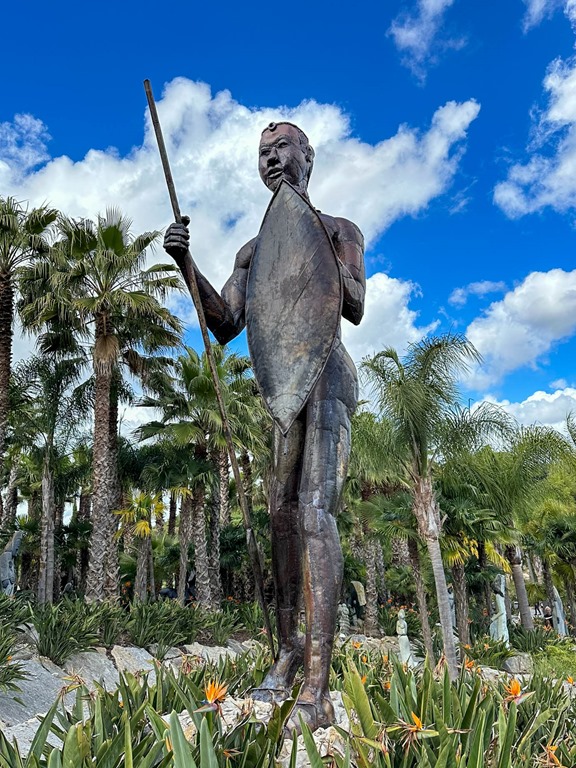

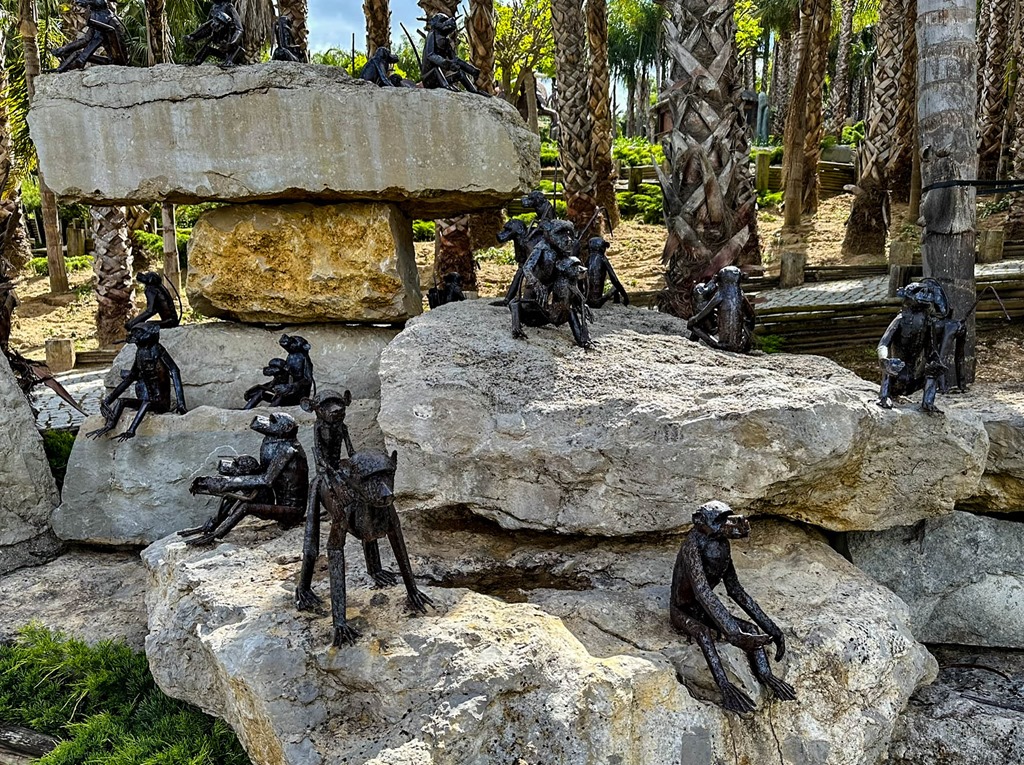
A couple of the exhibits were clearly designed to let the tourists take silly photos.
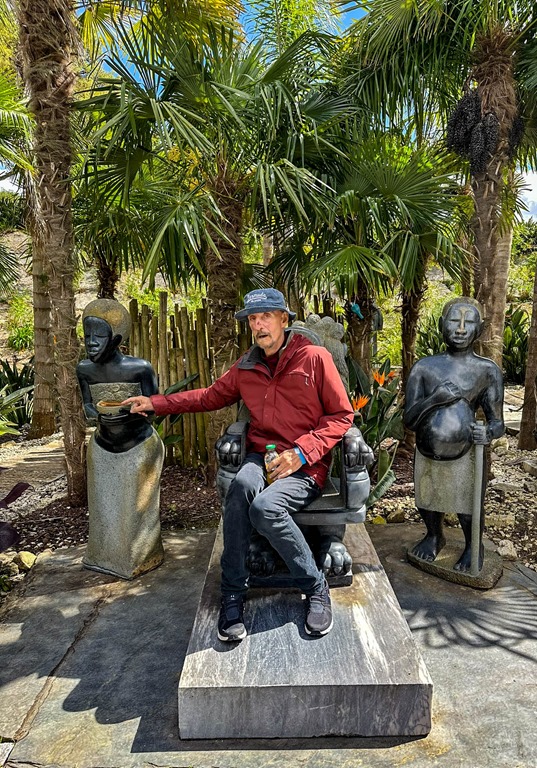
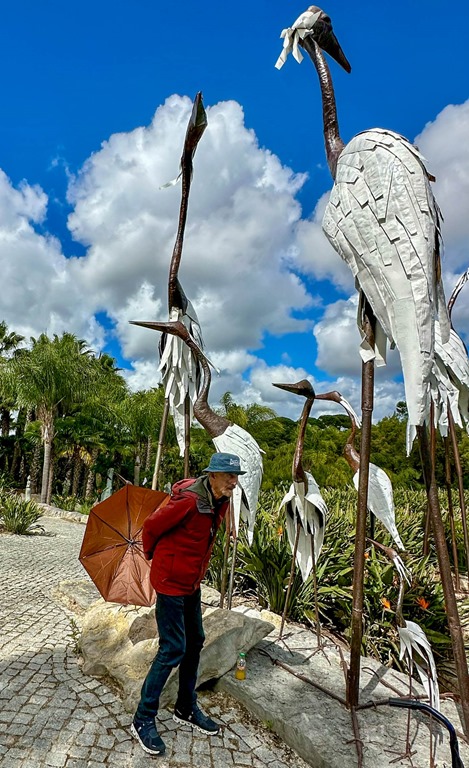
We had to exit, as you might expect, through the gift shop. Except this gift shop sold only wines. Remember the Bacalhôa at the beginning of of the name? Well, the Bacalhôa Group is a huge wine consortium that dominates growing and distributing Portuguese wines. Is Joe Berardo involved in this business? I could not find out for certain, but I feel confident that the answer is yes.
Tonight we are in lovely bed and breakfast in Nazaré. It is not weird at all. So I will write about it in our next installment.
 Traveling Johns