
We pulled into the port of Ålesund around seven o’clock this morning. It took about an hour for the ship to dock and for port authorities to clear us for disembarkation. No surprise, it was raining, and raining fairly hard and steadily. Had John and I been exploring this town on our own, we would probably have waited a couple hours to see if the weather would improve. But I had arranged a small bus tour of the area through Viator, and we were supposed to meet our group just after nine. So we went down to deck four, and the Filipino crewmen safely carried John in his chair down to the pier.
I have sometimes had difficulty locating independent tours, but the directions I had received were perfect and Iwefound a gold-colored Mercedes Sprinter van waiting for us. The friendly driver, who was also our guide, put John’s chair in the back. As we came into the bus, I noticed a couple displays of trolls. This was one right by the entrance. Norwegians seem to have a well-developed taste for kitsch and feel no embarrassment about it.

As we waited for the last couple guests to make it to the bus, our guide started giving us some background about the city. In the late nineteenth century, Ålesund was a fishing village like so many others in Norway. But its natural beauty and the charm of its hundreds of wooden houses attracted many summer visitors. One of the most prominent of those visitors was Kaiser Wilhelm. In January 1904 a fire started in a small factory by the waterfront. Within 36 hours, the entire city had been destroyed. Close to 10,000 people were homeless.
There was no homeowner’s insurance in those days, so the prospects for rebuilding seemed bleak. But the Kaiser, remembering his happy summers in Ålesund, send German ships filled with building supplies to help rebuild the city. The new city would be made out of stone, not wood, and it would be built in the latest European style, Art Nouveau, or as the Germans called it, “Jugendstil.” Rebuilding the city was not easy. There was little appropriate stone in the area for building, so stone had to be shipped in from other parts of Norway. Hundreds of draft horses were needed to drag it to construction sites. But about 1910, the new city was finished. In place or one or two story wooden homes, there were four and five story apartments with shops facing the streets. There were handsome banks and civic buildings. Ålesund was a perfect Art Nouveau gem.
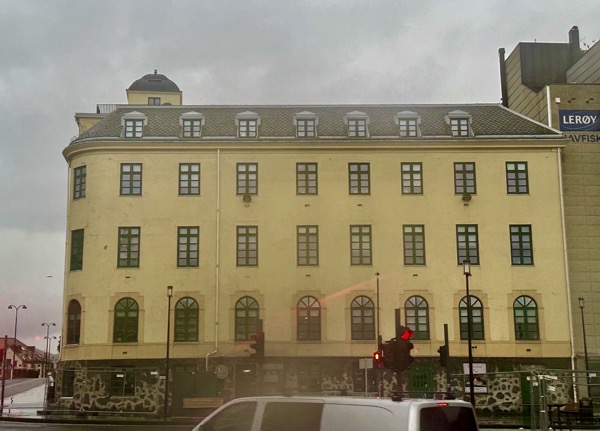
When the German occupied Norway in World War II, they were aware of the historical ties between the Kaiser and Ålesund. They deliberately attempted to preserve the city as an example of high German culture. However, by the 1970s, the buildings were no longer in fashion and most were in serious need of repair. A number were being torn down to build cement, steel, and glass boxes in the prevailing internationalist style. Many residents of Ålesund were appalled by the changes, and began a campaign to renovate and restore the city. They decided that the first step in saving the buildings was to paint them. The buildings had originally all been natural gray stone, mostly granite. But in the 1980s they were suddenly paintied all kinds of colors. Details on the structures were accentuated with bright colors. And the strategy worked. People began to notice and appreciate Ålesund’s Art Nouveau past. Tourists started to flock to the city to admire them. Before long, the city was short-listed as a UNESCO World Heritage Site.
By the time our driver was finished telling us this history, we had arrived at our first stop, Mount Aksla. This 518 foot massif towers over the town. The patio of a small cafe and visitor’s center there allows panoramic views over the city and the surrounding region.

From here you can see the cheerfully painted buildings lining the shore. Even on a cloudy day, you can notice how they reflect into the water.

Our cruise ship was also easy to see from there. The residents of Ålesund are a little ambivalent about the ships. They need the money that the tourists bring to town, but some of the ships have almost as many passenger and crew as the town has residents.
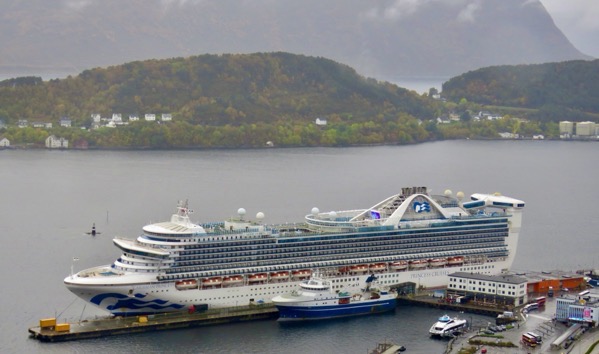
At the top of Mount Aksla we also saw the tourist “train,” which like the hop-on, hop-off bus connect most of the important attractions in the city. Particularly in the rain, I was glad we were in our warm minibus.

We drove down the mountain and through the city for about ten minutes until we reached our next stop, historic fishing center. Some of the buildings here managed to escape the fire as this area was a little separated from the main part of the city.

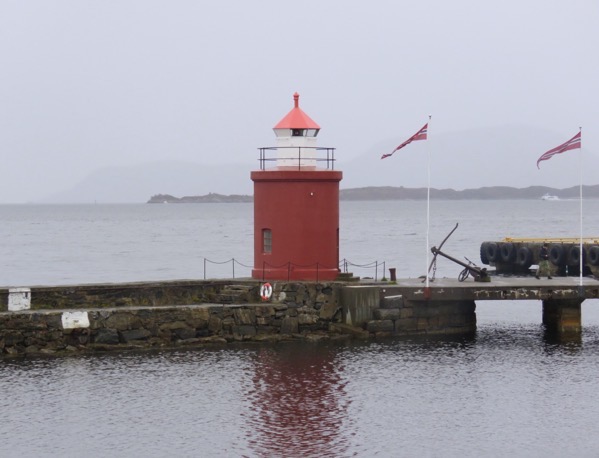
The small Molja lighthouse marked the entrance to the fishing port.
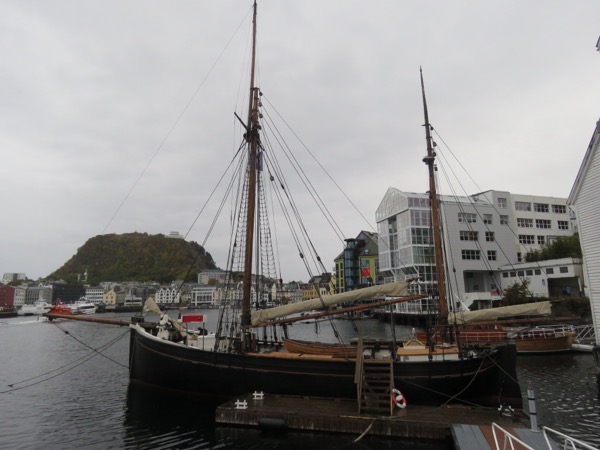
There was a small fishing museum located near the lighthouse. The guidebooks suggested that it was worth a visit, but it was closed today. There is a traditional Norwegian fishing trawler behind the museum, and I am pretty sure that when the museum is open you can visit it.
I saw these plaster-of-Paris busts on the top floor of the building where the museum was located.

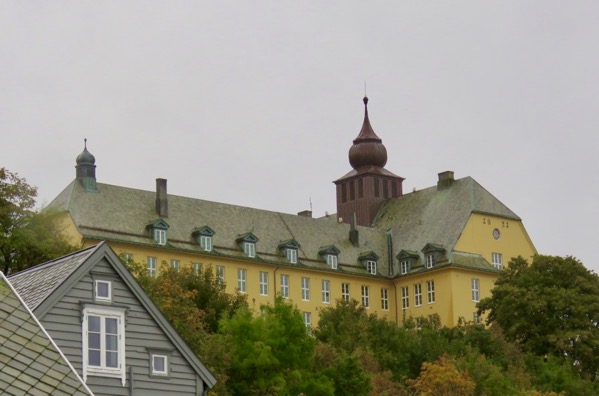
On the way to our next stop, our guide drove us past a couple landmarks in this area. The yellow onion-domed structure dates from 1923 and it was the city’s grade school. As recently as the 1950s, over 1000 students attended this school. Today, it is less than 100.
We also passed by the Ålesund parish church. This dates from 1909, replacing an older building lost in the fire.

The municipality of Ålesund is located on seven islands. The town center is located on Aspøya Island and Nørvøya Island. These have been connected by bridge for hundreds of years. The other island were accessible only by ferry until recently when a series of tunnels were built which allows each access from one to another and which connects all of them to the mainland. Our driver assured us that Alnes, the outermost island, was the most beautiful. The water surrounding Alnes, however, is notoriously dangerous. There is still an active lighthouse here.
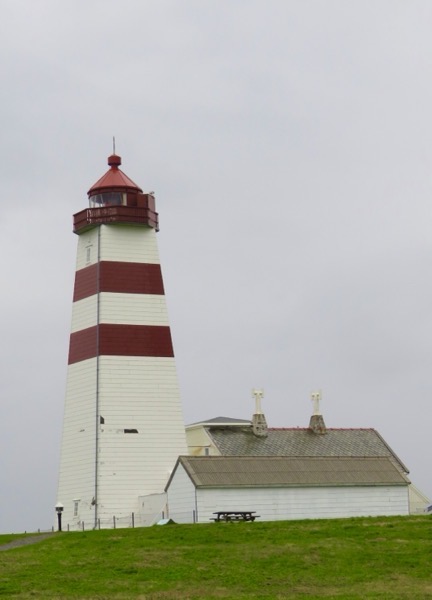
The lighthouse is occasionally open to the public, but it was closed today. There is a visitor center nearby. Most of this building is built into the side of the hill.
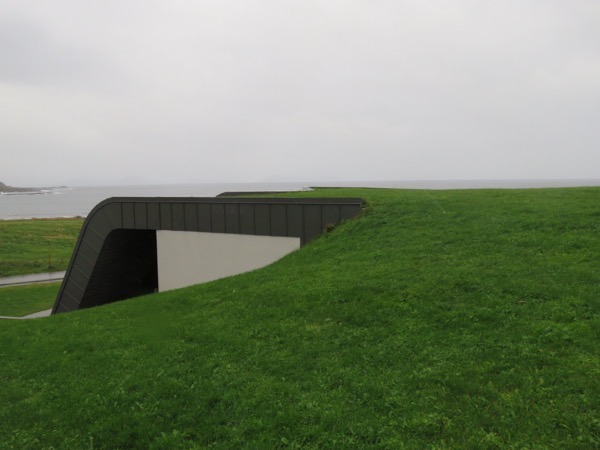
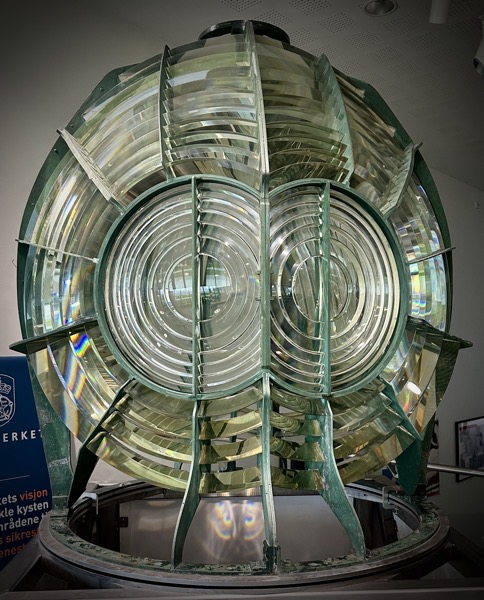
There is a cafe inside the visitor’s center. John and I had coffee and we each had some cake. There were a number of exhibits there as well including the almost obligatory display of the original Fresnel lens.
The most interesting thing I saw inside was a large poster explaining the government’s plan to create the world’s first ship tunnel. This will allow ships to completely avoid the treacherous open North Sea waters and take an inside passage.
I went outside in the rain to take a few pictures. The area is barren, yet still quite beautiful.

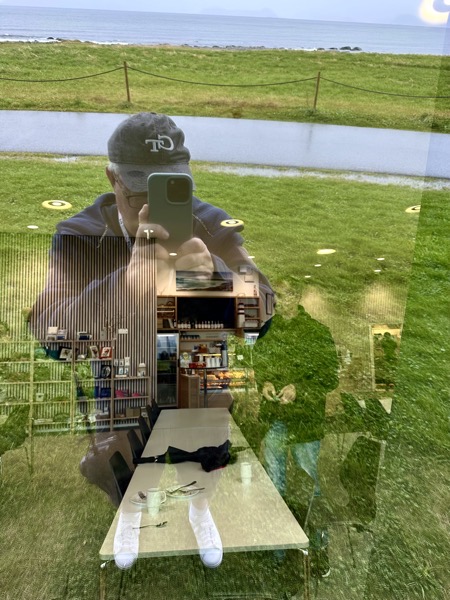
John wanted to stay inside where it was warm. I tried to take a picture of him inside the coffee shop and managed to photograph myself as well!
On our way back to the ship, we stopped on the island of Giske. Our driver explained that many people consider Giske to be the birthplace of Norway. The Giske family was the most powerful in Norway for hundreds of years.
In 1139 Giske Kirke was built as a family chapel. It is the only church in Norway made of marble, a precious stone that had to be imported from hundreds of miles away.
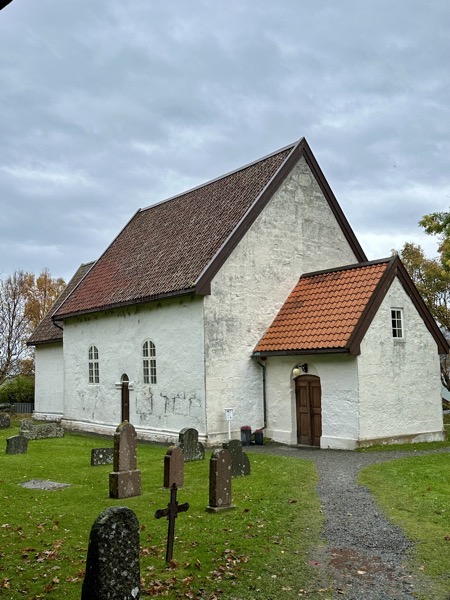

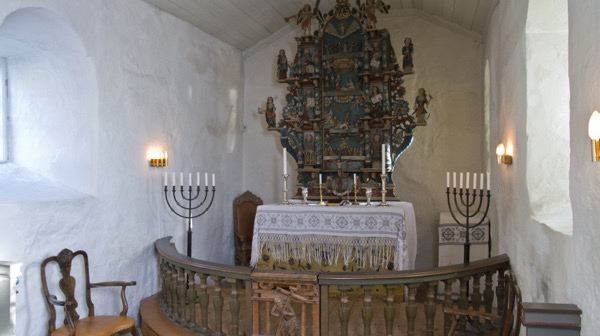
The church is not often open, and it was not open today. But our guide gave us these pictures of the interior, now decorated in a Norwegian folk style.

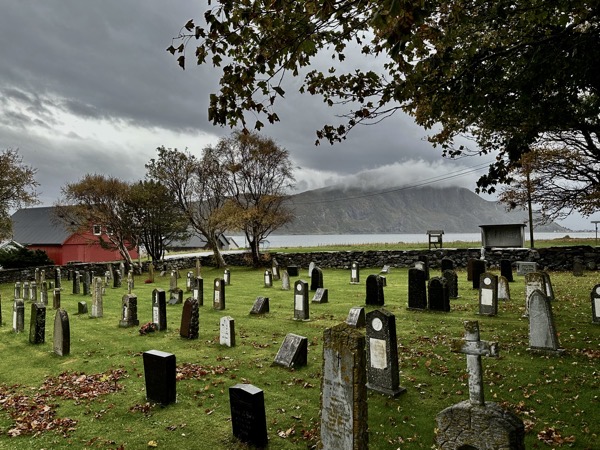
The churchyard, which appropriately opens out into the sea, contains the graves of many members of the Giske family.
And that brings to an end our time in Norway. We head back to Southampton tonight. I regret missing Alta and all the bad weather that prevented us from seeing the Northern Lights. But we are still grateful to have had the chance to explore a new part of the world, and I look forward to returning to Norway another time.
 Traveling Johns