Signing Off for Now

The last couple days of the cruise were a little dull. There is a lot of North Sea in between Norway and the UK, and even at full speed a ship takes at least two days to cross it. John and I were both pretty bored with being onboard, and we mostly just did nothing. I take that back—I successfully did some laundry. Princess has “launderettes” on its ships, but the competition for one of those machines is probably the most ruthless on the high seas. The woman from Minnesota who dumped my stuff out of the washer the moment it was done had brought along all her favorite laundry products including dryer balls! 

It was raining, of course, when the Caribbean Princess docked early Tuesday morning in Southampton. I have to marvel at the efficiency the ship had in discharging its passengers. All passengers are assigned a color and a number indicating the time and the place to meet before hitting that gangway. John and I had fortunately been given Red 4, the last group. I think Melvin, our ever helpful Filipino cabin steward, knew that we would need a little more time. 

We found our luggage without too much difficulty, and had no problem getting a cab. I had booked us again at the Harbour Hotel, but I knew that the room would not be ready when we arrived just before ten o’clock. They graciously stored our luggage and took my phone number so they could text me when it was ready. I called my friend Vicki. She and her husband Jerry live in the village of Romsey about ten miles from Southampton. I have known Vicki for almost 40 years now, and John has known her for longer. One of the reasons for picking a cruise starting and stopping in Southampton was so we could get a couple of days to catch up and have fun like always. 

Jerry had arranged to rent an SUV for our visit so that they could pick us up and later take us to the airport. They own little cars, the only sensible option when you live in a place where gas costs nearly 10 dollars a gallon. But they had not picked up the SUV yet, so John and I needed to figure out something to do for the next 90 minutes or so. 

By this time, the rain had stopped and the sun was playing hide-and-seek behind big, gray clouds. I pushed John along the quay and we look at some of the enormous yachts. Most of these are much larger than the ones we used to see at Marina del Rey or Newport. I suspect that more than a few are owned by Russian oligarchs and their ilk. We stopped in a cafe since neither of us had eaten breakfast. John had some cream of mushroom soup that looked remarkably like wet stucco. I had a glutinous panini accompanied by the inevitable tortilla chips. When exactly, I wondered, did Doritos become a staple of British cuisine?

That still left us with about an hour until Vicki would be ready for us. I looked at the nearby tourist options and decided that the Southampton Municipal Art Gallery looked promising. It was wheelchair accessible, and even had the benefit of being free. I called an Uber. Our driver could not have been more English, and in the best tradition of English cabbies could not have been more talkative. He gave us a lot of history of the area as we were driving, pointing out the areas that the Germans had bombed to rubble during the war and those that had managed to survive. We chatted about Sir Keir Starmer’s first hundred days. “I’m a Labour man myself, always have been,” he began, before admitting that he was appalled by the gifts from Lord Ali and the proposal to eliminate the winter fuel allowance. 

The Southampton gallery is part of a large municipal complex which includes various government offices and the central library. It dates from the 1930s and had a charming Art Deco sensibility amid obvious signs of deferred maintenance. 

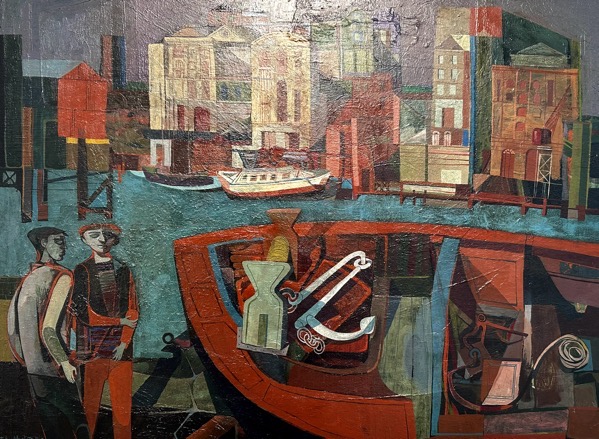
The collection is quite eclectic, no doubt the result of many donations over the years rather than a concerted plan for acquisition. There are many artists represented who have strong ties to the region. I failed to note the painter of this picture of the London Docklands. I loved the Cubist influence, however timid. 
1F7A8105 D4FE 485F 80C9 57581FE0E6F0_1_102_a.

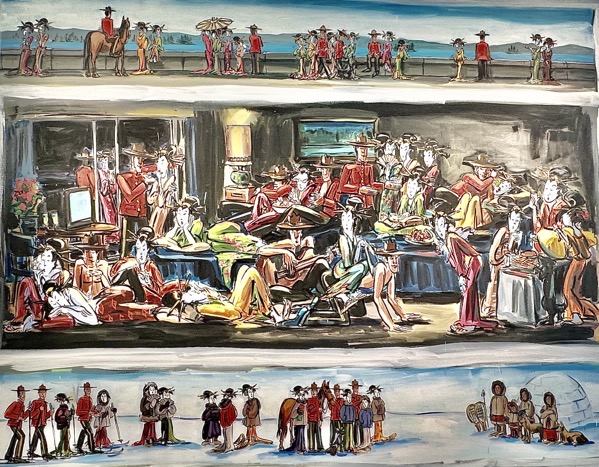
This one made me laugh. It was by a Canadian artist. She did a whole series of paintings featuring geishas. This one has geishas cavorting with a rather louche group of Mounties. 
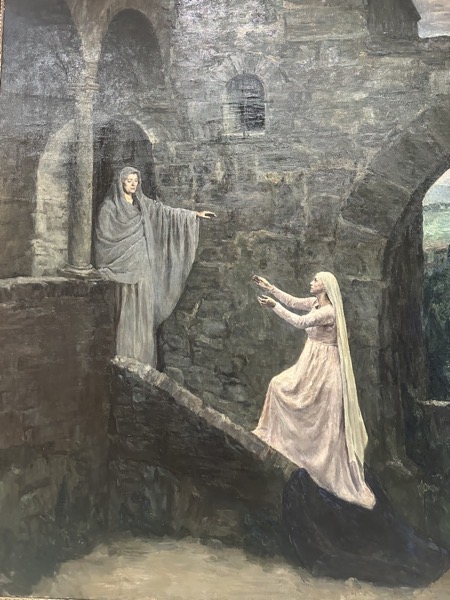
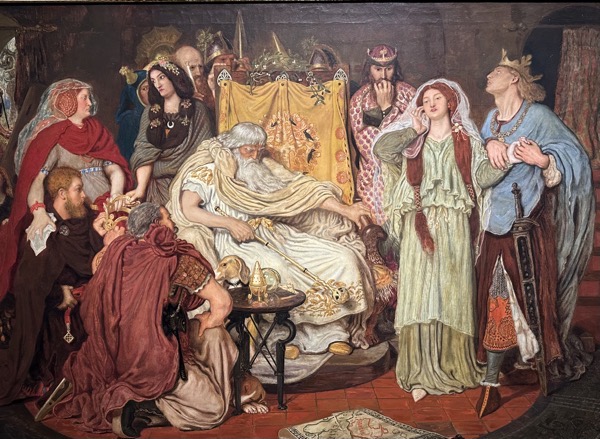
The scene below is from Lear and depicts the moment when the aged king disinherits his youngest and favorite daughter because she has too much integrity to lie to him. That’s Cordelia on the right with the auburn braids looking like she is about to faint. The evil sisters are on the left gloating. This painter—again I should have noted a name—was mostly a designer of theatric backdrops. It shows. 
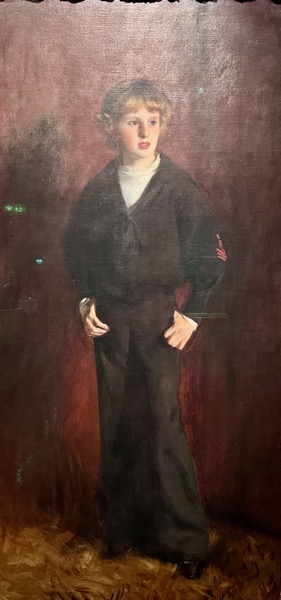
There are some works by more famous artists. From across the room I knew that this was the work of John Singer Sergeant. 
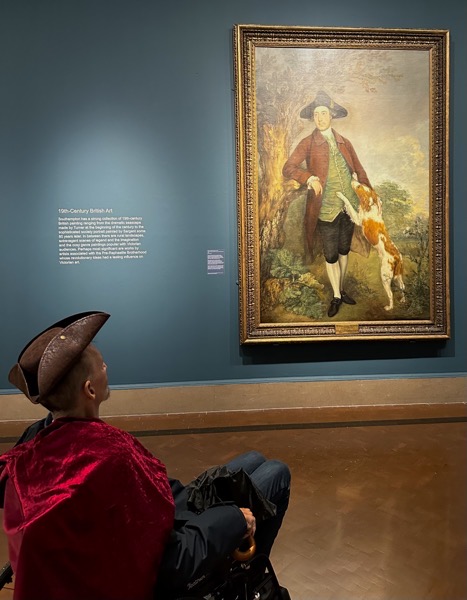
The Southampton gallery is remarkable “kid-friendly,” and there many areas designed to help make the art more accessible to children. In the room with all those eighteenth century Royal Academy pictures that even art history types find dull, there is a box filled with various costumes so you can dress up like the pictures. My kid found that appealing. 
Vicki and Jerry appeared about this time and whisked us off to their home. Romsey is a delightful little Hampshire village right on the River Test. In medieval times it had been home to a large monastery, and the center of the town is dominated by the old abbey, now a Church of England parish. There is a harmonious mix of Tudor, Georgian, and Victorian buildings. Vicki and Jerry, however, live in a modern development on the edge of town. We had lunch and chatted. John took a nap while Vicki and I went off to the village to get a couple things from Boots. It rained on and off the entire afternoon. 

In the evening, they took us back to the Harbour Hotel. One of the reasons that Vicki had recommended we stay here is that The Jetty, one of their favorite restaurants, is on the ground floor of the hotel. It is a beautiful modern dining room looking out at the Marina. We had a great dinner there, and then went up to our room. After our tiny cabin on the boat, it seemed quite palatial. 

The next morning, it was actually sunny. 
We checked out of the hotel and Vicki and Jerry were there to pick us up. Jerry had somehow convinced Avis to give him a full-size BMW SUV for the cost of a sedan. It was a perfect choice as our two large suitcases and John’s wheelchair fit in the boot with room to spare. 

I had booked our final night in the His Majesty’s dominions at the Hilton Gardens at Heathrow Terminal Two. It is hard to get John up and ready in the morning, so I figured we would be better off if we were already at the airport. So Vicki and Jerry planned to give us a long touristy ride up to London. They asked us what we wanted to see and were quite surprised when I said that in all the times we had been in England we had never done Windsor Castle. So off we went.

Windsor High Street manages to be both touristy and authentic. It is Tory England at its bluest. 

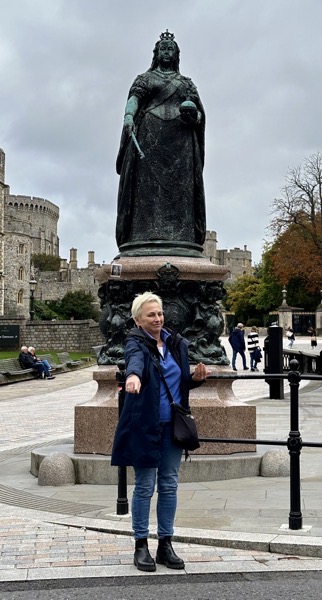
I had my Victoria pose with her namesake. But it was just hard for Vicki to say “We are not amused” because she is one of the funniest people I know. 
John and I had not had breakfast. It was about noon and we were a bit “peckish.”  The Ivy was the perfect choice. The first The Ivy was in London’s theatre district. There are several others now, but all keep the same 1930s tea room vibe. 
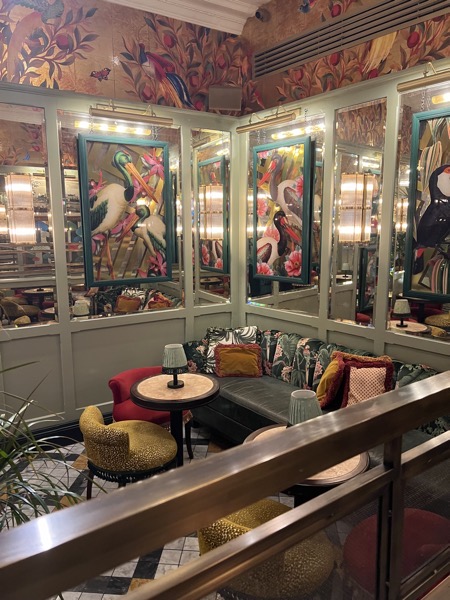
We had a good lunch. John had the perfect Shepherd’s Pie. Jerry snapped a picture of all of us after lunch, happy and probably a couple pounds heavier!

We had some sad news at this point. It turned out that the Castle is only open a couple days a week during the fall, and this was NOT one of those days. We had to content ourselves with looking at the outside. 

We peeked through the main gates. 
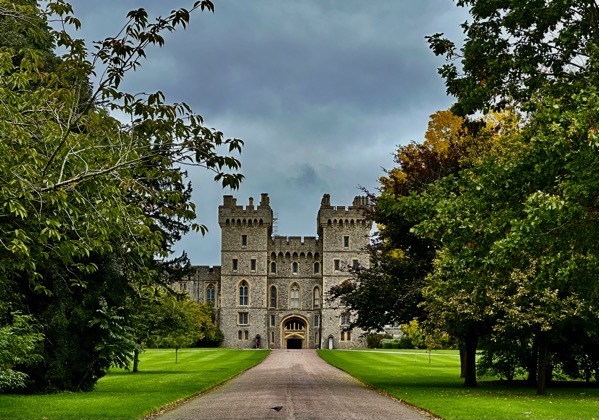
And we admired the famous “Long Walk.” 
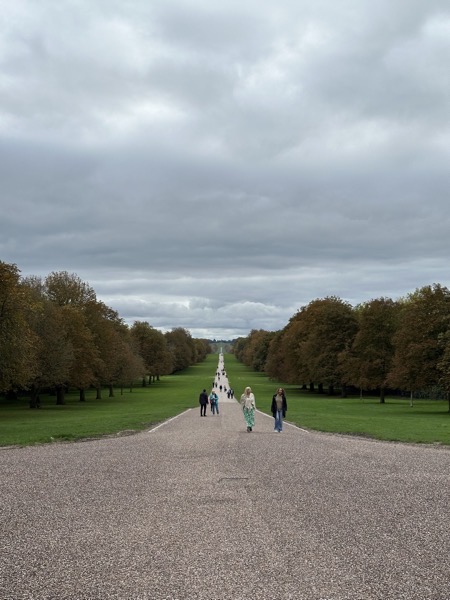
On the way back to the car, I took a detour. One of the most fascinating things about Windsor is that you can find a view of the Castle in the most unexpected places. 
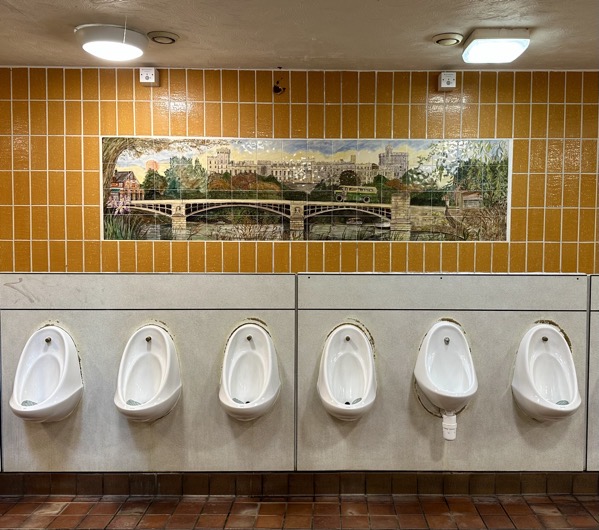
I believe that this particular facility is home to the “Warmstream Guards.”

Windsor is on the Thames, as are many of the royal palaces. The river was the Tudor equivalent to the M25. On the other side of the river from Windsor is Eton. 

Vicki could not resist the geese. 

I think they thought she would be more forthcoming with food than she was. 

Eton is the home of Eton College, England’s most famous, and most expensive, public school. I was stunned to see how enormous the school is. With all the different dormitories, gymnasiums, libraries, and labs it is larger than many American liberal arts colleges. One of the many famous things about Eton is that the senior boys wear morning dress. 
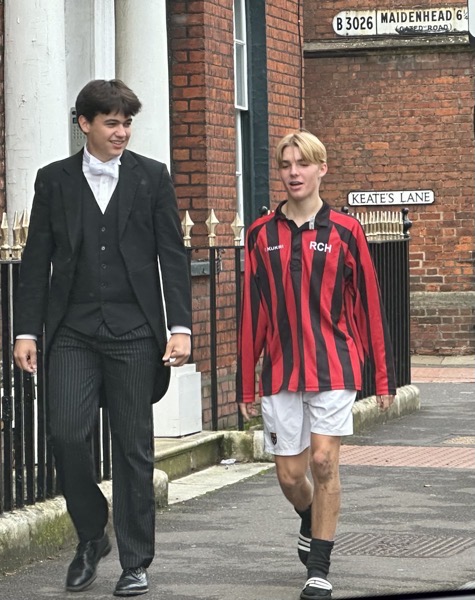
Not all the time, of course. But they still seem to be pretty dressed up even when coming back from a game of rugby. 

The scarf and flag color denote their house. 

We zoomed past Runnymede where the barons made King John sign the Magna Carta. There was not much there other than a memorial to President Kennedy. 

We soon caught sight of the Heathrow tower and knew that our time with Vicki and Jerry was over. The Hilton app gave me the option to check in remotely and to use my phone as my room key. We saw nobody as we took the life up to our room. It was efficient, but gave the starkly modern hotel a creepy sense of anomie. But I can put up with alienation and existential despair for the view we had from the top floor. 

Tomorrow it is back to Oregon. This has not been the most perfect trip for us. There have been some disappointing moments and John’s health has posed some challenges. Still, I wish we could keep traveling. I know he feels more alive when we are on the road, and I have to admit that I do as well. Traveling Johns signing off until our next adventure!

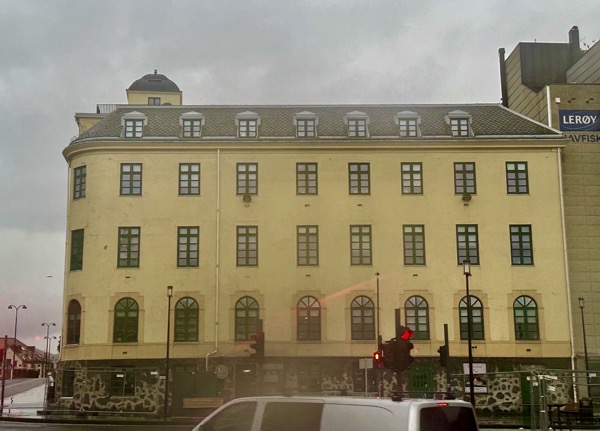
Ålesund

We pulled into the port of Ålesund around seven o’clock this morning. It took about an hour for the ship to dock and for port authorities to clear us for disembarkation. No surprise, it was raining, and raining fairly hard and steadily. Had John and I been exploring this town on our own, we would probably have waited a couple hours to see if the weather would improve. But I had arranged a small bus tour of the area through Viator, and we were supposed to meet our group just after nine. So we went down to deck four, and the Filipino crewmen safely carried John in his chair down to the pier. 

I have sometimes had difficulty locating independent tours, but the directions I had received were perfect and Iwefound a gold-colored Mercedes Sprinter van waiting for us. The friendly driver, who was also our guide, put John’s chair in the back. As we came into the bus, I noticed a couple displays of trolls. This was one right by the entrance. Norwegians seem to have a well-developed taste for kitsch and feel no embarrassment about it. 

65158512 Unknown.

As we waited for the last couple guests to make it to the bus, our guide started giving us some background about the city. In the late nineteenth century, Ålesund was a fishing village like so many others in Norway. But its natural beauty and the charm of its hundreds of wooden houses attracted many summer visitors. One of the most prominent of those visitors was Kaiser Wilhelm. In January 1904 a fire started in a small factory by the waterfront. Within 36 hours, the entire city had been destroyed. Close to 10,000 people were homeless. 

There was no homeowner’s insurance in those days, so the prospects for rebuilding seemed bleak. But the Kaiser, remembering his happy summers in Ålesund, send German ships filled with building supplies to help rebuild the city. The new city would be made out of stone, not wood, and it would be built in the latest European style, Art Nouveau, or as the Germans called it, “Jugendstil.” Rebuilding the city was not easy. There was little appropriate stone in the area for building, so stone had to be shipped in from other parts of Norway. Hundreds of draft horses were needed to drag it to construction sites. But about 1910, the new city was finished. In place or one or two story wooden homes, there were four and five story apartments with shops facing the streets. There were handsome banks and civic buildings. Ålesund was a perfect Art Nouveau gem. 

When the German occupied Norway in World War II, they were aware of the historical ties between the Kaiser and Ålesund. They deliberately attempted to preserve the city as an example of high German culture. However, by the 1970s, the buildings were no longer in fashion and most were in serious need of repair. A number were being torn down to build cement, steel, and glass boxes in the prevailing internationalist style. Many residents of Ålesund were appalled by the changes, and began a campaign to renovate and restore the city. They decided that the first step in saving the buildings was to paint them. The buildings had originally all been natural gray stone, mostly granite. But in the 1980s they were suddenly paintied all kinds of colors. Details on the structures were accentuated with bright colors. And the strategy worked. People began to notice and appreciate Ålesund’s Art Nouveau past. Tourists started to flock to the city to admire them. Before long, the city was short-listed as a UNESCO World Heritage Site. 

By the time our driver was finished telling us this history, we had arrived at our first stop, Mount Aksla. This 518 foot massif towers over the town. The patio of a small cafe and visitor’s center there allows panoramic views over the city and the surrounding region. 

From here you can see the cheerfully painted buildings lining the shore. Even on a cloudy day, you can notice how they reflect into the water. 

65158560 Unknown.

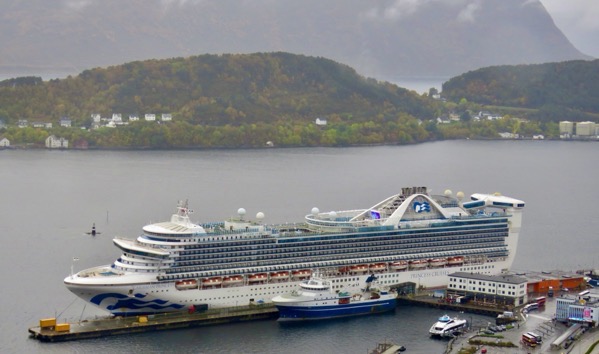
Our cruise ship was also easy to see from there. The residents of Ålesund are a little ambivalent about the ships. They need the money that the tourists bring to town, but some of the ships have almost as many passenger and crew as the town has residents. 

65158528 Unknown.

At the top of Mount Aksla we also saw the tourist “train,” which like the hop-on, hop-off bus connect most of the important attractions in the city. Particularly in the rain, I was glad we were in our warm minibus. 

65158592 Unknown.

We drove down the mountain and through the city for about ten minutes until we reached our next stop, historic fishing center. Some of the buildings here managed to escape the fire as this area was a little separated from the main part of the city. 

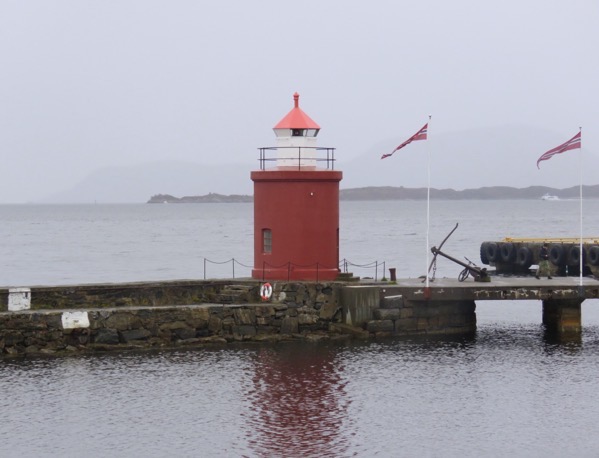
The small Molja lighthouse marked the entrance to the fishing port. 

65158608 Unknown.

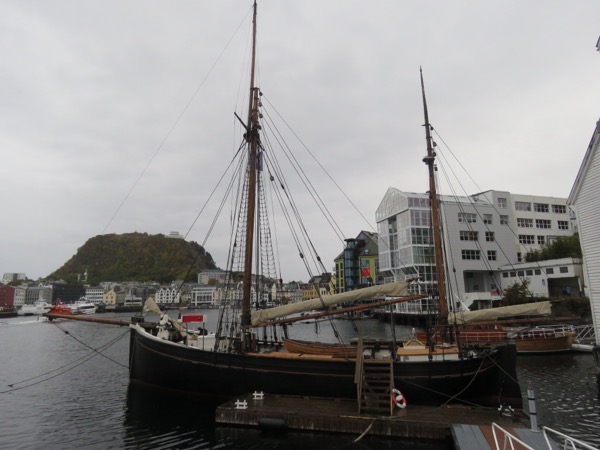
There was a small fishing museum located near the lighthouse. The guidebooks suggested that it was worth a visit, but it was closed today. There is a traditional Norwegian fishing trawler behind the museum, and I am pretty sure that when the museum is open you can visit it. 

65158736 Unknown.

I saw these plaster-of-Paris busts on the top floor of the building where the museum was located. 

65158672 Unknown.

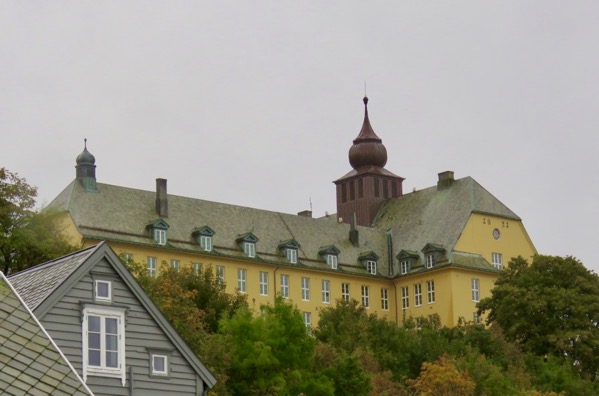
On the way to our next stop, our guide drove us past a couple landmarks in this area. The yellow onion-domed structure dates from 1923 and it was the city’s grade school. As recently as the 1950s, over 1000 students attended this school. Today, it is less than 100. 

65158768 Unknown.

We also passed by the Ålesund parish church. This dates from 1909, replacing an older building lost in the fire. 

Ålesund_church_10_July_2008 (1).

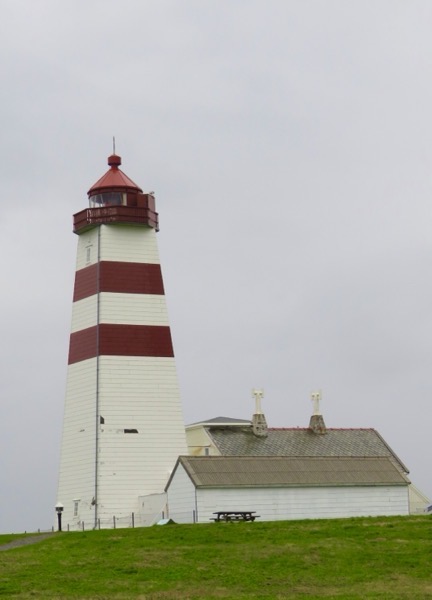
The municipality of Ålesund is located on seven islands. The town center is located on Aspøya Island and Nørvøya Island. These have been connected by bridge for hundreds of years. The other island were accessible only by ferry until recently when a series of tunnels were built which allows each access from one to another and which connects all of them to the mainland. Our driver assured us that Alnes, the outermost island, was the most beautiful. The water surrounding Alnes, however, is notoriously dangerous. There is still an active lighthouse here. 

65158784 Unknown.

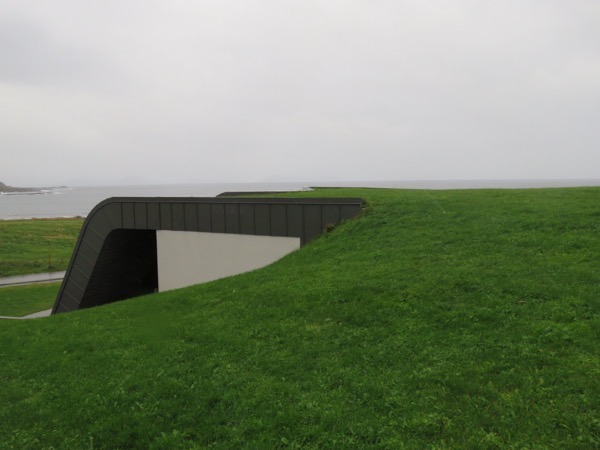
The lighthouse is occasionally open to the public, but it was closed today. There is a visitor center nearby. Most of this building is built into the side of the hill.

65158816 Unknown.

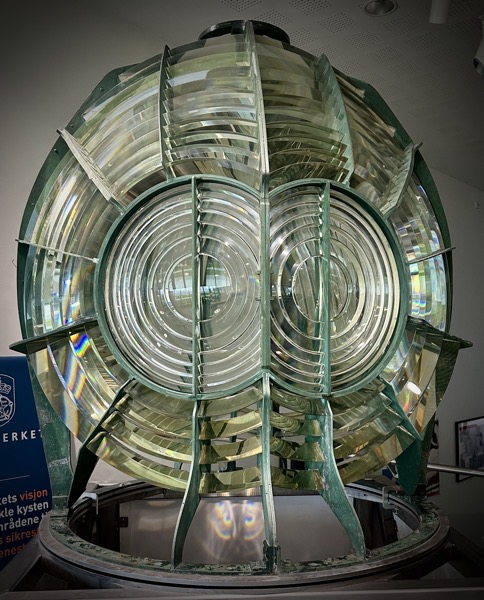
There is a cafe inside the visitor’s center. John and I had coffee and we each had some cake. There were a number of exhibits there as well including the almost obligatory display of the original Fresnel lens. 

The most interesting thing I saw inside was a large poster explaining the government’s plan to create the world’s first ship tunnel. This will allow ships to completely avoid the treacherous open North Sea waters and take an inside passage. 

I went outside in the rain to take a few pictures. The area is barren, yet still quite beautiful. 

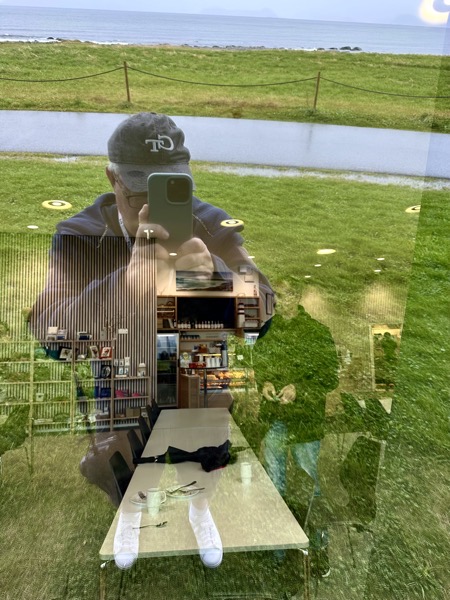
John wanted to stay inside where it was warm. I tried to take a picture of him inside the coffee shop and managed to photograph myself as well!

On our way back to the ship, we stopped on the island of Giske. Our driver explained that many people consider Giske to be the birthplace of Norway. The Giske family was the most powerful in Norway for hundreds of years. 

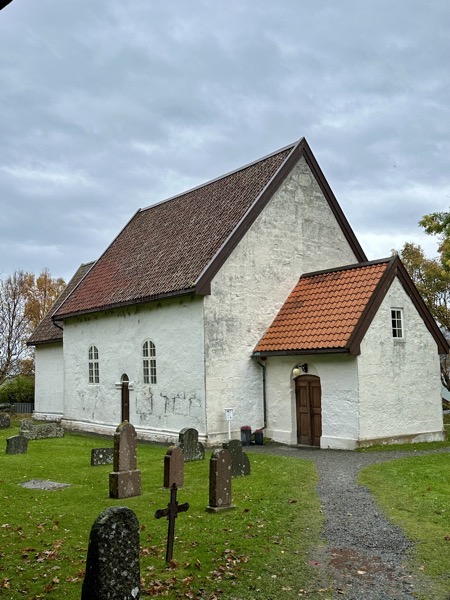
In 1139 Giske Kirke was built as a family chapel. It is the only church in Norway made of marble, a precious stone that had to be imported from hundreds of miles away. 

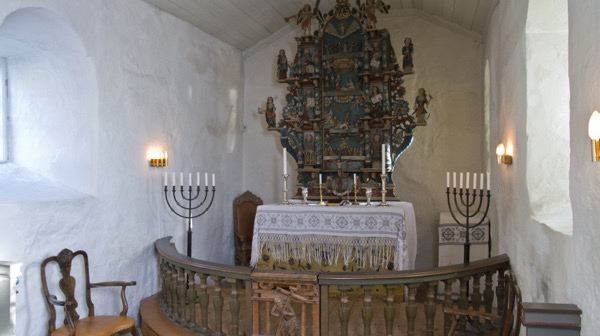
The church is not often open, and it was not open today. But our guide gave us these pictures of the interior, now decorated in a Norwegian folk style. 

Giske Altar.

Giske pulpit.

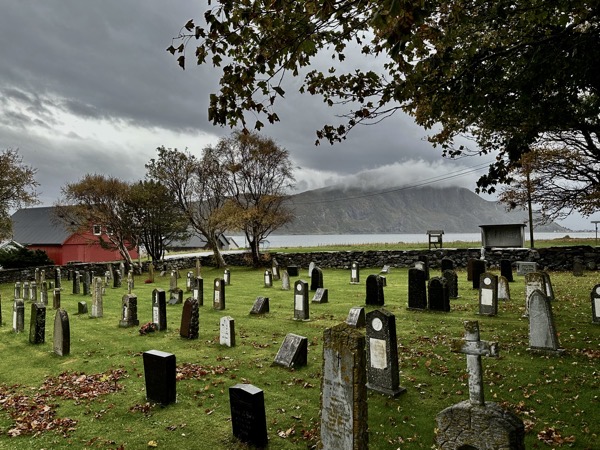
The churchyard, which appropriately opens out into the sea, contains the graves of many members of the Giske family. 

And that brings to an end our time in Norway. We head back to Southampton tonight. I regret missing Alta and all the bad weather that prevented us from seeing the Northern Lights. But we are still grateful to have had the chance to explore a new part of the world, and I look forward to returning to Norway another time. 

The Lofoten Archipelago

Finally having escaped Tromsø, we set on for the Lofoten Islands. Before I booked this cruise, I had never heard of these islands. Doing a little reading, I learned that this area was one of the first areas in Norway to be settled, with evidence for human activity dating back almost 11,000 years. There are extensive Viking archeological sites here.

Located just above the arctic circle, there are five main islands in this archipelago, all of them now linked by bridges and a highway. There are also many smaller islands. The area is not heavily populated. There are only two towns of any size. Fishing used to be the main industry here, but tourism is increasingly important with over a million visitors to the islands each year. 

I had initially planned trip up a narrow fjord in a Zodiac for us. But it involved taking a long bus ride both ways, and I knew that even though they planned to give us heavy, waterproof gear, John was going to be cold. Plus, if I the buses did not run exactly on schedule, we were going to miss the ship and be stuck in Lofoten. So, I cancelled that reservation and booked an excursion with the cruise line. 

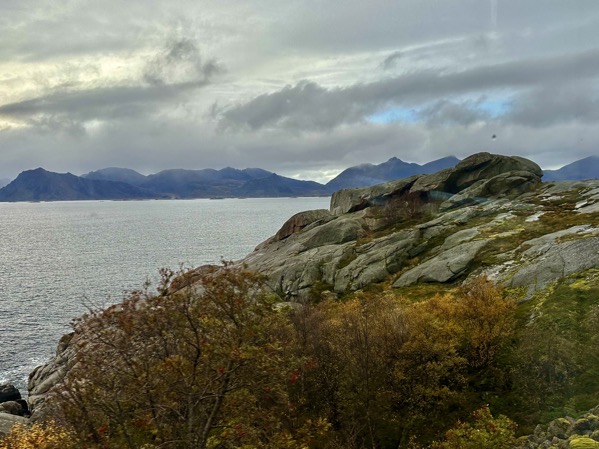
The tour was exactly what I expected. They put us in a big bus with a chatty English-speaking local guide. We had a couple of stops, but mostly drove about looking at the scenery. But that scenery is pretty impressive. Jagged mountains of black gneiss seem to erupt from the sea. Adjacent to them in places are flat plains with a patchwork of wetlands and farms. 

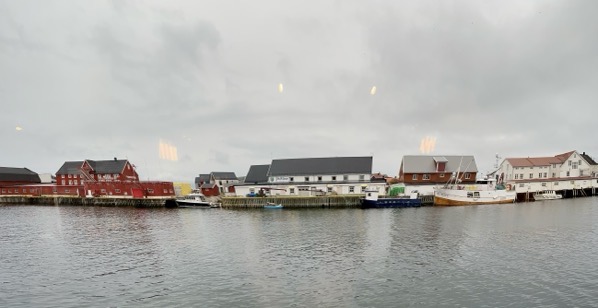
Our tour began in Leknes, one of the two main towns. It is obviously an important transit and commercial hub, but had not a trace of charm, particularly on a rainy day. We spent no time there. The bus pushed on towards the old fishing village of Henningsvær, several kilometers off the main highway. This was far more charming with lots of old houses and fish barns. 

The Norwegians seem to delight in brightly painted houses with no fear that the colors will somehow clash. 

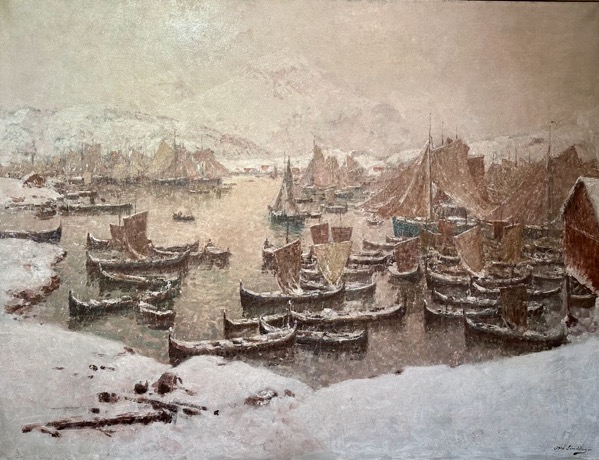
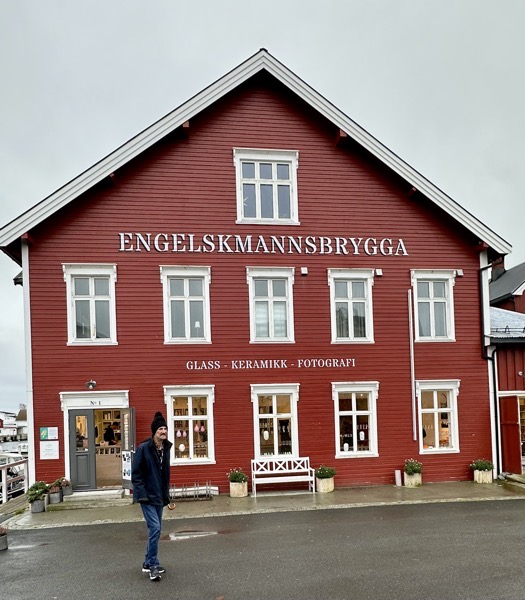
Henningsvær is an important artist colony. Many of Norway’s most prominent artists live here for at least part of the year. And this is not a new development.  Even in the nineteenth century, it was center for much plein-air painting. We stopped at a small museum there displaying some of the work of local artists, old and new. There were lots of landscapes

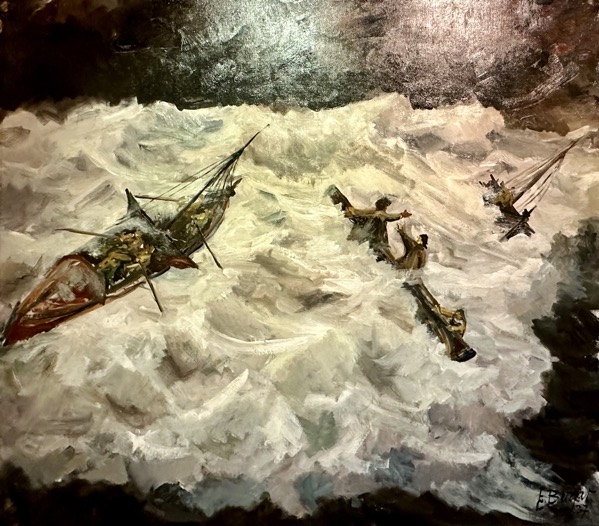
and a few of those disaster canvases so beloved by many nineteenth-century painters. 

There was apparently an extensive collection of modern art on the second floor, but that was accessible only by stairs so we skipped it. Instead we walked about the town.

The drizzle had let up for a bit, but these birds seemed determined to hold on to their dry spot. 

Back on the bus, we pushed on towards Svolvær. The scenery continued to be dramatic.

Just outside of Svolvær, we saw enormous racks for drying cod. 

There is still a fishing industry here, and an enormous market for salted cod in Brazil and parts of Europe. Having tried to cook salted cod a couple times, I find this inexplicable. 

There’s not much to see in Svolvær. Like Leknes, it is a commercial and transportation hub. But having come this far I suppose they had to have us do something, so we were given admission to some tourist trap called Magic Ice. When you enter, you are wrapped in some kind of Harry Potter style cape. 

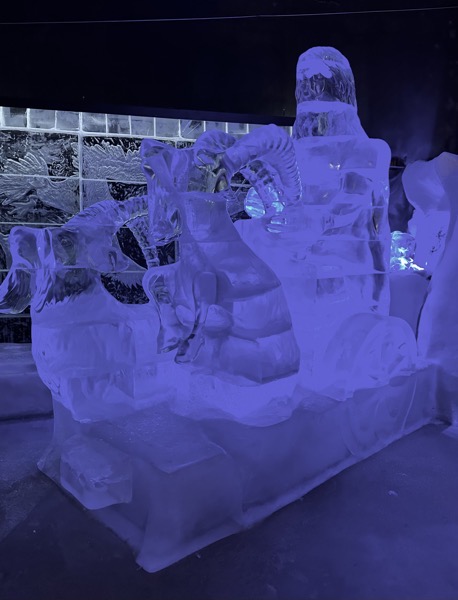
You walk after this into a giant freezer with all kinds of ice sculptures and carvings. 

There’s lots of cheesy lighting effects.

Things are frozen in ice. 

There’s a whole ice frieze. I don’t know if the word play works in Norwegian. 

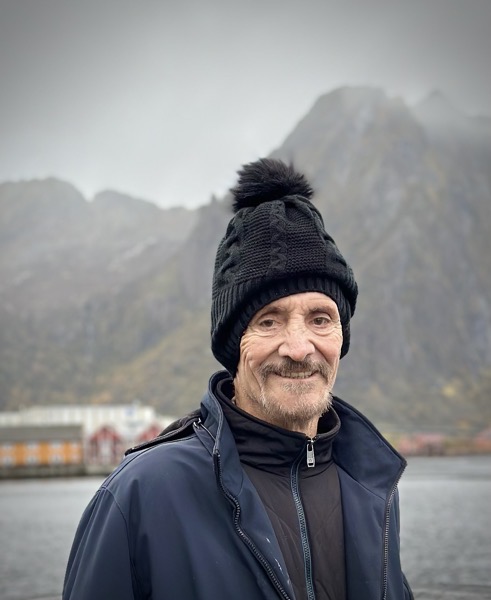
John HATED it. I think he was out in 30 seconds. I stayed a little longer to take these pictures, but I did not bother to stand in line to get a drink from a glass made of ice. We went outside. John posed with a happy Viking troll.

We looked a bit at the harbor area here.

John was ready to get back on the bus where it was warm.

It took us about 90 minutes to get back to the Caribbean Princess. We went back to the cabin and cranked up the heat, happy to have had a chance to visit these exquisitely beautiful islands. But if I have a chance to come back, I think I’ll do it in July!

Stuck

Some decades ago, in the twilight of the last century, John and I went camping in Yosemite. We were driving my car, a blue Mercury Sable station wagon, which had been nothing but a problem from the time we had bought it used, probably about a year earlier. We were heading down the Highway 120, the Tioga Pass Road, when about halfway from the summit we heard the sound of metal on metal when John put his foot on the brakes. On one of the steepest roads in the West, we had no brakes. 

John somehow managed to get us to the end of the road where it meets Highway 395, and he pulled into a service station in the nearby town of Lee Vining. It was a Friday afternoon. The mechanic took a look at it and shook his head. He listed off the different things that would no have to be replaced to be able to safely drive the car again. The total repair cost was daunting, but even worse was learning that the parts had to be delivered from San Bernardino. We would be stuck in Lee Vining for at least three days. 

I have thought about Lee Vining several times over the three days that we have been stuck in Tromso. There’s a bit more things to do here. And we do not have to deal with those nasty brine flies or the stench of the rotting algae. But it is still boring be stuck in some place where you would just as soon not be. 

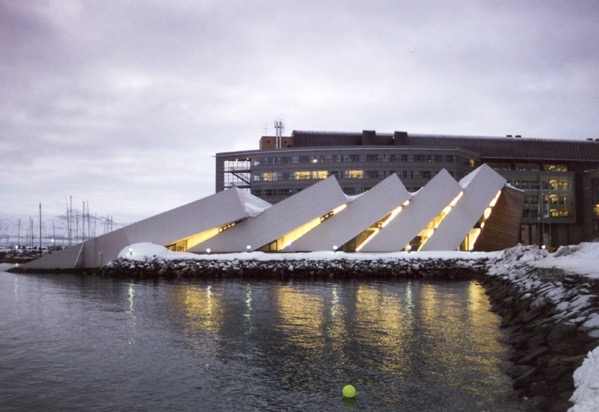
We’ve tried to make the best of it. Yesterday, we went into town in the late afternoon and did a little shopping for Christmas. And today we went back into town to visit Polaria, the Arctic research center that is also the world’s northernmost aquarium. The building is famous for its architecture, but it is currently undergoing a major expansion and the whole things is surrounded by chainlink fencing and all sorts of construction equipment. So I found this picture online to show you what it originally looked like. 

Polaria Tromsø.

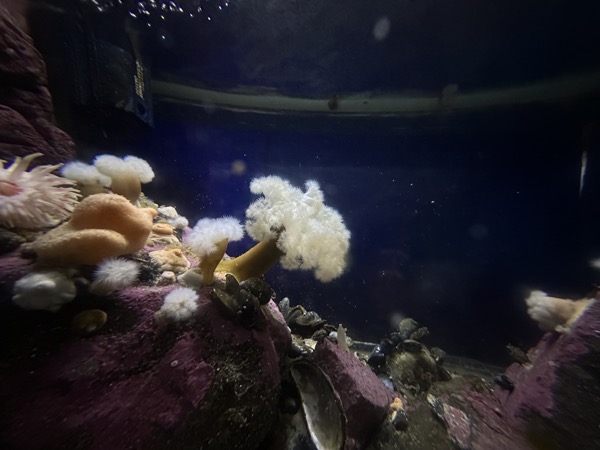
Pretty interesting and impressive, isn’t it? But the inside sadly does not quite measure up. It’s fairly cramped inside, particularly if you are trying to get through with a wheelchair. There are the usual displays of the anemones and their relatives. 

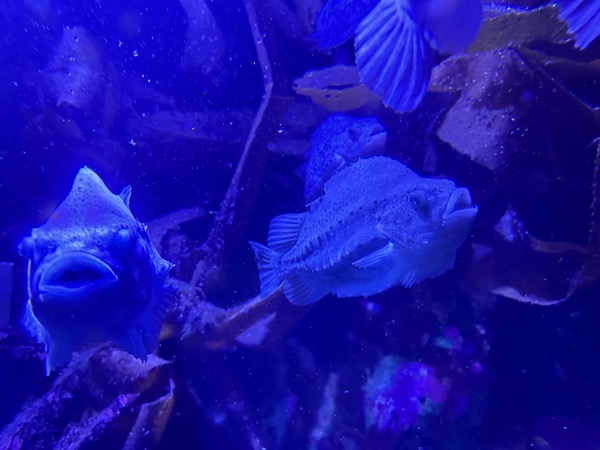
There was a tank devoted to the fish that live just outside in the harbor, also pretty predictable. 

I did like the shrimp tank because the glass in front of it made them look enormous. Sadly, that did not come through in the photo.

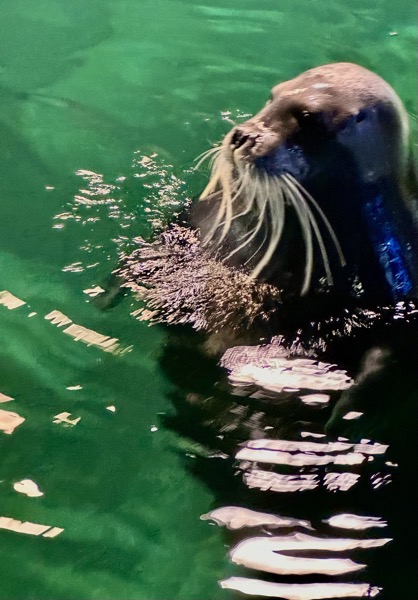
Also pretty typical, the sea mammals are the main attraction.

I did not have a bad time at Polaria, but somehow the weird building made me expect something other than just another imitation of the Monterey Bay Aquarium. 

We will finally leave tomorrow heading towards to Gravdal and the Lofoten archipelago. We’ll see what that holds. 

Stormy Weather

As we woke up this morning, the ship was coming down a channel between some coastal islands and the mainland. We were coming into Tromsø, the largest settlement in Norway north of the Arctic Circle. We could see small glaciers on the tops of the peaks of the islands. It looked chilly out there, and my phone told me that the local temperature was 1 degree Celsius. 

John and I went up to the buffet—or, as he and I less charitably call it, “the trough”—for breakfast. While we were there, the captain came over the intercom to announce that a serious storm was in the offing for the next couple days and because of this they were going to skip our next port of call, Alta. This was a hard blow for everyone, I think. It certainly was for me. Alta was the one time that we were supposed to stay overnight and many people had planned bigger excursions. I had arranged a car to rent in Alta and drive to Russenes, a small town on the fjord opening up to the Arctic Circle. I found a small cabin there on Booking. When I was planning our trip, this was going to be the highlight because it was such a wonderful spot to see the Northern Lights. 

After breakfast, John and I boarded a shuttle bus to central Tromsø. I was not expecting much. The city was not listed as a “must see” in any guidebook. But as we walked around, I was pleasantly surprised. There are a remarkable number of nineteenth century houses lining the Storgata, the Main Street. All of them have been converted into shops or offices. 

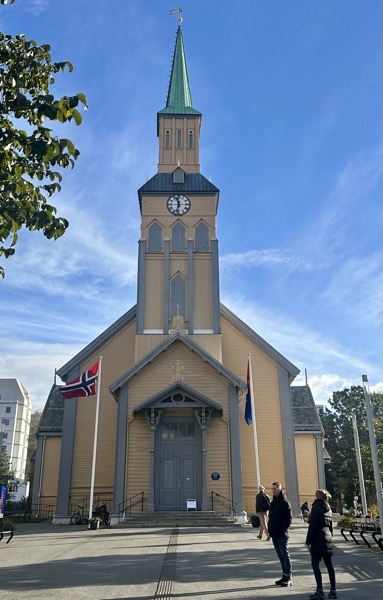
Right in the center of this stretch is the Lutheran cathedral. It is not a particularly large or impressive building. 

As we were there on a Sunday morning, the church was closed for services. In fact lots of things were closed here on Sunday. Only a few stores were open. But John and I checked out just about every one. One of the largest sold a combination of sporting goods and tourist trinkets. In the middle of the store was troll display. 

John had one of the clerks snap a picture of us crossing the bridge. 

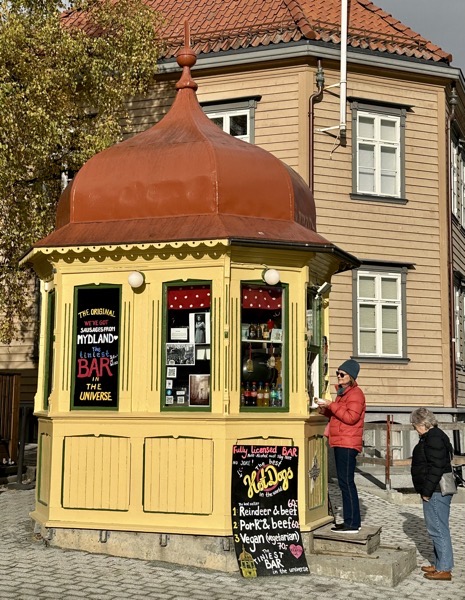
We continued walking down Storgata. We had another walking tour that pointed out some of the local monuments, old and new. One of these was this small onion-domed kiosk. Locals refer to it as “The Rocket.”

I was tempted to buy the reindeer hot dog, but the line was too long.

We went on to a very large old house at the end of the street that had been converted into a place called the Perspektivet Museum, the “Perspectives” Museum. From the description in our walking tour I was expecting it to be basically a a collection of historical photographs of the area. What we found instead on the first floor—the second and third were accessible only by staircase—was a fairly interesting history of manufactured homes in Scandinavia. 

By the time we left the museum, the sky was cloudy and I could feel the rain in the air. We probably should have headed back to the shuttle at this point, but John and I were having a good time so we stopped at a small cafe and had some lunch. John had some nice carrot soup. I had some vegan version of lasagna. Mistake! If the Italians knew what these Norwegians were doing to their cuisine, we might have another war in Europe. 

By the time we were done with lunch, it was raining fairly hard. I had neglected to bring the umbrella that we bought in England. I knew we were not too far from where the shuttle stopped, but I did not know the exact way. Once again, technology was not as helpful as I hoped. Google Maps had us walk a much more circuitous route—though not doubt it was more “pedestrian friendly”—and as a result both of us were soaking wet when we finally reached the bus. 

By the time we were in the cabin, John shivering and I could tell he was running temperature. He took off all his wet clothes and just went to bed. We had seen most of the films Princess has on its movie channel, so we picked one we had deliberately skipped, Ad Astra. I have to say, if you are having difficulty sleeping, this film is pure cinematic propofol. 

We now have two more days in Tromsø. I’m not sure what we will do here, but we’ll figure something out. 

Trondheim

We had rough seas as we headed north along the Norwegian coast. Throughout the night the ship seemed to clank and groan as if it were some doomed spectral vessel. I found it hard to sleep. I had finally fallen asleep when the captain came on the intercom sometime after midnight to call all hands to help prepare for an emergency helicopter landing. Apparently there was a guest in critical condition who needed to be taken to a hospital immediately. I know this sort of thing happens on cruise ships all the time. A crew member told John on a previous cruise that typically several passengers die during the voyage. But combined with the eerie noises and the rocky seas it was hard not to have a sense of apprehension. 

But “weeping may tarry for the night, but joy comes in the morning.” When the sun rose this morning the seas were smooth and the sun was peeking out from behind the clouds. Looking out our window, I could tell that we were starting to help down a long fjord. From the lecture the previous day, I knew that Trondheim is located on a peninsula at the end of the fjord, some distance from the open sea. 

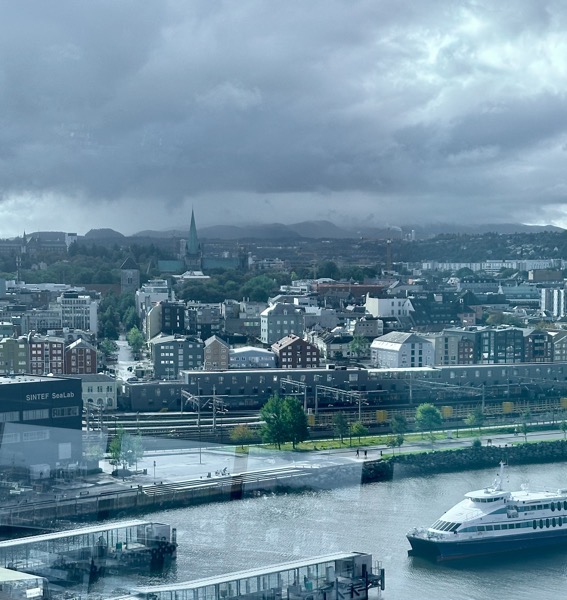
John and I went to his favorite perch on the top floor of the ship. As we pulled in, we could see the town.

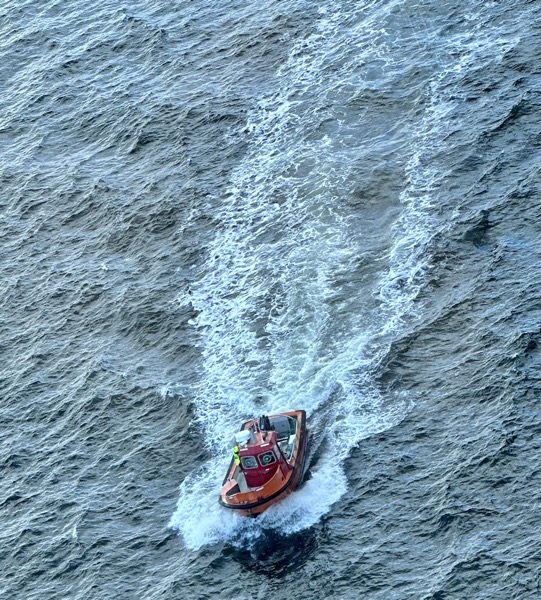
The small boat pulled up along side us From other sailings, I knew that this was the local pilot who would guide us as we docked.

John decided we could wait a bit and not join all the people rushing to get off the moment the gangway was opened.

But it was finally time for us to get off. There was a really steep ramp that lead over the railroad that that lie in between the town and the port. Right at the top of the ramp was a store selling tourist tchotchkes and supposedly discounted sporting goods. John announced that he needed to buy a cap and some good gloves. And so he did. 

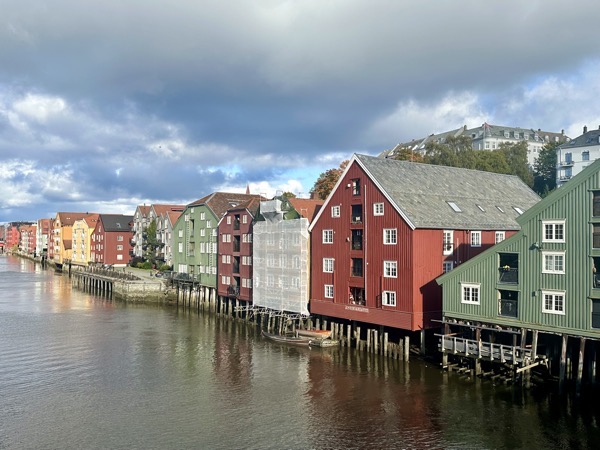
The river Nidelva runs through the center of Trondheim. There are colorful wooded warehouses all along the banks. 

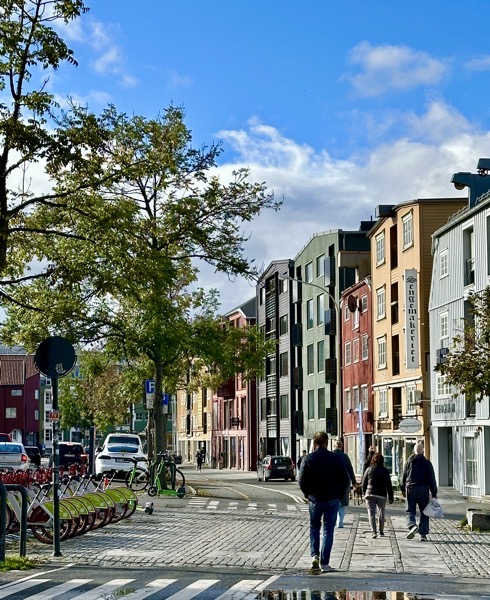
John and I went for a walk along the street behind these old buildings. It was surprisingly not touristy. There were lots of second-hand shops and hardware stores.

Still, it was quite an attractive area. 

We had a walking tour of Trondheim that I had found online and for most of the day we just followed it. The first stop on the tour was the Stiftsgården.

This is a 140 room mansion built by a the wealthy widow in the late eighteenth century. She seldom used it, however, preferring to travel abroad or live in Copenhagen. Norway was a part of Denmark at that time. With the restoration of a Norwegian monarchy, Stiftsgården became a royal palace. It is not open to the public, though the gardens in the rear of the building are. 

We continued on into the main square. This is dominated by a statue of King Olav Tryggvason, considered the founder of Trondheim. 

King Olav was instrumental in the conversion of the Norse to Christianity though his methods of doing this were characteristically brutal. In the statue, he holds a sword and a chalice and his food rests on the head of the god Thor. 

We continued down couple block until we arrived at the cathedral. 

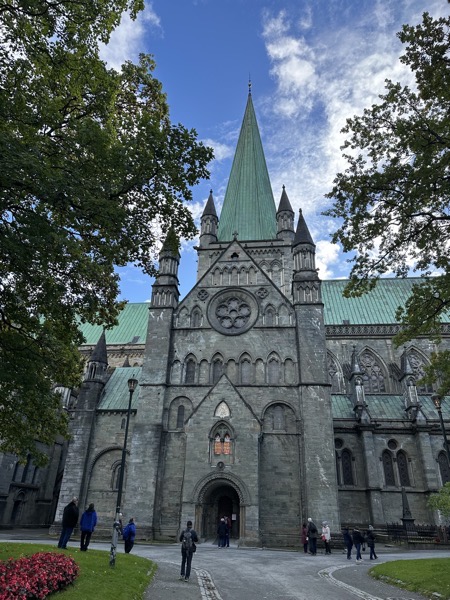
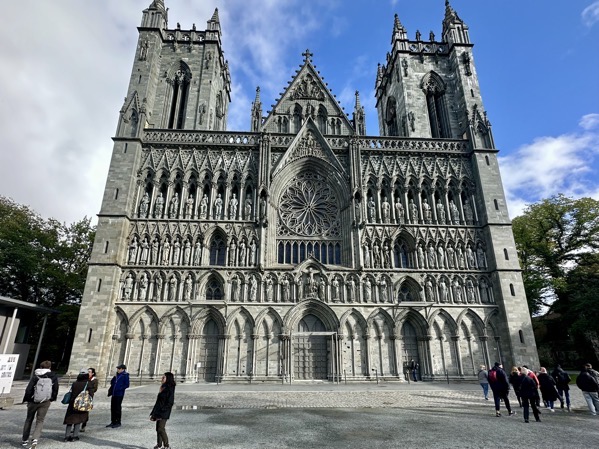
The Nidaros Cathedral is one of the oldest and largest gothic structures in Scandinavia. It dates to a time before the Reformation when the Archdiocese of Trondheim was one of the largest and wealthiest in Scandinavia. During the Middle Ages it was a great pilgrimage site connected with the Cult of Saint Olaf. It is also traditional site of the coronation of the Kings of Norway. 

Sadly, we discovered that it had closed for the day just before we arrive along with the Archbishop’s Palace, a major museum housing the royal regalia. So we had to content ourselves with examining the exterior.

The statuary on the West Portal is not medieval. The few that remained from that period are in a museum. These are nineteenth and twentieth century carvings. We noticed Adam and Ever right away. 

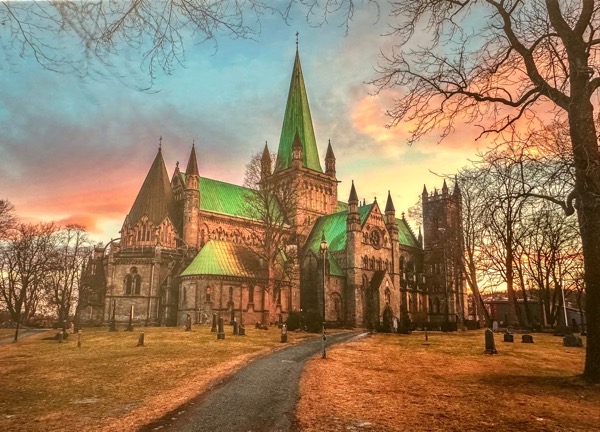
The cathedral gift shop was open, and John found a jigsaw puzzle of the cathedral at sunset. 

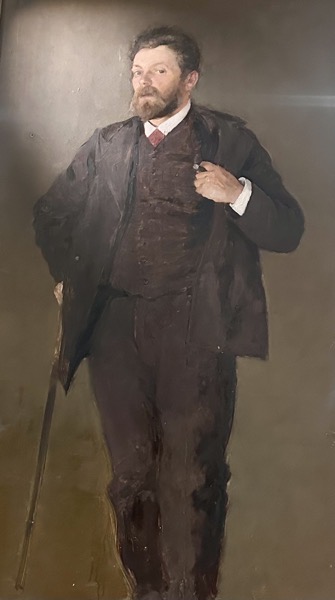
The Trondheim Art Museum was located nearby. We decided to go in as our walking tour said it had an important collection of Norwegian art. The collection inside was rather curious as it had been rearranged by various themes. There was a room devoted to faces. There were a couple dozen small portraits on one wall. There were a few larger ones such as this prosperous bourgeois..

There were a few kind of fantasy scenes

or historical ones.

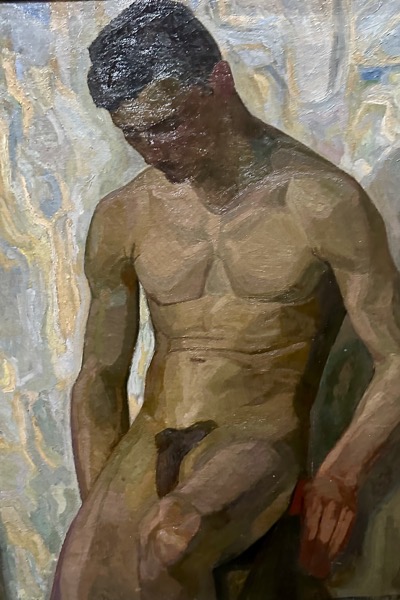
Another room was devoted to “bodies.” I was surprised by this male nude.. It seemed rather daring for a cultural backwater in the 1870s. 

Signage in the museum was in both Norwegian and English, mostly describing the theme of each room. Sadly, there was not much information about specific pieces or artists.

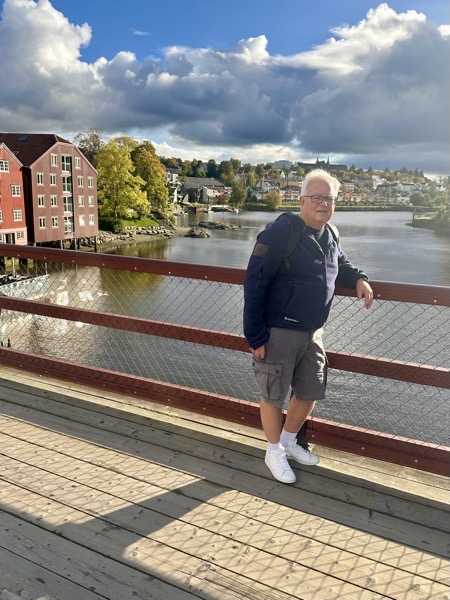
We continued on towards Bakklandet. There are two bridges linking this district with central Trondheim. The more interesting is Gamle Bybro, the “old town bridge,” which is open only to pedestrians and cyclists. 

Bakklandet is famous for its wooden buildings, particularly those on the river. 

While Bakklandet today is the hippest and most expensive section of Trondheim, it was not always that way. Developed as the city’s first suburb, it was a working class district throughout the nineteenth century. By the 1960s, however, most of the olde buildings were abandoned. The city planned to tear them down and create a roadway linking central Trondheim with its newer residential areas. Residents were outraged. They started squatting in the old buildings and painting them bright colors. The city relented when the tourists started showing up. 

We have a day at sea tomorrow. After that, we will come to Tromsø. 

In Transitu

It was a drizzly, gray Monday morning when we left London. We took a cab to Waterloo Station. Southwestern Railways assigned a helpful young man to assist us with getting our luggage on the train and attaching a ramp for John’s wheelchair. As I have said before, the British have come a long way in working with people with disabilities. 

We started chatting with a couple of Americans on the train and it turned out that they were both headed towards Southampton, both about to embark on the same cruise we were. Sharna was from a small town in Texas, about an hour south of Fort Worth. Amy was from Milton-Freewater in eastern Oregon. Before moving out there for a job, she had lived in Portland, and it turns out that that she sometimes has performed with Pink Martini. They explained that they are half-sisters who never met until they were adults. Chatting with these interesting people made the trip go by faster. 

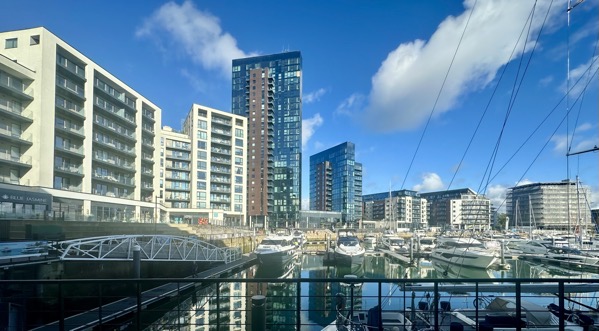
We stayed at the Harbour Hotel in Southampton. Our friend Vicki, who lives in the nearby village of Romsey, had recommended it. After our small and somewhat spartan accommodations in Russell Square, it seemed luxurious. When we woke up Tuesday morning, we looked out onto the marina. 

Both the Mayflower and the Titanic departed from Southampton. One of those, as I recall, had a better voyage than the other. 

Our ship is the Caribbean Princess and it was docked on the Ocean Cruise Terminal, a short cab ride from the hotel. Again, the people there were marvelous to John and a woman in a bright orange vest simply pushed us to the front of the line. But we had to wait around for about an hour before they would let us board. 

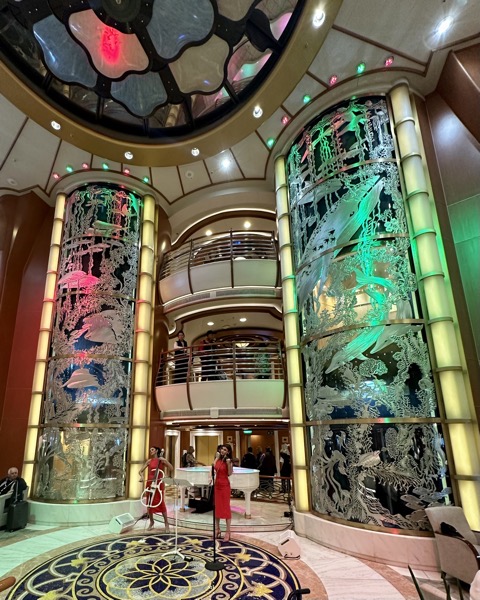
I thought that our waiting would be over when we arrived on board, But everyone was ushered into the central atrium of the ship and told that our rooms would be ready “soon.” A couple young women, obviously from somewhere in Eastern Europe, attempted to entertain. 

Twelve o’clock to one o’clock, one o’clock to two. The rooms would still be ready “soon.”  By three o’clock the mood in the room was almost mutinous. The Filipino servers would smile and say “How are you?”, departing before you could give them an answer. Finally around four o’clock they left us go to our room. 

When we booked this cruise, I told John that we had to be a little more frugal. We would fly premium economy, not business. And we would book a room with a window, not a balcony. I was definitely not expecting to like this room as much as I had the one on our transatlantic adventure last spring, but even so I was a little disappointed. While clean, the furnishings look to be about 20 years old. Cruise ships often claim to be floating five star hotels. In this room I feel like I’m in a floating Motel Six, well, maybe a Holiday Inn. 

Wednesday was the first of a couple days at sea. We started to learn our way around the ship. We went to a helpful overview of Trondheim from a woman from the cruise office.

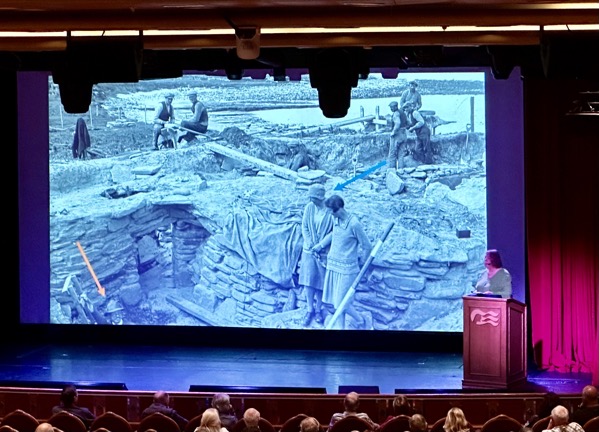
And shortly after that, there was a fairly lame presentation on the Vikings from some Scottish woman. She is apparently some kind of academic, but I have the feeling she was the equivalent of a community college professor. 

We had dinner with Sharna and Amy. It was supposed to be a formal dress night, though neither John nor I had brought along anything even remotely formal. It was typical cruise ship food: it sounded good, looked good, and tasted, well, sort of okay. 

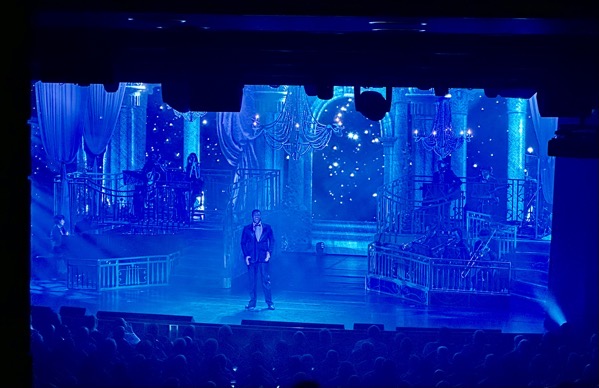
In the evening, we went off to the show. A couple of these on previous cruises had been pretty good. The Choir of Man, which we saw on our last cruise, is now a successful West End show. This one, however, seemed seemed like the initial auditions for America’s Got Talent.

We left early and headed to bed. 

Sunday at the Theatre with John

It was another difficult morning for John, and we simply spent most of it looking out the window at the drizzle while we waited until it was safe for him to get up and about. I confess to being a little disappointed as I wanted to go to the Solemn Latin Mass at the Brompton Road Oratory. But the most important thing to me is to be with him and make sure that he is doing as well as he can. 

By early afternoon, John was feeling strong enough for us to go out. I had promised John yesterday a trip to the National Gallery, and that was the first stop of the afternoon. 

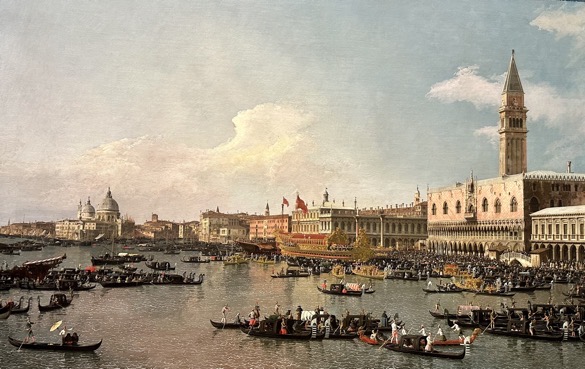
I have been to this museum at least a half dozen times, and walking through the wonderful collection was like seeing old friends. There is one gallery devoted only to pictures of Venice, and Canaletto’s Basin of San Marco on Ascension Day is a favorite. On this day each year the Doge would toss a gold ring from his enormous barge into the sea. It was a symbol of the “marriage” of this seafaring city state with the ocean. 

I have always been enchanted with Turner’s Rain, Steam, and Speed – The Great Western Railway since high school when it was the cover of my Norton Anthology of English Poetry. I have to admit, though, my deep disappointment when I took the actual railroad some years ago. It was scarcely more romantic than Metrolink. 

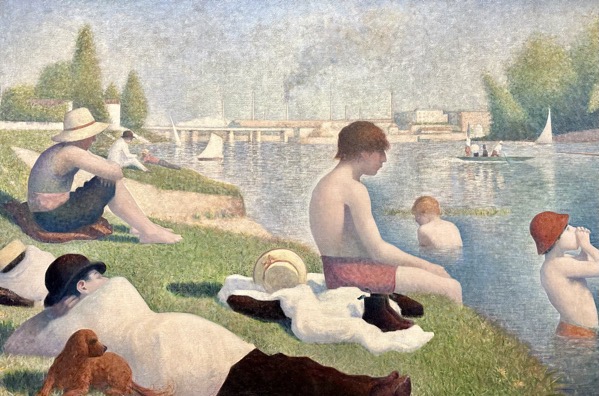
John was a big fan of Georges Seurat even before Sondheim wrote Sunday in the Park with George. While the famous painting that is the subject of that musical hangs in the Art Institute of Chicago, the National Gallery has the Bathers at Asnières. 

This summer, hearing all about how dangerous it still is to swim in the Seine, I wanted to yell at them, “Get out! Get out!”

Not that long ago all London theaters were dark on Sundays. I suppose it was the last vestiges of the Victorian Sabbath. So John was quite surprised when I showed him an extensive list of shows that we could go to today. Again, he rather surprised me. He picked Back to the Future: The Musical. It is playing at the Adelphi Theatre on The Strand, so it was easy to walk from the National Gallery to the play.

A little to my surprise, I really liked the show. It’s just a lot of fun. The show generally follows the plot of the 1985 movie, but a few plot points have been changed to make it work better on the stage. Some of the dialogue is almost the same, though they have added a lot of jokes about the eighties. The songs are not all that memorable, though I did like Doc’s dream sequence about “Living in the Twenty-First Century.” But the writers and composers know better than to tinker with the important stuff like the DeLorean. 

Back to Future.

There are all kind of special lighting and sound effects that extend from beyond the proscenium into the auditorium including having the car fly over the audience at the end. 

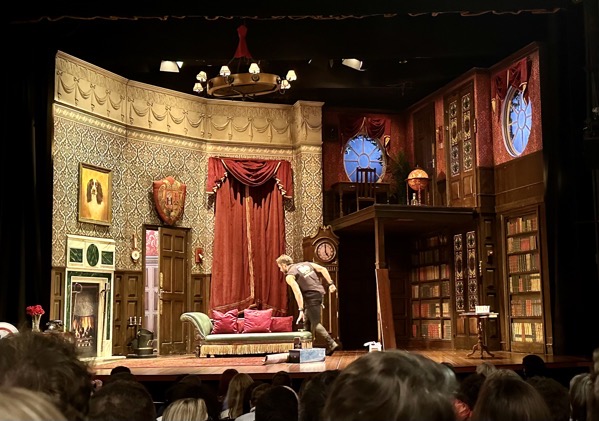
But the night was still young, as they say, and John was up for final piece of theater before we leave London tomorrow. We picked The Play that Goes Wrong. I saw this play at the Cabaret in Ashland. It was one of the best performances I had ever seen there, and Sandra King and I laughed our heads off. I cannot quite remember why John could not come that day, and he was always curious to see it after I told him what a good time I’d had. The piece had started here in London at the Duchess Theatre ten years ago, and I figured we might as well see it right where it started. 

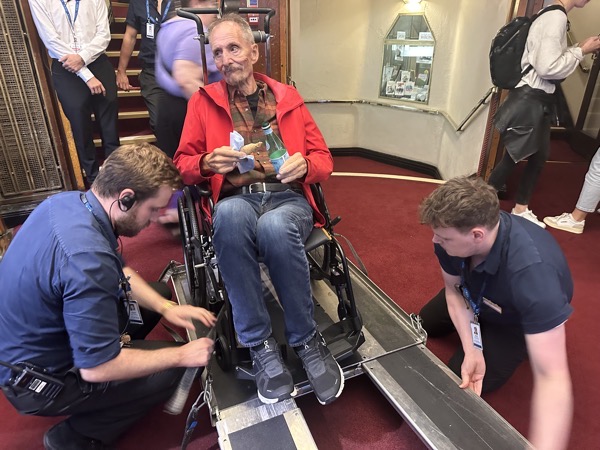
So we strolled down The Strand until we reached Catherine Street. The Duchess Theatre is a modest place, just steps from the very grand Theatre Royal Drury Lane. We asked about tickets at the box office as I had not bothered to buy any online. The very helpful people there offer John a wheelchair spot and said that I would only be charged for my companion seat. I was not about to turn down that offer. They did tell us that while the stalls were not accessible by life—they are on the basement level—they did have a machine.that would safely get him to his seat. 

This thing was amazing. It had belts and rollers underneath it like a tank, and it slowly and quite smoothly took him down the stairs. 

I am surprised yet happy to report, Ashlanders, that I think our local production was better. The cast was good, but you could tell that they had been doing it for a long time and it was just missing the manic edge I loved at the Cabaret. The set here in London was great, but in a way it was almost too elegant. The play is supposed to be the work of. fourth-rate community theater, after all. 

So tomorrow morning we pack up and leave for Southampton where we will start our Norway cruise. Despite a few rough patches, we had a great time in London as we usually do. And despite all the time we have been here there are still many things we still need to see and do. “When a man is tired of London, he is tired of life,” Doctor Johnson famously said. Well, I am not tired of London, and I give thanks to God that John is not tired of life. 

South Bank Explorations

I am not sure why, when I am planning a trip to London, I never think about staying south of the Thames. And yet, every time I find myself in Southwark I think, ‘This is an interesting area. I should spend more time here.’ Today was one of those days. 

But it took us a while to get to the South Bank today. In fact, it took us quite a long time to even get out of our room. I suppose I could be slightly dishonest and say, “Oh, we just had a quiet morning.” But the reality was that John had another bout of extremely low blood pressure. And he had another fall, though this time he did not cut himself. He went back to bed and slept for several hours.

By early afternoon, after a lot of coffee and a couple doses of Midodrine, he was feeling better and ready to go. I had already made plans for a dinner and a play later in the evening, but I thought we could go a museum for a bit. I was pushing for some place we had never been before, like the Imperial War Museum, but he insisted he wanted to go back to the British Museum. Since it was close, I figured we would walk. 

Leaving the Cleveland Residences, you should turn right to head to Russell Square and the Museum, but John wanted to go left. So we started walking a little aimlessly. It was sort of interesting, but after a while I decided it was time to make tracks to the museum. So I simply set the directions in Apple Maps, stuck the phone in my pocket, and trusted that my watch would give me the appropriate step by step directions complete with those haptics. 

“Put not your trust in princes,” warns the Psalter, and I would add, “And don’t trust in technology, either.” The damn thing would work for a few minutes and then apparently just decide to quit on me. This happened a couple of times, and once I realized what was going on we were about a mile from the Museum. I changed tactics. I used Google Maps this time and stuck the phone in John’s hand so I could see every turn.

The walk was not a total waste of time. For most of it, we were wandering through the area that is home to the University of London. It is a part of the city I have never explored and there was that pleasant sense of lively street life that you also find in Berkeley. The University is justly famous for its academic programs, but not for its architecture. There are a couple of interesting buildings, but most of the campus is composed of drab brick and concrete structures, the worst of institutional architecture from the sixties and seventies. 

We finally made it to the museum with about a hour to spend there before it closed, I started wandering through some of the galleries we had missed on our first day. John was clearly annoyed. 

“I wanted to go to the British Museum.”

“We are at the British Museum.”

“No, the one on Leicester Square.”

“There’s no museum on Leicester Square, just an ugly Swiss glockenspiel.”

I finally figured out that he wanted to go to the National Gallery, just off Trafalgar Square. There was not time for that today, so I promised him that we would do it tomorrow. 

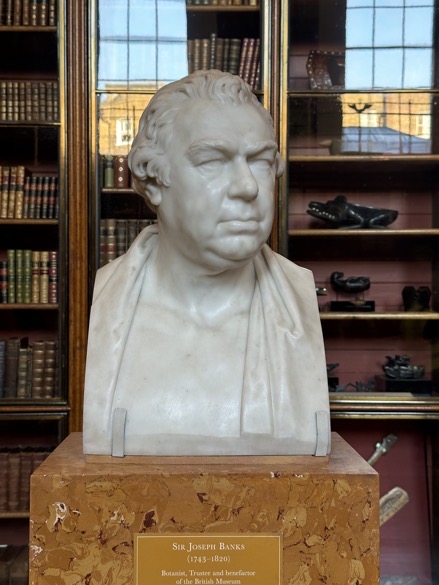
We spent most of our time in the weirdly wonderful Enlightenment Gallery. This is the largest and easily the loveliest room in the Museum. It is designed to evoke the collections of the wealthy eighteenth century explorers and scientists like Hans Sloane or Joseph Banks, whose bust, dressed as if he were a friend of Demosthenes, is shown below. 

While everything is carefully labeled, there is a sense that these men like crows simply collected whatever appealed to them. So you can find a huge Roman foot

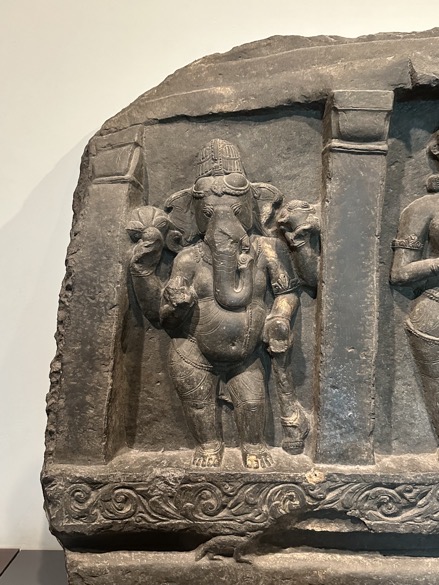
or a bas relief of Ganesha. 

The staff at the British Museum stands around bored for most of the day. But about 15 minutes before the official closing, they come to life, herding the tourists out as if they we were sheep and they Shetland sheepdogs. It is as marvelously efficient as it is annoying. So about ten minutes before five, John and I were out of the street, standing at the corner of Great Russell and Montague waiting for our Bolt to arrive. There was a large poster on the other side of the street advertising some listed Georgian house that was being converted into luxury offices. He became part of the picture. 

The driver dropped us off at a street simply called The Cut. It is just a few blocks from Waterloo Station. The area was a fruit and vegetable market for most of the nineteenth and early twentieth centuries. The costermongers were long gone in the post-war period, and a combination of German bombs and English city planners left the area fairly desolate for a couple decades. But now it is a lively district of theaters, galleries, and restaurants. I figured we would eat here before seeing a play down the street. I picked a Tas, a Turkish restaurant specializing in Anatolian regional cuisine, for our dinner. 

Tas restaurant the cut.

The food was not has amazing as I remembered eating in Turkey, but it was still quite good. We had a selection of mezze with some chewy bread. It is not a spot for people who have gluten issues. The mains—I had the mixed grill and John had the lamb meatballs—were good, but not all that memorable.

Tas was one of many restaurants on The Cut, and all those restaurants are here because of the theaters. The most important of these theaters is The Old Vic. Built in 1818 as the Royal Coburg Theatre, it was rechristened The Royal Victoria Theatre when the young queen acceded to the throne in 1833. After a few decades, it was just “The Old Vic.” In 1955, when Laurence Olivier was appointed as the head of the newly created National Theatre, The Old Vic was home for its productions until the until the new theatre, possibly the worst example of Brutalist architecture outside of Newcastle and Sunderland, was constructed in 1977. The National Theater moved out of the Old Vic, but converted a butcher shop down the street into a center for experimental theater. People started calling it “The Young Vic.” 

The Cut exterior e1565206404455.

We had come to The Cut tonight to see a production of A Face in the Crowd at the Young Vic. This is a new musical based on the 1957 film with music composed by Elvis Costello. John used to play Costello endlessly, particularly the CD he did with Bert Bacharach, and that’s one of the reasons I picked the show. 

The show sticks fairly closely to the movie, and few changes made to the story largely do not improve it. Though A Face in the Crowd is now considered an important political film, its reception in 1957 was fairly mixed, largely, I think, because both writer Budd Schulberg and director Elia Kazan had been “friendly witnesses” before HUAC and both had named names. 

For those of you who do not obsessively watch TCM, here is the plot of the movie. Larry “Lonesome” Rhoades, a drifter brilliantly played by a young Andy Griffith, is befriended by Marcia, a radio producer portrayed by Patricia Neal. She discovers that he is a natural performer and he rapidly becomes a local celebrity famous for saying whatever he thinks. Lonesome moves to New York where he soon has a hit national TV show. He is such a natural for television that he is enlisted to help support the presidential candidate of California senator Worthington Fuller. As his fame and influence grows, Lonesome becomes an egomaniacal monster. Marcia comes to hate him and she exposes his underlying contempt for his audience by putting turning his mike on when he is insulting Fuller and his fans. 

The show is written by Sarah Ruhl, and in her efforts to somehow make the play about Donald Trump she manages to mangle the real issues and concerns of the 1950s, something that the movie definitely understood. The references to international issues confuse incidents that happened at various times between 1947 and 1961. Art direction and set decoration feature some real howlers from flags with 50 stars to postcards showing palm trees in New Jersey. The landscapes of Texas and southern Utah are similarly confused. Fortunately, the leads are pretty solid. Ramin Karimloo, the very talented Iranian-Canadian singer and actor, is particularly exceptional. And while the score is not the best thing Elvis Costello has written, I think many of the songs are quite good. 

Ruhl’s problem with creating the Lonesome Rhoades-Donald Trump equivalence is that Trump is an actual candidate in an election while Lonesome was simply a celebrity who wanted to influence an election. The people who most fit that description this year, however, are all Democrats—Robert DiNero or Whoopi Goldberg. Rulh presumably is not keen on insulting them. It will be interesting if the A Face in the Crowd has legs and moves on from the Young Vic to other venues and if it still seems to grab attention after this November. 

Sequels

We both slept in pretty late this morning. I had hoped that John would be right as rain after about 15 hours of sleep, but he was once again experiencing some low blood pressures. We have a little kitchenette in our studio apartment here, and he walked over to the sink or the fridge this morning, I heard a loud crash and saw that he had fallen down. He had a couple of cuts, one on his nose and another above his eye, but he was otherwise okay. 

After a couple doses of blood pressure medication, John was feeling much better and was much steadier on his feet. I asked him what he wanted to see for theater today—the great pleasure of coming to this city is the abundance of superb theater—and he really surprised me by saying that he wanted to see the Harry Potter play. Neither of us were big fans of the series, though we had both endured countless book reports on every volume that J. K. Rowling had written, we had not read most of the books. But if that was what John wanted, well, that was what I wanted us to do. I looked online and found some slightly discounted tickets. Unlike New York, where you must suffer in a long line to get cheap same-day tickets, in London they are available online. 

We took an Uber down to the Palace Theater. It had been done over for the run of this popular show. 

It is a long play, and you have to buy tickets for both Part I at 2:00 and for Part II at 7:00. I was a little nervous bringing John in the wheelchair because London theaters used to be famously inaccessible for the handicapped. But the attitude has clearly changed and the staff could not have been more helpful getting him into the theater, helping us find our seats, and making sure we knew where accessible restroom was. 

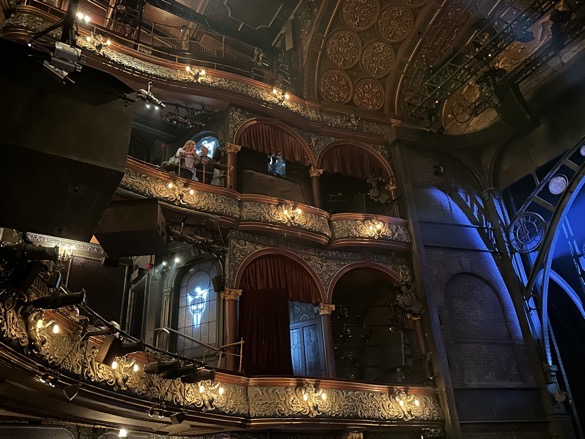
The Palace is one of the great old English theaters. We had pretty good seats, but they were a little to the side and it was hard to get a picture of the full proscenium and all the details. 

I confess that I had trouble following the play as I had only really read the first book when it came out in 1997. I had jury duty, and I was stuck at the downtown courthouse in Los Angeles waiting to see if I would be called for a case. I spent five wretched days there and was never even called in for voir dire. Maybe that colored my recollection of the book, but I did not like it all that much. I knew who Harry and Hermione and Ron were. I knew Voldemort was bad, really bad. I was surprised, though, when the curtain rose to discover that In this episode, Harry Potter and the Cursed Child, Harry is now much older and it is his son who is the student at Hogwarts. Naturally, father and son have a troubled relationship. There would not be much of a story without that obvious conflict. 

Even if the story was not always all that clear to me, I did enjoy the special effects. There is a lot of elaborate choreography that borders on dancing and all of that was quite well done. The sets were quite simple, but effective. They used some movable staircases quite effectively. I snapped a picture at the interval when the ushers were distracted. 

In between the first and second parts, John and I walked over to Chinatown for dinner.

In addition to all the usual Chinese fare there, mostly Cantonese, there is an abundance of other Asian eateries. John suggested one that we had been to a couple years ago, Viet Fare. we had been impressed with the food there, and two years later it was still really good. I had some Hue-style pho, and John had these amazing stir-fried pork ribs. I reflected that our meal, like the play we were watching, was a kind of sequel. And other than Beetlejuice, those are not necessarily bad things. 

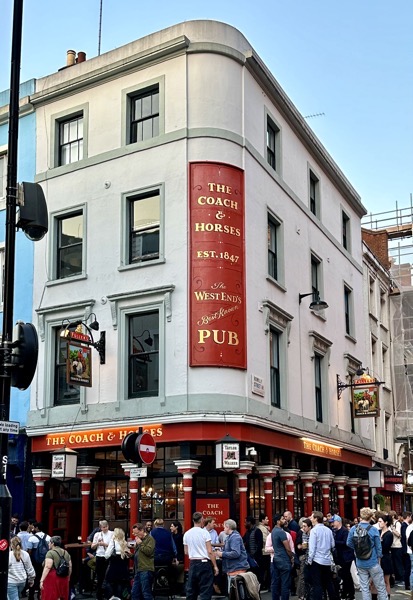
As we walked back, we looked at all the bars on Old Compton and Greek streets. These are no longer the exclusively gay pubs that they used to be. At some, young straight women seemed to be the majority. 

Part II brought the play to its predictable end. I never for a moment thought that time travel would really allow Voldemort to win and indeed he was defeated with the aid of a lot of cool special effects. When it was over, I was mostly glad I had seen it.