Flying Down to Rio

We had one last morning in Ouro Preto. After breakfast, we packed up, took our bags to the desk, and took the shuttle into town. We had not particular itinerary:  we just wanted to walk about and see what we might have missed in the earlier days. And, sure enough, we found one right away. We found what seems to be the only antique story in Ouro Preto.

https://farm6.staticflickr.com/5735/23734527150_b287b434bd_z.jpg

In an American town with historic attractions and many tourists, there would be many, many antique stores ranging from complete junk to authentic works of art. Ouro Preto has only this one shop, and it contains everything from old rusty hardware to actual pieces of colonial art. John was taken with this little statue. I am usually pretty good with religious iconography, but  I have no idea who this odd figure is supposed to be.

https://farm6.staticflickr.com/5714/23734532270_427ab60c0d_z.jpg

John was set to buy it until he discovered how much they were charging for it. We continued down Rua São Jose and then up towards the Rohsario church. Along the way we came across this remarkably little building.

https://farm6.staticflickr.com/5673/23921991822_71a4b632f7_z.jpg

As we continued down the road, we had a good view of Ouro Preto’s most famous rock formation. Some people called it the “witch’s nose” or “the old woman.”

https://farm6.staticflickr.com/5707/24004118586_56161f0d17_z.jpg

Walking back to town, we found a passage up towards the Carmelite church.

https://farm6.staticflickr.com/5640/23402013444_79d44d32f4_z.jpg

The church had been closed when John, our tour guide, had been taking us around the city. But today it was open and as it is the most famous church in the city. As usual, inside the building we were not supposed to take pictures. But managed to snap this one of the ceiling of the nave with the iPhone’s front-facing camera while pretending to be just checking my texts.

https://farm6.staticflickr.com/5736/23662425069_2b3f5b0d7b_z.jpg

We walked past the market near São Francisco

https://farm2.staticflickr.com/1460/23922087252_755c9acdab_z.jpg

to a restaurant we had seen a couple days before. It was a tiny cottage that had once been an artist’s studio, and the dining room on the second floor was had windows only all sides with beautiful views of the city and the surrounding countryside.

At two o’clock our driver met us and drove us two hours to Belo Horizonte. Like all Americans, I had heard about Rio de Janeiro and São Paolo, but I had never heard of Brazil’s third largest city. We arrived with several hours to spare, but the airport in this city was somewhat more pleasant that GRU was.

The flight to Rio was hardly as romantic as it was in those films from the forties and fifties. Azul airlines is not a bad carrier, but it definitely like Jet Blue or Southwest and not those great PanAmerican flights of the past. We were met at the airport by an older guy named Carlos who spoke good English. Not only could he speak, but he never stopped talking as he drove us to our hotel on Ipanema beach.

We have a totally great room here. It is not as wonderful as the one Fred Astaire had on Copacabana Beach — yes I know that was a set on the RKO lot in Encino — but we do have a great view.

https://farm6.staticflickr.com/5709/23454658193_05214601f3_z.jpg

Tomorrow we have a city tour set up.

Mariana

We had an unpleasant surprise this morning. After breakfast, as we started to pack up our things for the day, we discovered that we no longer had our camera. Apparently last night when we returned from town we left it behind in a cab. The staff at the hotel were sympathetic, but we were realistic enough to know that there was not much chance of us seeing it again. 

We had not scheduled any activity for today before we left Los Angeles. But reading some of the guidebooks we learned that there was another colonial town named Mariana nearby and that there was a train between the two towns that was a tourist attraction in itself. And really, the station should be as well. 

https://farm2.staticflickr.com/1607/23385078154_afc83295c7_z.jpg

We arrived in plenty of time to get a seat. We had been told that on the way to Mariana everybody wanted to sit on the right side of the train and on the way back on the left side. So, we wanted to be there early enough to get good seats. 

It’s an old diesel train with wooden seats that flip back and forth. 

https://farm2.staticflickr.com/1683/23386532493_dbd2a995d9_z.jpg

The train pulled out of the station and we went mostly through some pretty unimpressive countryside. We definitely figured out that Ouro Preto is far more affluent that some of the surrounding areas. Yet there would be occasional moments with stunning vistas

https://farm6.staticflickr.com/5831/23988202446_d93c1c63df_z.jpg

and, what everybody wanted to see the most, an occasional waterfall.

https://farm6.staticflickr.com/5709/23646399239_ba7329acc3_z.jpg

Our first sight of the Mariana made us wonder if we had made it on the right train after all. It was hardly as cute as Ouro Preto at all; in fact, it looked more like some small city in the Mexican interior. But once we walked a few blocks further we found a charming historical center. There are several squares. One is dominated by the twin Franciscan and Carmelite churches.

https://farm6.staticflickr.com/5816/23988419596_80ccbf9f10_z.jpg

A historical note here. These were not monasteries as they doubtless would have been anywhere in New Spain. I am not sure what the Portuguese did with the younger sons and the less-than-marriage daughters, but apparently they did not force them to enter convents. Instead these churches were built by laymen who were members of “third orders.” The grandeur of some of the churches represents a sort of rivalry among the groups. Today, I suppose, that same enthusiasm would be channeled into building sports facilities for your college teams. 

We went into the church on the right, the Carmelite church. This building was badly damaged by a fire in the early 1990’s. There were photographs showing how serious the damage was.

https://farm6.staticflickr.com/5654/23386462364_da9a8f945d_z.jpg

But today it has been completely restored inside and out.

https://farm2.staticflickr.com/1493/23718912290_f1322633ac_z.jpg

Across the square was the old government buildings. For a time, Marianas was the administrative center of Minas Gerais.

https://farm6.staticflickr.com/5699/23932239541_141e8a861f_z.jpg

It had started to rain while we were there, so no matter how dull the exhibits were, John was loathe to leave.

https://farm6.staticflickr.com/5821/23388022243_1014e516b3_z.jpg

But I finally convinced him to go out into the rain. Unlike me, he had come prepared.

https://farm6.staticflickr.com/5769/23386628104_917878986b_z.jpg

The reason we were hurrying was that I wanted to go to the cathedral. Not because it is all that impressive a colonial building. It really is not. In fact, to me it vaguely looked like the inspiration for many Southern Pacific Railway stations. 

https://farm2.staticflickr.com/1505/23931802201_d1bbde9f42_z.jpg

No, the attraction here is the organ. This is an old instruments, but it is not just any old instrument. This is perhaps the only Arp Schitger organ in the Americas.

https://farm6.staticflickr.com/5642/23932313311_a6a3f544dc_z.jpg

Schnitger was one of the two greatest organ builders of the German Baroque, and his work defines what we call the North German School. Bach played mostly on Schnitger organs, and the elaborate inner voices in his fugues assume the clear, bright tones of the Schnitger instruments. 

Nobody is completely sure how this organ happens to be here in a small town in the interior of Brazil, but it has been here for centuries. The best guess is that Schnitger may have built it for a church in Portugal, but for some reason they decided to not keep it. We think the King of Portugal may have given it as a present to the Bishop of Manaus. Like Ouro Preto, this was a gold town and the Portuguese loved gold. 

https://farm6.staticflickr.com/5801/23386640554_db7aabc375_z.jpg

We heard a fairly eclectic concert by Elisa Freixo, one of the cathedral’s resident organists. Afterwards, she invited the audience up to to the loft so she could explain the nature of organs and organ building. It was pretty much all in Portuguese, though she did ask for a couple questions from English speakers. 

After the concert, we walked to the main square. It is a lovely tree-shaped spot. There were lots of Christmas decorations here, but somehow I did not seem to photograph them. 

https://farm6.staticflickr.com/5623/23932326251_a3379f8546_z.jpg

We had lunch at a what Brazilians call a “self-service” restaurant. This is a buffet where your plate is weighed and you are charged based on how much food you have on your plate. It was reasonably good and quite cheap. I think the bill for the two of us, including drinks, came to about 12 dollars.

After that, it was time to return to the Mariana train station

https://farm2.staticflickr.com/1622/23386708544_76fe3706a2_z.jpg

and head back to Ouro Preto. 

Rich Town

Today we had another walk around Ouro Preto, and this time we had a much better idea of what we were seeing. We had a wonderful guide named John.

https://farm6.staticflickr.com/5827/23362837804_73f5f25a5b_z.jpg

No, not the one of the left, although I think he is pretty wonderful. No, our guide was the John on the right. Here he is chatting in French with a couple of ladies in a museum.

https://farm6.staticflickr.com/5629/23362910264_0eebe153af_z.jpg

Although he was born in Ouro Preto and has never traveled much farther than Rio, John speaks excellent English, French, and Spanish as well as Portuguese. And he loves his native city. As we walked from our hotel to the city center, the Praça Tiradentes, he explained the history of the place to us.

The Portuguese established control over the coast of what is now Brazil in at the beginning of the sixteenth century. But they generally did not venture inland much. It was only in the early eighteenth century that they came to the area that is now the state of Minas Gerais. And this happened because gold was discovered here. Deeply in debt from wars with Spain and the Netherlands, Portugal needed gold. And here in a town later called “Black Gold” — that is what “ouro preto” means in Portuguese — they found it. 

Why black gold? Gold is normally found in in veins of quartz as it is here. But it can also be trapped in pieces of hematite. In a local jewelry shop, John showed us a piece of hematite with gold flecks stuck in it.

https://farm6.staticflickr.com/5787/23364048414_8dde4dbc12_z.jpg

As in California, gold was found here at first in the streams. This is what we call “placer gold.” But this was soon gone and that sent the Portuguese deep underground to look for more. The first mines were established just after the beginning of the eighteenth century. As in other places in Brazil, labor was in short supply, particularly for such difficult and dangerous work. The Portuguese tried initially to enslave the native population, but most of them died either from the work or exposure to European diseases. And so the Portuguese began to bring in large numbers of African slaves to work the mines. 

For a time, Ouro Preto became the largest city in the Americas. The gold rush attracted not only the Portuguese, but also large numbers of gold seekers from other parts of the world, particularly China. The British, whose skill at underground mining was generally the best in the world at that time, were actively involved in establishing and running mines here. 

Money from the mines created a new city overnight. The first name given to the town was Vila Rica, or “Rich Town.” But Ouro Preto seemed a more suitable name and after a while that came to the the official name of the settlement. As it was a wealthy city, the miners and those who supported them built handsome private houses. The grandest houses belonged to the Portuguese officials. The mansion in the picture below belonged to a gentleman whose job was to collect one fifth of the mining wealth to send to Lisbon. This is now a museum. 

https://farm2.staticflickr.com/1610/23364273113_c6e5daed63_z.jpg

And the leading citizens showed off their wealth by sponsoring grand churches. The Church of Our Lady of Mount Carmel shown below, was one of the grandest. 

https://farm2.staticflickr.com/1681/23882848612_2345db7cab_z.jpg

The Church, unfortunately, was an incidental beneficiary of the gold rush, but was deeply involved in this brutal system. The Church provided the legitimacy for the Portuguese crown by teaching that God had appointed its kind, and it actively supported slavery by suggesting that Africans were a lesser class of humans who were therefore legitimately placed into slavery. 

The Crown and the Church insisted on the conversion of the slaves from their indigenous faiths, but often this resulted, as it did in many places under Spanish ruler, with a syncretism between African religions and Christianity. The slaves generally had their own churches. Our Lady of the Rosary was one of the largest slave churches.

https://farm2.staticflickr.com/1500/23621457539_3f1449f240_z.jpg

 It may seem odd that the slaves would embrace so wholeheartedly an institution that was part of their oppression, but attending Mass was one of the few times that the slaves were permitted to form a community and they certain found ways of incorporating some elements of African culture into Catholicism. 

While Ouro Preto thrived during the early part of the eighteenth century, the gold mines provided less and less for the mine owners as the decades passed. The crown, however, was certain that the mines were still highly productive and blamed the diminishing income on local corruption. They demanded review above the twenty percent originally required. This in turn bred deep resentment among the local elite, and they began to think about becoming independent from Portugal. In 1789, leading citizens in Ouro Preto were the leaders of a conspiracy to start a revolution. Unfortunately, one of the conspirators leaked the plans to the Portuguese government before the movement for independence could develop the resources needed for an effective revolt. The Brazilians refer to this as the “Inconfidência” or the “Betrayal.” The conspirators were rounded up and tried. Most were exiled to Angola or other Portuguese holdings in Africa. However, Joaquim José da Silva Xavier, usually called “tiradentes” or “tooth puller” as he was a dentist by trade, was hanged in Rio and then his head was stuck on a pole in Ouro Preto as a warning to other would-be revolutionaries. The large monument in the Praça Tiradentes in the center of town is set up on the spot where he decaying head was displayed.

https://farm6.staticflickr.com/5710/23612288219_5863633c55_z.jpg

We went through a museum on the plaza where some of the trials took place. We also stopped by the Church of São Francisco.

NewImage

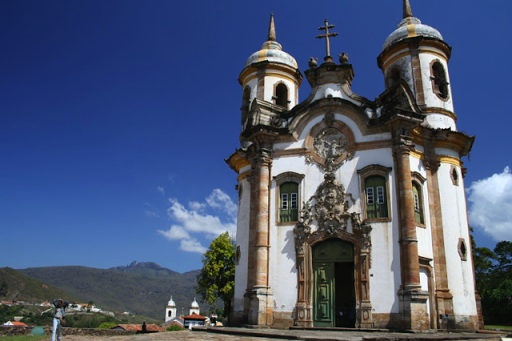
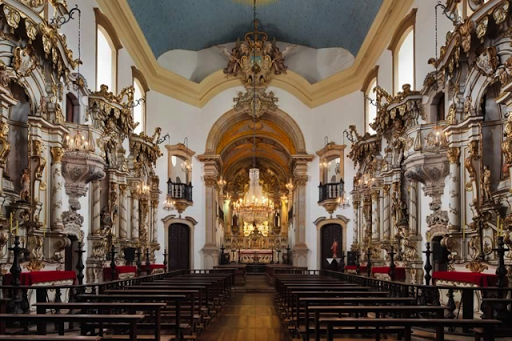
This church is regarded as the masterpiece of Mineras rococo. John was pretty strict about making sure we did not take pictures in churches — that’s the usual rule everywhere in this area — so I swiped this one from Google Images. 

NewImage

We had a buffet lunch at a place the specializes in the cuisine of this part of Brazil. It was all pretty decent, but I will not be rushing out to buy a Brazilian cookbook. 

In the evening, we returned to town. John in particular wanted to look at the Grand Hotel. This was the work of Oscar Niemeyer, Brazil’s greatest modern architect. To me, it looked like a lot of ugly buildings I grew up with in the 1960’s. But it was built in 1938 and I can see how at the time it was a pretty revolutionary piece of work. Here is a shot we took earlier in the day.

https://farm6.staticflickr.com/5683/23623214199_86e1c30350_z.jpg

And this is what the pool looked like at night.

https://farm6.staticflickr.com/5663/23999973125_f20ea6820a_z.jpg

It gave John Mad Men flashbacks and he just had to make it black and white. 

Madmen

Tomorrow we are off to the nearby town of Marianas. 

Feliz Natal

Merry Christmas, everybody! We are in Ouro Preto, Minas Gerais, Brazil. John tells me that I cannot tell you how we came here because hearing about travel connections is boring. I am sure he is right. Just let me say that the airport code for Sao Paolo is GRU and five hours in Terminal 1 is GRUesome. 

Oh, and I slept on the flight and missed seeing Santa. And he missed me in transit, too. Oh well. When you’re pushing sixty you don’t mind missing presents so much. Now if I could only find a way to miss birthdays….

Back to Ouro Preto. It’s utterly lovely. We are having a tour tomorrow so I am sure I will be full of information about the town and its history then. So here are just a few pictures of this lovely place.

https://farm2.staticflickr.com/1679/23897599631_6b0434c568_z.jpg

https://farm2.staticflickr.com/1606/23684494700_ea62039fc5_z.jpg

https://farm6.staticflickr.com/5781/23684480630_f6363ee0b0_c.jpg

https://farm6.staticflickr.com/5795/23953012366_53efea951c_z.jpg

https://farm6.staticflickr.com/5765/23351936274_038b4dd8cd_z.jpg

https://farm6.staticflickr.com/5745/23611482609_c1114df034_z.jpg

https://farm2.staticflickr.com/1624/23979119645_3a5d262f36_z.jpg

https://farm6.staticflickr.com/5639/23352521923_69e4b45339_z.jpg

https://farm6.staticflickr.com/5759/23953217986_026b002d4c_z.jpg

One last thing before I sign off for the night. As you can imagine here in the tropics, there aren’t big chimneys for a fat man to climb down. So Santa appears to come through the window. So, it’s not “Santa baby, hurry down the chimney tonight.” It’s more like, “Santa burglar.”

https://farm6.staticflickr.com/5806/23350897714_a18b6cb1a1_z.jpg

Up in the Air with Santa

I did not sleep well at all. Even reading Alasdair Macintyre was not enough to force my eyelids to close. John, fortunately, did not have the same problem. With a great deal of grumbling, I packed up and we went down to breakfast. Leo was scheduled to pick us up at 9:00, and we were early for a change. John snapped some pictures of the hotel lobby

https://farm2.staticflickr.com/1629/23324159893_6512712214_z.jpg

and a little atrium garden with this lovely mural.

https://farm6.staticflickr.com/5699/23655282120_ac36355fef_z.jpg

Leo told us that ten years ago Ronda was one of the most dangerous neighborhoods in the city and that most of the buildings were either abandoned or were brothels. I am not sure which our hotel once was, but either way the restoration is lovely and La Casona de Ronda is great place to stay. 

Leo picked us up and drove us through the old city. Along the way, we passed by the Basílica del Voto Nacional. This is supposedly the largest neo-gothic structure in the Americas and is the only church in Ecuador to have been built since Independence with public funds. I learned later that its grotesques include Galápagos iguanas and tortoises, so I wish we had stopped and taken a closer look at it. 

https://farm1.staticflickr.com/565/23655306220_ddc024e85a_z.jpg

Leo took us to the Teleférico de Quito, a cable car that runs from the edge of the city to Cruz Loma. It climbs from 9,678 feet at its base to 13,288 feet at the top. As you might guess, it was a bit cool up at that altitude even here on the equator, and the air was t-h-i-n! John really felt it, but then I guess when you are that tall the blood has to pump farther.

https://farm6.staticflickr.com/5713/23324211183_0b0531e3c4_z.jpg

But the views over the city were amazing.

https://farm1.staticflickr.com/565/23868473811_9b44f9667c_z.jpg

Quito has about 2 and a half million people, but the city is long and narrow, occupying a valley between two mountain ranges. Most of these peaks are volcanic, and the area around Quito is sometimes called “Volcano Alley.” Fortunately, most of the fourteen volcanos are quite dormant. 

https://farm1.staticflickr.com/565/23924915326_6ab745fe41_z.jpg

https://farm2.staticflickr.com/1471/23324232153_c5a64a2f74_z.jpg

We went up the funicular with some guy from Finland who planned to hike the five hours from there to the Pichincha volcano. I hope he was in good enough shape for the trip. He certainly did not seem particularly prepared for how quickly weather can change up high in mountain. I hope he did not end up as a Christmas Eve snack for an Andean condor….

Returning to the base station, Leo put us in his car and we started off for La Mitadad del Mundo, a monument to the discovery of the equator. It took us quite a while to get there, and the traffic was pretty awful. I hate to say this, but cities this size really do need some kind of freeway system. And the fact that the Quito police are given to closing streets for no apparent purpose does not make it easier.

When we arrived, the first thing that struck us was not the monument but this startling piece of modern architecture.

https://farm6.staticflickr.com/5802/23951004585_2bb1635d8f_z.jpg

This one of the headquarters of UNASUR, the Union of South American Nations. This is designed to be South America’s answer to the European Union. I do not get the feeling much has come of it yet, and given the problems Europe is facing right now, maybe they should not rush into this. 

Ciudad Mitad del Mundo, the “City at the Center of the World,” commemorates the French Geodesic Mission of 1736 which attempted to find the equator. This was not the first time that people had attempted to find this spot, but until the advent of modern satellite technology it was generally accepted that they had located it here. And so a monument was built with busts of the eighteenth century scientists to honor their contribution to geography. 

https://farm6.staticflickr.com/5650/23924947686_7888d545da_z.jpg

The only problem is — they were not quite right. The actual equator is actually about 200 meter further south. And ironically — it had already been discovered. Ruins of a pre-Columbian site on a nearby hill mark the exact spot. A pole has been erected here to commemorate the indigenous accomplishment. 

https://farm6.staticflickr.com/5804/23951037165_e2575c533e_z.jpg

It’s hard to figure out what exactly the point of La Mitad is other than to separate tourists from a few dollars. Admittedly, it’s kind of fun to spread yourself across  two hemispheres

https://farm6.staticflickr.com/5782/23322821754_17b6711c57_z.jpg

 until you remember that this really isn’t the equator at all. 

The tower has a museum with a number of exhibits on Ecuadorian native peoples. Most of this just shows the typical dress and some pictures of their homes. But an exhibit to an Amazon tribe does purport to show a shrunken head. I am sure that this is a hit for field trips. 

https://farm1.staticflickr.com/566/23583209949_43868aa887_z.jpg

The science exhibits are not only a little cheesy, but not even accurate. One claims that the Coriolis effect changes the direction that water drains in sinks and toilets, something that has been disproven many, many times. 

Attached the monument and the museum is a the “city.” It is not much more than a few restaurants and souvenir stands. Maybe this place gets more business on days other than Christmas Eve, but I was not sure how any of them stayed in business. 

https://farm6.staticflickr.com/5669/23333530093_557a37db4c_z.jpg


Even though our flight was not until six thirty, Leo dropped us off at the airport just after three. He had to drive back to his home and from there to his parents house in the lowlands at least three hours away. Quito airport is not Singapore, but there was worse places to pass the time. We splurged for the VIP lounge where there would be free food and drink and really good wifi. 

On the plane tonight, they fed us dinner. (This happens all the time in Latin America. Nobody has told them that you should charge people 9 dollars for a wretched sandwich — and oh, by the way, the chips are extra.) Maybe because it was Christmas, they decided to offer pavo or turkey. So here is our Christmas feast.

https://farm6.staticflickr.com/5812/23336753143_e24a435525_z.jpg

We’ll probably be asleep up in the air as Santa makes his rounds tonight. If we see him, we’ll snap a picture. 

Last Day in the Islands

Today was our last in the Galápagos. Some members of our group will continue on for another four nights, but most of us will be heading home or on to other South American destinations.

We ended our adventure in San Cristóbal. This is the farthest east of the islands. To help anybody without an atlas handy, here is a map. You may notice Spanish and English names as the British made a half-hearted attempt to claim the islands. 

https://farm1.staticflickr.com/565/23323004534_3c26afbb15_z.jpg

We spent most of our trip around Santa Cruz in the center of the map. Baltra Island, where we arrived, is just north of Santa Cruz. North Seymour Island is just north of Baltra.  The Plazas islands are just off the east coast of Santa Cruz, and Santa Fe Island is not that far southeast of Santa Cruz. San Cristóbal, however, is a fair distance away and we spent all night plowing through the pretty rough seas to make it there by dawn. Many members of our little company became somewhat ill. John Pratt, alas, was among those who looked a little pale the next morning. 

Puerto Baquerizo Moreno on San Cristobal is the capital of the Galápagos Province even though it is only a fraction as large as Puerto Ayora and considerably less affluent. It reminded me of a number of small Caribbean towns I have been to over the years:  buildings only half-constructed, the same bright, but peeling paint, and a kind of musty smell everywhere. I did not dislike the town, but I would not make any special attempt to visit here. 

Our first stop was at an interpretive center. This had a number of large pictures explaining in both Spanish and English some of the geography and history of the islands. It was interesting enough. We were then invited to take a stroll through some brush to the top of a hill. The Palo Santo trees were in full leaf here. 

https://farm2.staticflickr.com/1494/23582956699_a680b64755_z.jpg

The view was nice, but hardly exceptional. 

https://farm6.staticflickr.com/5637/23842561142_1a336c0967_z.jpg

On our way down, we came across this statue of Charles Darwin as interpreted by some devotee of Socialist Realism. 

https://farm2.staticflickr.com/1621/23322597194_0cf85356ef_z.jpg

John shared his hat to the tortoise. It looked good on him. I think John could have left it as a gift…

https://farm6.staticflickr.com/5693/23582993089_d163df7ee7_z.jpg

Returning to town, we had a couple hours to kill before we went to the airport. There is about five minutes of sightseeing and ten minutes of shopping in Puerto Baquerizo Moreno. So we amused ourselves by watching a sea lion who had taken over the bench in the middle of town. We figured out later that she had a pup underneath the boardwalk. 

https://farm2.staticflickr.com/1715/23950797435_32997cc5a3_z.jpg

We were not ravenously hungry, but we ate lunch at a small place there called Calypso. It was a relatively good meal for this kind of town. After we finished lunch and were waiting for our bus, we noticed some splashing about in the water and figured out that it was a sea lion teacher her pup how to swim.

https://farm6.staticflickr.com/5686/23924817456_8c88734237_z.jpg

The youngster was frankly not enjoying this lesson and protested mightily every time his head was shoved under the water.

https://farm6.staticflickr.com/5760/23868382951_efaec8e0bd_z.jpg

When mother gave a short break, the relief was obvious. 

https://farm2.staticflickr.com/1495/23868355201_b52aab6073_z.jpg

The flight from San Cristóbal to Quito was largely uneventful. When we arrived, Leo was waiting for us. It was starting to get dark, and he drove us back to La Casona de Ronda, the hotel where we had stayed our first night. That was not easy:  perhaps because of Christmas shopping crowds, the police had closed many, many streets in the Old Town. 

After we checked into our hotel, John wanted to go out for some dinner. The front desk recommended a place called “Los Geranios” or “The Geraniums” three doors down the street. It was easy to spot from the pots of geraniums (yes, you gardening pedants they are really pelargoniums) on the balcony of the second floor dining room. 

https://farm6.staticflickr.com/5659/23583070439_7f9d4d86fd_z.jpg

The food was pretty good. It featured both Ecuadorian and Mediterranean items. We went for the native stuff. John had some ceviche. It Ecuador this is made with shrimp and lupine seeds. The latter give a pleasant crunch to the dish. He also ordered the potato soup, and it came with a flourish!

https://farm1.staticflickr.com/566/23924855496_d8ebf4f78c_z.jpg

On our way out he noticed a lovely display or fruit and candles. We could not figure out if this was traditional for the season or if somebody just liked to decorate tastefully.

https://farm6.staticflickr.com/5754/23842662542_b273cf4998_z.jpg

Tomorrow Leo gives us another tour and we will head to Sao Paolo on Christmas Eve. This will be the first Christmas Eve I will spend in the air. Maybe we will see Santa!

Birds and Barges

Today we found ourselves moored at North Seymour Island, described by one of guidebooks as the “most popular … of the Islands.” And definitely with good reason:  the bird life on this small island is truly extraordinary. 

We disembarked onto the island a little before nine in the morning. There were at least a dozen sea lions waiting for us, but somehow sea lions seemed so … yesterday. We dutifully oohed and ahed over a mother and her baby, but the moment we saw our first blue-footed booby we completely forgot about the mammals.

The term “booby” is a corruption of the Spanish “bobo,” a term meaning crazy. The early explorers saw the boobies engaged in what struck them as crazy antics. The Spaniards, as usual, were rather imperceptive:  the booby acts erratically in order to fend off predators who would feed on their eggs or young. Birds of prey apparently find young boobies rather tasty. 

IMG 1971

I have yet to read a good explanation for why having blue feet is a survival adaptation for the birds. 

IMG 1973

The feet of juvenile boobies are a vaguely gray color.

IMG 1975

But it does make the adults strikingly handsome birds.

IMG 1995

But the real stars of the day were the “fragata”, the frigate birds. The males have this enormous red pouch which they inflate to attract females. 

IMG 2018

Young birds, male or female, are mostly white and just as cute as can be.

IMG 2004

IMG 2027

Birds in the Galápagos are so tame that the seem unperturbed by humans close to their nests.

IMG 2036

We also saw some of the usual wildlife as we walked around North Seymour. We were struck, however, by one of the land iguanas climbing in a tree instead of simply sitting around on the ground.

IMG 2053

Soon, however, it was time to return to the ship for lunch and some rest time. Trish and John, our honeymoon couple, look radiant even while waiting for a dinghy. 

IMG 2057

We had a nice lunch — I loved the Swiss chard in a light cream sauce — and then everybody read and napped. The passengers on this ship are readers, particularly the kids. After lunch every single person had a book or a Kindle in front of them. I suppose people who like to read go to the Galápagos instead of say, Cancun.

In the afternoon we stopped off at Balchas Beach on Santa Cruz. This area is directly adjacent to Baltras, the island that the American used as a base during World War II. When the war was over, it was cheaper so sink some of the barges and ships than to send them back to the states. The Ecuadorians could not pronounce “barges” easily, so Barges Beach became Balchas Beach. Despite the hulks of twisted steel under the water, the beach looks pristine. 

IMG 2059

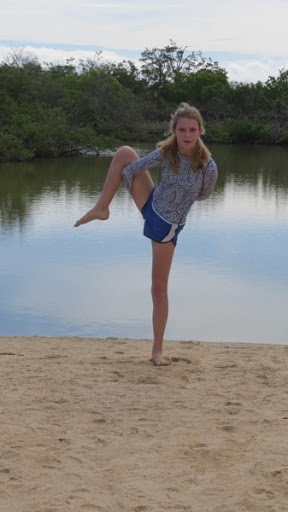
On Balchas, there is sometimes a small colony of flamingos. Unfortunately, the water was apparently not to their liking right now and they had looked for other places on the island. Our group consoled itself by trying to do the Flamingo pose in yoga. John did pretty well

IMG 2082

but none of us old folks have the twistiness of the young. 

IMG 2083

I think Margot may be perfect at everything. 

Speaking of the kids, they loved the beach 

IMG 2073

and we enjoyed watching them frolic in tide pools and in the surf.

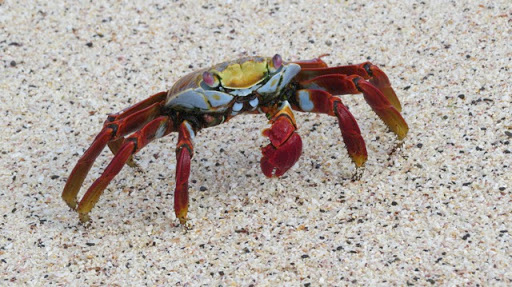
We did see some wildlife on the beach such as pelicans

IMG 2078

and crabs.

IMG 2090

This afternoon we had our most National Geographic moment when we saw giant sea turtles mating.

IMG 2095

IMG 2125

I am not sure that the younger kids completely figured out what was going on, and fortunately the older ones did not seem to feel the need to inform them. I cannot believe what great families we have on this trip.

Tonight is the last night of our Galápagos adventure, and although we are eager to explore Brazil, we will be sad to go. It has been great.

IMG 2118

Santa Fe and Beyond

We traveled during the night from Santa Cruz to Santa Fe. Not California to New Mexico, but two of the islands in the Galápagos archipelago. The Spanish were not all that creative with their names, were they?

This morning we had breakfast and then we were placed in the two dinghies. John and I were not paying attention to the time and I think the last of the two had left before somebody noticed that we were not there and it had to return. Our guide was obviously irritated though he said nothing. It only took us a couple minutes before we landed on a lovely sandy beach. 

From the beach you could get a good view of our ship.

IMG 1744

But not many people were looking back. Instead, everyone was busy taking pictures of a couple dozen sea lions. There were small groups of females and their pups everywhere.

IMG 1728

They were so unafraid of humans that it was easy to come close and photograph the three graces. 

IMG 1720

And they seem quite happy to pose for pictures.

IMG 1748

The male was not at all happy about us being there, and regularly barked warnings from the water whenever he thought we came too close. 

IMG 1725

While we were on the beach, we also took pictures of ourselves and each other. This is the family from Virginia. From left to right, Thomas, Margot, Katie, Tim, and Brook. 

IMG 1736

And this is the family from New York:  Ceci, Charles, Cali, Susanne, Catherine, and Charlotte in front. 

IMG 1741

And our friends from Atlanta, John and Trish.

IMG 1754

After we had spent some time taking pictures, we started walking over a fairly rocky trail. Our guide stopped along the way to provide some background information about the animals we could see.

IMG 1752

We saw many of the same plants and animals that we had seen yesterday at the Darwin Center, but seeing them as a part of a complete ecosystem was particularly interesting. The island is covered with both Palo Santo trees and the tree-like cactus. 

IMG 1780

I suppose the only reason these cacti are not used much for decoration in the States is that they take so long to grow. This is not a fully mature specimen, and our guide said it was probably about a hundred years old. We saw more iguanas

IMG 1791

and discovered that they quite happily coexist with sea lions.

IMG 1801

There were birds on the shore

IMG 1827

and perched on cacti.

IMG 1771Because there are no natural predators here most of the animals are oblivious to us and we are strictly forbidden to touch.   


After this we came back to the ship. After a short break to get changed, everybody except me went snorkeling. I am so blind that I see pretty much nothing when I go snorkeling and I find it a pretty unsettling to be in the water and not have any idea where anybody else is when I stick my head up. So I stayed and edited photographs while John and the others went out. 

IMG 1835

After about an hour, they returned for lunch. After we finished eating, the ship left Santa Fe and headed towards South Plazas Island, about two hours further. Most of the passengers took a nap.  

We disembarked on South Plazas around three thirty in the afternoon. The moment we stepped off the launch we were astonished to see a mother sea lion who had just given birth to a baby not more than a day before. 

IMG 1844

IMG 1847

IMG 1853

It was hard to tear ourselves away from watching the mother and her baby, but Victor, our naturalist, finally told us we had more things to see so we headed up the trail. 

The rocks here are pretty interesting all on their own. They are white and shiny, and from a distance you would be almost certain that they are marble. 

IMG 1885

And, in a way, they are. This is a former sea gathering area, and the animals literally left tons of their scat on the rocks. As the main ingredient in their diet is fish, the calcite from the fish skeletons remained after the organic material had washed away. The sun then baked it over the years into a hard, white, shiny surface covering the volcanic rock. It is especially shinny where people and sea lions walk. It looks like well maintain ballroom floor.

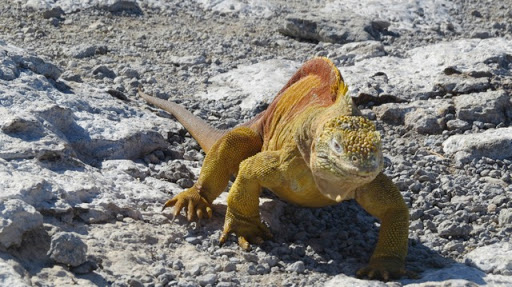
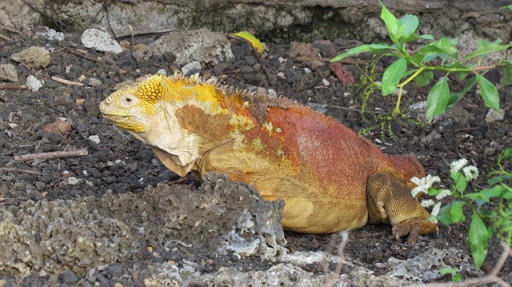
We had not gone far on the trail when we once again saw a land iguana.

IMG 1866

But it was soon joined by another male, and for a time it looked like the two were going to fight. They both hissed and shook their spines and circled each other. 

IMG 1873

But after a few minutes, the one on the right, probably a bit younger, decided that against the challenge and walked away.

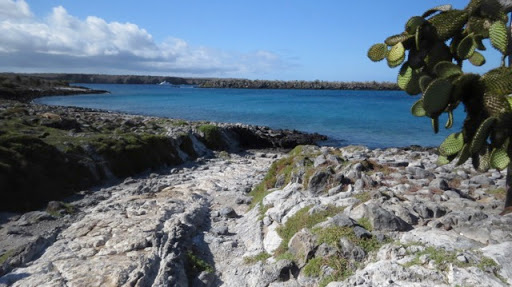
The landscape of South Plazas is remarkably beautiful. It is too dry even for the the Palo Santo trees, and the only significant vegetation are the cactus and some succulents that must be related to ice plant. These turn a bright orange red during the dry season, which camouflages the orange iguana.

IMG 1918

When it rains, as it has recently, the plant turns green again. The yellow warbler is almost perfectly camouflaged in this environment.

IMG 1886

We passed a something that looked remarkably like an old Roman road. Our guide explained that a lava tube had once been here, but that it had collapsed leaving only the base of the tube. 

IMG 1884

After walking for a bit, we arrived at a headland. John normally does not get very close to any kind of cliff, but he could not resist posing in the later afternoon light on this stairway too where.. 

IMG 1907

There were pigeons of some kind nesting there, but even they looked beautiful in this light and on these cliffs.

IMG 1914

Walking along the path, we found the remains of an iguana. Young Thomas speculated that maybe it had been burned to a crisp by a volcanic eruption, and I liked that idea more than any more pedestrian explanation. 

IMG 1911

Santa Cruz

The trip from Quito to the Galápagos was not particularly interesting, but it did consume a fair amount of our day. Our flight left the capital at 7:15 in the morning and stopped for about 30 minutes in Guayaquil, a fairly large coastal town, before continuing on to Baltras, the main airport for the Galapagos region. I had read that Baltras was desolate, and as we walked off the airplane I saw that it indeed it is a flat, dry, barren place. 

At Baltras airport we had to present our passports and other documentation even though we had never actually left Ecuador. We had to even have our luggage inspected again, although this was mostly to make sure that we had brought no food with us. We waited around for a while before we were put on a bus.  This took us to a small dock we were met there by a couple dinghies that took us to the ship. 

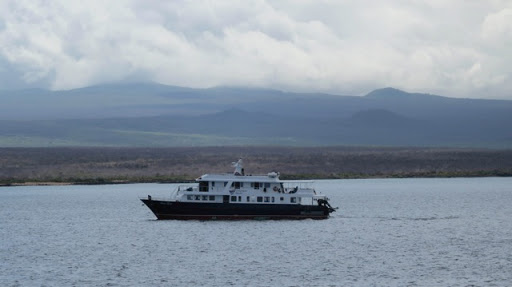
We are passengers on the Marine Yacht Coral II. It is a pretty small boat. Even if were completely filled, I think there would only be about twenty passengers or so. Once we were all onboard, we figured out that there our comrades consisted of a family with three kids from Virginia, another with four girls from New York City, and a newly-married couple from Atlanta. I hope by tomorrow I will know everybody’s name. 

From Baltras  we went to nearby Santa Cruz Island. This is not the largest island geographically, but it does have the largest population. The volcanic peaks have largely been worn down, but the center of the island is a few hundred meters above sea level, and this is enough for the clouds to gather around it and produce some rain. 

IMG 1645 2

From the other side of the boat we could see some of the smaller, uninhabited islands. I think this one is called Daphne. As you can see, it is nothing but the remnants of some ancient volcano.

IMG 1646 2

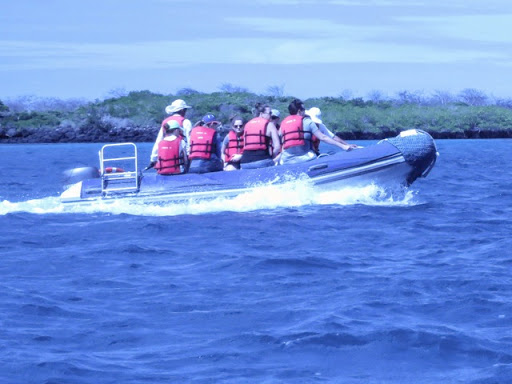
After we had lunch, we were all placed on two dinghies and we headed to shore. At one point, the boats seemed to be racing one another. 

IMG 1651 2

Once on land, we took a forty-five minutes bus ride from one side of the island to the other. It was a moderately interesting ride. We noticed the mangroves along the shore as we disembarked. As we started to climb, we passed through a barren forest landscape. I tried to ask our guide about the plants, but he did not seem to want to leave his prepared talk. I learned later from the Moon Guide that these were called Palo Santo or “Holy Trees” because they usually bloom around Christmas. I saw a couple starting to blossom, but most looked pretty dead. 

Our destination for the day was the Charles Darwin Research Station in Puerto Ayora. The center is about a quarter mile or so from the center of town. 

IMG 1653 2
 
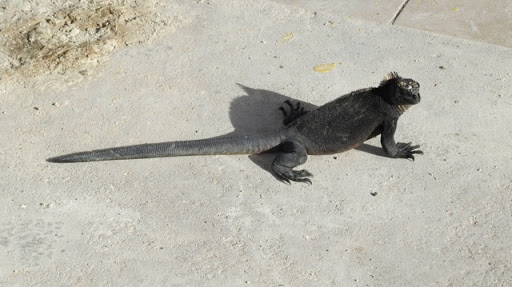
Our group had not gone far on the road when we saw our first iguana. This is one of the marine iguanas that are found only here on these islands. This iguana will dive into the water for food and can even stand underwater for over an hour!
 
IMG 1656 2
 
Darwin was repelled by the iguanas and called them “ugly creatures.” I have to say that I must disagree on this point with the great biologist. I think they are truly handsome creatures. 

IMG 1658 2

The Darwin Station engages in a wide variety of research and conservation activities, but breeding Galapagos Tortoises is the most important. There were at least half a million tortoises when the first Europeans arrived here; there are barely forty thousand left now. Three of the fourteen species are extinct. While the tortoises are   no longer hunted by humans today — Darwin thought them quite tasty — rats, dogs, and other non-native species eat tortoise eggs and devour their tiny young. In order for the species to survive, they have to get bred in captivity and later released when they are old enough to survive on their own. 

Tortoise 1

The Galápagos islands get their name from these tortoises. An early Spanish bishop thought that the shells looked like saddles:  “galápago” is an old Spanish word for “saddle.” Darwin noted that the shape is an adaptation for survival. These turtle live in arid regions where they need to be able to reach the most food. Having a shell like this allows them to reach their heads much higher to eat leaves from bushes and small trees. 

Tortoise 2

With no natural predators, the tortoises never evolved any aggressive mechanisms or behaviors. They are remarkably gentle creatures. 

Guide

The children, even the young ones, were remarkably attentive and curious. I would be happy to have any of these kids on a field trip. While they found the turtles interesting, they really loved the iguanas. 

IMG 1682 2

There are two main kinds of iguanas in the Galápagos archipelago. The marine iguanas are a drab gray and black. This allows them to blend in on the volcanic rock found on the shore. The land iguanas are a little more colorful. I suspect this is has to do with mating as it does in many species, but I have yet to find anything in the guidebooks or the signage that confirms that. 

The many varieties of cactus on the island also show evidence of natural selection. These cacti have enormous tree-like trunks to elevate the protect them from all the creatures that would eat them for water. 

IMG 1688 2

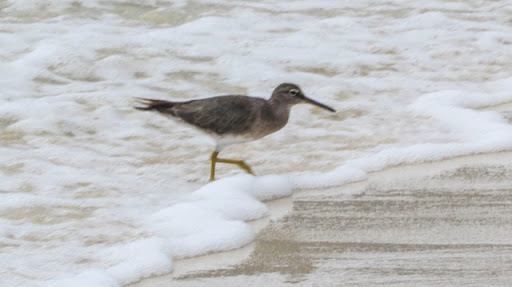
Bird life is quite abundant on the islands. I am a member of LA Audubon, but I admit that I am not particularly good at identifying birds. I think this is some kind of finch, 

IMG 1660 2

and I am pretty sure are frigate birds. 

IMG 1694 2

In the air or on the land, there always seems to be something interesting to look at. And most of the time the animals seem to be looking at you as well. This little guy was definitely checking us out. 

IMG 1659 2

I suppose a certain amount of shopping is obligatory on any group trip, and we spent about an hour in Puerto Ayora wandering about so that the people could purchase souvenirs. Puerto Ayora has about 12,000 residents and it is the center of commercial activity for the Galápagos Islands. If you are traveling to Ecuador and have more time than money, you can rent a hotel reasonably cheaply Puerto Ayora and do most of the islands as day trips. When we were younger, I am sure we would have done this instead of our short cruise. As these kinds of towns go, Puerto Ayora is, as the Moon Guide put it, “…hard to hate.” There is an abundance of overpriced tchotchke, but there are also some real galleries and not all that much honky tonk. 

IMG 1710 2

There is abundant natural life even here in this relative metropolis.

IMG 1702 2

IMG 1703 2

IMG 1705 2

Some of the animals are quite comfortable living around humans, perhaps even grateful for the pleasant facilities provided.

IMG 1697 2

There was some sense that we are nearly at Christmas. Outside the municipal buildings there was a small crèche. 

IMG 1706 2

I am not exactly sure who the visitor to the holy family on the left side is supposed to be, but it looked to me like a cross between a snowman and a Bolivian woman.

We stopped in at the church as well. It was a modern building with absolutely no architectural merit, but somebody did have the good sense to put in some stained glass of the local wildlife.

IMG 1707 2

 We returned to the bus and drove back to the ship. I started to doze off on the way back. We cleaned up and had dinner with our friends from Atlanta. Our guide says that tomorrow will be a full day of hiking and snorkeling. 

Up and Away

It was still dark when we arrived in Quito this morning. We cleared immigration without any problem, and after claiming our bags we went through customs. Our guide was waiting for us to take us to the hotel.

I had never thought much about going to Equador, this fall John decided that he wanted to go to some places he had always dreamed about this winter. Even though the Galapagos Islands are not particularly close to Brazil, John wanted to do both of them and we worked with a travel agent we knew in Chile to help arrange this. Still, with my mother’s illness, we were not certain until almost the last minute that we would even be able to go. 

We are staying only one night in Quito before flying to Baltra where we will meet our boat. We asked Felipe to find us a hotel in the historic center of town, and he did quite well by picking La Casona de la Ronda. It is a new hotel in a large eighteenth century and the rooms all open to a lovely central courtyard. 

https://farm6.staticflickr.com/5649/23227225044_62606b8ea9_z.jpg

https://farm6.staticflickr.com/5643/23772867641_31958629fe_z.jpg 

We had only slept three or four hours on the flight, so our guide suggested that we get a little more sleep before he returned to take us on a tour of the old town and its many churches and museums. We were only too happy to go along with that suggestion. 

Our guide is named Leonardo, though he likes to go by Leo. He has been a been a guide for about eighteen years and speaks faultless English. He pointed out to us that the area where we are staying — La Ronda — had almost been completely abandoned until about ten years ago. Now this part of the old city, and pedestrian alley that give it its name, is considered perhaps the more interesting part of the city and it is the area where all the Quiteños like to go on Friday and Saturday night. 

https://farm1.staticflickr.com/598/23772910061_ec4082247c_z.jpg

Our first scheduled stop on our walking trip was the enormous monastery of San Francisco. Along the way we passed the much more modest convent of the Poor Clares. 

https://farm1.staticflickr.com/651/23228627593_bc51e8cbb2_z.jpg

John, ever attuned to anything theatrical, noticed a small store on this square selling masks.

https://farm6.staticflickr.com/5818/23227323214_245916ab36_z.jpg

Leo explained the reason for this.

https://farm6.staticflickr.com/5718/23747124282_8374fa9255_z.jpg

On New Year’s Eve, the custom in Ecuador is to make effigies, usually stuff them with fireworks, and set them ablaze right on the stroke of midnight. As this is a symbolic destruction of all that was bad about the old year, it is traditional to put faces of demons or the visages of current politicians on the effigies. It sounds much more fun than Burning Man to me. After all, you don’t have to go to Nevada!

The San Francisco monastery is the oldest is Quito and it covers several city blocks. 

https://farm1.staticflickr.com/678/23487664189_339929f511_z.jpg

The interior of the church is sumptuous.

https://farm6.staticflickr.com/5707/23490939889_99130d729f_z.jpg

We walked through some of the cloisters. It is still, at least in part, an active Franciscan community. John posed with an effigy of a friar

https://farm1.staticflickr.com/743/23829425326_beea11948c_z.jpg

and then bought a little trinket from a real one.

https://farm6.staticflickr.com/5801/23227399224_1e4535e57d_z.jpg

In the square outside, there were people selling everything. There was even this man selling thuribles.

https://farm1.staticflickr.com/649/23227432644_cc8f120489_z.jpg

I was tempted, but honestly couldn’t think of a place to put it in the house. Besides, anything that sets off the smoke alarm makes Edie very unhappy. 

As ornate as San Francisco is, the Jesuit church tops it. Leo thinks there is more gold in this church than in any other in South America. He is probably right.

https://farm1.staticflickr.com/753/23230802374_c7e18ff973_z.jpg

Notice the intricate Islamic inspired designs on the columns and arches of the nave. I found that more fascinating than all that gold leaf.

From here, Leo led us toward the Plaza Mayor, the main square of the old city. The Law of the Indies was the first urban planning in since Roman times. It decreed that all of the Spanish cities in the New World would be laid out in a grid. At the center would be a square or plaza. On the west side of the square would be the cathedral or main parish church; government offices would fill in the area around the plaza. The central square is still a vibrant urban space. 

https://farm1.staticflickr.com/754/23231275343_36ce11e9f2_z.jpg

Leo explained to us that the cathedral is not a particularly interesting building because the archbishops keep renovating it, and each one seems to have worse taste in ecclesiastical decor than his predecessor. Instead, he took us to the Presidential Palace. We could only peak in. But he did take our picture with the ceremonial guards.

https://farm1.staticflickr.com/584/23562369070_c9b5f18ea2_z.jpg

After this, we went to lunch at one of the nearby hotels. This was clearly a stop on the tourist trail because there was also a large tour group there. Probably the reason that guides take us all there is that they do an elaborate dessert. The waiters dress up in the traditional outfit of the “penitentes” and dry ice smoke completes the scene!

https://farm1.staticflickr.com/740/23749775662_e791781e3c_z.jpg

It’s actually only a bowl of ice cream and some cookies, but presentation is everything.

https://farm6.staticflickr.com/5833/23229994464_9b7d4e4568_z.jpg

At this point it was about two in the afternoon and Leo had to leave us to because both his teenage children had basketball games today. John and I were about to just wander around when the sky opened up and it poured for over thirty minutes. We stayed dry and a little bored walking through the shops that now occupy the old archbishop’s palace. When it cleared up, we walked across the square and into the cathedral.

Leo was right:  it’s pretty ugly inside. They were setting up for a concern and that allowed us to get away with taking some pictures pretty flagrantly. 

https://farm1.staticflickr.com/685/23562447870_143be86298_z.jpg

Maybe the most interesting thing in there is the tomb of Antonio José de Sucre, one of the leaders of South American independence.

https://farm6.staticflickr.com/5712/23858197885_f8157fa34e_z.jpg

Ecuador now uses the dollar as its currency, but for many decades the “sucre” was the legal tender of the nation.