Around Otranto

Today we are staying at the same hotel. Our itinerary is having us explore the area around Otranto. We started by riding along the Idro River. Only in Southern California or southern Italy would this be called a river. It’s really a dry wash or an “arroyo” if you hail from my part of the country.

IMG 1291

IMG 1292

As we rode along, our first stop was a crypt of some Byzantine monks. During the iconoclastic era, when some leaders of the Byzantine Empire, perhaps influenced by Islam, decided that icons and other images in churches had to be destroyed, some of those who felt strongly religious images were worthy of use in worship, even veneration, sought refuge in southern Italy. 

IMG 2362


IMG 2364

Our guide materials next suggested that we stop at the Constantine Foundation. Apparently this place is devoted to preserving ancient weaving techniques and the biodynamic agriculture ideas of Rudolf Steiner. We did not such much evidence of either. We did find this circle of stones. I wanted to think that it was performing human sacrifices or something, but it’s probably just the outlines of a cistern. 

IMG 7346

Along the way we saw some prehistoric stones. We do not know much at all about the people who lived in this part of Italy before the Greek established colonies here several centuries before Christ. We’re these cultic items or maybe just places to post messages? Nobody knows.

IMG 1299

IMG 2366

We then came to some “dolmen.” Again, nobody is sure what these stone structures were used for. Were they just burial places? Or were things sacrificed on them? 

IMG 2367

After this we stopped in a village to get some food for lunch. Our guide materials suggested a bakery. It was pretty decent and quite cheap.

IMG 1300

We sat for a while at a nearby square. 

IMG 1306

And then we were on our bikes again, riding through the narrow streets.

IMG 1304

By this point, John had figured out that his front gears really did not work at all. We could see at least part of the reason why – the cable had come unconnected – but we did not have the tools to fix it. After riding around Otranto a couple times, we finally found the only bike shop. The mechanic there was great and did his best to repair it. 

IMG 1317

But he was not complimentary at all about the bike, using a rather vulgar Italian term that indicates fecal material to describe the rental bike. Strangely, that made us feel good and we decided we would send off a couple texts and emails complaining about the bike and see what response we received. 

In the evening, we did some more exploration of Otranto. We found a Franciscan church dedicated to Saint Anthony and it had the inevitable grotto.

IMG 1320

We went to the nearby headland at sunset.

IMG 1324

Finally, after it grew dark, we came back to the hotel.

IMG 1334

Good night!

IMG 1340

Winds Through the Olive Trees

Our first day on riding around Salento was amazing. But before I get to that, maybe I should pull out the map. Puglia, sometimes called Apulia by the English, is the southeast part of Italy on the Adriatic Sea. The very southern part of Puglia is Salento. If you think of Italy as looking like a boot, well then Salento is that stiletto heel. Look for the blue dot on the map. 

Salento

Over the next week, we are going to doing a complete circuit of Salento. This shows how far we went on the first day – about 60 kilometers. 

Day 1 Cycling

It rained a good deal during the night, but by the time we were getting ready to leave the sun was out and it was starting to get warm. We had a great breakfast, and as we were finishing up the local representative from the cycling company showed up. He was a charming young man named Francesco, and he went over the route and explained the GPS to me. They are giving us a Garmin hiking GPS with all seven days of travel set up as treks. We were not so happy with the bikes which both look like they have seen better days. We paid about 125€ each for the bike rental, so really it should be a decent bike. 

Francesco stayed with us as we left Lecce to make sure that I could figure out how to follow the GPS. Also, the streets in Lecce are a little tricky, anyhow. At the edge of town we exchanged phone numbers in case of trouble, and he wished us a good trip. We crossed over a bridge above the autostrada – that’s Italian for freeway – and after making a sharp right turn we were on a dirt road traveling through farm fields. The were some BIG puddles in the road from all the rain in the previous 24 hours, but amazingly enough both of us stayed upright and relatively dry. 

Our first stop was the town of Acaya, a sixteenth century fortified village. The Turks had invaded southern Italy at the end of the fifteen century, and although they had been expelled shortly afterwards Puglia remained a tense frontier between Christendom and the Islamic powers of the east. Acaya is best preserved of a number of fortified towns established to keep the Turks out of Italy.

At the Castle at Acaya

From Acaya, we continued down the road a bit to the La Cestine wetland. Run by the World Wildlife Federation, this Italian park is the beginning of efforts to restore avian habitats in southern Italy. Despite the rural landscape, the environment here has been seriously stressed by centuries of overpopulation and intense and inappropriate agriculture. 

Despite the environmental problems posed by monoculture, endless fields of olive trees are quite lovely. We went through miles and miles and miles of fields like this. 

Olive Trees

We finally emerged on the Adriatic Sea. Somewhere on the other side of that water is Albania. As on now, Albania not on either of our bucket lists. It was a little breezy, so we decided to postpone getting wet. 

At the beach at La Foca

We stopped in the village of La Foca for lunch at a place our cycle tour materials had recommended. They spoke even less English that we speak Italian, and they announced we were getting the mixed friend antipasto, their specialty. Folks here in the south of Italy tend to like Americans I am discovering, probably because they all have relatives in New Jersey. So they proudly brought us out and American flag and stuck it on the table. The food really was quite delicious, and there were several more smaller plates that didn’t fit into the picture. 

Lunch

We went to the beach area at the a couple blocks down from the restaurant. Italians tend to all go on vacation in August, so this little town was pretty empty. I imagine in a month or so it will be packed. It was fairly warm, but the wind was pretty intense. 

John at La Roca

So, there was nobody on the beach, and we did not feel like sitting in the wind, either. We pushed on.

Beach Umbrellas

Once again we went through miles and miles of olive trees. As we were approaching Otranto, we saw a shepherd with a dog and flock of sheep. I wished the man a good day and also said, “Buon guirno, cane” to his dog, and very handsome German shepherd. He smiled at me, and proceeded to have the dog go through all the classic sheepherding movements. It was so wonderful I completely neglected to record it! Memories will have to do, I guess. 

image

In the evening we went off to explore Otranto. The historic center of the town is lovely.

https://farm4.staticflickr.com/3855/14467194912_45c741f0cf_z.jpg

The waterfront has this odd statue of a woman with a flag holding a cross. It is a monument to the 800 martyrs of Otranto. In 1480, when the Turks captured the town, they ordered the residents to convert to Islam. 813 men supposedly refused to do so and were executed on the spot. Some historians question the veracity of the account, suggesting that they were probably executed for resistance to the Turkish forces and were never given the option of conversion to save their lives. Nevertheless, the story of the martyrs is important to the people of Otranto and they were declared saints recently by Pope Francis. 

Statue Commemorating Martyrdom

Much of Otranto reminds me more of Greece than Italy. This kind of pergola with grape leaves is ubiquitous in Greece.

Vineyard pergola

John found a place to relax near the castle. 

Relaxing by the Castle

While all the men were watching the latest World Cup match on television, some of the young residents of the town, maybe hoping to play for Italy some day, were practicing their game. 

Playing Soccer

Lecce in the Rain, Just Lecce in the Rain

Our train was scheduled to leave at 8:05, and so we rose early, had our breakfast, and said goodbye to Bruno, our host. As always, the television was on in the small dining area, and, as everywhere in Italy, the only thing anybody was watching on television was news of the World Cup. 

https://farm4.staticflickr.com/3889/14273478399_aa358b653c_z.jpg

Bruno called us a cab, and we were at Termine, Rome’s train station, in no time. John had been been swarmed by gypsies here 30 years ago, so he was quite vigilant this time. But it seemed fairly safe, and it was certainly modern and clean. Trenitalia referred to this as a high speed train. It certainly was as fast as the Amtrak Accela trains, but it was hardly going the speed of the Japanese bullet train we rode to Kyoto. We had purchased tickets in first class, and while this was not particularly luxurious it was uncrowded and comfortable. 

https://farm4.staticflickr.com/3891/14460111625_e7428b06aa_z.jpg

Our destination was the Puglian town of Lecce. This is pronounced “Leh chay,” the same as the Spanish word for milk, but I am not sure if it has the same meaning in Italian. Our bike tour will both begin and end here. I had heard so much about how beautiful Lecce was that I confess on our cab ride over to our accommodations I was more than disappointed. The town did seem to have a few older buildings, but it was mostly ugly, post-war, and covered in graffiti. It looked more like the Tijuana of Italy than the “Florence of the South.” 

Our bed and breakfast here, grandly called “Il Palazzo dei Dondoli,” looked nice enough from the outside when we arrived. It was a late eighteenth or early nineteenth century house dominated by two massive wooden doors. We paid the cab driver and tried to open the doors. They were locked. We rang the bell marked “Reception” several times. No answer. We tried calling the hotel. No answer again. Meanwhile, we began looking nervously at a sky that was starting to turn nearly black. It was going to rain soon, and it was not going to be a gentle rain. 

At this point, an older couple came down the street and pulled out keys to the door. They asked us if we spoke Italian, but I nodded no. “¿Español?” I asked since many Italians can speak Spanish. They nodded sadly no. “Do you speak English?” they asked. Yes, indeed I could do that. It turned out that they were Swiss and they also guests at the hotel, and they had been in our same situation yesterday. The explained that the hotel, like everything in Lecce, closes for the afternoon and would not be open until about 4:30. They assured us if we just left our luggage inside it would be safe and dry and we could just go into the town and have a bite of lunch until it was time to check-in. That sounded like a great idea.

We walked in the direction the Swiss couple had indicated and soon we were looking at the city walls and a grandly baroque city gate. We had no sooner entered than the sky almost exploded with thunder and lightning and rain poured down as hard as I have ever seen it in my life. We went inside the first open door we saw thinking it was a museum. It turned out to be an old monastery that had been converted into an art school. 

https://farm3.staticflickr.com/2928/14459000394_9dacaa32fe_z.jpg

We stayed there for about 30 minutes, maybe more, until the torrential downpour had given way to mere showers. At that point, we decided to explore. The town is all built out of a handsome honey-colored  stone. It looks like sandstone, but on closer inspection you realize that it is a kind of limestone. While Lecce is famous for its exuberant baroque architecture, the cathedral seemed fairly subdued. 

https://farm6.staticflickr.com/5589/14460118735_f44dfe2362_z.jpg

We walked by the ancient Roman theater. It is obviously still in use.

https://farm3.staticflickr.com/2937/14273490679_7e363c875e_z.jpg

https://farm6.staticflickr.com/5471/14273676517_8234f14194_z.jpg

We found a restaurant recommended by Lonely Planet for lunch, but the kitchen had closed. There was a wine bar open nearby, and they were serving antipasto, so we had a light but quite pleasant meal there. When we came back to the Palazzo dei Donaldi, it was open. This is the interior courtyard. 

IMG 7304

We did not unpack much as we will only be here one night. We did nap and check our email. In the evening we strolled back into town. We stopped outside one of the gates to the city where an allée of oleanders in bloom seemed to stretch to the setting sun.  

IMG 1214

The wet paving stones of the many plazas looked cinematic. 

IMG 1220

We did not feel like having a full dinner, so we stopped at an ice cream shop. I ordered “spaghetti”. Those are not noodles! They are made of frozen custard and they were delicious!

https://farm6.staticflickr.com/5471/14274846308_39da098d77_z.jpg

Tomorrow the bike ride begins!

Villa Borghese

We did not really have much of a plan for today. We thought about going to Palatine Hill and joining the crowds looking at the ruins, but somehow I felt that after Ostia Antica it would be a disappointment. On a whim, we decided explore the Piazza del Populo, right by our local metro stop. We had walked by it for a couple days, and it only seemed right to check it out. It was a good decision.

The Piazza dei Populo was the northern entrance to the city of Rome, and as most of the important visitors to the city came from the north, it was their first glimpse of the city. For this reason, Rome’s papal rulers were determined to make it as impressive as possible. As you enter through the Porta dei Populi, grandly redone by Pope Alexander to welcome Christina of Sweden after he conversion to Catholicism, you see an obelisk of Rameses II and two twin churches. The churches appear to be identical, but this is actually an illusion created by Bernini, one of the architects brought in to finish the building of these churches. 

https://farm6.staticflickr.com/5496/14272803717_7e473bf0ae_z.jpg

The most important church on the square, however, is just inside the city gate. This is Santa Maria dei Populi, and it was the church of the Augustinian canons. These friars apparently had outstanding taste in art, and the chapels inside contain outstanding work by the likes of Rafael, Bernini, and Pinturicchio. To me, the finest items there are two pictures by Caravaggio. I was particularly struck by his Conversion of Saint Paul.

640px Conversion on the Way to Damascus Caravaggio c 1600 1

We also loved the amount of funerary monuments in the church, the one below. Using skeletons like this in art was called the “momento mori” or “remembrance of death.” It was supposed to make the viewer recall how short life was and how they ought to be aware that perhaps final judgment was lurking around the corner. 

https://farm3.staticflickr.com/2922/14272646890_1f27bc2683_z.jpg

There are lots of people hawking things on the square as there are almost everywhere in Rome. John could not resist having his picture taken with these two guys even if it set him back 10€.

https://farm3.staticflickr.com/2922/14272654448_82992fb836_z.jpg

https://farm6.staticflickr.com/5505/14272612309_93595fb12d_z.jpg

At the south end of the Piazza, three roads converge. We took the one in the middle, the Via del Corso. This is the longest straight street in the city of Rome. It was once used during Carnival for horse racing; now the racing is done by tourists running from shop to shop along the street. Most of the major chain stores like H & M have branches on the Via del Corso. Guess decided that nothing sells clothes like dead or almost dead Italians; perhaps an updated form of the momento mori.

https://farm4.staticflickr.com/3847/14459253165_3076d298f9_z.jpg

There are also a number of churches on the street. The only interesting one, as far as we were concerned, was Saints Ambrose and Charles. This church belonged to the Duchy of Milan, and Ambrose and Charles Borromeo were the most famous bishops of Milan. The latter, a great leader of the Counter Reformation, has his heart on display in a reliquary behind the high altar.

https://farm4.staticflickr.com/3883/14455901281_001eeabba7_z.jpg

The light seeming to emanate from the relic is really just a result of using the flash, but I thought it seemed sort of appropriate….

The far end of the Via del Corso is the monument to King Victor Emmanuel. Originally planned in the nineteenth century to commemorate the first king of a unified Italy, it was finished under Benito Mussolini. Perhaps that is one of the reasons that Italians often deride it, although it is a fairly popular place for them to get married. 

https://farm4.staticflickr.com/3899/14272811377_0f368c97e3_z.jpg

From this point we tried hard to find a way to get to the metro. The Italian authorities have been trying to build a third subway line for 20 years, but there are so many archeological sites in this part of the city that it may never be finished. We could not figure out exactly what bus or streetcar to take, so we finally just hailed a cab and headed towards the Villa Borghese. 

The Museo Borghese is considered probably the most important museum in Rome after the Vatican Museums. Tickets are not expensive, but they sell out days in advance and we had not been smart enough to order them online at home. So we had to get ours through a tour company. We had to pay five times the face value, but we also had an superb tour guide, Stephanie, an Canadian expatriate. She made it worth every penny. 

The Borghese admits only two hundred people four times a day. Once inside, you have only 1 hour and 50 minutes to look at the art. Although the museum is not large, the quality of the art is so phenomenal that even twice that amount of time is not really enough. Stephanie showed us only about a dozen of the pieces, but she provided excellent interpretive background. This is a marvelous neoclassical sculpture by Antonio Canova of Napoleon’s sister Pauline Buonaparte Borghese as Venus Victrix. It caused a scandal as important women in the nineteenth century did not pose nude!

https://farm4.staticflickr.com/3854/14455905511_12b524e0fb_z.jpg

Other great pieces include Bernini’s David

https://farm4.staticflickr.com/3853/14272661578_109edcf9df_z.jpg

and his Apollo and Daphne.

https://farm6.staticflickr.com/5197/14272656800_f27984f0a5_z.jpg

We also looked at some masterpieces of painting including Pieter Paul Ruben’s Deposition of Christ.

https://farm4.staticflickr.com/3882/14458141054_f61092ce65_z.jpg

It was pouring when we entered the museum – so far it has rain for part of the day every day we have been in Italy, usually quite heavily – and it was still sprinkling when we left with Stephanie to do a tour of the park. We ended up in the Pincian Hill overlook. The light was quite splendid and caught the colors of the umbrellas and raincoats just perfectly.

https://farm4.staticflickr.com/3897/14272659450_a55a1e8319_z.jpg

https://farm6.staticflickr.com/5535/14457900242_c472d07606_z.jpg

I could not have done that in Photoshop no matter how hard I tried!

Pincian Hill overlooks the Plaza del Populi. So, in a way, we ended up where we had begun.

https://farm4.staticflickr.com/3841/14458143964_21aa44dc3b_z.jpg

We walked down the hill past the Villa Medici, now home to the Academie Nationale Française, toward the Spanish Steps. We view was exquisite.

https://farm4.staticflickr.com/3837/14272662280_a2b475ac72_z.jpg

We had our best meal of the trip at Gusto, a restaurant Stephanie had recommended. The pappardelle with prosciutto was superb, as  was the broccolini sautéed in olive oil and garlic. John had fun people watching. The woman behind us was somewhat sloshed and she and her friend seemed like they could have been on the Italian version of Absolutely Fabulous. iPhones are great for taking surreptitious pictures. 

photo

We are making an early night tonight because tomorrow we head off toward the south! Arrivederci, Roma!

Outside the Walls

After jostling about with the crowds at the Vatican and the Spanish Steps, we were looking for something a little quieter today. We were also looking for something that we had not done before. Ostia Antica fit both of those criteria perfectly. It is located about an hour outside of Rome, but it is easily accessible by subway and city rail. With our host Bruno’s help, we figured out the connection and started our adventure. 

Ostia literally means “mouth” and it is where the Tiber enters the that part of the Mediterranean called the Tyrrhenian Sea. During the Republican and early Imperial periods, the city of Ostia was the harbor for the city of Rome. All the grain and other food needed to feed the people of Rome was imported through Ostia. As ships from around their world landed there, it was also one of the most cosmopolitan of Roman cities. Though the trade through Ostia made many Roman quite wealthy, the town itself was more working-class. By the end of the first century, silt had largely filled the harbor making it increasingly difficult to land ships there, so Emperor Claudius ordered the creation of a new harbor a little north, near was is now Fiumicino International Airport. This new harbor, called simple Portus or “Port” started the decline of Ostia. After repeated sackings by pirates and barbarians, Ostia was abandoned. 

Today it is not only one of the most important Roman archeological sites, but a surprisingly easy one to visit. Unlike the Roman ruins, protected by fences, visitors can wander freely through the ruins at Ostia. And pines seem to outnumber people there. 

https://farm3.staticflickr.com/2914/14444464474_a4c05c715d_z.jpg

With all the recent rains, the site was also overrun by wildflowers. This was a typical scene in the necropolis, or “city of the dead” that was the cemetery just outside of the town walls. 

https://farm4.staticflickr.com/3917/14258980370_444a36226b_z.jpg

Once inside what remains of the the town walls, we first passed the remains of dozens of warehouses. These were important, but not particularly interesting buildings even in their time. The first notable site was the remains of the Baths of Neptune. Like most Roman cities, Ostia had multiple baths. These were not merely places for cleaning, but were opportunities for Roman men to both work out and do business. John is standing on the west side of the baths, an enormous open area where boxers, wrestlers, and other athletes would have trained alongside ordinary Romans. 

https://farm4.staticflickr.com/3909/14258943819_031870fa4e_z.jpg

The east side had hot and cold pools, like a sauna today, and pipes heated the mosaic floor in the winter. As both our audio guide and the excellent signage reminded us, it was a staggering amount of slave labor that made this possible.

https://farm6.staticflickr.com/5193/14422457886_39ace7e45d_z.jpg

Not surprisingly, John really came to live when he saw the theater. There was originally a wall behind the stage separating the theater from the commercial square behind it. Apparently they still stage Roman plays in the theater at times, and they use it for other special events. There seemed to be some kind of presentation going on the day we were there, but we could not quite figure out what was happening. There were just a lot of slightly overweight, middle-aged Italians talking, gesturing, and, of course, smoking. 

https://farm3.staticflickr.com/2931/14444525294_a5b7149cdb_z.jpg

While the wealthy lived in beautiful, one story suburban villas, the urban poor were crammed into small apartments in ramshackle buildings sometimes ten stories high! They had no plumbing of any kind, nor were there cooking facilities. Many of these apartments were made of wood and often collapsed or burned. A few of the better ones were made of brick. We climbed to the top of the tallest one left, and looked over the remains of the residential neighborhood. It was perhaps in one of these buildings that Saint Monica, mother of Augustine of Hippo, died. 

https://farm6.staticflickr.com/5507/14444530374_4af11ffc53_z.jpg

There was another, larger bathhouse nearby. This is one of the few remnants of a Roman latrine. The Romans had no sense of privacy and even defecating was a social occasion. They had no toilet paper, either, and they cleaned themselves with a rag shoved on the end of a stick. The hole in the front is for what we might call anal access. I have no idea if they bothered to clean the rag between uses. 

https://farm4.staticflickr.com/3837/14444531524_3d0e3b1e00_z.jpg

After leaving we decided to go to Testaccio, a neighborhood not far from the old Jewish quarter. Like Trastevere, this area used to be working class, but has now become somewhat bohemian. It’s sort of the Echo Park of Rome. There is a famous farmer’s market there. It used to be located in an old building attached to a slaughterhouse, but has recently been moved to a somewhat antiseptic new facility. Our guidebook suggested this stall for some authentic Roman panini, and the sandwiches were quite good. And in Europe, who can argue with 3€ for a meal?

https://farm6.staticflickr.com/5516/14259047398_697786aa88_z.jpg

This was a stall, however, I do not think you would find in a California farmer’s market. Or if you did, there would certainly be protesters!

https://farm6.staticflickr.com/5560/14445655085_d32d7336ba_z.jpg

 Testaccio is also the home of the so-called Protestant Cemetery. The Roman cemeteries were all Roman Catholic and refused burial to people of other faiths. So a number of foreign embassies bought land so that people from their countries who died in Rome could be buried. So the cemetery really is not simply Protestant as there are many Jewish and Orthodox graves here as well. A number of famous people are buried here. We never did quite locate the grave of John Keats, and since we were having the almost inevitable afternoon thunderstorm at this point, we finally gave up looking. As Californians, we were delighted to find the grave of Richard Henry Dana, the author of Two Years Before the Mast, the best description of life in Alta California before the American conquest. 

https://farm3.staticflickr.com/2900/14444541834_19e3f1511a_z.jpg

We did discover the last resting place of Percy Shelley. John paid appropriate homage.

https://farm4.staticflickr.com/3889/14422536276_cd27758c0b_z.jpg

 Our next stop was Rome’s second most important church, Saint Paul’s Outside the Walls. This church was built on the spot where the apostle was thought to have met martyrdom at the hands of the Roman authorities. There has been a church here since the days of the emperor Constantine, but the basilica has been rebuilt several times. The last reconstruction occurred after a devastating fire in 1823. While contributions came from all over the world to rebuild the church, American Roman Catholics were particularly generous. 

https://farm6.staticflickr.com/5559/14422543866_587cd6b9fa_z.jpg

The doors of the church commemorate the events in Paul’s life from his conversion on the road to Damascus to his beheading. His body is supposedly in a sarcophagus under the high altar. 

https://farm4.staticflickr.com/3898/14259067118_2b684266fd_z.jpg

The interior of the church is incredibly vast. Double rows of columns line the nave. The clerestory windows let in a surprising amount of light, even on a cloudy day like today. 

https://farm4.staticflickr.com/3893/14259058228_f116705b83_z.jpg

Besides the body of the Saint, the other important relic in the church are the chains that supposedly bound Peter on his way to his crucifixion.

https://farm3.staticflickr.com/2929/14422537896_55a596d62f_z.jpg

By the time we had finished our visit to Saint Paul’s, we were pretty tired. We decided to go back to our apartment in Flaminio for a little rest. Later, in the evening, we felt rested enough to deal with the tourist crowds. We went to the Plaza Berberini metro stop, which notes Fontana di Trevi as its local attraction. The fountain was not close by, however, and we wandered for about 30 minutes before we finally found it, even with the help of the iPhone maps app. Of course, like all great European attractions, it was closed for repairs when we arrived. We went on to the Piazza Navona where the Fountain of the Four Rivers was at least operational. 
 
We had our only bad cab ride of the trip when we caught a taxi from the Piazza Navona to the Coliseum area. I had read in guidebooks that some drivers will claim that you gave them a 5 euro note instead of a larger bill, and sure enough this is what our driver did. I angrily insisted that I had given him a 20, and he finally grunted and gave me a two euro coin instead of the three he owed me. I think I compensated by giving him an impolite gesture. 
 
image
 
It was a fun neighborhood for watching Italians and tourists alike, but we had a perfectly dreadful meal. The food in Rome is famously not that good. Italians will tell you that you really need to go to other places in Italy to get a decent meal for a reasonable price, and so far I think you get much better Italian food in Los Angeles. We will see how it is in other parts of Italy later. 
 
We rushed to catch the last subway back to our place. 

Crossing, yet not Swimming, the Tiber

We had made arrangements before we left home for a tour of the Vatican Museums and the Sistine Chapel. Various tour companies have an agreement with the Vatican Museum to allow early entry and to avoid the long lines for tickets. As a money-making scheme for the Holy See this is probably not as bad as John Tetzel’s indulgences, and we decided it was worth the extra money to avoid so many people. You may think think, with some justification, that there is something odd about going to a spiritual place with something less than complete affection for the rest of humanity, but as I recall the the evangelists’ accounts, Jesus also fled the crowds at times, and that seems like precedent enough.

We found our tour group, curiously named “Dark Rome”, and after giving us pink sticker and a headset with more static than an AM radio station in Big Sur, we were escorted through the doors and into the Vatican Museum complex. Our guide was a young woman named Alexa who seemed to have a great deal of affection for both Renaissance art and her bottle of henna. She assured us repeatedly that she was a trained art historian. I have some doubts about that, but at least her English was quite good. She snapped a picture of John and me as we were waiting.

https://farm4.staticflickr.com/3896/14436587214_6fa86dd352_z.jpg

We were led from there to the Belvedere Courtyard. Built by Innocent VIII, who other accomplishments included murdering the Waldensians and establishing the Spanish Inquisition, the Belvedere did allow the Holy Father to enjoy some cool breezes during the summer as he prepared, one hopes, to enjoy the heat of hell in the afterlife. It is dominated today by two bronze pieces. The first is a first century Roman pine cone.

https://farm6.staticflickr.com/5192/14251109658_58fa0aff78_z.jpg

The second is a modern sculpture by the Italian artist Arnaldo Pomodoro called Sphere within a Sphere. The piece is massive, yet can be pushed easily.

https://farm4.staticflickr.com/3875/14414585446_58f1141865_z.jpg

Alexa moved us rather quickly through some of the many galleries in the museum. We saw an strange statue of Aphrodite as a fertility deity: the appendages in the middle of her torso apparently represent bull testicles. Perhaps an odd piece for celibate men to collect….

https://farm3.staticflickr.com/2913/14434369961_3b07a98863_z.jpg

We continued on to a hallway covered by tapestries. We were taken by the one showing Herod slaughtering the children. Perhaps an odd choice for two teachers to notice….

https://farm6.staticflickr.com/5074/14251116948_d82c36c39f_z.jpg

We strolled down the long gallery of maps with its representations of the different regions in the Italian peninsula. It is rather astonishing how accurate these early Renaissance cartographers were with only the most basic instruments. This is the map of Venice showing the Grand Canal and the Lido. 

https://farm3.staticflickr.com/2896/14252337660_1e1aeac28e_z.jpg

We continued from there to the Borgia Apartments. We sadly skipped, as most tours do, the frescoes of Pinturicchio, in a favor of a speedy trip through the Vatican’s insipid collection of modern religious art. 

https://farm4.staticflickr.com/3906/14251078379_b7c201332d_z.jpg

At least we spent a much longer time in the Raphael Rooms. We went through the Constantine Room fairly quickly. In addition to the iconic, if deeply depressing, picture of the Battle of the Milvian Bridge, I observed the enormous depiction of the Donation of Constantine. It seemed strange that Julius and Rafael would depict this many decades after Lorenzo Valla had proved that the document, purporting to give the popes control over the western Rome Empire, was a complete fraud. We then looked at the Expulsion of Heliodorus from the Temple, a story apparently dear to the heart of Pope Julius II as it seemed to suggest that God’s highest aim was to keep his church as affluent as possible. In modern times, I suspect that if this story were not part of the deuterocanonical literature it might be much more widely used as a basis for sermons on stewardship. 

In the Room of the Signature, we spent a good deal of time discussing the iconic School of Athens painting.

https://farm4.staticflickr.com/3920/14436602384_cef07f8f00_z.jpg

Alexa pointed out how Rafael had included not only Michelangelo and Leonardo in the picture, but also included himself.

https://farm3.staticflickr.com/2930/14251119640_892bbeec9a_z.jpg

We took a more cursory glance at the Disputation of the Holy Sacrament on the opposite wall. 

https://farm4.staticflickr.com/3855/14436603734_115ac3f7b4_z.jpg

From here we continued on into the Sistine Chapel. Before entering the chapel visitors are admonished that they must dress appropriately and cannot take pictures because it is such as holy place. It did not feel that way at all to me. The guards constantly demand that the visitors keep moving and stop looking at the frescos, apparently desiring to push as many paying customers through the space in the available time. At the Basilica of Our Lady of Guadalupe the faithful are placed on a conveyor belt so that they do not spend too much time looking at the holy cloth – just enough time to toss down some money in front of it. I was surprised that the Vatican had not adapted the same system to the room of the papal conclave. As I could not take a photograph, even without a flash, here is the famous ceiling courtesy of Google images.

sistine_ceiling

From the chapel we were hustled over to the Basilica. When I was first there I remember being astonished by the sheer space inside the building. Perhaps it was because there were so many thousands in it yesterday it did not seem to large to me. All the familiar art was there, of course, such as Michelangelo’s Pieta

https://farm4.staticflickr.com/3905/14434384071_f1551586e8_z.jpg

and Bernini’s iconic baldachin soaring above the high altar.

https://farm6.staticflickr.com/5118/14461263123_8a852b370e_z.jpg

Despite my admiration for Pope Francis and for the intellectual power of the Roman Catholic tradition, I walked out of Saint Peter’s feeling cooler to the Catholic Church than ever. I am hardly the first to wonder how we came from Jesus’ declaration of “Blessed are you who are poor … Woe to you who are rich” to this staggering display of power and wealth. It is true that these art works are part of the heritage of human accomplishment and should be preserved. But is that really the mission of the church? Did Jesus commission the leading artists of his time to commemorate his deeds in frescos and statues? On the Mount of Olives, before his ascension, did the Savior command us to go through the world and collect art in the name of the holy Trinity? Anglicans often speak of converting to Roman Catholicism as “swimming the Tiber.” I found myself on its bank without the slightest desire to stick my foot in that metaphorical water.

After picking up a backpack at the coat check, John and I had to decide what to do with the rest of our day. We decided to do something that neither of us had done before and to explore that Trastevere district on the west bank of the Tiber. When we had last been in Rome some 20 years ago, this was still considered a bit of a slum and few tourists ever bothered to visit. Today, like San Telmo in Buenos Aires, it being transformed from a bohemian enclave into one of the most fashionable neighborhoods in the city. We took a cab from the Vatican City south, and of course as we arrived, so did the thunderstorm. We found a dry spot in a restaurant where we had a mediocre but inexpensive lunch. As we finished, the rain let up and we decided to explore. We had downloaded some audio tours of Rome before we left Los Angeles, so we decided to try to the tour of Trastevere. 

We crossed the bridge to the east side of the river, not far from Palatine Hill. We looked at Rome’s Great Synagogue where John Paul II had made the first papal visit to a Jewish house of worship. It is only open for occasional guided tours, so we simply admired the outside.

https://farm3.staticflickr.com/2926/14434385711_9e025f3419_z.jpg

We crossed over the small island in the river that marks the entrance to the Trastevere neighborhood. This, we learned from the audio tour, had once been the home to a temple to Asclepius, the Roman god of healing, and had been favored by Romans as an auspicious place for women to give birth. It now seemed like an auspicious place to buy gelato, but we decided to wait for later for that. One of the reasons for the recent popularity of the Trastevere neighborhood is that the Roman authorities had not thought the area important enough to warrant widening its streets. As a result, Trastevere is much easier to maneuver on foot, although pedestrians have to be careful of the Vespas as well as the cobblestones.

https://farm3.staticflickr.com/2935/14457919973_cb09a4d415_z.jpg

We stopped to book at the Church of Saint Cecilia, but it was closed. So we continued on, glancing through the windows of trendy new stores, to the Piazza Santa Maria, the central square of Trastevere. The church here is supposedly the first one in Christendom named after the mother of Jesus. 

https://farm6.staticflickr.com/5553/14251295737_e60ef0e57a_z.jpg

The interior is not that interesting apart from a Byzantine mosaic in the apse behind the high altar. 

https://farm6.staticflickr.com/5520/14437621482_b7601bf80d_z.jpg

After looking in the church we stopped on the square and had some espresso and gelato. The scene could not have been more Italian. The storm had passed and the piazza was lit by the warm tones of the afternoon sun. People sat around the fountain in the central square. Some boys were kicking a soccer ball around. A man was playing an accordion while other man danced to the music. Bicycles loaded with groceries and Vespas with pairs of young lovers whizzed by. Had the whole scene been in a movie by Fellini I might have thought it contrived. But there we were, not only visiting Rome, but almost living in Roma

We walked back through the narrow streets. There really was laundry hanging out to dry between the Renaissance tenements. 

https://farm4.staticflickr.com/3845/14414675496_ec1c1f3a2e_z.jpg

An occasional open door revealed a lovely interior courtyard.

https://farm4.staticflickr.com/3923/14441327805_6209a7dde7_z.jpg

As the siesta hours were over, we figured that the Church of Saint Cecilia might be open now, and so we went to look at it. Cecilia was supposedly a Roman noblewoman who became a Christian. She was betrothed to a Valerianus, a pagan man of an equally important family, and she confided in him on her wedding night that she wanted to remain a virgin. One might have thought that this would send him looking for a more available spouse, but supposedly he was so moved by her devotion that he became a Christian. The Roman authorities found out about this and promptly had him killed. According to legend, they found Cecilia harder to execute, first trying to suffocate her and then hitting her repeatedly with a sword. In later centuries Cecilia became the patron saint of musicians, though most people find the link between musicians and virginity somewhat tenuous. The church, supposedly built over the site of Cecilia’s house, was completely renovated in the eighteenth century and is not particularly interesting inside.

https://farm6.staticflickr.com/5542/14439985452_a657f75354_z.jpg

The most interesting part of the church is the preserved remains of the saint displayed under the high altar.

https://farm3.staticflickr.com/2900/14457988873_4c9f5165a0_z.jpg

By this time both of us were tired and ready to return to Flaminio for a nap. But before we caught a cab back we had to catch another church. This one was on the right bank of the Tiber, opposite Trastevere. We noticed a long line there and realized that it was tourists who were waiting to get their picture taken with the same lion’s head made famous by Audrey Hepburn in Roman Holiday

audrey_hepburn-roman_holiday-bocca_della_verita-mouth_of_truth-001

We decided to skip it, but did go down into the crypt to look at the simple tomb of Pope Adrian.

https://farm6.staticflickr.com/5486/14251364787_f88a7818fb_z.jpg

We caught a ride with a particularly surly cabbie back to the Villa Riccio. John napped for a bit and I edited photos. In the evening we decided to go out for a little bite to eat in the neighborhood. Almost on cue, the thunderstorms returned. Despite getting a little wet, we had a good meal. A fine ending to an occasionally dry day!

The Pines, Fountains, and Thunderstorms of Rome

Looking back, the flight to Rome was surprisingly easy. It did not always seem so at the time, particularly when we were stuck in miserable traffic at the airport or waiting in an endless line at Alitalia counter. But once were were on the plane, everything was better. They fed us an adequate meal when we were flying over Saint George, Utah; by the time we were over Bemidji, Minnesota John was fast asleep and I fell asleep a short time after. We woke up somewhere around Lyon, and by the time we had finished our breakfast it was time to land in Rome.

Although both us of have been to Rome before, it was the first time we had flown into the city. The airport is a distance from the the center of Rome, and we had made arrangements with our innkeeper to have a driver meet us there. The last thing we wanted to do was to figure out the intricacies of public transit with several pieces of luggage. We are staying at the Villa Riccio. It sounds quite grand, doesn’t it? It’s actually a spare bedroom that a man and his wife rent out to visitors. But it is located in a lovely old apartment complex in the fairly affluent Flaminio district of north Rome. 

https://farm6.staticflickr.com/5519/14430352575_82462a6b2d_z.jpg

There is a nice view from the room, and it has its own bathroom. And at 90 euros a day, it is a relative bargain. 

After we settled in an unpacked a few things, we decided to go for a walk. We had not gone far when the sky opened up. Ottorino Respighi celebrated the pine and fountains of Rome; but perhaps he should have made a trilogy by writing a piece about its thunderstorms. The last time I was here I was in a particularly violent one, but I had the good fortune to be able to be inside that time. We were walking towards the Piazza Populo when it started to pour. Hiding out in a bus shelter, we noticed a museum across the street and decided any place inside was good. Fortunately, this turned out to be a particularly interesting museum, the National Etruscan Museum at the Villa Guilia. 

Built by Pope Julius III in the middle of the sixteenth century, the villa is still a grand piece of Renaissance architecture on the outside, though its conversion into a museum has preserved little of the interior. There are dozens of galleries showing the development and the demise of the Etruscan civilization. The origins of the Etruscan people are unclear, and we most of the information we have about them comes from the pottery and other items found in tombs. There was a great deal of pottery on display, and while I want to find pottery fascinating, I think I need to know more about it. The bronze work, both weapons and domestic articles, was a little more interesting. But what was really fascinating was some of the late Etruscan work.

This is part of a temple frieze.

https://farm4.staticflickr.com/3895/14243712689_6686290949_z.jpg

This head seemed unusually realistic for its period.

https://farm6.staticflickr.com/5118/14429045222_50b5e16d32_z.jpg

And this sarcophagus for a married couple is probably the most famous item in the collection.

https://farm6.staticflickr.com/5564/14407232126_80769cdf14_z.jpg

Once the rain had subsided a bit, we explored the grounds of the Villa Guilia. 

https://farm4.staticflickr.com/3879/14243759468_66a1d945d9_z.jpg

There was a small mausoleum but I could not quite figure out who was buried there. Somewhere along the way it had been adorned with some Etruscan temple decorations. 

https://farm4.staticflickr.com/3882/14407240446_81dd2d72d9_z.jpg

The fountains were the most famous feature of the original villa. They do not apparently create the same theater of water that they once did, but frankly I have seen enough water in Rome already and I have only been here one day!

https://farm6.staticflickr.com/5578/14243720119_14945700d6_z.jpg

https://farm6.staticflickr.com/5192/14429245554_1f047ac3d1_z.jpg

After leaving the museum, we strolled through the Villa Borghese gardens. I think on most Sundays this park would have been packed, but after the rain it was virtually deserted. Walking through the old city walls, built in the third century by the Emperor Aurelian, we arrived on the Via Veneto, the affluent shopping district made famous by Fellini in La Dolce Vita. We did not feel like paying 8€ for a cup of espresso, so we kept moving. 

https://farm4.staticflickr.com/3923/14243768708_2d1156dfdc_z.jpg

Since we were in the neighborhood, we stopped at the Spanish Steps. Other than the fine view of the city it commands, there is really little of interest here. The church at the top of the stairs was under scaffolding, and the fountain at the bottom was under reconstruction. So we just took a couple pictures and went off to find some supper.

https://farm4.staticflickr.com/3858/14429250254_e1c29083c4_z.jpg

We had a pleasant meal at a restaurant recommended in a guide book, and we grabbed a taxi back to our quiet, comfortable room. 

¡Regresamos!

We woke up early to get one last view from our wonderful hotel room at dawn. We were supposed to be picked up and taken to the airport in David at eight, according to our itinerary, but this made little sense because our flight was at three in the afternoon. But we packed up just in case.

https://i0.wp.com/farm8.staticflickr.com/7430/11888450864_116f114ebd_z.jpg

We went down to breakfast. The service staff at Bocas del Mar wants to please, but their inexperience shows. One of the nicest – and least competent – was Jose, one one of the waiters. He insists on pronouncing his name as “Josie,” maybe being unaware that in the United States this is a woman’s name. Or maybe knows. Jose does not exactly fit with the usual Latin ideas of machismo. 

https://i0.wp.com/farm8.staticflickr.com/7446/11888037035_336496382a_z.jpg

He seemed very intrigued by John and me. He wanted to know, as several people have, if we are brothers. Now as far as I know, only George Forman gave his children the same first names, so this seemed a little strange to me. Finally, John told Jose that I was his “esposo.” This really seemed to make him happy. So at breakfast he put his down his pitcher of orange juice on a chair and said, “I tell you secret.” At this moment, he spilled the whole pitcher of juice on the floor, and he had to wait to spill his secret until the rest of the staff, who seemed to roll their eyes at him, cleaned up the mess. Finally, he said, “This my last day here.” I figured it was just as well he was going to quit because at the rate he was going they were probably planning on firing him. He went on to tell us that he was recording a song “in English,” and he was sure it was going to be “big success.” He told us how much he likes Michael Jackson. I hope for the best for this young man, but is he the next Ricky Martin? I am not so sure. 

By ten, we asked Joost to call Amazing Panama Travel to see what was up with our transportation. They said something about not having their usual driver, but there would be somebody by noon. So we kept hanging out by the pool. 

https://i0.wp.com/farm8.staticflickr.com/7296/11888454404_7f6c183542_z.jpg

We met two couples, one from Salt Lake City and another from Minneapolis. All four were doctors and had done their residencies at the University of California-San Francisco. John had a particularly good conversation with one of them, a neurologist who had moved to the United States from Ukraine when she was sixteen. They were also taking the same flight from David to Pananá.

Our ride did not arrive at noon. Joost called again and was assured he would be there at twelve thirty. Just before one o’clock he finally arrived. It turned out he had been waiting for us by the boat dock in the center of the village. I guess the agency was not too specific in their directions. Despite all this drama, we had an uneventful trip to the airport. David, pronounced “Dah VEED,” is Panama’s second largest city. But it is nothing really in comparison to the capital. It would be like coming Buffalo to New York City. But it may have actually had a better airport. Even though we only had forty five minutes before the plane took off, there was no line and they handled security quickly and politely.

The flight to Panamá was interesting. Looking out the window I could see the different areas of forest and agriculture in the city. As we were landing at the former Albrook Air Force Base in the old Canal Zone, we had great views of the canal entrance and the Miramonte Locks. A driver met us right away, and took us to our hotel, the Wyndham Garden in the Bella Vista district of downtown Panama City. This was where the travel agency had originally selected for us to stay for our first four days until John was insistent that he wanted us to stay in Casco Viejo. I am SO glad he made that decision. The Wyndham is clearly a business hotel, and even at that it is not for the most successful of business people. It is basically clean and the rooms have nice beds, but the hallways and lobby have a sort of grim institutional feel that could only seem hospitable in the old Soviet Union. There was a rooftop pool, but frankly the water did not look that appealing. So I just worked on the blog a bit. 

https://i0.wp.com/farm6.staticflickr.com/5532/11888040665_669aa16d25_z.jpg

We did not want to spend the entire night in the hotel room watching television, so we decided to explore the Bella Vista area. You can tell at one time this was one of Panama City’s fanciest neighborhoods with houses that look sort of like the ones you see in Hancock Park or Saint Francis Woods. But commercial development has largely replace the housing and second and third floors of most of the buildings consist of rather nasty-looking apartments, even by Panamanian standards. There is a lot of subway construction in this area, and that made the whole neighborhood seem even grungier. But who knows? When the subway opens in March maybe this area will become fancy again. We were taken by this sign asking “Did you forget something?”

photo 1

John wanted to go to some tourist attraction which had a Panamanian dance show. I was quite willing to go along, but it was unfortunately full. So we checked reviews for the best restaurants in Panama City, figuring we would have one last fling, and the one that seemed closest to us was La Posta, a vaguely Italian place. It also appealed to us because it was in near Calle Uruguay. We had read that Calle Uruguay was the traditionally considered the happening spot for nightlife in Panamá, sort of like North Beach in San Francisco. We walked through there, dodging some enormous pothole and puddles, and finally we were thoroughly disappointed. Clearly you could tell there had once been a number of nightclubs there, but many were closed. We were accosted by a young man who wanted to know, “Do you guys think you’d have to ask your wives if you wanted to make a really great investment?” Even without community property concerns, we were not interested in a Panama City time share.

The restaurant was also a bit of a disappointment. It was in an old house, and it looked like it had been decorated after a sale at Tommy Bahama. The menu, mostly northern Italian, seemed dated as well. John had tiger prawns wrapped in bacon. It was pretty good, but the rest of the meal was ho-hum and kind of expensive for what it was. 

photo 2

Tomorrow to we’re going back to Los Angeles, and Monday it is back to work. Thank you all for sharing our adventure with us. 

Exploring

In an email, Steve McLean wrote that he wished he had a better idea where the different places we have been visiting are on a map. “What a great idea,” I thought and with the help of Skitch I put this little map of our voyages in Panama together.

Panana Map

Panama is a little disorienting at first because the Atlantic is north and the Pacific is south. The western part of the country, bordering Costa Rica, is mountainous. It also has some of the country’s most famous tourist areas. Moving eastward to Panama City, the land becomes flat. Originally thick jungle, this area has been cleared and it now agricultural. The center of the country contains the Canal and Panama City. The majority of the country’s people live in this area. East of Panama City, on the Caribbean, is the land of the Guna Yala, a fiercely independent people who have fought with the Panamanians for independence in the past. South of that is The Darien, perhaps the most untouched rainforest on the planet. It is not only difficult to travel there as the facilities are few and undeveloped, but it is sometimes dangerous as Columbian rebels have used it for their training bases. 

Although our hotel is beautiful and really a wonderful vacation could be spent there just by the pool, John and I are inveterate explorers so we signed up for the hotel’s “Discover Tour.” Boca Chica right next to a cluster of islands, some large, some small. Most of the islands have no human inhabitants while others have small settlements on them.

Boca Chica Map

Our tour took us mostly to the small islands just south of Boca Chica. We had a boatman and a guide and a French couple. The French couple spoke absolutely no English, and frankly my brain seems to only be able to handle one foreign language at a time. So even though I studied French for many years, mostly all that would come out of my mouth was Spanish. So I never learned much about them. But they seemed nice enough.

Once again, the first thing we saw on our boat trip was dolphins. But how different this was! There was only one boat, and I suspect we were observing a pod of males. 

https://i0.wp.com/farm8.staticflickr.com/7299/11869982113_2c1c41f5ab_z.jpg

Our guides kept a respectful distance and cut the engine. The dolphins decided to come and check us out.

https://i0.wp.com/farm6.staticflickr.com/5489/11869983073_f1ab2d453e_z.jpg

They seemed to enjoy swimming with the boat and showing off for us. 

Our next stop was a cluster of rocks used by pelicans. The French couple were particularly delighted to see the pelicans. I suppose they are not that common in Europe.

https://i0.wp.com/farm8.staticflickr.com/7456/11870527806_61bb834723_z.jpg

We stopped to snorkel a bit after this. Once again, the coral reef was not that good, though it was in better shape than the one in Bocas. This time I remembered to put some sun block on my back, so I did not end up with the painful sunburn I had the last time I went snorkeling. We went from there to a small beach. When we arrived we were the only ones there.

https://i0.wp.com/farm6.staticflickr.com/5515/11870547306_ebc9302cd2_z.jpg

This little island was thickly forested and John could only make it a few feet into the surrounding jungle.

https://i0.wp.com/farm6.staticflickr.com/5542/11870531386_b089b39948_z.jpg

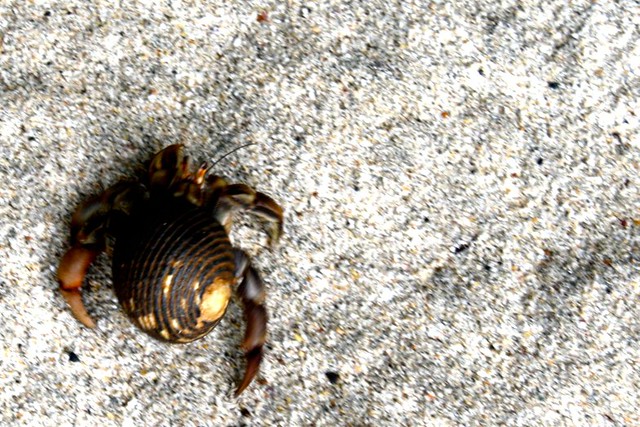
But the beach itself was not only a beautifully clean stretch of white sand, but it had life of its own. It was covered with hermit crabs.

https://i0.wp.com/farm3.staticflickr.com/2806/11870532986_fa2ff7aaa5_z.jpg

And there were still bromeliads everywhere.

https://i0.wp.com/farm4.staticflickr.com/3720/11869967163_4f32640f8c_z.jpg

We swam for a while and ate the sandwiches the hotel had packed for us. The French couple went snorkeling a little more. This area is quite well-known for starfish. Our guide caught a couple for us.

https://i0.wp.com/farm4.staticflickr.com/3786/11870131554_3e072dc787_z.jpg

But he also made sure they stayed wet and when we had finished photographing them, he gently tossed them back into the sea. 

He also found some conch. I think this went home for supper.

https://i0.wp.com/farm8.staticflickr.com/7417/11870133034_1c3936083b_z.jpg

After this we went to another small island with a beach. This one was clearly popular with Panamanians enjoying their summer holidays. I suppose at the equator you still have to pick some months of the year as summer, and since December to March is generally drier, they call this summer. They were having a party on the beach with boom boxes and barbecues. A boat pulled up to sell them live langosta.

https://i0.wp.com/farm8.staticflickr.com/7291/11869702855_d4de4577dc_z.jpg

Snob that I am, I found all this intrusion on natural beauty vaguely offensive, so I went off to find a more secluded place. I walked down the beach until the rocks turned into small boulders. These became quite slick, and I also became aware than John had wisely decided not to follow me. By the time I figured out that I had been really foolish coming this way, it seemed more dangerous to go back than to keep on trying to go forward. Meanwhile, the rain, which we had seen looming in the distance before, arrived.

https://i0.wp.com/farm6.staticflickr.com/5489/11869701815_8ea4a0167f_z.jpg

Right about this time, I saw an area where the bluffs above the rocks had a break in it, and I figured that I could walk back through the jungle to where our boat was located. This was probably a better idea than walking further on the shore, but as soon as I was in the jungle I became completely disoriented and had no idea which way to go. I remembered Arnold in Silico Creek had described being bit by a copperhead when he was young and I wondered if there were any on this island. Being an English major, I consoled myself by recalling the opening verses of the Divine Comedy.

Midway upon the road of our life I found myself within a dark wood, for the right way had been missed.

Ah! how hard a thing it is to tell what this wild and rough and dense wood was, which in thought renews the fear!

Fortunately, I had the good sense to move beyond poetry to some survival skills, and I heard the pounding beat of the Panamanian music in the distance. I figured if I kept moving towards the music I would soon find the beach and our boat. And it worked! I was saved by a boom box! Unfortunately, when I arrived, the boatman told me that John had become worried and he and the guide had gone off looking for me. Fortunately, they had not gone that far and I saw and called to them. When he reached me, John tried to strangle me! Honestly, I could hardly blame him. 

After this, we headed back to the hotel. After being lost in the jungle, I can scarcely tell you how nice it was to see the room!

https://i0.wp.com/farm6.staticflickr.com/5538/11870135944_f6eb7f0662_z.jpg

John wanted to keep on exploring and to get a water taxi to take him to Isla Boca Brava, the island directly across from the hotel. I had frankly explored enough for the day, and I just wanted to nap by the infinity pool. So he set out for Boca Brava by himself on a water taxi.

https://i0.wp.com/farm4.staticflickr.com/3739/11870140854_c620a4d8d3_z.jpg

There is one hotel on Boca Brava, but it the kind of place young German backpackers like. It did have a nice view from its restaurant.

https://i0.wp.com/farm4.staticflickr.com/3737/11869705625_fd2929de29_z.jpg

John had come to Boca Brava looking for sloths and monkeys. He did not find any sloths, but he did see a few monkeys.

https://i0.wp.com/farm6.staticflickr.com/5516/11870541736_90b215977e_z.jpg

At the boat dock, while he was waiting for the water taxi, a young kid came and practiced his English with John.

https://i0.wp.com/farm6.staticflickr.com/5492/11869981123_94d49c717d_z.jpg

Meanwhile, back at the hotel, I was admiring the sunset.

https://i0.wp.com/farm6.staticflickr.com/5492/11870138884_72f874c00f_z.jpg

We had dinner. The service was unbelievably slow, but I brought along the MacBook and edited pictures while I drank some vinegar that was supposed to be Argentine Malbec. But when the scenery is this perfect, really, who cares?          

Just Possibly Paradise

Our final morning in Boquete was clear

https://i0.wp.com/farm3.staticflickr.com/2838/11845859485_bcdef2948e_z.jpg

but still quite cool!

https://i0.wp.com/farm6.staticflickr.com/5494/11853276683_4acd0dfd5a_z.jpg

There was some problem – we never quite figured out what it was – with our transit to the Pacific Coast. The driver did arrive, but over an hour late. We liked him. His name was Alexander and he spoke pretty good English. He took us through the back route to Boca Chica and along the way explained a little of what we were seeing. I wish I had taken pictures here of some of the different landscapes. It was definitely far drier than on the Caribbean coast, and much of it reminded me of the scrub Mesquite forests in parts of north Texas. We went by several hydroelectric projects, and he told us about how much the indigenous people fought the construction of these dams. It took us about two hours to make it from Boquete to Boca Chica. We had told Suzie, our fabulous travel agent, that we wanted to end the trip with a bit of a splurge, and a place where all we would want or need to do would be to sit on the beach or by the pool! She hit a home run by picking the Hotel Bocas del Mar!

https://i0.wp.com/farm3.staticflickr.com/2854/11847728223_25711b93a3_z.jpg

The hotel is owned by a Belgian family, and we were warmly greeted by Joost, who spoke impeccable English with a hint of a Flemish accent. Our room was not yet ready as it was only about noon, so we had lunch. 

https://i0.wp.com/farm3.staticflickr.com/2873/11847865994_aa7a3d8a98_z.jpg

When we were shown to our room, it had an utterly fabulous view. And there was a bucket of champagne there because I think they had been told that this was sort of our honeymoon!

https://i0.wp.com/farm4.staticflickr.com/3751/11847452565_6922bd7f7e_z.jpg

I could spend the rest of my life on the deck here. 

https://i0.wp.com/farm4.staticflickr.com/3773/11847732043_dd42ca7bd7_z.jpg

Except the view from the bathroom is pretty stunning, too!

https://i0.wp.com/farm8.staticflickr.com/7431/11848252546_f76622095c_z.jpg

Just below our room, number 15, there is an infinity pool.

https://i0.wp.com/farm8.staticflickr.com/7373/11847457495_6b437df5a9_z.jpg

I found it almost impossible to not spend the whole afternoon in it!

https://i0.wp.com/farm6.staticflickr.com/5549/11848255246_93783de291_z.jpg

In the evening, John was taken with the beautiful clouds.

https://i0.wp.com/farm3.staticflickr.com/2883/11848258106_05a46b7e45_z.jpg

The sunset was gorgeous.

https://i0.wp.com/farm3.staticflickr.com/2880/11847876494_f731dd0db1_z.jpg

We had a fine dinner. The service was slow, but the wifi was fast, so I was more than content. 

Tomorrow will be our last real day of vacation as Friday will be most about getting transported back to Panama City for our flight Saturday morning. A couple of you have asked about Edie. She has been in great hands with Jason and Heather while we have been gone. In fact, she seldom get trips to Runyon Canyon with us!

IMG_20140103_153432