
Yesterday, John and I had an early day. We were up as soon as the lovely Italian sun came streaming through the windows of our Roman apartment. I made some coffee—a Nespresso machine, of course—and packed up the two of us. Our taxi arrived right about eight o’clock to take us off to Fuimicino, the larger of Rome’s two airports.
I had booked our flight to Lisbon on TAP, the Portuguese national airline. I admit I had never heard of them before, but the only other option for a direct flight was Ryan Air, and that is a completely miserable experience. I looked at business class on TAP, but it was almost triple the price of economy and I figured that for a three-hour flight John would just have to be a little uncomfortable. But when I started the check in, suddenly the upgrade to business was less than two hundred each. I decided to go for it.
The flight was okay. It turns out that business class on TAP consists of a guaranteed empty middle seat plus a reasonably good lunch. This did make John a little more comfortable as he could stretch out a bit. The flight attendants could sense that John had some mobility issues and they were quite helpful and kind.
At Lisbon airport, I had a ride already arranged to the airport. This was some kind of reward for using Booking.com so often. Our driver was a Brazilian who is in Portugal about to start his PhD in education. He was a huge fan of American basketball, so when he heard we were living in Oregon he was excited. “Portland Trailblazers,” he beamed. “Very good team!”
We checked in to our hotel, and the moment we were in the room we took a nap. After sleeping for a little bit, we went out. We had some coffee in a little square while we heard a group singing.

One of Lisbon’s famous trolley’s went past.
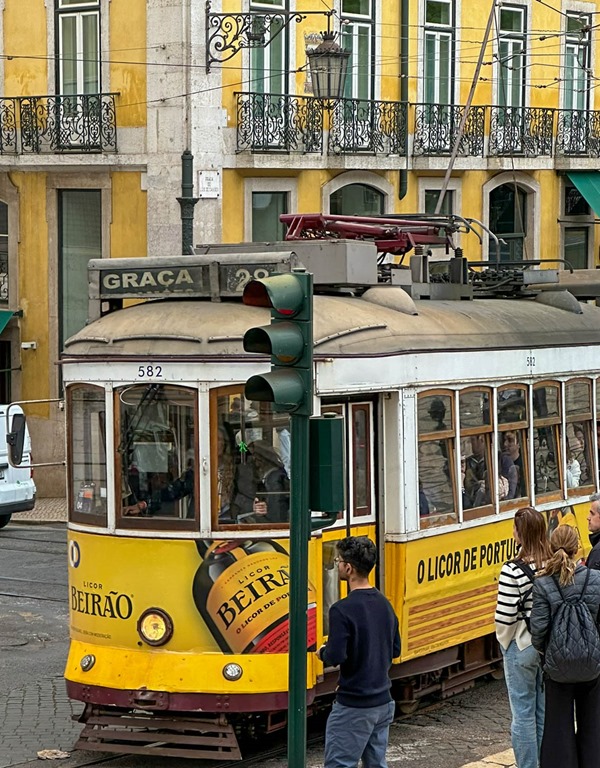
It was a little chilly so, we did not spend long in the square after our coffee. After that, we had a Portuguese dinner is a restaurant called Trinidade, housed in a former monastery, and we called it a night.
Our hotel in Lisbon was the biggest splurge of the trip. Most places in most towns in Portugal are reasonable, and many are downright cheap. But Lisbon is always the most expensive, and on weekends the prices go up. So looking at the options I decided we would stay at the Palácio das Especiarias, the former home of a wealthy Portuguese trading family, now a boutique hotel.
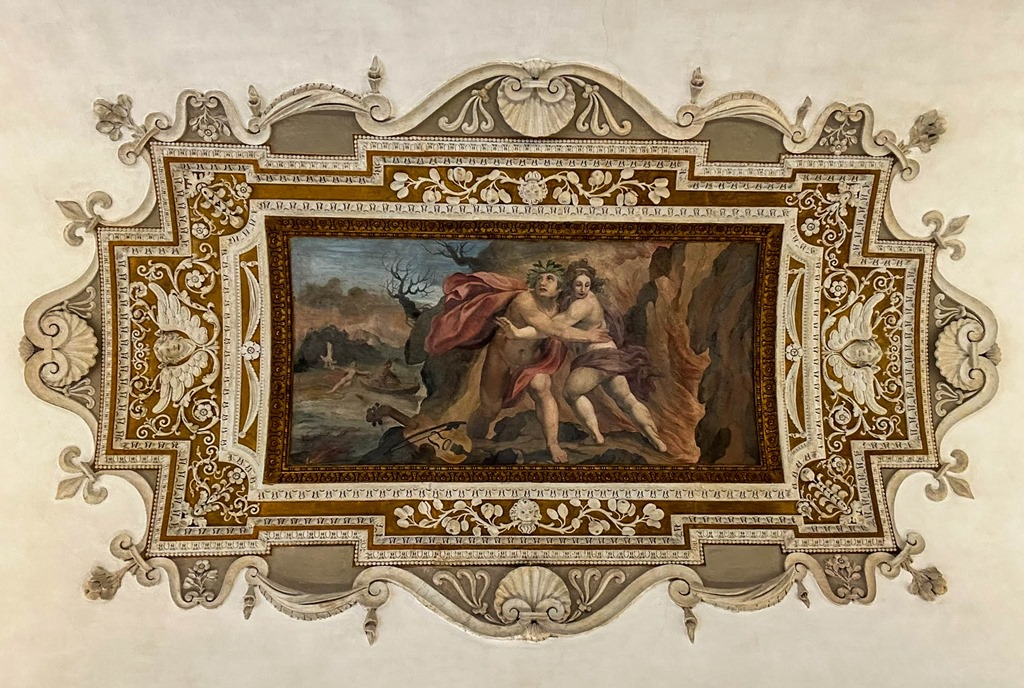
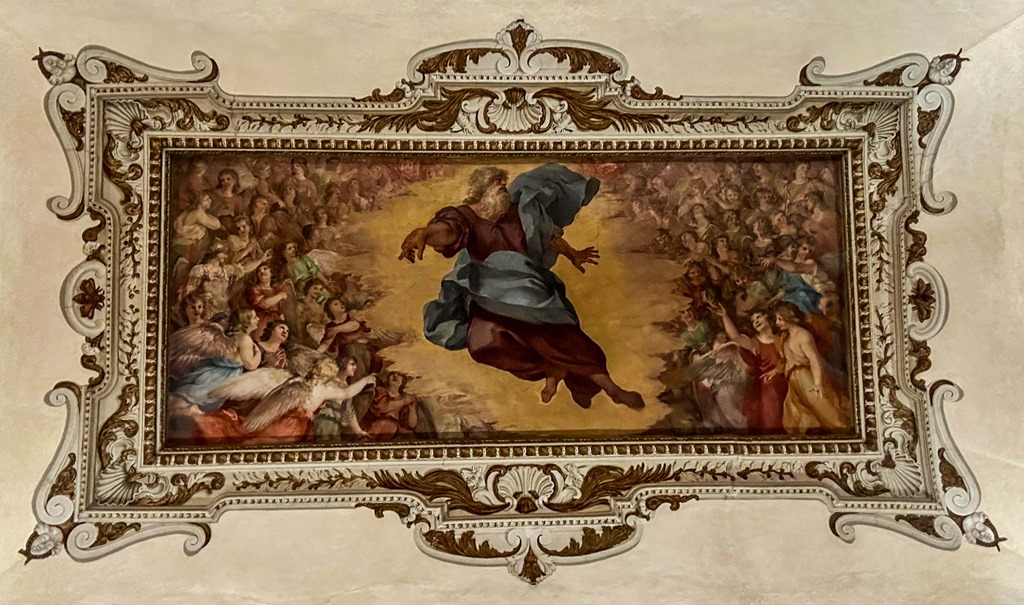
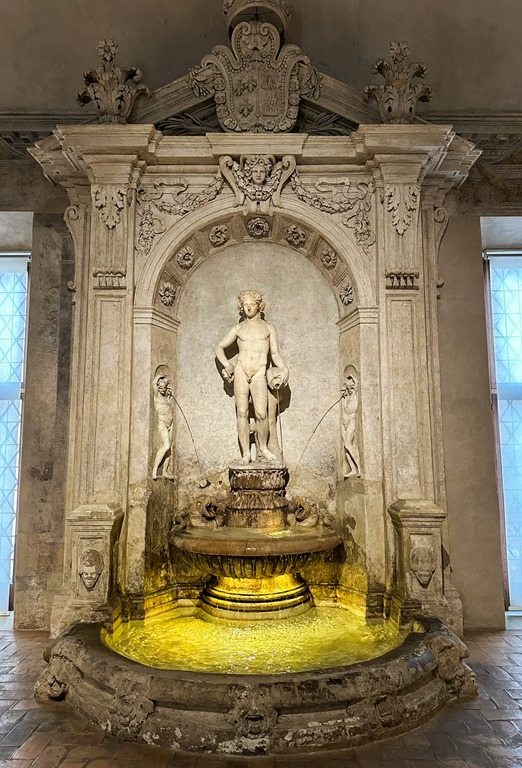
The public rooms are quite elegantly furnished.
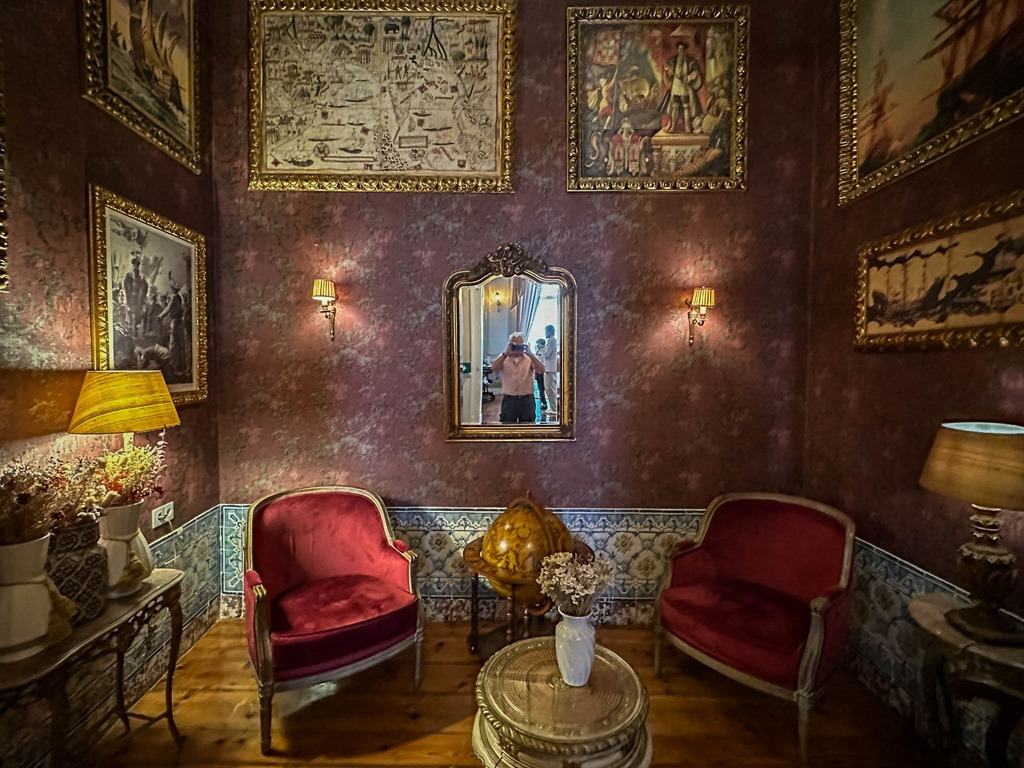
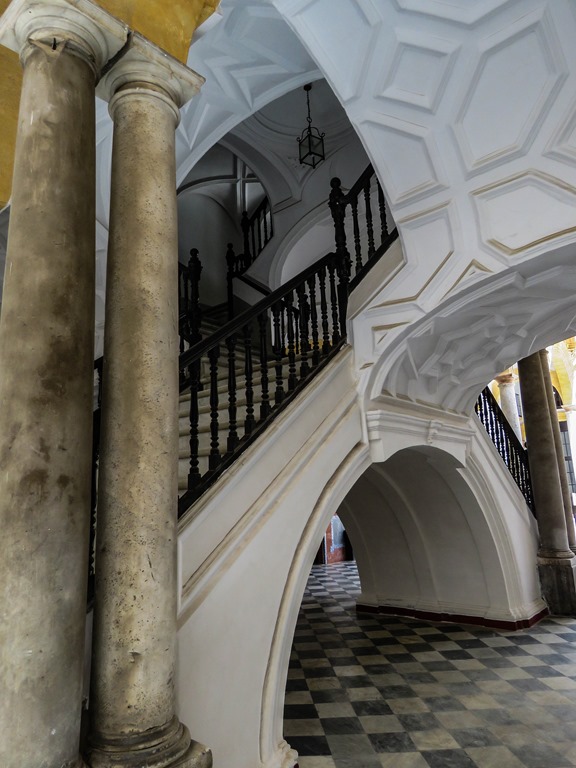
I particularly loved all the faux marble effects such as in this staircase.

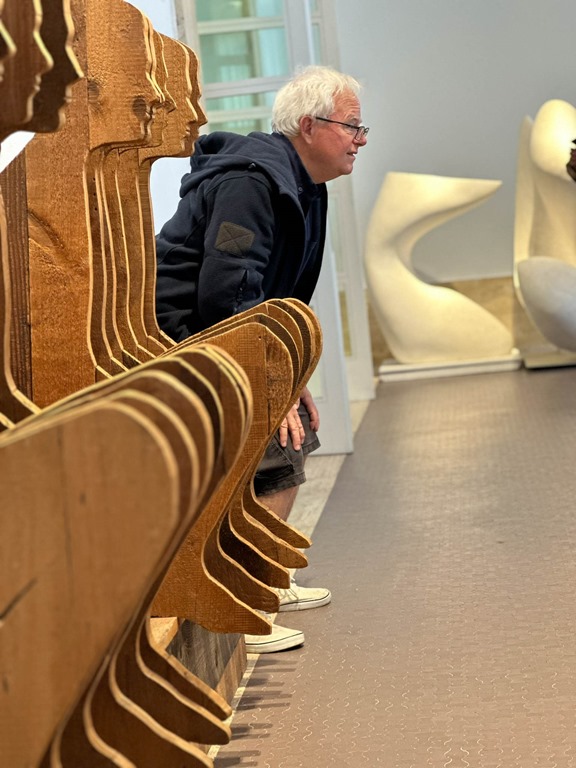
Breakfast was served in several rooms on what we would call the second floor, but the Portuguese call the first floor. I liked this odd piece of furniture in one of the rooms were the buffet was laid out.
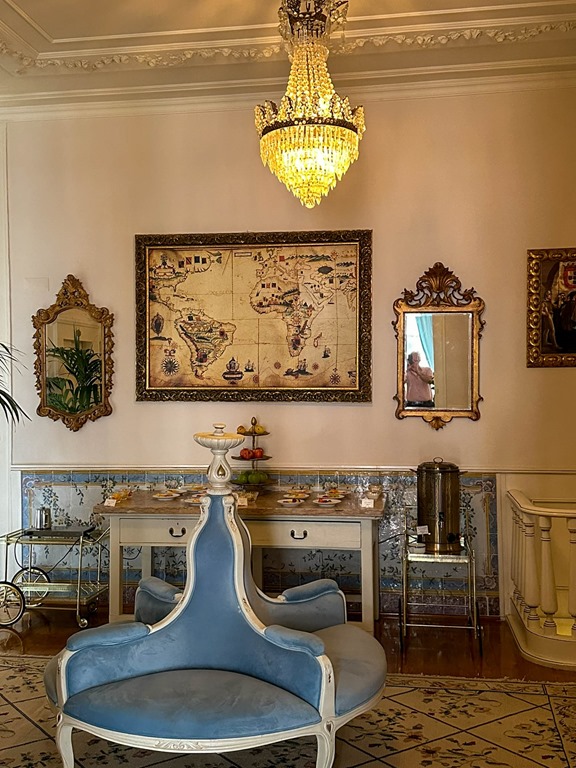
Four people can sit there and not have to talk to each other! I need to get this for my living room.
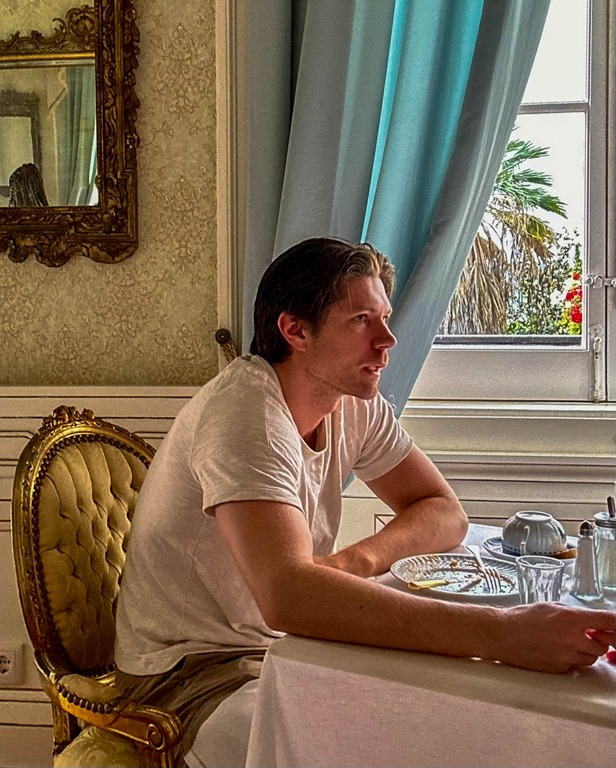
John spent his time at breakfast thinking about pretty things that were not part of the permanent décor.
Walking around, I could tell that many of the room were spacious and beautifully furnished. I had my heart set on a room with a view of the estuary, and those, it turned out, were on the top floor, an area that pretty obviously had once been servants’ quarters. Our room was nice enough, and it had a wonderful view. But it was overpriced for what it was.
There are a lot of things to see and do in Lisbon. In our youth we would have spent twelve or fourteen hours rushing from one to another, determine to see and do everything. But now, John’s energy is far more limited, so it works out best to do a couple things only. So our plan for the day was to visit the National Tile Museum in the morning, followed by a look at the area around the Cathedral. In the evening, I had arranged a Portuguese cooking class for us.
The day started out as planned. We took a Bolt—that is the local ridesharing platform—to the tile museum. It may seem odd to spend time a museum devoted to making tiles, but tile is a Portuguese obsession. Most older homes in Lisbon have a fair amount of tile inside and there are some whose exteriors are completely faced with colorful ceramic tiles. It is considered the national art form.
Like so many things in the Iberian peninsula, there is a Moorish influence here. The early Portuguese tiles, we learned, were derived from Islamic models.
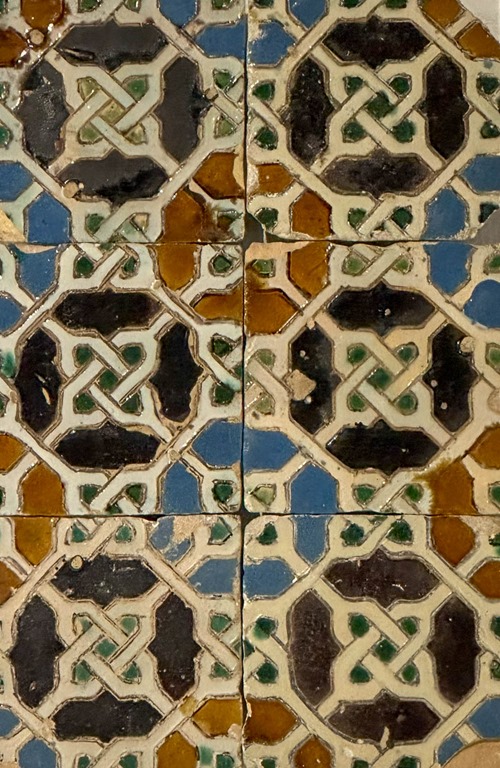
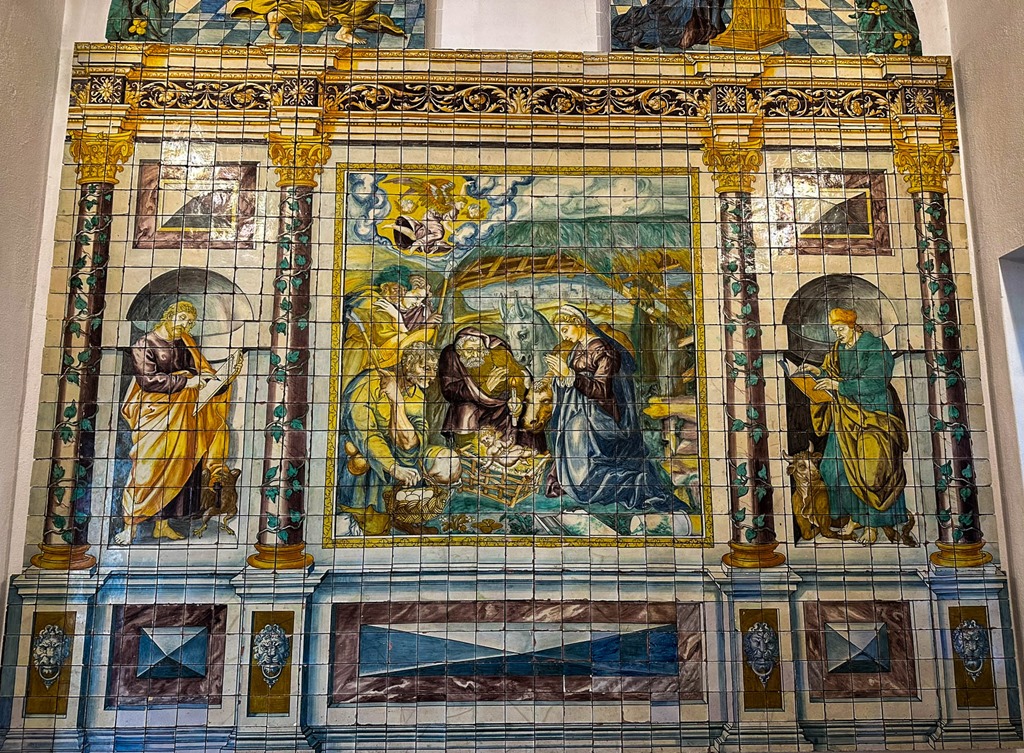
But the Christians soon moved beyond geometric abstractions and began to paint pictures of biblical scenes on them.
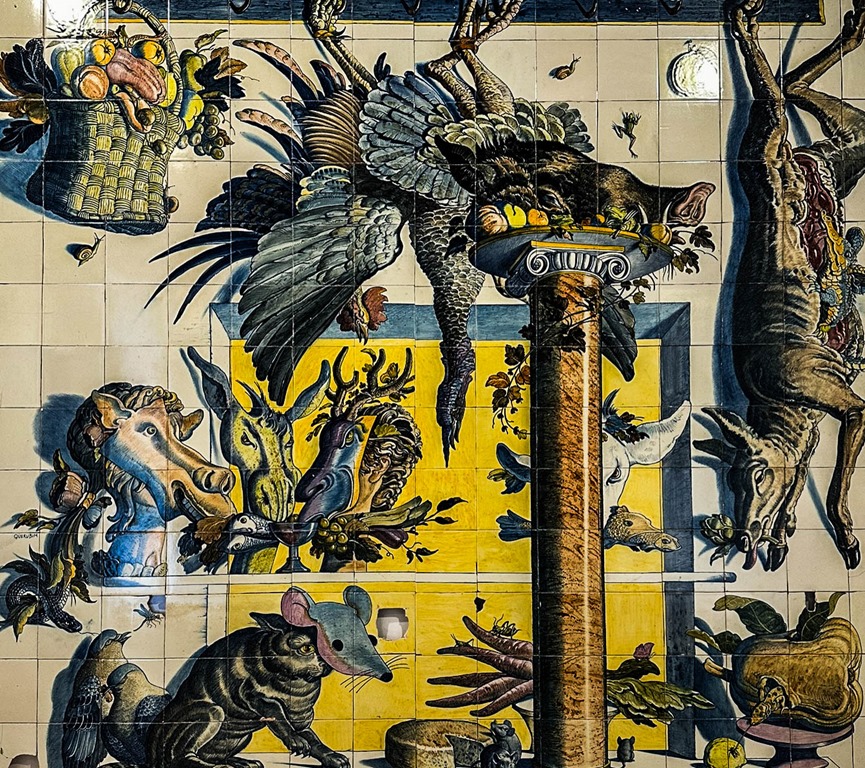
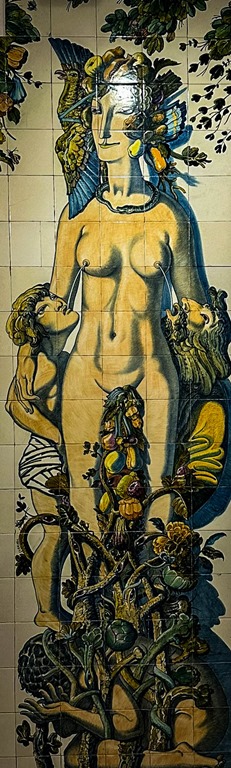
Many of the classic Portuguese tiles, particularly from the eighteenth century are blue and white. This reflects both Chinese and Dutch influences. I find these a little boring, so I did not take that many pictures of them. I did find some of the modern versions of tile fascinating. These were made for the walls of a kitchen.
The tile museum is also located in a former convent, as you can see from the cloister.

Unlike most of the dissolved monastic sites, the church here was preserved. It is absolutely stunning.
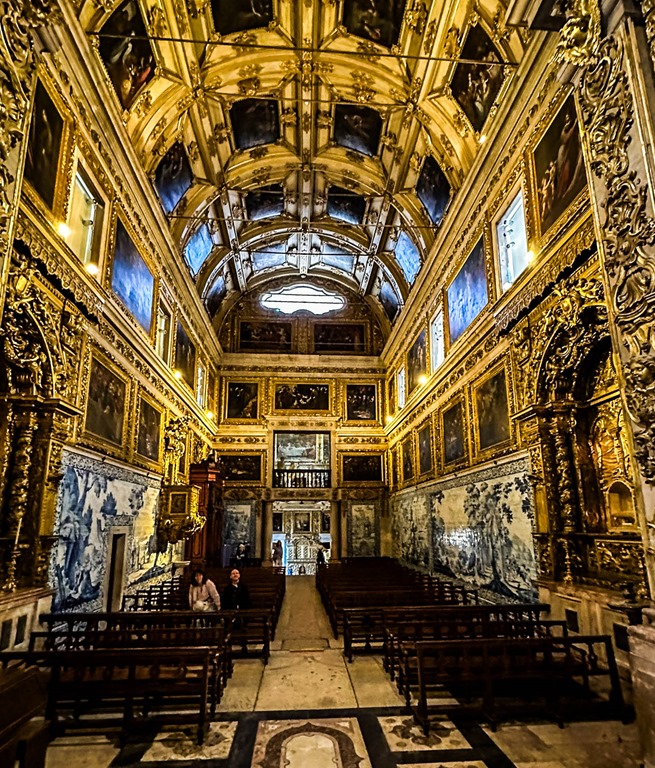
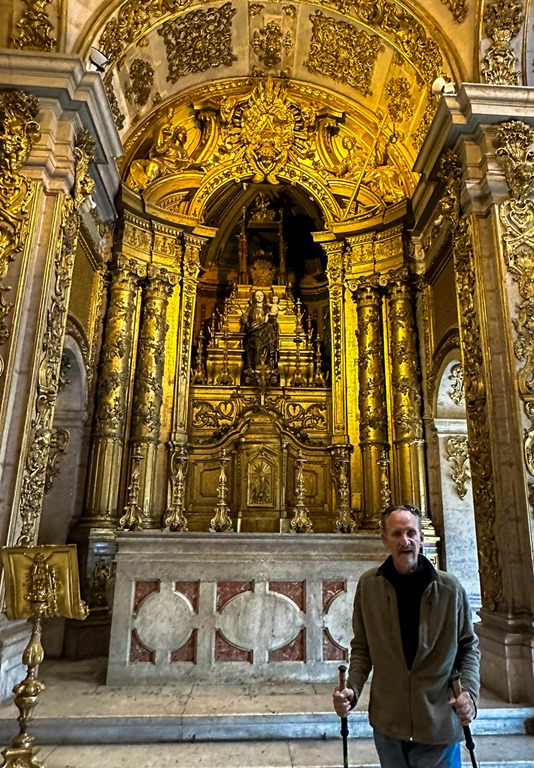
After a couple of very informative hours in the museum, we had seen it all. John was up for one one more sight, so we went ahead to see the cathedral. I was mostly interested in this building because it was one of the few to not be completely destroyed in the devastating 1755 Easter Sunday earthquake.
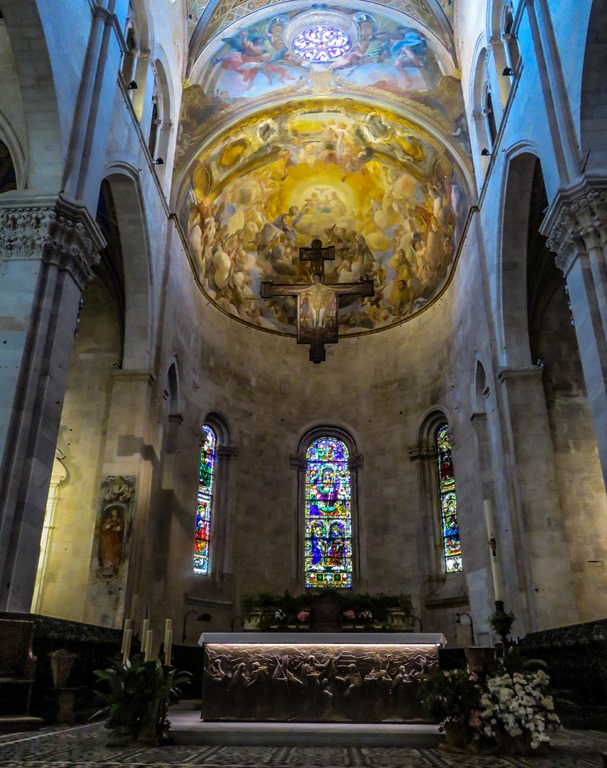
The building is not that great. Construction was started by the Normans, and it looks more like a castle than a church from the outside. The inside is dark, with massive stone walls and barrel vaults. There was some effort later to make the choir and the apse look more appealing.

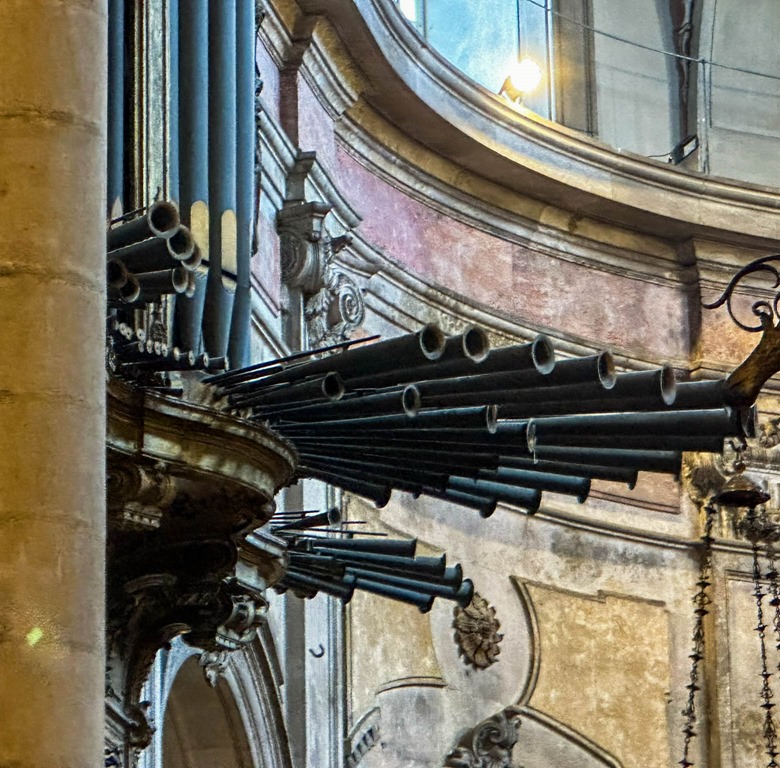
I was fascinated by the en chamade trumpets on the historic organ
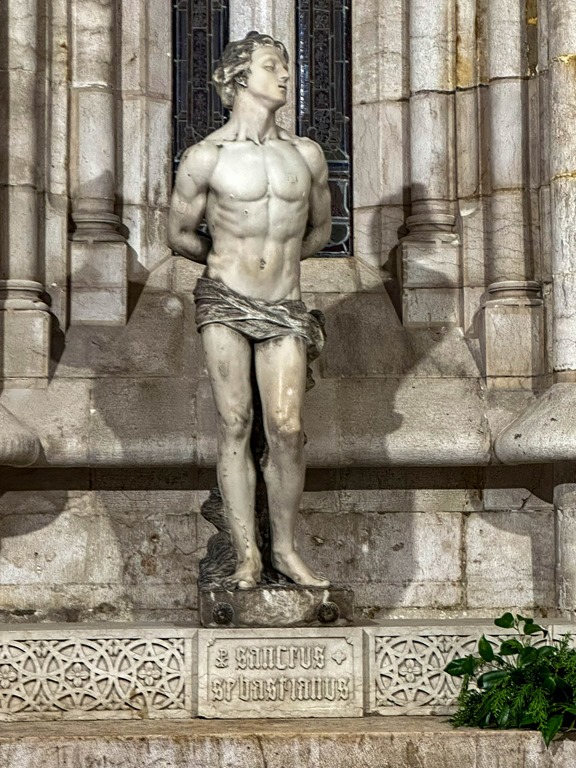
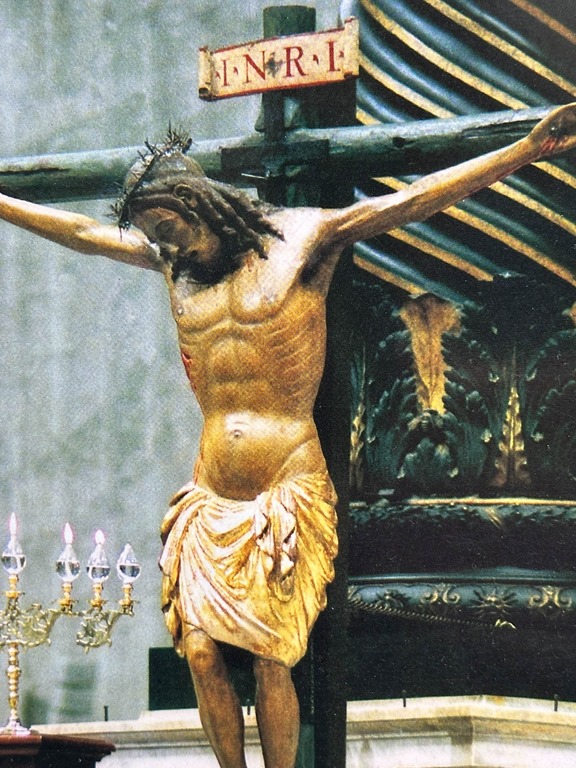
while John gravitated to a statue of Saint Sebastian.
We did not spend that much time in the Cathedral. After we walked out, John was feeling good, so he started to walk around the neighborhood with his trekking poles. And that was when disaster struck. There was an area where the cobblestones were missing and a small orange mesh fence marked it off. The sun was quite bright, and John just did not see the mesh. His poles caught in it, and he fell face down.
I raced over to him. His faces was covered in blood, mostly coming from a gash in his nose. Somehow, he had not hit his forehead. He was sure he had broken several teeth, but I checked, and they were fine. One small and painful touch, though, told both of us that his nose was broken.
A crowd gathered. A woman who looked Pakistani gave John her handkerchief. It was soaked in blood in a minute. I opened the wheelchair, and a couple men helped John to get into it. A Portuguese woman pulled out her phone and told me in English that she was calling the ambulance. She stayed until they arrived and helped translate for me.
The ambulance took us to the Hospital de São José. If you look up this medical facility online, you will be told that it is a world-class teaching institution with some of the best facilities in Portugal. If you talk to people in Lisbon, you will be told that the place is a nightmare where people often wait for care for hours and never see a doctor. Both are probably true.
It was a little scary to be in a hospital and unable to really communicate with people. A few staff members spoke a little English. Almost all of them radiated indifference to the patients. There was some system where numbers were displayed on a screen and you were expected to go to the consulting room that corresponded with the code on a sticker you were given. But nobody explained that to us. A few times we would hear names called as well. After two hours, we heard, “Pratt-John-Winsor room 7.”
We talked to a young doctor. She spoke decent English. “You did not expect to get to see the Portuguese health system on your trip,” she said. I noted that she sighed and rolled her eyes when she said “Portuguese health system.” She cleaned the wound and agreed that the nose was broken. She said she was planning to order a CT scan for his head, and that he would be evaluated for stitches inside his nose, a procedure she said would be done under general anesthesia. All that started to make me really nervous because these people have no access to John’s extensive medical history.
We went back to the waiting room. And we waited. And we waited. And we waited some more. By this time, my cooking class had already started, and there was no way I could have gone anyhow. John was feeling really restless. The bleeding from his nose was only a trickle. He said he just wanted to go back to the hotel.
I went to the desk and tried to pay. I had been quoted 112 euro for a basic evaluation. The man brusquely told me that he could not charge me until John was released by the doctor. I told him I had no idea who the doctor was. He almost exploded and told me to find her. I went back and sheepishly knocked on door to examination room seven. There was nobody there.
So, we just left. Part of me was certain that somebody was going to chase after us, but when we walked out the emergency room doors there were only a cluster of staff members smoking in the street. We grabbed a cab and went back to the hotel.

































 Traveling Johns