Two Plays, a Museum, a Concert, and some Laundry
This was one of our tougher days. Even though the hotel was less than half a mile to the airport main entrance, we still took a cab as we had bulky luggage and John has medical conditions. The drop off point, however, was still not exactly close to the airport departure area. I wondered what somebody with more challenges than John would have done. Nevertheless, we made it to the airport in what seemed to be more than enough time. I felt like things were going smoothly. We picked up our boarding pass and deposited our luggage. We then went to the office of “special assistance” so that John could have help getting through security and to the gate. We waited there. And we waited there. And we waited some more. Almost nobody spoke to us, and when we finally managed to get someone’s attention, he seemed to suggest that we should have come earlier if we needed help. But a young man finally came with a wheelchair and efficiently moved us through security. He was great and I tipped him generously.
As it turned out, we had plenty of time as the plane was delayed by close to an hour. EasyJet is often called “Squeezy Jet” in the UK as they shove as many people as possible on each plane. If you have ever flown Frontier or Jet Blue, you have the basic idea. Poor John was crammed into a tiny seat with his knees somewhere around his navel. Despite being so uncomfortable, he somehow managed to fall asleep.
He woke up just before we landed at Gatwick. There was a man waiting there with a wheelchair to help him, and he took John down to baggage claim. While we were waiting for our bags – a process that took over thirty minutes – John discovered that his phone was missing. We immediately figured out that John must have dropped it as he was exiting the plane. We also knew that we had exited from the secure area of the airport and that there was no way we could go back to get it. I figured we had lost it forever.
It took almost 45 minutes for the baggage to arrive. We went over to the EasyJet check-in desk to ask about lost and found. The people there seem befuddled by the question as if nobody had ever left anything on a plane before. One woman made a couple of phone calls, and then told us that yes, a phone had been found on our plane. We asked where and when we could pick it up. She was not sure, but told us to wait in the assistance area and it would be delivered there.
So we went there and waited. And waited. And waited some more. I finally told John I was going to go back to EasyJet and ask again. I had the same confused expressions from several of the people at the desk there until one woman, apparently a supervisor, seemed almost embarrassed by the situation and decided to get involved. She made a couple phone calls and asked a guy named Gavin to come and deliver the phone to her. It took about a half hour more, but I finally had the phone in my hand. John was so relieved when he saw it!
But by this time we had spent at least an extra three hours in Gatwick. And by the time we caught the train to Victoria Station and a cab from the station to the little studio apartment I had rented for us in Leicester Square, it was late afternoon and we were both exhausted by the ordeal. So we just decided to skip even attempting to go to a play today and we just went out for dinner in Soho.
As usual, London’s Chinatown was crowded and festive.
From Saint Andrews we drove about an hour to Edinburgh. We have an early plane tomorrow for London, so I decided we would just stay at the airport Hilton. It is hardly Rufflets, but all I want is to get to the airport on time tomorrow. I did not want to drive into Edinburgh, so I left the car at the hotel and we took an Uber into the city to have dinner. I picked an interesting restaurant from one of the guidebooks, and discovered after we had been dropped off that it had not survived the draconian Scottish COVID lockdowns. We took another Uber over to Princes Street. In the gardens there, we saw a lovely floral display to commemorate the Jubilee.
We had a great guide who walked us around the field explaining the background of the conflict, the movement of the troops, and the course of the fighting. The actual fighting began when the Jacobites, that is the supporters of Charlie, fired a canon shot that landed on the roof of this cottage.
We are staying at the Palace Hotel directly across the River Ness from the castle. You can identify it from the turrets in the picture below.
We took home a few leftovers from the restaurant. Back at the hotel, we had a particularly aggressive visitor who demanded a share of the food.
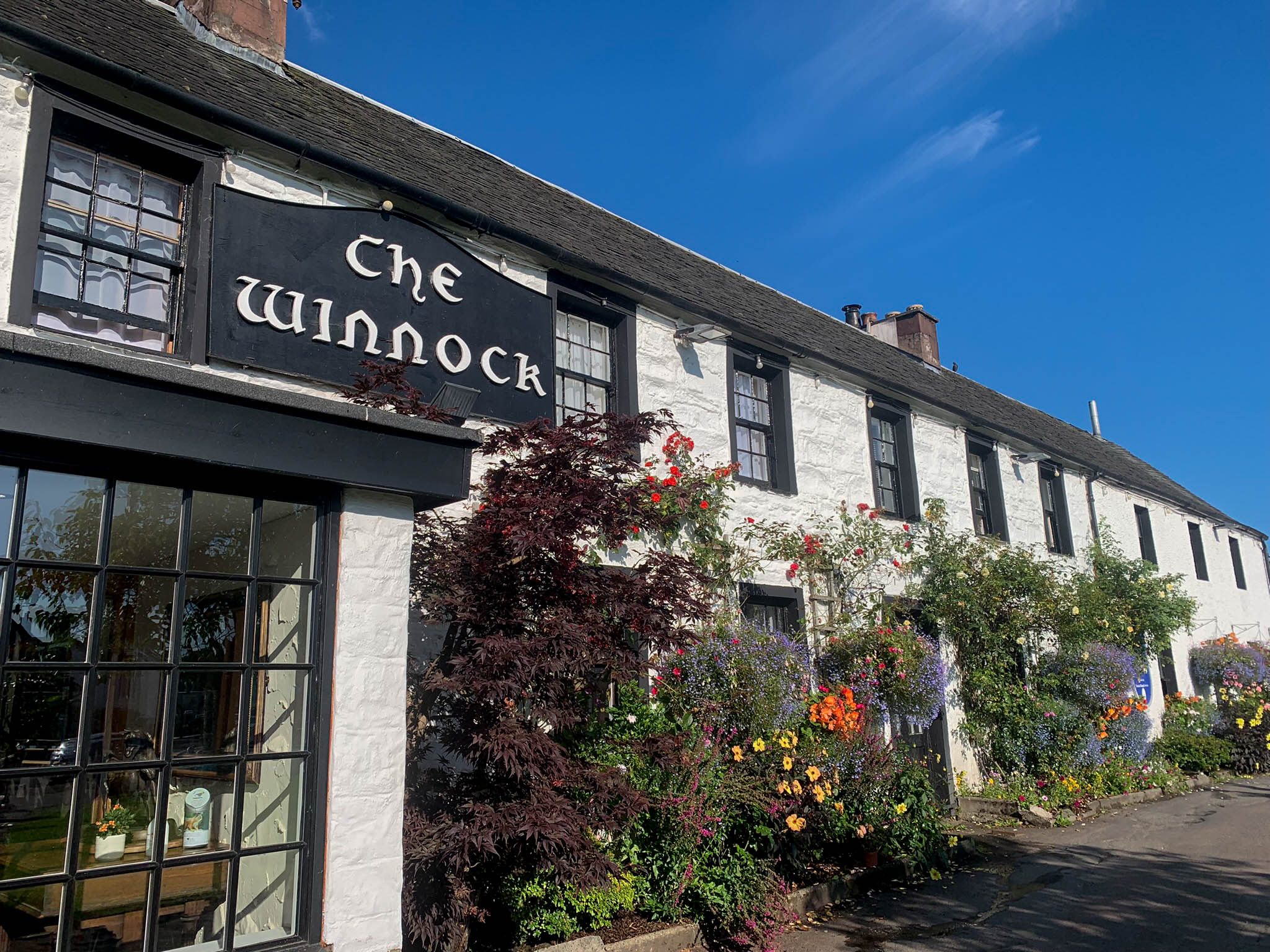
It was a bright, beautiful cool morning when we woke up in Drymen. My weather app said it was a brisk 46 degrees, but when I considered how hot and dry things are in Southern Oregon, I felt very grateful to be in Scotland. We had breakfast and packed up. Before we left, we took pictures of our hotel
But rather like Hetch Hetchy, others saw wasted water where Scott saw a mysterious spirit in the depths. So for the past 150 years Lake Katrine has also been the City of Glasgow’s municipal water supply. Not everyone was thrilled with the change. When the first water came piped in from the Trossachs to the city, a Glaswegian, accustomed to the brownish well water, supposedly exclaimed, “It’s got nae color, nae taste – it’s nae good!”
We drove on. The scenery suddenly became extremely dramatic.
This is both Scotland’s most famous scenic area and the scene of its most famous massacre. It was here that the royal army, led by a Campbell, slaughtered men, women, and children of the MacDonald clan. Many of those who fled from the soldiers died in the winter snows in these mountains. For most Scots it is hard to separate the scenery from the savagery, no matter how bucolic it seems.
Today is part of the August Bank Holiday weekend, so it was it was hard to get a place to stay. I did find a bed and breakfast just outside of Glencoe. It only has two rooms, and I immediately had the sense of staying with a maiden aunt. But it was located in a beautiful area.
Today was the end of our cruise, and although I am excited to start our exploration of the Highlands and then to see our friends in England, I am sad to part with the friends we have made on this boat. The sights have been interesting, the scenery rather breathtaking, but the best part of the experience has been the people we met here. I will always remember Shirene
![]() |
Roger and Sandra,
Annemarie and David,
We pulled out of Tobermory early in the morning and sailed down the Sound of Mull. It did not take us long to reach our first stop of the day Duart Castle. We all bordered the tender
and headed toward a small stone pier.
John was snapping a picture of the castle itself, looming high above us on a bluff.
particularly this iconic one.
A seal seemed to be posing for us, though he was probably just too lazy to get into the water. We also saw a white-tailed eagle, Scotland’s largest bird of prey. It was hard to get a good photograph here without having a special lens for my camera.
Just before we landed, we took a look at a mussel farm. I think a lot of the production here probably ends up in Europe.
Even compared to much of the American West, the Scottish islands are empty. It is hard to grasp that these places were once filled with small farms and villages prior to the clearances of the eighteenth and nineteenth centuries. Now, there are not even all that many sheep left there. I had a sense of melancholy as I went by much of Mull. Maybe, had my ancestors not been among those more or less forced to emigrate, I might not have have felt this so strongly.
We crossed to from Bunessan to Iona early and rather quickly. Ted wanted us to be there before the first ferries showed up, sometimes disgorging entire bus loads of tourists.
Given my background, I was already pretty familiar with Iona and the Iona Community. For those of you who have spent your life studying more normal and useful things, here is an almost brief synposis.
In 563, the Irish monk Columba, apparently expelled from Ireland, though the reason is not particularly clear, landed here at Iona and proceeded to establish a monastic community. Columba was clearly a charismatic personality, and Iona rather quickly became a center of Celtic monasticism. Like many of the Irish monasteries, copying and illustrating manuscripts was a central activity, and The Book of Kells, perhaps the greatest artistic achievement of the era, was created here on Iona. Unfortunately, all this attracted the attention of the Vikings and after successive raids the monastery was ultimately abandoned. Almost nothing remains of Columba’s monastery.
Around 1200, a group of Benedictines reestablished monastic life on the Island. Both monasteries for men and women were founded, and these thrived for about the next three hundred years. Scottish monasteries were not directly affected by Henry VIII’s suppression of the monasteries as Scotland was an independent kingdom at the time, but none of them survived the radical Scottish Reformation led by John Knox. The monasteries were left in ruins, and Iona became only another fishing village.
About 1900, the Duke of Argyle, whose lands included the village of Iona, decided that the “cathedral” there needed to be restored. Rebuilding ruined castles and churches was an obsession of the Victorian period, so it is somewhat surprising that it took so long to turn attention to Iona. The Duke established and endowed a foundation to restore the building.
During the Great Depression, George McLeod, a liberal Church of Scotland minister in Glasgow, wanted to establish a retreat and study center for his fellow Presbyterians, particularly those who shared his commitment to a kind of socialism. He was allowed to establish this on Iona, using the partially restored abbey building.
The Iona Community has been tremendously successful, and the Community finished the restoration of the abbey church and building a retreat center adjacent to it. Although I find worship resources the community produces to be almost unbearably vapid, they are extremely popular among mainline Protestants in the United States.
As you approach Iona, the abbey building immediately catches your eye.
Ted took us in the boat to the town pier. One of the smaller CalMac ferries does dock here, so the pier was a somewhat more solid structure than many places where we have disembarked. The town is almost unbearably cute, rows of whitewashed house with ample gardens facing the sea.
The abbey church is always visible from just about anywhere you look.
I was a little underwhelmed the church, however, we we arrived. The visitor’s center does a terrific job providing a variety of interpretive and historical materials. I learned a fair amount I did not already know about both early and later monasticism here. I was particularly fascinated by many of the crosses on the site, and some of them, like this one, are quite ancient.
But the abbey church itself was disappointing. The interior of the church itself is quite stark. There is no sense of the richness and sensuality of medieval Catholicism. Instead, the feeling is far more Calvinist.
On our way back, we passed George McLeod’s house.
Perhaps I am cynical, but this seems a little grander than living in the slums of Glasgow. I wanted to update Viking Cruises’ motto to “Saving the world … in comfort.”
In the afternoon, we finally did make it to Staffa and Fingal’s Cave. Ted, waving hello here,
split us into two groups. One group would come with him in the tender into the cave itself, while the other group would go up to the top of Staffa and enjoy the view. John and I were in the first group. As we came close to the cave, John noticed how similar it is to the Giant’s Causeway in Ulster. Ted regaled us story of formation of Giant’s Causeway was formed by a big, but stupid Irish giant, who was tricked by a smaller, but much more clever Scottish giant. I wondered if they reversed the story in Ireland.
The exterior of the cave is dark and almost sinister.
But the inside is remarkably colorful. The water is an astonishing shade of blue green.
John definitely thought this was a high point of the trip.
When we returned to the dock to change groups, Ted suggested that John stay in the boat as he knew John could not climb the 100 steps or so to the top. The four who had walked to the top of the island could only talk about how horrible the “midgies” were. Midgies, very tiny flies the seem to swarm in clouds, are the bane of summer life in Scotland. I decided not to walk up to the top. Instead, I followed the path around the side to the cave hoping to get there when the boat did. And it worked. In fact, I was at the mouth of the cave as they entered.
And I snapped a couple photos of them as they made their way into the cave.
We left Staff and continue on, mooring for the night by Ulva, the “wolf island.” Tomorrow, Ted says that it may be stormy and we will be making tracks for Tobermory.