On Our Way

 I love to watch people taking airplane trips in movies. Not the modern ones, but old movies from the 1940s. The glamorously dressed man and woman casually walk up to the airline representative, casually ask for a ticket to New York or Paris, and then stroll on to the plane where they have a beautiful young women wait on them. And need I say that there is always a lot of space?

The beginning of our summer adventure, our first real trip since 2019, lacked any of this glamor. We took a cheap flight from Medford to Portland last night, and need I say that the Bombarier jet provided only a fraction of that woman’s legroom? 

We spent the night at the Radisson “Country Inn.” I picked this spot, dear reader, because it was cheap and had a free shuttle from the airport. I am not sure what exactly make it a country inn other than thed doughy biscuits with gloppy sausage gravy served for breakfast. Unless, perhaps it is a tacky little gazebo right just off the parking lot. 

The motto of this chain, as written on their shuttle, is “I love this country.” As I walked through the parking lot, I wondered if that was what had attracted the driver of this Prius with not-your-usual Portland decals. 

Ellen, my sister, and Mike, her husband picked us up at the hotel and we went to a really good Thai restaurant on Sandy for lunch. Ellen is the new dean of the College of Design at Georgia Tech in Atlanta. She and Mike used to live in Portland, and they still kept their house here with the idea of living here when they retire, and they have been spending their summers back in Oregon for many years.

After lunch, we went back to the airport. We decided to fly Icelandair to Scotland because we could get a free stopover in Iceland on the way. We on our way this evening. Icelandair has two classes of service on their planes, economy and “Saga Class.” The latter was not all that much more expensive than economy and I always like to make sure Mr. Pratt has enough legroom for his six feet and five inches. And for that it was worth it. Other than that, Saga Class sort of seems like flying first class on an American flight to Dallas.  Yeah, the seats are a little bigger and there’s more legroom. but other than that … well, it’s hardly Emirates. 

Montevideo

I was extremely excited about our trip to the Falklands. I was not particularly excited about returning to Montevideo. John and I had been here some years ago when we were doing an Easter Week trip to Buenos Aires and Punta del Este. I remembered Montevideo, particularly the center of the city, as being rather rundown and dangerous in spots. And I need go no further than downtown Los Angeles for that kind of experience! But I did not want to spend the day on the boat, so I looked online for things that seemed more interesting than the excursions that the Norwegian Sun offered. I came across a company that offered bike tours in English, and it looked like the route was pretty flat and easy. John was a little noncommittal about going, so I put off making a reservation. But two days ago, after we left Stanley, I finally sent off a request for a spot for two people. The woman who replied, giving her names as Professor Alicia Barbita, told me that there were two spots available, but only for the Spanish-speaking tour. I figured my Spanish is usually good enough for these kinds of things, so I agreed to it. 

It took a bit of searching, but we finally found our guides outside the port area. Our fellow guests again were all Mexican. There was a family with several small children, and there was a large man in his late forties with two enormous sons both in their twenties. I figured between the children and the fat boys we would not be going all that fast. And I was right! Our guides, a girl about 25 and a boy about 18, walked us up to where we were to get our bikes. While I can say nothing bad about our guides, I can also say nothing good about the bikes. I think if most of these bikes had been left unlocked on a street in Los Angeles, nobody would bother to steal them, even for scrap. And mine was absolutely the worst. 

IMG 7205

Nevertheless, it took quite a bit of time to get everybody fitted to a bicycle, no matter how bad they were, and to find helmets for the children. As I waited, I looked around. Montevideo still looked pretty shabby overall,

IMG 7204

but I could tell that they were attempting to slowly do some restoration. At least some Uruguayan hipsters had started to move downtown. 

IMG 7203

As I said, it was a Spanish-speaking tour, but our guides did speak some English and would usually give us the short version in English of what they had told the Mexicans in Spanish. I learned a bit more about the history of Montevideo. This is not a particularly old city. It was only towards the middle of the eighteenth century as Spain and Portugal began to contest their borders and particularly the control of the Rio de la Plata, that the Spanish decided to establish a settlement here. The Portuguese had already placed one a little further up the river, almost across the river from Buenos Aires, called Colonia de Sacramento. Colonia, by the way, is a truly charming place, and may have been the highlight of our previous visit to Uruguay. The Spanish did choose a strategic spot, a point with a good view of the entire estuary, and they placed both a city and a large fort there. I later found this map in the the local history museum. 

Montevideo 2  1 of 1

You can see all the characteristics of a city as mandated in the Leyes de Indias, the mandated model for all Spanish cities in the New World. There is a central square, the Plaza de Armas. On one side of it is the cathedral, always facing west, as the church required, always the most imposing building in the city. On the other side of the plaza is the colonial or municipal government building, always the second grandest building in the city. From the plaza, streets run east and west, north and south, in a perfect grid. Formidable walls surround the city, at least on land, and there is a military base to protect the city from enemies without and sometimes within. 

Today the Plaza de Armas is no longer suitable for mustering and training soldiers. Instead, there is a lovely nineteenth-century fountain in the middle. 

IMG 7211

The cathedral is nearly hidden among all the foliage.

IMG 7210

It is basically a neo-classical structure.

IMG 7213

The interior is pretty ho-hum by Latin American standards.

Montevideo 2  1 of 1 2

Back on the square, a statue of Bruno Mauricio de Zabala, the city’s founder, stands proudly on horseback. 

IMG 7206

The American craze for tearing down statues of dead white men, particularly if they are vaguely military or otherwise patriarchal, seems to have not yet arrived in Latin America. 

We had quite a while to wander around here. One of the things we noticed before in Montevideo is that people love to set up tables in public spaces and sell stuff. The goods displayed range from minor antiques to complete and absolute junk. And there is far more of the latter than the former. The last time we were here one table had quite a collection of severed Barbie doll legs as if somehow Ken had turned into Hannibal Lector. There was nothing that memorable today. 

IMG 7212

Oddly, I never really saw anybody buying anything and the vendors are as unaggressive as possible. I almost feel like setting up a table is a more a way to meet people than a meaningful income stream. 

From the old plaza, we went to a new one. This square is located where the old fort used to be. The main gate of that fortress was preserved.

IMG 7259

The rest of the square is dominated by an even grander equestrian statue, that of José Gervasio Artigas.

IMG 7224

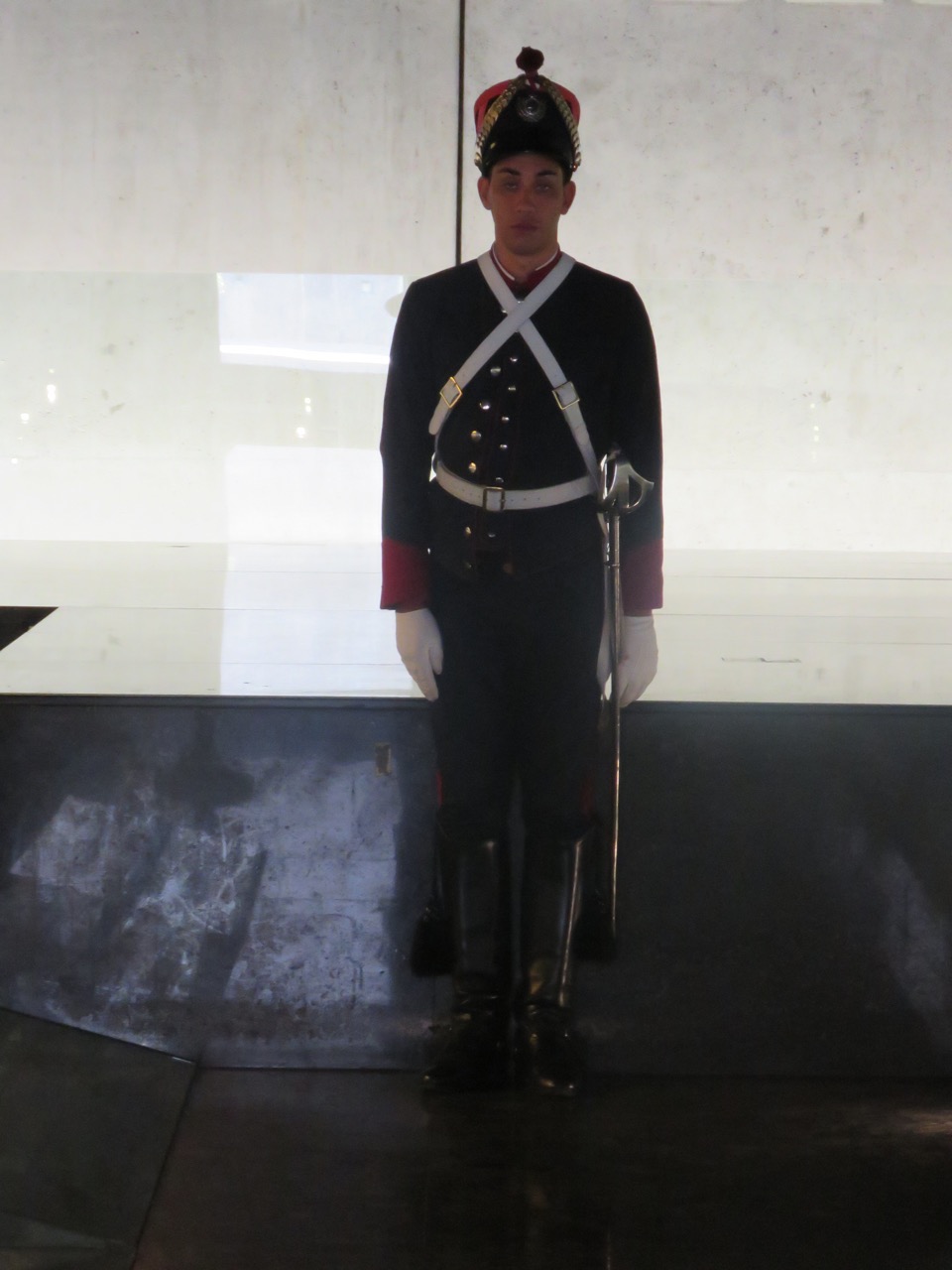
Artigas was credited with preventing Uruguay from be divided up among its neighbors, and so in a way he is the father of the country. Underneath the statue there is a crypt with his remains. 

IMG 7226

Two ceremonial guards stand on either side. 
IMG 7227

The area around Plaza Artigas is lined with office buildings old and new. 

IMG 7228

The Palacio Salvo is one of the most iconic buildings in Montevideo. It was once the tallest building in South America and it is still the tallest in Montevideo. It once contained a hotel and in the basement there was a theater where Josephine Baker and many other celebrities of the era performed. Today the Palacio is mostly used as office space. 

After our stop here, the tour continued on towards the shore. One of the nice things about Montevideo is that it has open shoreline from one end of the city to another. It rather resembles Chicago in this way. And just as Chicago has Lake Shore Drive, so Montevideo has its “Ramblas.” Again like Chicago, some of this area is well-developed parkland while other parts are just stretches of grass between the road and the water.

IMG 7231

We stopped at some of the more interesting sections. One was an outdoor physical fitness area. 

Montevideo 2  1 of 1 3

Along the way, we saw the Embassy of the United States of America. There was something inexpressibly depressing about seeing our country’s offices here surrounded by high walls and razor wire. I understand, particularly in the aftermath of the attack on the embassies in places like Nairobi the need to keep State Department workers safe, but when this is the image presented of freedom and an open society, well, somehow you can understand how cynically foreigners can view American claims. 

IMG 7229

We continued along the way until we came to a point with a historic lighthouse on the end of it. 

IMG 7238

Although the lighthouse was handsome enough, the rest of the area surrounding it was mostly a kind of parking lot. Nevertheless, we stayed here for a bit to get a view of the city. 

IMG 7235

The color in this picture is intentionally quite accurate. The Rio de la Plata, like the Mississippi, is a big muddy looking stream and even here in Montevideo, where the water is mostly salty, there is a slight brownish tinge to the water. I think one of the reasons Punta del Este became the big resort area, besides the bigger, sandier beaches, is that open to the Atlantic, the water there is clear and blue. The kids were ready to take a break here.

IMG 7236

and so was John.

IMG 7237

From here we continued back mostly the way we came along the Ramblas. We had not gone long, however, when the kids apparently demanded something to eat and we stopped at a convenience store attached to a gas station. This messed up the schedule and that annoyed one of our guides though she did the best she could to keep smiling. The younger guide, the boy, took a couple of us over to see the nearby Holocaust Memorial. This was designed to look fairly bleak, although with perhaps inadequate maintenance it looked even worse than it should have.

IMG 7241

There were some plaques with inscriptions such as this one from Maimonides, the medieval Jewish philosopher. 

IMG 7240

While this may not be one of the most moving Holocaust memorials I have seen, it is interesting enough the Uruguay has one. Its nearest neighbors, Paraguay and Argentina, were both notorious for their Nazi sympathies before, during, and after the war. Uruguayans proudly tell you that theirs was the first country in the world to give diplomatic recognition to the new State of Israel in 1948. 

We finally got moving again, even though one of the large Mexican boys kept having problems with the chain falling off his bike.

IMG 7243

We passed by the headquarters of MercoSur, one of the two open trading blocks in South America. 

IMG 7249

Going back into the city we passed by some restored buildings like this cafe with its wonderful tile facade.

IMG 7251

I think at some point in the future, Montevideo will have an utterly charming historic center. It is not there yet, but the heritage of great late nineteenth and early twentieth century architecture is there. 

Around two o’clock we finally ditched our crummy bikes and said our thank you’s to our tour guides. We still had a couple hours more before we had to be back on the boat. We went in search of the cafe shown above, but never managed to find it. We did find an open restaurant with high marks on TripAdvisor and we had an outstanding meal there, probably the best meal of the trip. I should have taken note of the name of the place in case any of you, gentle readers, find your way to Uruguay some time soon. 

On our way back to the ship, we passed by the Plaza de Armas and went into the old colonial administration building, now the museum of the city of Montevideo. They proudly showed us the room where the original constitution of the country was signed. 

IMG 7256

Like other countries in South America, Uruguay has had its problem with authoritarian governments. But it is probably one of the most stable and open societies on the continent. Uruguayans are also proud to tell you that theirs was the first country in the southern hemisphere to adopt same-sex marriage. 

Despite the fact that the city is relatively compact, we had some problems getting back to the ship and we walked more than John should have walked. We saw a couple interesting things along the way like a remnant of the old fortifications 

IMG 7260

and a sign telling about Darwin’s time here in Uruguay.

IMG 7261
Tonight we sail up the river towards Buenos Aires and the end of our trip. We have to get off the ship as early, so we have to pack tonight. 

Overall, this has been a good trip. The cruise was a necessary compromise between what John wanted to do and what he physically could do as his foot continues to heal. As I had been to a number of these places before, I was not sure how memorable the experience would be for me. But coming back to places I had seen before was unexpectedly pleasant, and there were unforgettable memories like cruising down the Beagle Channel or going around Cape Horn. And I can never get enough of my little penguins! 

There are other places I hope to see in South America like Columbia, the Atacama desert of Chile, the highlands of Bolivia, and much, much more of Brazil. Nearly 62, I may not ever return to many of these place again. But I will always cherish the memories I have of my time here in the Southern Cone. 

The Last Day at Sea

Today was our final sea day. It finally started to feel like summer today. They filled the pool, and for the first time the deck chairs were filled with people trying to get sun tans. I went to the gym as usual in the morning, and we otherwise just spent a quiet day. I tried to do some reading on the deck, but ultimately the DJ We had dinner with two couples that John had met, one from British Columbia, another from Madison Wisconsin. We had the big final show where the captain and most of the crew showed up at the end. 

We have one more stop before the trip is over, Montevideo, but somehow today felt like the last day. And even though it has been two weeks, I’m already starting to miss our home at sea. 

The Patagonian Desert

We came back to Argentina today. We pulled into a small city called Puerto Madryn. I had never heard of this place before we started planning this trip. As we pulled into the port, I could see that the main attraction could not be the city itself. It looked like a bleak industrial town with a half-hearted attempt to put a few cheap holiday high-rise apartments on the far side of the city. Neither the cruise ship nor Viator had offered tours of the city itself. Instead, the main attractions appeared to be Peninsula Valdez, a wildlife area just north of the city, and Punta Tumbo, a breeding ground for Magellanic penguins. 

John and I had opted for the first choice, Peninsula Valdez. Norwegian offered two versions of this trip, the usual big bus tour and an “exclusive” version with a small group in a minivan. We opted for the second even though it cost a bit more. The meeting place for the tour was in the lounge at 7:15. But as some of you know, it is not always easy to get John going in the morning. And when we reached the lounge it was already 7:20. They pushed us to the front to the line and we tried to get through security as fast as we could. But when we arrived on the pier, we learned that our tour had already left. We pointed out that we were a mere five minutes late. The shore excursion agent did not offer an apology, but did not blame us, either. Instead, he announced he was switching us to the big bus tour and refunding the difference. John was upset, and I was not happy either. 

It took a while for the bus to fill up. We had a guide who spoke reasonably good English, though it seemed like she had mostly memorized a script filled with an almanac of not particularly interesting fact about the city. We learned a great deal, for instance, about the local aluminum industry and how many cubic meters of metal were produced there each year. It was pretty boring, but it was mostly designed to distract us until we arrived at the nature reserve. 

As we left town, I finally understood why the southern part of Argentina is so empty. The part of Patagonia, which is really the largest part of the region, is in the rain shadow of the Andes. It is a basically a desert.

Https farm5 staticflickr com 4810 31696374037 0c03d9cbdb z

We stopped briefly at an interpretive center at the entry of the park. There was not much there, just some restrooms, an observation tower, and a  boardwalk path with some interpretive signage. The plants were not the same as those you see in the intermountain west, but they were similar enough. 

Https farm8 staticflickr com 7832 39672739303 a3a89c2d9c z

Https farm8 staticflickr com 7866 31696389287 0527786990 z

We learned from our guide that Peninsula Valdez was a UNESCO World Heritage Site. I have already expressed my opinion that this honor is too freely bestowed, but certainly the area is a significant wildlife sanctuary. Perhaps the most important reason to this designation is that Peninsula Valdez is a breeding ground for the Southern Right Whale. However, the whales do not come here until later in the year, so we did not have the chance to see them. As we drove towards our first stop, we saw some guanaco. 

Https farm5 staticflickr com 4819 46585520502 9a2b4984ff z

These are related to the llama and the vicuna, but their fur is considered the least desirable. While all the tourists on the bus found the animals fascinating, the drive and the guide clearly regarded them as mundane and even irritating as Virginians might think of deer. 

We continued on to our first stop, a colony of elephant seals. We could only observe these animals from a distance.

Https farm8 staticflickr com 7905 46637686591 25904e2b4f z

But the optical zoom on my camera certainly came in handy. 

Https farm5 staticflickr com 4847 46637674991 8f430dba5e z

Https farm8 staticflickr com 7820 46637678821 204e358a18 z

Https farm8 staticflickr com 7810 46637682011 9c808813e7 z

While there were a few bulls around, mostly we saw cows and their calves.

Https farm8 staticflickr com 7852 31696405627 eecc7b4048 z

We stayed here for about a half hour, but as it was raining most of our group went back to the bus quickly. A couple refused to even leave it!

Another half hour in the bus brought us to our second stop, a small breeding ground for Magellanic Penguins. I just could not stop taking pictures of these guys.

Https farm5 staticflickr com 4867 46637711641 ca3af8aac5 z

Https farm8 staticflickr com 7879 45913170184 eaed5cc0f1 z

Https farm5 staticflickr com 4836 45913164904 f50d598935 z

Https farm8 staticflickr com 7845 45913159574 1a3268e569 z

Https farm5 staticflickr com 4907 46637721221 b6484a2843 z

Because this was a nesting area, there were lots of young penguins. 

Https farm8 staticflickr com 7901 46637703791 7d2dbd436b z

Https farm8 staticflickr com 7833 46637716801 c179e44190 z

Https farm8 staticflickr com 7811 46637707041 64993b2b28 z

Https farm8 staticflickr com 7883 32763348068 91546fd66d z

Https farm5 staticflickr com 4893 32763343988 a49634a356 z

I could have stayed here for hours taking photographs — I have dozens more on a flash drive — but it was time to move on again. 

Our last stop was at a colony of sea lions. Again, we could only see them from a great distance, and like the elephant seals, they mostly just lay there. 

Https farm5 staticflickr com 4910 46585488562 b91d8182d5 z

Https farm8 staticflickr com 7853 32763353848 5bec038830 zHttps farm8 staticflickr com 7817 46585496722 dec23882d6 z

Https farm5 staticflickr com 4808 46585501962 8ce1e99ed0 z

This final stop was located on one of the last remaining ranches on the peninsula. It had an Old West look about it with a horse

Https farm8 staticflickr com 7801 46585519032 f6c4365729 z

and a poor armadillo that legions of Chinese tourists seemed intent on photographing.

Https farm8 staticflickr com 7848 46585517342 72f4b42b9d z

There was a small restaurant at this last stop, and I think if we had been on the “exclusive” tour we would have had lunch here. Instead, as we drove back to the boat they gave us box lunches with virtually inedible empanadas. 

Quiet Seas, Quiet Day

We were at sea all day today, and for those people who had had too much to drink the night before, I am sure that was a good thing. I spent some time at the gym in the morning and then did a good bit of reading and photo editing during the day. John had a “fire and ice” pedicure.

Https farm8 staticflickr com 7835 32689265588 c47ea49ec3 z

Today it was noticeably warmer as we started north along the coast of Argentina. Tomorrow, we come to a new spot for me, Puerto Madryn. 

Penguins and Tuxedos

For many reasons, and I will not recount them here, 2018 was not a particularly good year for either John or me. Although there were some bright moments like Rebecca and Kris’s wedding or my week at the Library of Congress this summer, for the most part it has been 12 months I would just as soon forget. So I am glad it ended on a happy note … or a “happy feet” note. 

We arrived fairly early this morning in the Falkland Islands. I had booked an independent tour here to go to Volunteer Point, the best spot in the Falklands to see penguins. Our tour operator, a man named Patrick Watts, had been requested to see if we could get on the first or second tender boat. So, after working out in the gym and taking a shower, I had a quick breakfast and was in the lounge 15 minute before ticket distribution to make sure I received a place in the coveted first boat. I was a little aggressive about putting myself towards the head of the line, but I did walk away with two tickets for the first boat. 

We were parked further away from shore than we had before, and the sea was a little rough getting us to the pier. Once there, we had no trouble finding Patrick Watts Tours. It was a bigger operation than I thought it was, and Mr. Watts had about 60 people going and 15 drivers to take them to Volunteer Point. While we waited for everybody to arrive, John and I had time to look a little bit around Stanley, the main settlement in the Falklands. It is unmistakably British. Other than the green iron roofs, these row houses could be just about anywhere in Old Blighty. 

Https farm8 staticflickr com 7863 44742825720 db5dc7ca79 z

There were even things like red phone boxes that are nearly impossible to find in England anymore. 

Https farm5 staticflickr com 4834 31619573807 6cb101ffe1 z

The way that tours work in the Falklands is that the three licensed tour operators hire local people to drive tourists in their own four-wheel drive cars. This spreads work out among islanders, and it gives tourists a better chance to interact with local people. I think it’s a terrific idea. Our driver was David and he showed his Falklands pride by putting the flag on his old Land Rover.

Https farm5 staticflickr com 4913 32686894608 a0db45f448 z

There were five of us crammed into that little vehicle, David, John and I, and a couple from Hanover, Germany. The Germans seemed like very nice people but spoke minimal English. We had driven to the town limits of Stanley in a couple minutes, and we were going on a two-lane paved road toward our destination. David warned us that the pavement would not last for long, and about ten minutes later we were bumping up and down on a dirt and gravel road. With a convoy of similar vehicles ahead of us, we could trace their progress in the clouds of dust. About another 30 minutes brought us to the entrance to a farm. Volunteer Point lies on the far edge of this ranch. 

IMG 0373

Https farm8 staticflickr com 7830 45646679585 0f41e54e82 z

We stopped here for a bathroom break. There was an “honesty bank” where you could buy baked good and a can where you put in money of whatever denomination you chose as payment. The Falklands, by the way, have their own currency, the Falklands pound, but it is tied to the value of Sterling at one-to-one. In a few minutes, we were off again, this time crossing fields with no roads headed towards the point. Patrick makes a point of having the drivers travel in convoys because it is easy to get lost and so that the drivers can help one another if an axle breaks or a tire blows. 

Https farm8 staticflickr com 7850 45646689855 207738aeaa z

The Falkland Islands are pretty bleak. There is obviously not much rain here, and the very rocky soil does not hold the water when the rain does fall. It looks a lot like the sagebrush landscapes of the American West. There was not a tree in sight. We traveled, in a seemingly random direction, for about another ninety minutes before we caught sight of Volunteer Point. And when we saw the birds, the whole trip was completely worth it. 

There are three different types of penguins here. The most prominent are the King penguins, close relatives of Antartica’s Emperor penguins. And they love to pose!

Https farm8 staticflickr com 7815 46535994752 1ae724a2bf z

Https farm8 staticflickr com 7926 45863825774 354ff36a39 z

They are very social birds.

Https farm5 staticflickr com 4886 44770161020 5ea48a189a z

Https farm5 staticflickr com 4847 31621861447 ff4623a731 z

Https farm8 staticflickr com 7898 32713873078 5e03cb5176 zStanley  1 of 1

Watching these birds and photographing them is absolutely addictive. I was fascinated as a group of them went down to the sea. Volunteer Point is an absolutely gorgeous white sand beach, and it sort of looks like Bora Bora, only with 40 degree water. Even then penguins seemed to pause before diving in. 

Https farm8 staticflickr com 7912 32713976548 77dfe21e5b c

Https farm5 staticflickr com 4852 32713964048 e34d993cff z

Https farm8 staticflickr com 7912 32713976548 77dfe21e5b z

Https farm8 staticflickr com 7905 31647072817 105233bca7 z

The reserve is admirably set up with a system of “wardens” who make sure that visitors do not get too close to penguin breeding areas. These trained local people are well-informed about the birds and happy to share their information. They told us a good bit about the juvenile penguins. The young birds are pretty easy to spot by their distinctive brown feathers.

Https farm8 staticflickr com 7868 46560564471 6b4820301d z

After they molt for the first time, they will then have the distinctive white and black coloration.

John was as fascinated by these creatures as I was. 

Https farm5 staticflickr com 4880 31619783657 92ab5f7e92 z

But the King Penguins, as fascinating as they are, were only one of three species at Volunteer Point. The Gentoo Penguins were another group. These are a little smaller and somewhat shyer than the Kings. They were very focused on raising their young. Both females and males share this duty.

Https farm8 staticflickr com 7876 46560570721 0e0d59a30e z

Https farm8 staticflickr com 7807 44743071850 71233f0fcf z

The way the preserve was set up, the Gentoos had access to the sea by a separate cove and people were not allowed to enter that corridor. These penguins tolerated humans from a distance, but unlike the gregarious Kings, did not actually seem to seek out contact. 

The final group here were the Magellanic Penguins. These were the penguins I had seen on my last visit to Chile. They are probably the most common species here in South America. 

Https farm5 staticflickr com 4834 46562783581 69961c8289 z

Https farm8 staticflickr com 7903 45863859734 9625d8e587 z

The distinctive feature of the Magellanic Penguins is the way they dig nests. Unlike the Kings and Gentoos who give birth and raise their young in crowded colonies, each pair of these birds finds digs a nest a few feet from the next nesting pair. 

Https farm8 staticflickr com 7872 44770139390 312f1ac287 z

The Magellanic Penguins tolerate humans well unless people come too close to their nests. If that happens, the birds will abandon their nesting area and seek another safer spot. This is what apparently happened at Seno Otway, the cove near Punta Arenas where I had first seen the bird about ten years ago. For this reason, most of the Magellanic nesting area was fenced off at Volunteer Point and we could not go there. Fortunately, a few were close enough to the fence and the optical zoom on my camera was good enough. 

After about ninety minutes on the beach, it was time to go back. I went in another car on our return. My driver, Shaun, was a little less gregarious than David and my fellow passengers, an IT guy from Austin and his daughter, were not much all that more chatty than the German couple had been. So I somehow managed to nap for some of the two hours back. 

We had about a half hour to explore Stanley. We went into a local shop which seemed like a mashup of Tesco and Waitrose. I found these in the pharmacy aisle.

Https farm8 staticflickr com 7885 46588095321 df5d654d06 z

We also passed by one of Stanley’s most iconic buildings, Christ Church Cathedral.

Https farm5 staticflickr com 4834 46588089311 d39b03e2ed z

During the nineteenth century, the Falklands was the center of Anglican missionary efforts in South America. Now, although it is called a cathedral, is really does not deserve the appellation as it has no resident bishop. The arch in front was created out of the jaws of two whales that beached themselves some years ago. 

We were supposed to catch the last tender at 4:30 in the afternoon, but when we arrived they were obviously far behind schedule and the lines were long. John hates standing in lines and with his injured foot and low blood pressure, he probably should not stand in them anyhow. So we wandered about a bit while we waited for more people to be taken to the ship. 

So today was New Year’s Eve, always one of my least favorite holidays of the year. John and I went to the evening show, and we asked somebody to snap a pictures of us as the sun set.

Https farm5 staticflickr com 4839 31621864337 02c1917e3c z

We had dinner at one of the specialty restaurants on board. These charge extra for your meal, but the food in generally significantly better. After that, John wanted to go to see the countdown. They handed out all kinds of silly hats and whistles and the like. John ended up with two after I declined to wear mine.

Https farm8 staticflickr com 7836 46510825902 037fea82e7 z

At the stroke of midnight — well, actually ten seconds too early according to my infallible Apple Watch — people screamed “Happy New Year” in several different languages and the balloons came tumbling down.

Https farm5 staticflickr com 4899 31621883727 1223b9ca9d z

Https farm8 staticflickr com 7801 45648867615 442d455425 z

Around the Horn

We had one of those “bucket list” experiences this morning as we went around Cape Horn. This stretch of water, where the Atlantic, Pacific, and Southern oceans with their different currents meet, is considered one of the wildest and most treacherous stretches of sea in the world. It was the graveyard of many ships in an earlier time, particularly if they had to come through here in the dangerous winter months of June, July, and August. 

All that seemed quite overblown to me as we began to approach it on calm seas. Yet the moment we caught sight of the the Horn itself, Isla Hornos, it seemed to drop 20 degrees and the wind began to blow so hard it was difficult to move.

Https farm8 staticflickr com 7881 44740314120 7820dfe613 z

In time, we came close enough to see the monument constructed there to those lost at sea.

Https farm8 staticflickr com 7857 44740319790 d3cc36daa0 z

Just to prove I was there, I asked some stranger on deck to snap a picture of me. Those of you who know how shy I am know that took a lot of courage. 

Https farm8 staticflickr com 7840 46505951822 b024ac82b4 z

We did a tour around this island, and this time, for a change, the best views were from starboard, not port. Our cabin in on the starboard side, and John snapped this picture of the backside of Horn Island from our balcony.

Https farm5 staticflickr com 4883 46505966902 b69e559264 z

At lunch, Adriano, the flamboyant cruise director, and his crew did some weird ceremony where people were “baptized” with the water from Cape Horn. Neither John or I decided to line up.

Https farm8 staticflickr com 7907 46505968862 68397a9c73 z

The rest of the day was pretty peaceful as we sailed east, I did a lot of work on photographs and some writing. The evening show was a tribute to Bert Bacharach. It was mediocre, but compared to the shows we’ve seen here it was like seeing this year’s Tony winner. 

Tomorrow we land on the Falkland Islands and we see penguins! I am so excited.

Ushuaia 

Our day began sailing down the magnificent Beagle Channel. This narrow passage lies south of Tierra del Fuego and north of the islands that surround Cape Horn. It was named for the ship that first mapped it, the HMS Beagle, the ship that carried Charles Darwin on its second voyage. The Beagle Channel is probably the most beautiful waterway in the world. On both side of the dark blue water you are surrounded by tall black granite mountains sheathed in ice and snow.

Https farm5 staticflickr com 4821 46481936812 1da5c0c6e0 zHttps farm5 staticflickr com 4908 45620419495 663cf415d1 z

Https farm8 staticflickr com 7902 45810211554 98291a0023 z

Https farm5 staticflickr com 4837 44716636030 c12ddc6b75 z

Https farm5 staticflickr com 4890 46482007702 e497c7d254 z

It was unforgivingly cold standing on the bow watching the procession of glaciers, but it was so beautiful I could barely move.

About an hour after seeing our last glacier, we caught sight of the Argentine city of Ushuaia. This name is not an easy one for Americans to pronounce, but it sort of sounds like “ooh SWHY uh.” There is definitely not a “sh” sound in it, and to say “yoo shwhy uh” makes South American eyes roll. Argentines are very insistent that Ushuaia is the southernmost city in the world. They admit the Puerto Williams, in Chile, is somewhat further south, but dismiss it as a mere “town” lacking a cathedral and the other necessities for being a proper city. 

From the boat we could see a relatively compact settlement with a fair number of tall buildings in its center and a dramatic backdrop of mountains, some still capped with snow, behind it.  

Https farm5 staticflickr com 4841 46534124441 dd19aa5d9f z

From my window I could see an old municipal museum. But what caught my eye was the slogan painted on the wall in front of it proclaiming Ushuaia to be the capital of “Las Malvinas,” the Argentine word for the the Falkland Islands. The bitterness over Argentina’s defeat in the 1982 war has never subsided. 

Https farm8 staticflickr com 7806 46482053292 9dd9168bd3 z

John and I separated today. Well, not permanently, but just for the afternoon. I wanted to do a more adventurous activity for the day with hiking and canoeing in the National Park. John wisely figured that his foot was not up to any kind of hike, so he signed up for a boat and bus tour of the park. So, gentle readers, you get to hear about two different afternoons.

My tour was called a little before John’s and after I disembarked I was directed to a small van. There were 10 of us there, plus the guide and the driver. Our guide introduced herself as “Marin” and explained that while she considered Ushuaia her home now, she was originally from France. I noticed she was pregnant. We all went around and introduced ourselves. There were five people of the bus from México, and five from the United States. The Mexicans were all in their thirties and they seemed quite well-educated and were very well-dressed and groomed. All three women were quite attractive, and one of the men was movie star handsome. The Americans, whom I came to know a little better, were a mixed bunch. Besides me there was Chris, a middle-aged guy from Atlanta, and a family from Chicago, Debra, her daughter Alicia, who apparently just graduated from college, and her son Chris who appeared to be in college right now. I liked all of them. 

We drove from the town into the National Park until we came to a small lake.

IMG 1627

It had become increasingly cloudy during the morning, and right at the point we were changing into our canoeing clothing, it started to rain. I began to think I had made a dreadful mistake. I idly snapped pictures of some birds to keep myself from sinking too deeply into regret. 

Https farm5 staticflickr com 4846 45810291574 e8bcd2dc67 z

In time we were all set up and ready to go. As there were ten of us, plus our guide, we split into two boats. Marin was the captain of what she called “Team USA” and the handsome Santiago was captain of “Team México.” By this time it was raining hard, but I decided to just make the best of it. 

I turned out that the Americans worked together pretty well as a group. The two Chrises are in the front of the boat, Alicia is in front of me, and Debby is next to her. 

IMG 1628 2

Some of the Mexican girls were so attractive that they could not resist putting the oars down and taking selfies no matter how much Santiago chided them. 

IMG 1634

We paddled for about 90 minutes, on and off. The route, we basically figured out, took us from the glacier-fed lake where we had started into the Beagle Channel. As we came towards the end of our route, we had a special visitor.

IMG 1638

Ushuaia  1 of 1

While I had my phone out, I also snapped this atmospheric picture. I may use it as an inspiration for an exercise on monochromatic color with my class. 

IMG 1641

By the time our leisurely trip down the river had ended so had the rain. The boats disembarked on the shore

IMG 1640

and we all started to put our stuff away. Marin, in the blue, was helping Team México to to empty some of the water out of their boat. 

IMG 6886

Before I took everything off, I had Chris from Atlanta snap a picture of me. 

IMG 6887

Once all our boots and pants and life jackets were off, Marin put us in the van and we went off to a less congested spot on along the channel. 

IMG 6891

IMG 0293

We had a fairly small hike down a well-marked trail through the woods. I would have preferred something longer and more vigorous, but I guess the time was rather limited. 

IMG 6892

IMG 1643

We saw a couple interesting things along the way. One was this brave soul who appeared to be planning a swim in the waters of the Beagle Channel. Although it is summer here, I doubt that the water ever gets much warmer than 40.

IMG 6893

Marin also stopped to pound out what she called the “Winter Bark” tree. Apparently there is a good deal of vitamin C in the bark of this tree and it was chewed to help prevent scurvy among sailors and settlers. I think I’ll stick with orange juice myself.

IMG 6894

We had a little lunch after our hike and then we were on the bus, back to town. I asked to be dropped off in the town itself to look around a bit. There was not all that much of interest to see, frankly. There were lots of souvenir shops and restaurants including several American chains such as this familiar brand.

IMG 6903

 John later described Ushuaia to me as looking like a “rough part of Switzerland.” That seems pretty accurate.

IMG 6902

Around six o’clock I went back towards the boat to meet him. But more on that later.

Meanwhile, John, after some problems, finally met up with his group. This tour was more of a classic cruise ship excursion with lots of people piled into big buses. I am sure he would rather have done something more like what I did, but he has to be careful with that broken foot. 

After a bus ride, they were all placed on a “catamaran,” which seems to be what people in this part of the world call anything smaller than an aircraft carrier.

IMG 0272

They went out into the Beagle Channel where they saw sea lions

IMG 0263

Https farm5 staticflickr com 4912 31593806067 5682151b1b z

and lots of bird life, particularly around this iconic lighthouse.

Https farm8 staticflickr com 7895 45810307364 bb5ac6625a z

Https farm8 staticflickr com 7859 45620554695 73b00e9518 z

Https farm5 staticflickr com 4831 45620547705 200c33e03d z

My tour ended before John’s did, so we had vaguely made plans to meet in town and perhaps even have dinner. Unfortunately, as he does not really have a working phone, we could not call each other and say, “Hey, I’m here by the entry to the pier.” So I waited around for about 40 minutes walking back and forth between the street and the pier, but we never able to meet up with him. Meanwhile, John, feeling the same frustration, just went into town. He snapped some more picture of the city including the cathedral.

IMG 0312

The interior apparently was even less inspiring. While this looked like a ski resort, it was apparently some kind of municipal building. 

IMG 0316

Meanwhile, back on the pier, I saw my friend with the teddy bear.

IMG 6908

I finally gave up and went back to the boat. The ship was scheduled to leave at 7:30, and when John had not yet appeared in the cabin by that time, I went down to guest services to see if he had check onboard yet. They assured me he had. I felt much better!

In the evening, we watched as Ushuaia disappeared from the stern.

Https farm8 staticflickr com 7809 31594021057 fd446a56f7 z

About a couple hours later we briefly pulled into the waters of Puerto Williams. I have to agree with the Argentines here:  it’s not much of a settlement.

Https farm5 staticflickr com 4910 46482321362 57763a6d15 z

Tomorrow, we go by Cape Horn itself! 

Punta Arenas

This morning we pulled into Punta Arenas, the largest settlement in the south of Chile. I had been looking forward to our visit here because I had been able to book a trip to Magdalena Island, the famed penguin sanctuary in the middle of the Straights of Magellan. However, when I checked the reservation I had made some weeks ago on Viator, not being completely sure where I was supposed to meet the tour, I discovered that my reservation had been cancelled by the local operator. I sent a some emails and received an apology that that it had been overbooked and that my money had been refunded. The remaining tours offered by the ship did not seem all that interesting, but I picked the one that looked the most interesting and resolved to make the best of it.

John Byron, an eighteenth-century English explorer, observed a small piece of land on the west side of the Strait of Magellan, and he called it “Sandy Point” on his map. For some reason, the name stuck and the Spanish “Punta Arenas” is a translation of this earlier English name. A settlement here was established by the Chilean government in 1843 after the failure of the earlier settlement at Fort Bulnes — more on that later. The Chilean government understood how difficult it was to attract people to live in such a desolate region, so it was planned at first to be mostly a penal colony and a military outpost. But beginning with the Gold Rush, Punta Arenas also became an important place for ships to stop on their traveling from the Atlantic to the Pacific, particularly for ships needing coal and water.  Of course, the opening of the Panama Canal almost seriously reduced the need for ships to travel through the Straits. But by that time southern Patagonia had become one of the world’s most important sheep-raising areas, so Punta Arenas was not as hard hit as Valparaiso had been by the loss of ship traffic. 

We did not have to take tender boats to the shore here, but the ship docked some kilometers north of town. The trip I had booked through the ship did not leave until just after noon, so we had the morning free. My plan was to spend the morning at Museo Nao Victoria, a local attraction featuring a full-scale replica of Magellan’s ship. Leaving the boat, I approached a couple taxis drivers on the pier and asked them how much they would charge for a trip to the Nao Victoria. Without the slightest trace of shame, they demanded 15 dollars for a trip that was barely over a kilometer. I refused to robbed like this, so John and I took the free shuttle to the center of town as he had a couple things he needed to buy anyhow.

The bus dropped us off at the Plaza de Armas, the square that forms the center of almost every Chilean town. This one is dominated by a monument to Magellan. 

Https farm5 staticflickr com 4841 32651927708 0666bd61bb z

Both tourists and locals seem to like to rub the foot of the statue on one side of the monument. I think he is supposed to be a native person of the region, but I am not completely certain of this. At any rate, you can see how the patina is worn off the bronze here. 

Https farm5 staticflickr com 4902 44707800350 7db4385b6a z

As always, the cathedral is located on the east side of the square. It is not an inspiring liturgical space. 

Https farm8 staticflickr com 7824 44707743820 c1fb52cba0 z

Also on the square is the hotel where John and I stayed during our last visit here ten years ago. 

Https farm8 staticflickr com 7845 45801373754 764e6fcdf5 z

It was not as grand on the inside as it looked outside, but the restaurant, located in the glassed-in solarium, was filled with plants in the best nineteenth century manner. 

From the Plaza we caught an Uber to the Museo Nao Victoria. It is not a particularly grand location, and one reviewer on TripAdviser rather harshly said it was “just in somebody’s backyard.” That is not quite true, but coming down a small gravel road you see the ships behind cyclone fencing rather as if they were being imprisoned there indefinitely by the authorities. But once I passed through the gates, I focused on the ships and not the bleakness of the setting. The highlight, as the name suggests, is the reproduction of Magellan’s ship.

Https farm8 staticflickr com 7830 45801548254 66d9042d71 z

 Https farm8 staticflickr com 7863 45801451554 9d88b351c7 z

It really was a pretty tiny vessel to make such a long voyage. Inside, they had attempted to reproduce some furnishings such as that of Magellan’s cabin. 

Https farm8 staticflickr com 7835 44707862730 eb1d74124c z

There we also a number of kitschy statues of Magellan

Https farm5 staticflickr com 4911 45801503484 9646cbdc74 z

and his men.

Https farm5 staticflickr com 4851 46473100552 209c35f288 z

There was not a great deal of signage, even in Spanish, so visitors were left to guess the functions of some parts of the ship. 

The owners of the museum decided to reproduce a couple other historic ships. The most interesting of these to me was the HMS Beagle, the ship that carried Charles Darwin on his famous voyage to the Galapagos. 

Https farm5 staticflickr com 4813 32652018468 c467a98949 z

This ship is not completely finished yet, but it the original plans for the vessel are still extant, and the reproduction should be quite perfect when it is done. Just for my students I had to take this picture of the ship’s head.

Https farm8 staticflickr com 7858 45611842015 7fa9e7b98a z

There were two other vessels on the property. One, a very small boat indeed, was a reproduction of the James Caird, the lifeboat the Ernest Shakleton used when he and his crew had to abandon the Endurance.

Https farm8 staticflickr com 7822 32652131998 7fe710e3f5 z

The other was the Ancud, the ship that carried the first Chilean settlers to this region in the 1830s. 

Https farm5 staticflickr com 4893 31584998547 956c800dbe z

After a little over an hour, we were finished with the boats and it was time to go back to our own boat to catch our trip. We stopped in the small ticket office are to get a cup of coffee. They had some costume items there, and John could not resist putting them on.

Https farm5 staticflickr com 4868 45801516714 e632714ae7 z

But before I went, I had to have John taking a picture of me by the Strait of Magellan so that when my class reads By the Great Horn Spoon! I can prove that I had been there … and survived.

Https farm5 staticflickr com 4886 46525446571 782cce1f0c z

We went back inside the ship so John could get his heavy winter coat, the one he calls “Big Blue.” It was starting to rain when we met the bus on the pier. Our afternoon trip was to the Strait of Magellan National Park and Fort Bulnes, the first Chilean settlement on the Strait. Our guide on the bus was a young man with that lean, dark look of a Catholic seminarian or a Marxist revolutionary. He did speak excellent English. However, the sound system on the bus was almost worthless, and I could hear only about half of what he was saying. 

Our first stop was in the city. We stopped at the Mirador Cerro de la Cruz, or Cross Hill Viewpoint. This was another place that John and I had been before, but it was interesting to come back to it again, despite the rain, to take some more pictures.

Https farm5 staticflickr com 4874 46473321842 ffca668410 z

Maybe it was the rain, or maybe it was because I had been here before, but instead of trying to take panoramic shots of the city and the Strait, I concentrated on small details like windows

Https farm8 staticflickr com 7859 46525473821 2a587d80fb z


and roofs.

Https farm5 staticflickr com 4812 46473309882 3512ee9f91 z

One things that definitely was not here ten years ago were the locks. Somehow sticking these on a bridge in Paris seems like a promise of eternal love. In Punta Arenas I wonder if isn’t a promise that someday in Springsteen’s words “we’ll get out while we’re young.”

Https farm8 staticflickr com 7898 45801686404 07e01e00cc z

Getting back on the bus, they had done something to fix the audio system on the bus, and that helped a bit. But we had a long ride to the national park, and the guide finally stopped talking and most of us sort of napped until we got there.

It was still raining when we arrived at the national park. Our guide purchased admission for all of us, and we received a little brochure with a map of the area. We drove through some old wooden gates — apparently a favorite place for local families to take pictures — until we arrived at the interpretive center, a new modern building. 

There was a lot of interesting stuff here, and our guide gave us a good tour. He told us some really fascinating things about the first people of Patagonia. I had seen some photographs of these people and knew that despite the cold weather, they seldom wore clothing but instead painted themselves in different colors and with geometric shapes. I did not know, however, that they were quite tall. Skeletal remains suggest that 2 meters, or about six feet, six inches, was a typical height. For most Spaniards, who were barely even five feet, the natives appeared to be giants. Magellan called them “Patagon” or “Big Feet” and the land where they lived became “Patagonia.” 

Https farm5 staticflickr com 4898 46473334692 56ca133f58 z

John, who is six foot five and wears a size fourteen, immediately felt a kinship with these people. Sadly, not only did European diseases devastate this native population, but the Spanish settlers eliminated the remaining population by rounding them up and putting men and women in separate settlements. 

From the interpretive center, we continued on to Fort Bulnes. This is a restoration of the first Chilean settlement on the Start of Magellan. It was not the first settlement in this area by Europeans. The Spanish had attempted to establish a couple settlement in the sixteenth century, and they had failed miserably. The second of them, the grandly name Cuidad del Rey don Felipe, became known to history as Port Famine. The few who did not starve to death in this unforgiving landscape begged passing English pirates to carry them away. The Chileans were determined to do better, and to make sure that their newly established country assert its control over the strategic Strait. The settlers came here from Chacabudo on the Ancud, the ship whose reproduction I had seen earlier. There were about thirty people on the tiny vessel including two women. The place they chose about 80 kilometers south of the present Punta Arenas, did have a commanding view of the Strait.

They built walls

Https farm8 staticflickr com 7890 46525631261 a17aea10ea z

Https farm5 staticflickr com 4847 44708092370 6ab0f1006d z

and had some armaments.

Https farm5 staticflickr com 4808 45801822284 069854a89c z

While the canons look impressive, our guide explained, they really were not powerful enough to actual repel attackers. As a good deal of convict labor was also used to construct the fort, the first building built there was a prison! Only after that was the church

Https farm5 staticflickr com 4864 45612099225 3b80f44ffa z

homes, and stables constructed. 

Https farm8 staticflickr com 7848 46525596221 66737ca326 z

I was surprised, given the amount of wood in the area, that they used a kind of adobe for the walls of the stables. I wondered how they ever got it to dry in this climate.

Https farm8 staticflickr com 7925 31585176147 4754cd52d8 z

While the settlement was more successful than Port Famine, the settlement had problems not only with poor soil but with a steady water supply. Although rainy days are frequent in this area, not all that much rain actually falls because this part of Patagonia is in the rain shadow of the Andes. So the settlers requested the government to abandon Fort Bulnes and move their settlement north to the Las Minas river, the location of present-day Punta Arenas. 

Before we left, I we took a walk down to the Strait so I could have my picture taken again here.

IMG 6828

On our way home, the sun came out. I was surprised that while a few new expensive houses have been constructed along the shore, most of what you see there looks pretty miserably poor.

IMG 6830

Coming back we also spotted some birds that initially looked like penguins. But our guide told us that they were a local species of cormorant. 

Https farm5 staticflickr com 4828 45801868054 58144828eb z

In the evening, after dinner, we discovered Dale’s latest creation ready to greet us.

Https farm8 staticflickr com 7912 45612167045 61840e03e2 z

¡Adios, Chile! Tomorrow we will be in Argentina. But I will be back. There is much more to see in this fascinating country. 

Https farm5 staticflickr com 4849 46473341812 8723a87fa9 z

Getting Colder!

We have entered south Patagonia now, and as we look out we can often see glimpses of the vast ice fields in the distance. But we had the opportunity to come close this morning to the Amalia glacier. I went up on deck early to catch a look. It was drizzling and probably about 40 degrees. Basically, summer here is rather like winter in Portland!

IMG 6729

Those of us who braved the bad weather were rewarded with beautiful views of the glacier.

IMG 6717

IMG 6722

As more and more people came on deck it was harder to find a good spot to take a picture. Some people had some help.

IMG 6730

I have a mediocre camera, but it still has enough zoom to catch what the actual glacial ice looks like.

IMG 6740

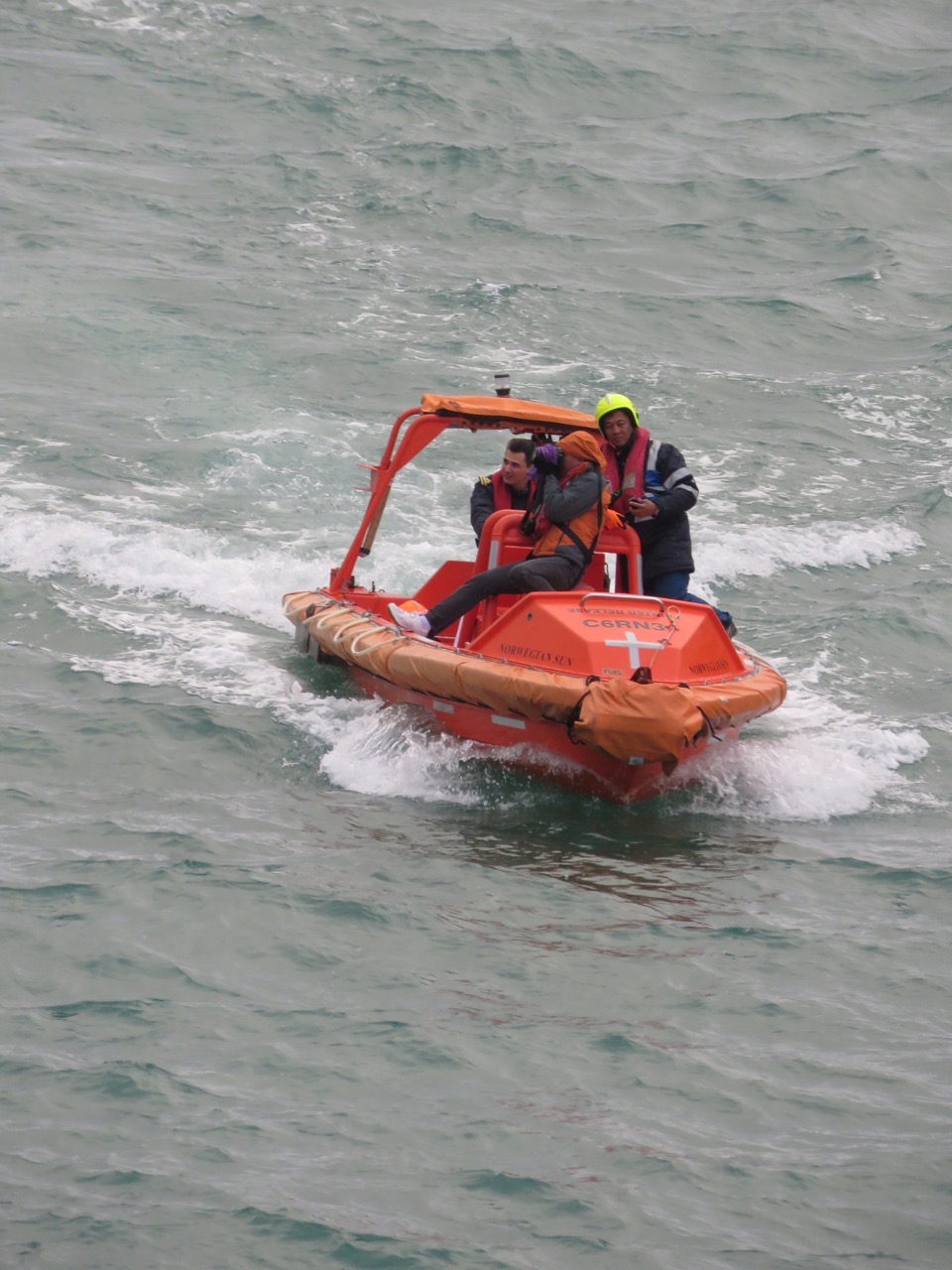
There was a little boat zooming around the ship. I figured out later that it carried crew photographers snapping pictures of the ship in front of the glacier to sell as souvenirs.

IMG 6744

As the ship turned around to reenter the main channel leaving the glacier behind, the light was just perfect.

IMG 6747

The rest of the day was again very peaceful and pleasant. Tomorrow we will be on land again, this time in Punta Arenas.