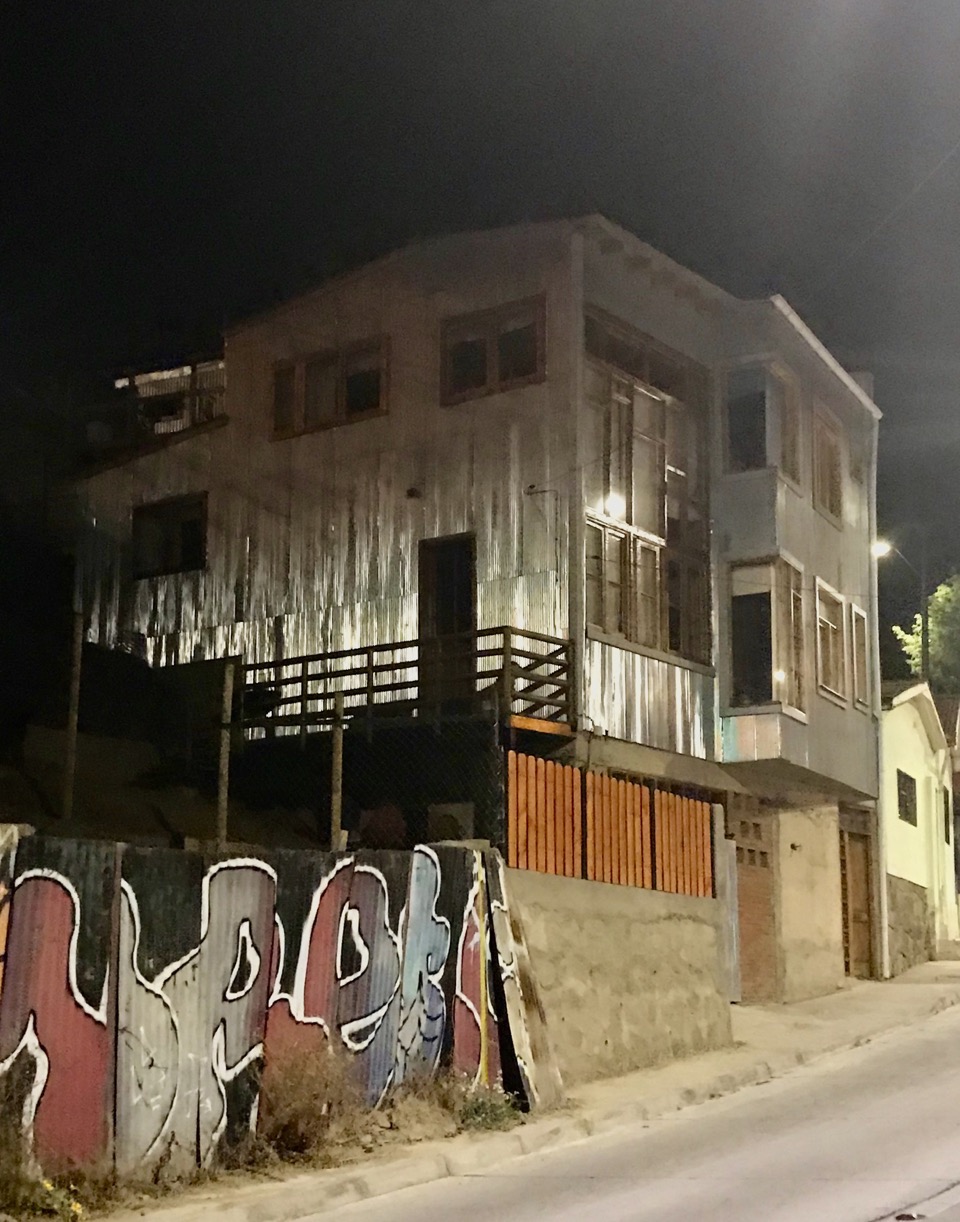
A Quiet Day

We had a quiet, pleasant day at sea today. I started the day, as I usually do, with a trip to the gym. John did the same later in the day. After that, we mostly stayed in our cabin or spent some time in one of the lounges just watching the world go by. We went through the area today known as the Chilean Fjords. I am not sure that they were true fjords as those are carved by glaciers and generally are lateral to the shore. Instead, we seemed to go through channels in between islands and the mainland. Yet there is no doubt that glaciers shaped this landscape.

Https farm8 staticflickr com 7905 32639986798 befd9513d5 z

It’s a bleak but beautiful landscape. 

IMG 6712

IMG 6713

Just sitting on my little balcony, wrapped up in a couple layers of blankets, watching these silent giant masses of granite was extraordinarily peaceful.

In the evening, we splurged for a special meal. While the Lyft driver we had on our way to the airport raved over the food on Norwegian, we have found it only tolerable at best. That may be by accident as they have a series of small restaurants that cost extra money. Not surprisingly, the food is also generally much better. We went to their version of Benihana tonight. It was the usual schtick with the joke-cracking chef. But it was still fun and the food was pretty good. 

IMG 0194

But now it’s time to go to bed. IMG 0198

On Christmas Day

Today was our first completely new experience in Patagonia, the area of Puerto Chacabuco. This area is entry to the Aysén fjords, one of the top areas in Chile for adventure tourism. The boat drew into the port early in the morning.

Chacabuco  1 of 21

As we came down the long fjords I was struck by the emptiness of the place. “Patagonia is like Alaska,” I wrote in a text to my brother-in-law, “without all the people.” About 9:30 the tender boats were starting to shuttle people to the shore.

Chacabuco  2 of 21

After breakfast, we went on the bow to enjoy the scenery.

Chacabuco  3 of 21

Chacabuco  4 of 21

I was determined for some reason that we needed to be on one of the first boats, so I made pushed John to keep moving. We went down and received our tickets in the lounge. I was disappointed we were in group four. 

I should not have worried. We were ashore in a fairly short time, and after surrendering a banana to the local authorities, who had accumulated enough contraband fruit to have made a fine salad for a Christmas potluck, we were on a little shuttle bus from the dock to the “domes” where we were to meet our tour operator. The domes were clearly places for people to wait for transport in the rain, and their shape suggested just how much it must rain in this area. The place was jammed with minibuses and taxis and there were plenty of local people offering a trip to the attractions for a negotiable amount. But enPatagonia, the local firm I had chosen for our trip, was one of them. I looked closely at my printout for the first time and realized that I had unnecessarily rushed us. The tour was not scheduled to commence until eleven thirty, and we were only supposed to be there 15 minutes before that. We were an hour early.

And there was not an hour worth of stuff to do in Puerto Chacabuco. There was just about nothing there except the port and a few houses. I would gladly have stopped in at the local parish for Christmas Day Mass, but the only church in town was a small Assemblies of God building that looked like it had recently been an auto repair shop. And it was closed up tight. So we walked around. Most of the houses were small and ramshackle. This was the most impressive place we saw.

Chacabuco  5 of 21

Around the town, there were the unmistakable signs of urban planning at its worst. We walked by a park located close to nothing in particular with no seats or play equipment. Not far from the port, there several rows of tiny, prefabricated houses, all the same shape and color, though it looked as if only a few were actually occupied. We stopped into a large hotel on a bluff overlooking the harbor. I wondered if this too had been a government-subsidized project because there were only handful of people in the dining room and this is the very height of tourist season in Chile. 

We returned to the domes and finally I found a woman in a red jacket holding the enPatagonia sign. We learned later that her name was Ann and that she was a middle school teacher in Laramie, Wyoming. It turned out that we were the absolute last of their guests to arrive, but we were still able to leave well before the scheduled time. 

Our tour guide was a local woman named Isadora, though she preferred to be called “Izzy.” Her English was excellent, and she was certainly passionate about the area and its people. We thought at first that she must also have been a teacher, particularly when she quizzed us and gave out stickers for correct answers, but she had never been in front of a classroom. 

Our first stop was by the Aysén River. Izzy explained that this river was once far deeper and that ships could navigate it all the way to Puerto Aysén until the runoff clearing the land for farms filled it with silt. Now only a few fishing boats come up the river and they can only come and go at high tide. 

Chacabuco  7 of 21

We stopped in the town of Aysén. It was a pleasant little settlement with the usual plaza in the center of town flanked by a Catholic church and some municipal buildings. We were surprised, though, to see horses grazing freely in the park.

Chacabuco  8 of 21

They were annoyed when we tourists wanted to take their pictures, and the trotted down the streets in an equine huff.

Chacabuco  9 of 21

We next drove up the Simpson River valley. Along the way, we stopped and Ann showed us both the river and a small homestead. 

Chacabuco  10 of 21

Ann explained that it was still pretty typical in Patagonia for people to live as self-sufficiently as possible in isolated houses or farms. 

We later stopped on a bridge over the river. 

Chacabuco  12 of 21

We had to occasionally get out of the way for a car.

Chacabuco  11 of 21

From there we continued on to a small estancia or sheep farm where we were to have lunch. The place was modest but spectacularly located in a lovely valley. Like many Patagonians, these farmers had a special outbuilding designed for grilling lamb and having parties. 

Chacabuco  13 of 21

We were greeted as we went in with a Pisco Sour, a drink whose charm I really do not understand, and a far more appealing piece of deep-fried bread. The lamb was nearly finished cooking. Ann explained that it had been cooked over the embers of the fire for five hours.

IMG 0184

John snapped that picture just before they took the beast into the kitchen to be cut up. Ann led me in so I could get pictures of that.

Chacabuco  14 of 21

We had a pair of locals do traditional dances for us. Izzy told us that these two are well-known competitors in the Patagonian folk dance world. I am not sure how large that world is, but both of them had some definite talent. 

Chacabuco  17 of 21

A young boy —  I think he may have been one of the owner’s grandchildren — was apparently learning some of the traditional dances.

Chacabuco  15 of 21

And towards the end of the afternoon, they invited some of our fellow tour guests to dance with them. This man and his wife, Indian by birth, currently live in the suburbs of Sacramento. They had two teenage boys with them who obviously found just everything about being on a cruise with their parents embarrassing. And seeing dad dance with some strange woman in Chile — well, you could tell that they wished that the earth would just open up and swallow them! Both parents frankly enjoyed their discomfort and so did I!

Chacabuco  19 of 21

The food was absolutely exceptional. 

Chacabuco  16 of 21

But it was all too soon time to get back to the ship. As we left we all stopped to say hello to the alpacas in residence.

Chacabuco  20 of 21

And after our delicious meal, we were not surprised that the other sheep were a little wary of what happened when tourists arrived.

Chacabuco  21 of 21

It was a nice Christmas day, even if we were away from family and church, and one I do not think I will ever forget. 

Christmas Eve

Sometimes things turn out much better than you expect. Of all the stops on this ship’s itinerary, Puerto Montt seemed the least interesting to me. John and I had spent time in this part of Chile before, and while we enjoyed it then, as I looked over the different tours offered by this ship and those I could find on TripAdvisor or Viator, I thought, “Been there. Seen that.”  So I picked one which offered as part of the package a boat trip on Lago Todos Los Santos as that was something I had not done before. So my expectations for the day were quite modest. Despite that, John and I had a pretty good time. 

First a little about the area we visited. Tourist guides call this area the “Lake District” as a comparison to the area in the north of England. The Chilean government to it simply as the “Zona Sur.” In this case, though, not only is the tourist designation more poetic, it is also more accurate. The defining characteristic of this part of Chile are the many large lakes that cover the region. Here is a screenshot from Google Maps. 

Screen Shot 2018 12 26 at 12 49 56 PM

The other thing that defines this region are the large number of volcanoes here. You can the two largest ones on the map, but there are many small ones, both dormant and extinct. The combination of the volcanic eruptions and the effects of glaciation have shaped the land into its present form. 

The day started out cloudy and overcast, though we did have a little sun breaking through as a promise of better weather to come. 

Light on the Water

I had a short workout in the gym, and we had breakfast in our room. At quarter of eight, we were in the lounge awaiting transportation information. The piers at Puerto Montt are not large enough to fit a ship as enormous as the Norwegian Sun, so we had to take small boats from ship to shore. The correct nautical term for the shuttles is “tenders.” The M/S Sun uses some of its lifeboats as tenders. I took a pictures of them lowering them down in the morning. 

Tender Boats

After we landed in Puerto Montt, we went to our assigned bus. John cringed when he saw a dozen big busses lined up to take the cruise ship passengers. We have always thought of ourselves as more independent travelers and been rather snobbish about those people on big package tours. Now we were those people. But we like the guide right away. He was an older gentleman named Pablo who spoke good English and knew a lot about the area. He kept up a pretty steady patter of facts as we drove through Puerto Montt. 

Nobody spends any more time in Puerto Montt than they have to en route to either the Lake District to the north or to Chiloe and the ice fields to the south. It is a city without much history, though there was half-hearted effort to create a central plaza amid the many commercial blocks of downtown. 

P Montt

I took this picture through the bus windows as we never bothered to stop here. It is about thirty minutes or so from Puerto Montt to Puerto Varas. As Pablo explained to us, we would be coming back to Puerto Varas for lunch and for some free time in the afternoon. I was pleased by that because I had pleasant memories of staying in the town on our last trip. 

We drove along the edge of Lake Llanquihue. The Chileans pronounce this sort like “zhan QUEE way”. Like a number of the place names around here, it reflects the influence of the Mapuche, the indigenous people of this area. This is the largest of the lakes and there are a number of towns around its edge. As we drove through the pastoral countryside, we caught glimpses of the snow-capped Volcan Osorno whose 8000 foot peak dominates the region. 

Osorno

Osorno is a favorite ski spot for Chileans, and when John and I had been here before we had taken the ski lift up to where there was still some snow. 

The bus took us to Lago Todos los Santos, also known as Emerald Lake. The All Saints name apparently was given to it because the Jesuits had discovered it on All Saints’ Day. Here we left the bus and walked to a waiting boat. Pablo kept referring to it as a “catamaran” though it hardly looked like what I would call a catamaran. It just looked like a small ferry. 

John and I found some seats on the upper deck and placed our coats there. We then walked around as the boat took off. 

emerald lake

john on the lake

From the boat, we had more great view of the volcano.

osorno and dock

We had a very pleasant time riding around the lake. At one point the captain pointed out Tronador, one of the highest Andean peaks in the distance. He explained that it is almost never visible and congratulated us on being here on such a marvelously clear day. 

Our next stop was Petrohue Falls in the Vincente Perez Rosales National Park. John and I had been here before. In fact, we had done a white-water rafting trip on the Petrohue River. My most vivid memory of that day had been the biggest and most menacing flies I had ever seen in my entire life. Fortunately, I did not come across more than a couple of them on today’s trip. The falls are really not particularly high. It is just interesting to see the river coming through a landscape fairly recently shaped by volcanic activity.

falls 1

falls 2

falls 3

And Osorno is always in sight looking rather like Mount Fuji. 

osorno

osorno and john

Alas, there were no shortage of tourists admiring the scenery.

bridge 1

But this tourist is my favorite one.

bridge 2

And then there was this guy. I saw him all day taking pictures of his bear in front of different scenic views.

IMG 6619

We walked about for a bit, and I think had we had more time I would like to have seen more of the park. 

From the falls, we went into Puerto Varas. By an incredible coincidence, our lunch here was exactly at the hotel where John and I had stayed ten years ago. We watched fireworks over the lake from our bedroom window.

puerto varas 1

While the exterior of the building is fairly anodyne, the interior is quite stylish. The meal was pretty ho-hum, though we enjoyed talking to some of our fellow travelers. After lunch, we had a hour or so to explore Puerto Varas on our own. 

Puerto Varas is a prosperous little city and has been for many decades. In the middle of the nineteenth century, the Chilean government recruited German settlers to homestead in the Lake District. The German influence remains quite strong in this region. There are private high schools where much of the instruction is still in German, and there are innumerable German social clubs.

varas 1

The Catholic Church in Puerto Varas looks more like it belongs in Bavaria.

church 1

The bus took as back to the trip. There was a miserably long line for the tenders, and John’s foot throbbed while standing in line. 

Tomorrow, Christmas Day, we explore a whole new area of Chile for us. 


Settling In

Today we sailed south from San Antonio towards Puerto Montt. It was what cruise ships call a “sea day.” John and I used this as an opportunity to orient ourselves to the ship and to get used to this place which will be our home for two weeks. 

This entry will be short. It was a pleasant day, and a calm one after all the excitement of yesterday’s mad rush to the ship. I found out that the ship has a reasonably good gym on the eleventh deck with a nice view from the windows. I also learned about the jogging track on the sixth floor. So I hope I can still sort of keep active and do something to compensate for eating more than I should! 

The show this evening was better than the Beatles cover band. It was a trio of three women who did a competent job with close harmony arrangements of pop standards.

IMG 1609

One of the things I like is the way that when we come back in the evening, Dale, our cabin steward, has made towels into animals. 

IMG 1616

So, an early night for us as we have to be up at the crack of dawn for Puerto Montt!

Onboard

After our wonderful day yesterday, we could have happily stayed for more time in Valparaiso. But our cruise leaves today and we did not want it to leave without us! The directions in our boarding documents told us to arrive at the dock well before three o’clock. We figured aiming at one o’clock would give us time to return the car and find a place to put some more minutes on John’s phone. We decided against trying to do any more exploring this morning, as appealing as another walking tour might have been. Instead, we packed up quite deliberately this morning, determined not to leave anything behind. 

Thanks to GPS, we had no particular problem finding our way to San Antonio. It was only when we got there that the problems began. San Antonio is now Chile’s largest port, but other than the container ship facilities it has nothing of interest at all. There is one long road, Barros Luca, that runs from one end of the town to the other. Everything looked simple enough on paper. The address given for the cruise ship was 1613 Barros Luca and the address for returning the rental car was 2550 Barros Luca. Our plan was to drop John off at the ship, I would return the car, and we would be happily on board in no time.

Needless to say, gentle reader, it did NOT turn out that way. 1613 Barros Luca turned out to be a commercial building with a branch of Banco Santander and some place that sold fried chicken. We could see the smokestacks of the ship from there, but a rail line and an unbroken stretch of warehouses may it impossible to reach it. We drove up and down and down and up the street looking for some way to get from Barros Luca to the port itself. We finally stopped a young man who patiently explained to us that we had to drive down on particular street for about a mile until we could find the entrance to the port. By this time I was already an hour late for returning the car. 

We dropped off our luggage without problem, but we debated whether it would be possible for us to check in separately. We both figured that might be problematic, so John agreed to return the car with me. That proved to be no easier. Although we rented our car through Expedia from an outfit called NU, the actual car was provided by Rosselot. A lady in the tourist office gave us directions to the Rosselot office at 2550 Barros Luca. But when I arrived there, they refused to take the car and kept pointing me down the street. We drove up and down the street a couple times more until we finally found ANOTHER Rosselot office. This was indeed the one we were expected at, but it was definitely not at 2550. 

By this time, it was nearly three, the hour by which all passenger were supposed to be on the ship. One of men from the rental agency drove us back to the ship, saving me the agony of trying to find a cab in San Antonio. We checked in without any particular problem, though by that time I was testier than Donald Trump in a Twitter fit. They put us on a small shuttle bus and in a few minutes we were at the ship. As I left the bus, the driver gave us all a small candy and wished us “Feliz Navidad.” He was the highlight of the afternoon. 

John had hoped that our room was going to upgraded, but this did not happen as the ship was not only full but apparently had been overbooked. I understand how they do that on airplanes, but I wondered how that worked on cruise ships. Had we come a little later would they have given our cabin away? Fortunately, they had not and as it turned out we had a nice cabin on a high deck with a small balcony. John was exhausted after all of this and I let him rest while I unpacked.

We had the usual emergency drill at four o’clock. John dropped his brand-new phone on the way there, and despite having a good case on it the screen cracked. After the interminable drill, we had a truly mediocre meal on the stern as the ship started to pull out of port. We did some exploring of the ship. In the evening we stopped by to see the show. They had four guys, all of whom I think were Filipino, impersonating the Beatles. They were just awful, and we left after a few minutes. 

I am hoping tomorrow will be much better. 

A Nearly Perfect Day

After the mishaps of the past two days, today was … nearly perfect. 

We had a leisurely morning. I did some work on my photographs and some final edits to my blog and John managed to get a bit more sleep than I did. I noticed this on the front of the refrigerator. I am not sure how I missed it last night.

Https farm5 staticflickr com 4908 45500766175 c8ee865570 z

We had breakfast on the patio a little before ten. The food was mediocre, but the view from the balcony was perfect. As I ate, I observed the other guests gathered for breakfast, most of them in the twenties or thirties. I remember how when I was their age I sometimes came across people in their sixties who were staying in the same kind of places as I was and how I thought then how interesting it was that those older persons were still trying to to travel and stay active. And I then thought, I am one of those old people now. How did this happen so quickly? Sigh.

Our big event of the day was a walking tour of Valparaiso at three o’clock in the afternoon. We thought about taking an Uber down to the Plaza Sotomayor where the tour was to begin, but we had some time and decided to do some exploring on foot. Valparaiso, as I mentioned yesterday, is built on about 40 hills. I say “about” because Porteños, as the residents of this city style themselves, cannot actually agree on the exact number. What they can agree on, as can all visitors, is that these hills are miserably steep. Before the advent of the car, there were 28 funicular railways that helped carry people and things up the slopes. But not everybody could afford to pay, so there are also a series of stairways up and down each of the hillside neighborhoods. The Winebox Hotel is located in the Teniente Pinto neighborhood and so we walked down the Escalera Teniente Pinto. 

Valparaiso  9 of 41

Teniente Pinto, by the way, refers to a certain Lieutenant Ignacio Carrera Pinto whose face also graces the 1000 peso note. He showed a great deal of bravery in the war against the Bolivians and the Peruvians in the nineteenth century, but he died in battle. The Chileans seem oddly adverse to honoring heroes who actually survived the Pacific War. 

John survived the staircase, but just barely.

Valparaiso  4 of 41

Walking down stairs is part of his physical therapy, but neither of us realized we when started down that there were at least 300 steps here. Despite that, there were definitely interesting things to see along the way. When I saw this garden built out of old plastic bottles, I thought, “Hmm. Easy instant science project with the appearance of caring about the environment thrown in for good measure.”

Valparaiso  5 of 41

There are telephone and electrical wires just everywhere in Valparaiso. I do not much care for them in Los Angeles, but here the profusion here almost becomes art.

Valparaiso  6 of 41

Valparaiso  7 of 41

There was, of course, a also good deal of street art along the stairs, and some of that was quite good indeed.

Valparaiso  8 of 41

By the time we reached the bottom, John’s right foot was throbbing and the first stop we made was at a pharmacy. Traveling in Spanish-speaking countries I have learned that if I usually take the English word for a drug and just switch the vowels to Spanish — make the i into a long e, for example, or the e into an a — I usually have the name of the medicine in Spanish. But my efforts to do that with “acetaminophen” only created confusion. Lots of mime and the use of Google Translate finally resulted in some tablets that had the desired effect, whatever they may have contained. 

We were still about a kilometer from the Plaza Sotomayor and John was not up to walking it. So we requested an Uber and were there just in time for the beginning of the tour. Central Valparaiso is a UNESCO World Heritage Site, a designation that is all too frequently conferred. The area is somewhat historic, yes, interesting, definitely, but is it really an essential part of the patrimony of the entire human race? it would be a stretch to put it in the same category as Renaissance Florence or the Great Wall of China. But I digress…. The tour was sponsored by an outfit called Tours for Tips. The idea is that you pay the guide what you think it was worth. The guides all wear red-and-white striped shirts with the name “Wally” written on them. We were greeted by one Wally who signed us up and seemed very excited to meet people from Los Angeles. He had once spent two weeks living in Lomita and getting around the city on Metro buses and somehow seemed to have a genuinely warm memory of that experience. 

Our actual tour was led by another Wally whose real name was Sergio. He was evidently a teacher of some kind, but here in the Southern Hemisphere summer vacation is just beginning. His English was not bad at all, though he occasionally struggled for a more technical term. We started off right on the quay with a view of the port. 

Valparaiso  10 of 41

He gave us a quick history of Valparaiso. The area was home to a small group of native people until the Spanish arrived in the middle of the sixteenth century. During the colonial period there was a small port here, but given the Crown’s prohibition on trade with other nations, it was hardly an important place. After independence, and particularly once Santiago was named the capital of the new country, Valparaiso began to grow more prominent. But it was really the California Gold Rush that propelled Valparaiso into one of the nineteenth century’s most important cities. In 1849, thousands and thousands of Argonauts headed to or from the foothills of the Sierra Nevadas stopped here to pick up provisions. And even after the Gold Rush, trade among the United States, Europe, and the different countries of Asia all still seemed to require a ship to stop at Valparaiso before or after making the dangerous journey around Cape Horn. Valparaiso was also an entrepôt or free port, that is, goods could be traded here without the imposition of tariffs or duties. All of this made Valparaiso one of the most prosperous cities in South America. 

But disaster struck in 1906. Only a few short months after an earthquake destroyed San Francisco, another temblor leveled Valparaiso. As it had in San Francisco, fire almost immediately broke out and destroyed much of the wooden city. But Valparaiso had an even fate than San Francisco as the earthquake here was also accompanied by a tsunami. The triple disasters of earthquake, fire, and flood left little standing in the great port city. Porteños vowed, as San Franciscans also had, to rebuilt their city bigger and better than before. But the opening of the Panama Canal in 1914 completely eliminated the need to take ships all the way around South America, and almost overnight ships stopped appearing in its harbor. So Valparaiso did rebuild, but a smaller and far poorer town replaced the once great port city. 

Oddly enough, the the military coup of 1973 gave a boost to the city’s fortunes. Valparaiso was dominated by its labor unions and was a center of support for the communist Allende government. But as a port city it was also the home of the Chilean navy and naval officers were central to the plot to take overthrow the government. The navy moved into the old blue municipal palace that dominates Plaza Sotomayor, and today it still remains the headquarters of the Chilean Navy.

Valparaiso  1 of 1

Determined to weaken opposition, the military regime also moved the national legislature and some of the key departments of government from Santiago to Valparaiso, in effect making the old port a second capital city. So much of Valparaiso’s renewed prosperity is due to the man whom Porteños then and now utterly loathed. History is nothing if not ironic. 

Sergio walked us all around the historic neighborhood of Cerro Concepcion with its colorful houses.

Valparaiso  34 of 41

Valparaiso  35 of 41

He explained that houses in Valparaiso have been covered in metal shingles and siding for years because the weather is so miserable most of the time and it causes concrete to deteriorate quickly. Plus, ships from the nineteenth century to today left huge amounts of scrap metal behind. So Porteños started cutting this into strips and squares and putting it on the sides of the houses. Paint, of course, was required to keep the metal from rusting. Sergio did not offer any explanation for while so many different colors are used on the same street. I suspect that in minimally literate cultures color is any easy marker to help people locate places. But that is just my guess.

We went up one of the eight remaining funiculars, the “ascensor reina victoria,” named in honor of the British Queen who had just recently died when this funicular was constructed. It starts its ascent in the area right by the brewery where we had dinner last night.

Valparaiso  33 of 41

It works exactly like Angels’ Flight does in Los Angeles. There are two cars and the weight of the one going down pulls the other going up.

Valparaiso  14 of 41

The process still requires the operation of a conductor and an operator. 

Valparaiso  31 of 41

At the top we waited until all the members of the group had arrived — the funicular only carried 8 people at a time — and Sergio told us a little more about the history of the area.

Valparaiso  17 of 41

You can see him there in his “Where’s Wally?” shirt. Sergio explained that this area had originally been settled by the English and the Germans and it became home to a large Protestant community. The Lutheran parish, perhaps Valparaiso’s loveliest church, is visible from all around.

Valparaiso  15 of 41

But it was not the first Protestant church here. That distinction belonged to the Anglicans. When members of the Church of England first wanted to establish a parish in Valparaiso, only Roman Catholic worship was legally permitted in the country. But the local authorities gave the English permission to build a church as long as it had no steeple or cross on it. And Saint Paul’s Church, now raised to cathedral status, still does not have either.

Valparaiso  21 of 41

Of course, in time the Anglicans and Lutherans departed this life for the next, and the Protestants next petitioned the government for a cemetery as they could not be buried in consecrated Catholic soil. The government agreed to this request and the “Cementerio Disidentes,” the “Cemetery of the Dissidents,” was established. But the Protestants took death as just another way to demonstrate their preeminence in the community:  they picked one of the most visible sites in Valparaiso.

Valparaiso  23 of 41

As interesting as all this was, John was starting to get seriously tired and his foot was throbbing.

Valparaiso  26 of 41

So we had to slip away from the tour before it was over. I still feel bad about this because I never had the chance to give Sergio the tip he so richly deserved. So, Sergio, in the unlikely event you read this, email me and I will send you 20,000 pesos! You were a great Wally.

We took Uber back to the Winebox. Usually I have had great experiences with these local drivers, but Rafael did not seem to know the city that well and GPS was sending him the wrong way on one way streets. Thankfully, we made it. 

Back at the hotel John took a long nap and he felt much better. In the evening. we went up to the rooftop of the hotel where there was a bar. Grant was leading a wine tasting with a couple from Argentina. 

Valparaiso  38 of 41

We had a great dinner at Verso, the restaurant which could not accommodate us last night. They recognized us, and gave us a couple free drinks. John’s, of course, was a mocktail. Returning for our last night at the Winebox we admired our room reflected city lights.

Valparaiso  39 of 41

Valparaiso  40 of 41

Valparaiso  41 of 41

Tomorrow we are off to San Antonio where we start our cruise.

Unsought Adventures

Today brought unexpected adventures. Sometimes those are the best part of traveling. And sometimes they are not. 

The day began well enough. Our bed in the Castillo Rojo was comfortable, and when we woke up it was nearly nine o’clock. Those of you who know me well know that I am usually up before five, so this was a late morning indeed. We had a pleasant breakfast on the hotel patio. It is summer here in Chile, and the temperatures in Santiago at this time of year are usually in the eighties. One of the things I liked about the patio were the figures hung from the wires. They danced about merrily in the mistral wind.

IMG 1570 2

We had a better view of the hotel by day.

IMG 1573

IMG 0001

We walked up towards the San Cristobal Park and the Santiago Zoo, only a few blocks away, as that appeared to be the nearest bank machine. Alas, when we arrived the screen informed us that the machine could not dispense any cash and we like several other visitors to the ATM, wanted it only for that purpose. John’s foot was starting to hurt — after his accident he still cannot walk any significant distance most days — and so we decided to take an Uber to the nearest branch of Banco Santander. Santiago traffic is miserably congested, and I am sure we could have walked those two kilometers much faster. The stop-and-go, really more stop-and-stop, traffic gave me an opportunity to look at the neighborhood from the car window. As we went down Pio Nono Street, I saw the Gym Pio Nono. Catholic humor, I suppose, but the idea of the Pope Pius IX fitness center made me laugh. 

We finally figured out the cash machine, but by that time we needed to start packing and check out of the hotel. We decided walking back would be faster. The Mapocho River, a shallow, fast-moving brown stream, runs through the center of Santiago and divides it in two. Like the Los Angeles River, it has been seriously canalized to prevent flooding in the city. But at least the city leaders here had the sense to place parkland on either side of the stream to make it somewhat more appealing. 

IMG 1576

Back in the room I packed up quickly and John did the same a bit more slowly. I began moving some bags to the car and checked out. But when John came down from the room he was seriously agitated. He said he could not find his phone. I knew that the phone had been in the room since we returned from our walk because his medication alarm had sounded at noon. I called him, but there was no answer. We tried the “Find my iPhone” app and the phone appeared briefly on the map about three blocks away — and then went right offline. 

We began to piece together what had happened. John told me that the maid had entered the room when he was on the toilet. Surprised, she quickly retreated but apparently must have left the door open. In the few minutes when he was in the bathroom but the door was slightly ajar, someone must have entered the room and taken the phone. I spent some time on the phone with ATT to make sure that somehow nobody could make calls on it, and we pondered what to do. John needs a phone for many reasons other than the one Alexander Graham Bell envisioned, and he felt that he could not wait until we returned to California in January. The staff at the Castillo Rojo was seriously upset by a theft from their property, perhaps by a member of the staff, and they offered to do anything they could to help us. We asked if there was an Apple store in Santiago, and we were told that there was one in the Costanera Center, the six-story shopping mall attached to the Gran Torre Santiago, Latin America’s tallest building. Eduardo, one of the English-speaking staff members, offered to take us there and be our interpreter. 

The prices of new iPhones in Santiago were pretty much the same as the those in California, at least when you adjust for the fact that the VAT tax is already included in the price here and the rapacious California sales tax comes as an unpleasant surprise at the cash register. I decided that John could make do with the XR rather than the higher-end models. At our age, we are fortunate if we can still see the screen much less appreciate the differences between displays that offer resolutions higher than our eyes can possibly distinguish. It was not possible, of course, for him to get his old number attached to his new phone in Chile. So we figured out that we could get him a SIM card here as a temporary measure and reactivate him on ATT when he returned in January. 

Eduardo snapped a picture of the two of us, though not in the best light, at the mall. 

IMG 1581

John was not feeling much happier than he looked at this point. We also stopped by the North Face store. Just about every shop you could think of at the Westfield Century City or South Coast Plaza is in the Costanera Center. Yesterday I made a concerted effort to not mention that in the Bogotá airport I took off my jacket to find my passport and boarding pass and accidentally set it down. Of course, when I remembered what I had done a couple hours later and went to find it, my coat was gone. So skinny John, who is always cold, insisted on buying me a new coat for our days penguin watching in Punta Arenas and Ushuaia next week.

Eduardo drove us back to the hotel. He had thought that he had an extra SIM card in his backpack he could give us, but when we returned he could not find it. He assured us that we could get one nearby for about 2000 pesos. That is about three dollars in case you do not have a currency converter handy. Finding a shop was not quite as easy as he made it sound. We asked a couple people and a charming young woman hawking bicycle tours to English-speaking tourists, pointed us to the Centro de Llamadas. Despite its somewhat grand name, the “Calls Center” looked like a particularly dingy English newsagent’s shop. The proprietor, a fat man in his sixties, seemed to spend most of his time selling candy and loosies, but he did have a few SIM cards behind the counter. He offered us one, and the price was indeed 2000 pesos. He seemed both stunned and annoyed that I had no idea how to insert a SIM card into a phone. I wanted to explain to him that the nation that had actually invented the phone had been held captive by the dark forces of Verizon and ATT for decades and that we had been led to believe that evils far greater than those of Mordor would fall upon us should we ever attempt to change our own SIM cards. But my Spanish was not up to telling him this, so I just appeared stupid. He helped me. 

Before we had left on this shopping excursion, Eduardo and Nicolas at the desk of Castillo Rojo had warned us about continuing on to Valparaiso our destination for the evening. Valpo, as Chilenas often call it for short, was in the midst of a bitter strike by port workers who had rioted days before. We  were warned of molotov cocktails and burning automobiles. John was set to just forget about going, but I suggested that we call the hotel and ask them about it. We ended up speaking with the hotel’s owner, a New Zealander named Grant. He assured us it was all overblown and the hotel was four kilometers from the port. We decided to go. After all, if you can’t trust a Kiwi, who can you trust? (Or should that be “Whom can you trust?” I can’t quite remember….)

Getting out of Santiago proved to be pretty easy and as we drove along the Costanera Norte we encountered little traffic. In a little over an hour we were coming into the outskirts of Valparaiso. We did spot two vehicles, including one that looked a bit like a tank, sporting the insignia of the Carabineros de Chile, two crossed rifles with the somewhat ominous motto of “Orden y Patria.” But that proved to be the only suggestion of rioting we saw here. I was relieved. John might have been disappointed.

There are many hotels, guest houses, and pensions in Valparaiso, but none are quite like the Winebox. The moment I saw this place on Booking I knew this was where I wanted to stay in Valpo. 

152564814

The story behind the hotel is pretty simple. Grant Phelps, the New Zealand winemaker who had moved to Chile,  saw how shipping crates had been used as emergency housing in Christchurch following the massive earthquake there. He thought, “This could work really well in Valparaiso. It would be a fun and relatively cheap way to build a hotel.” You can check out this video, en español but with English titles, to find out more about the history of the hotel and container architecture.

While building this structure on a hilltop corner affords many stunning views, parking is relegated to a small area in the cellar of the building with the entrance awkwardly located right at the corner. We followed directions and pulled up on the curb while a young woman donned a yellow vest and directed us inside. We carried all of our luggage — John and I both seriously overpacked for this trip — upstairs. The room I picked for us was the most expensive of this otherwise fairly cheap hotel, but the view was worth every bit of the price. Not only was our room made of not one container but two, but it has a deck almost the size of the room itself. And from that deck you can see almost the entire city of Valparaiso spread out over its hills and the Pacific Ocean beyond. And all this for less than the price of a basic room at the Sacramento Hilton!

IMG 1592

IMG 1593

IMG 1595

While I took in the view, John was enchanted by the work of the street artists that Grant hired to decorate the rooms. This picture of Pam Grier dominates our room.

IMG 0009

Grant stopped by not long after we had settled in to talk with us for a bit about the hotel, the city, the strike, and life itself. And as we had come into Valparaiso around eight in the evening, by the time we had finished our chat it was after ten. We were both hungry having eaten little since breakfast, and he recommended a nearby restaurant. He called them and they promised to to keep the kitchen open if we arrived by ten thirty. Grant assured us that it was just a short walk.

It was really close to a kilometer, but we had a pleasant stroll. Valparaiso is a much poorer city than Santiago, and yet a far more interesting one artistically. The city covers some forty different hills, and for that reason it reminds many people of San Francisco. But while American builders insisted on imposing a grid upon the hills of San Francisco, the Chileans were content to allow roads to follow the natural contours of the land. For this reason, there is scarcely a single straight road anywhere outside of the downtown and the port areas. Until the Panama Canal opened in 1914, Valparaiso had been one of the most important ports in the world and most of the people who lived here were stevedores. The homes they erected for themselves in the hills were small wooden structures built higgledy-piggledy against each other on small lots. That tradition still lives today. Here homes are constructed out of corrugated iron because it is cheap, not because it is the whim of a prominent Canadian architect.

IMG 1586

The residents of this city have a rich tradition of street art and many otherwise utilitarian spots are painted.

IMG 1584

This was the entrance to the garage of an otherwise quite uninteresting little house. 

IMG 1587

Even thought it is summer here, it is still Christmas and the residents love to put up lights.

IMG 1582

IMG 1583

We were not surprised, when we arrived at the restaurant, a charming place called Verso, to learn that the kitchen had closed. After all, it had almost been ten thirty when Grant was giving us directions! But the staff could not have been more friendly. They were friends of Grant’s and felt bad about turning his guests away. So, while we waited they called just about every restaurant in Valparaiso to see if they could get us in.

IMG 1590

But they not only found us a space at a downtown brewpub called the Casa Cervecera Altamira, they even paid for the taxi there! We had two enormous burgers and I had a fine amber ale. Tomorrow, we see more of Valparaiso! 

To the Southern Cone

So John and I are off on another adventure. Over the next three weeks we will be in South America exploring the southern parts of Chile and Argentina with a brief stop in the Falklands Islands, that last outpost of Her Majesty’s Empire in the South Atlantic. 

Tonight’s entry in this journal will be short. To paraphrase Tolstoy, good travel days are all alike and bad travel days, even though they are miserable in different ways, are not any the more interesting for it. We were unfortunately delayed leaving Los Angeles and missed our early morning flight from Bogotá to Santiago de Chile. The Avianca lounge at the Bogotá airport is pleasant, but I would rather we had not spent over six hours there. 

It was nine in the evening when we finally arrived at the Santiago airport. We cleared immigration without any problems, but it was the usual wait to pick up the luggage. We leave on our cruise Saturday from San Antonio on the coast, so I had done the math and figured out that renting a car was a bit cheaper, and certainly more flexible, than trying to take taxis between the cities. I picked up the car and we drove into town.

I have been to Santiago before and I like the city. The old sections have some of the European charm of the nicer parts of Buenos Aires, but they feel much calmer and far safer. In fact, some of the newer parts of the city vaguely resemble Tustin! We are staying the night in an old house in Bellavista that has been converted into a small hotel. It is called the Castillo Rojo. It does not particularly look like a castle, but someone painted it a bright shade of red. The interior is quite fun as you can see. 

IMG 1561

IMG 1563 2

IMG 1565

Tomorrow we will do some exploring and a little shopping in Santiago, and then we will be heading out to Valparaiso. 

Birthday Boy

Today was my birthday. As a child I never liked having my birthday on the Fourth of July. People squeezed my cheeks and said stupid things like, “You’re just a little firecracker, aren’t you?” As an adult, though, I came to appreciate always having the day off work and having special things happening on my birthday, even if obviously they had nothing to do with me. Celebrating the day abroad, as I often have in recent years, I find myself feeling a little miffed that the world is carrying on, utterly oblivious to the occasion. Fortunately, I was surrounded here in London with people who had remembered that I just turned 61 today. As I joked to Vicki, “If I am no longer in my prime, at least I am a prime number!” Vicki gave me a plate of croissants for breakfast surrounded by strawberries with candles in them. It was so sweet. I ate a couple with some peanut butter, a culinary atrocity, of course, but somehow it seemed like an American touch for the day. 

IMG 1384

Having fed myself, I also thought I might feed the local swans.

IMG 1393

Jerry had to leave for Leeds today where he is in a golf tournament with friends from his old company. I must admit that I seldom think of golf and Leeds as having much to do with each other, but apparently there is a famously difficult course just north of that old industrial city. Vicki did have the day to spend with me and John, so we had a few adventures. I knew that we would be going into the West End later in the day, so when they asked me what I wanted to do this morning, I asked to see Kew Gardens again and a couple sights in the area that I have never seen. It turned out that Vicki, who has lived in this area for most of her life, had never seen them either, so it worked out well for all of us.

Our first stop was Strawberry Hill. This is not one of England’s great stately homes, but it is monumentally significant in architectural history. It was the estate of Horace Walpole. Horace, who sometimes preferred to be called Horatio, was one of the strangest characters in a country that seems to produce any number of strange characters. His father was Robert Walpole, the man who not only was England’s longest serving Prime Minister, but the man who more or less invented the office during the reign of King George I. Robert Walpole, born a minor country squire, became the first Earl of Orford and a very wealthy man as well. Horace was his youngest son. He was an odd child who probably would have been severely bullied at Eton had he not been the son of the monarch’s most trusted advisor. As an adult, he was bone thin and extremely pale. He seemed to glide more than walk, and he had an odd kind of voice. He never married at a time when marriage was socially required, and his biographers have speculated that he was probably gay and for a time may have had a relationship with a former schoolmate. He tried to follow his father into politics, but despite holding a few seats in the Commons he never made a name for himself as a Whig politician. Instead, he made himself famous by inventing the Gothic Revival. 

At a time when all houses in England had followed the rules for architecture that Andrea Palladio had derived from his study of Roman buildings, Walpole chose to flout just about all of them. He bought a small estate called Strawberry Hill in Twickenham, then quite far out into the country. There was already a house on the land, apparently a small and rather uninteresting place built in a simple classical style. Horace changed all that. He knocked out the window and put in weirdly shaped stained glass. He built a turret. He placed fake arrow slits on the roof line and added gargoyles for extra effect. He broke every possible rule, and adopted all the touches that Palladio and his disciples had derived as barbaric elements of the Dark Ages. Nobody had ever seen anything like it, but the world was apparently ready for something different. Strawberry Hill Gothic became the rage for much of the remainder of the eighteenth century until far more extreme forms of Gothic architecture would take its place. In the library of this house, Horace wrote The Castle of Otranto, one of the first pieces of Romantic prose in English, a clunky preview of far better later works like those of the Brönte sisters, Bram Stoker, or Mary Shelley. 

IMG 6419

IMG 6417

By the nineteenth century the estate had fallen from fake ruin into actual ruin. Walpole’s heirs sold it to Saint Mary’s College, the first Roman Catholic university in Britain since the Reformation. The grounds of the estate became the campus of the school. In recent years, Saint Mary’s with the help of a private foundation has refurbished the interior to suggest what it might have looked like when Walpole lived there. It was, unfortunately, closed when we arrived. That did not stop John from pretending to seek admittance. 

IMG 6410

Our second stop on the tour of Twickenham was Eel Pie Island. There are a about three dozen aits or small islands in the Thames River. We know that one of these islands was home to a small inn as early as 1743, and by the early nineteenth century the island was a popular day trip from London. The inn served pies made of local eels — the British loved this dish back then — and hence visitors began to refer to Twickenham Air as” Eel Pie Island.” By the 1900 the inn had been replaced with a large hotel and dance hall.

Screen Shot 2018 07 05 at 7 13 37 PM

This dance hall became one of the most celebrated music venues of the 1960s. All kinds of bands which later became huge like The Who and the Rolling Stones played Eel Pie Island when they were just starting out. In fact, Pete Townsend named his music publishing business Eel Pie Music. Unfortunately, the owners of the hotel had difficulty with the Richmond Council over various issues, and the storied place mysteriously burned to the ground in 1990. 

Today, Eel Pie island is home to a boat repair business and a couple dozen artist studios. It is about the most bohemian spot in London. It seems remarkably reminiscent of Venice, California before Julia Roberts and Google moved in. 

IMG 6428

IMG 6427

There is a kind of old hippie art everywhere.

Https farm2 staticflickr com 1821 42316665685 a7279b3187 z

Sometimes you are not even sure if it is deliberate.

IMG 6430

IMG 6431

Several fake crows had been placed atop some steel bars outside of one artist’s studio, and John and Vicki tried reenacting scenes from The Birds.

IMG 6434

My favorite place on the Island was a boat that had been converted into a home and a studio. It reminded me of the boat on the beach in Great Yarmouth where the Peggotty family lived in David Copperfield

IMG 6433

Vicki was ready to move to Eel Pie after we finished our walk. But we had a few more things to do on our last day in London. We left Twickenham and drove across the river to Kew Gardens. 

The Royal Botanical Gardens is one of the largest and most important botanical gardens in the world. Yet it was not planned originally to be anything other than a summer home for aristocrats and later for the royal family. The gardens there were laid out for the diversion of the monarch and family. But Victoria had no interest in keeping Kew as a summer home, probably because it was by then fairly close to London itself. So in 1840 the Royal Horticultural Society convinced the crown to make it a national botanical garden. There are elements of its days as a royal residence.

IMG 6447

IMG 6449

IMG 6451

During the nineteenth century, the great draw was the greenhouses. These allowed Londoners to see plants during winter. There was the Palm House and the Temperate House. The later has been remarkably restored to its 1848 perfection.

IMG 6452

IMG 6455

The interior is a stunning open space.

IMG 1416

But to a Southern Californian, it was also a little disappointing because most of the plants grown there can be found in many of our back yards. We were hoping for something a bit more exotic. But I suppose for the English they are.

IMG 6456

IMG 6462

Despite this, we could have stayed and explored Kew all day. But we were scheduled to meet Kris, our niece Rebecca’s husband, for dinner that evening and we had a play in the West End. So we planned to take the boat from Kew to Westminster. It is not all that much slower than the Underground and it provided a lot more interesting sights. Unfortunately, for an amateur photographer it was not easy to capture the buildings on the side of the Thames in a way that really caught their history or occasional beauty. Most of the industrial buildings than once lined this river have been demolished and huge glass and steel apartment complexes have taken their place. Although these no doubt provide a great view of the Thames, the size and materials used are completely out of place with the gentle flow of a small English river. The older architecture has a much better sense of place and style, particularly the utterly lovely Albert Bridge. 

IMG 6473

As we grew closer to Westminster Pier, we could see the House of Parliament. Despite its Gothic appearance, this building is not really all that old. It was build in the 1840s, making it a younger structure than the American Capitol. Much of it is always under renovation.

IMG 6482

The London Eye, one of the many unfortunate results of the Tony Blair years, is not far off. 

IMG 6488


We met up with Kris in Covent Garden after a short but pricey pedicab ride. We had a pleasant dinner in a small Greek restaurant there. 

Our last event of the evening was to go to one of London’s hottest shows, Tina. This is a musical version of Tina Turner’s life. John jokingly called this my “birthday present” because he knows he likes this sort of stuff way more than I do. We did not have very good seats, though we had no problem either seeing the stage or hearing the score from Row Z (remember, say “zed”). I was not surprised that I was pretty bored and quite critical of it. I was surprised that John had just about the same reaction. 

We took the tube and Uber back. Tomorrow, we leave for New York. Sigh. Our trip is almost over. 

Two Plays … and a Winning Play

Today was pretty good day for us, and a pretty good day for England! I’ll explain that last part a bit later.

We had coffee and pastries as usual with Vicki and Jerry as we plotted out our day. Their deck overlooking the Brent River is absolutely one of my favorite spots in England. The weather has been unseasonably hot for London as it was last week in France. Fortunately, London is just a few degrees cooler than the Rhone Valley, so it seems just a bit more like normal Los Angeles summer weather to us. Vicki drove us up to the Northfields tube station where we caught the tube. It wouldn’t seem like a trip to England without at least one trip with that calm voice saying over and over again, “This is a Piccadilly Line service to Cockfosters.” John amused himself by taking pictures of people on the train. 

IMG 4678

We got off at Leicester Square and headed towards the TKTS booth. We wanted to go to the matinee of An Ideal Husband and I was sure that we could get the tickets for the show cheaper than buying them online. As it turned out, the discount was not that great and we only saved about 10 pounds this way. I suspect that the internet has somewhat undercut the role of the last minute ticket sales offices in places like New York and London. But I have bought so many tickets to shows there over the last thirty years that it seems almost wrong to pay a visit to London without looking at the listings on the board — now, alas, electronic — on the booth in Leicester Square. 

John was not feeling his best, and I figured that some lunch might be in order. We decided to have at the Peter Jones department store in Sloan Square. John and I hopped on a double decker bus and enjoyed the sights as it went down Regent Street and Piccadilly, past Green Park and the Wellington Arch, and through Knightsbridge. I have no idea why I did not take some pictures here as John managed to grab the front seats on the upper deck. 

The attraction of the Peter Jones store is certainly not the building itself, a rather ugly bit of concrete, glass, and steel that jarring contrasts with the red brick and terra cotta of the Victorian buildings that surround the rest of the square. The appeal is the view from the cafeteria on the sixth floor.

IMG 1339

The food is decent for cafeteria fare. They offer salads and things like that, but you know when you’re in England you just need to be a little old school sometimes and order fish and chips or the bangers and mash!

IMG 4294

We were running a little late, so we ordered an Uber rather than trying to mess about the the tube. John has fascinated by the elephants that were a temporary art installation on the square.

IMG 3821

IMG 6108

Our afternoon performance was Oscar Wilde’s An Ideal Husband at the Vaudeville Theatre on The Strand. Once again, I seem to have forgotten to take some pictures here, so this is one borrowed from some London theater website.

Https farm2 staticflickr com 1781 28405777277 9094014c11 z

You will notice is that picture that the play is The Importance of Being Earnest. This theater has done new performances of all of Wilde’s plays as its season this year. I am rather sorry I was not there to how they adapted De Profundis for the stage. Nevertheless, I was definitely curious to see what they would make of An Ideal Husband. The play is something of a mess. The plot is rather complicated even by the standards of the time. It concerns Sir Robert Chiltern, a wealthy, Liberal member of Parliament, considered one of the most morally upright members of the House of Commons. At a dinner party at his home, Mrs. Cheverly, an English woman who now lives on the continent, approaches Sir Robert and asks him for his support of a canal scheme in Argentina. Sir Robert tells her that he considers this scheme basically a fraud, and that he cannot support it. She tells him that if he does not she will publish a letter revealing the source of his wealth. Many years earlier Sir Robert had sold a wealthy Austrian a Cabinet secret, telling him to buy stock in the Suez Canal company three days before the British government announced its purchase. Not only would revealing this secret destroy Sir Robert’s career, but Sir Robert knows that his wife Gertrude would be devastated to learn that he was ever dishonest. Lord Goring, a dandy obviously based on Wilde himself, manages through a series of rather farcical scenes to obtain the Mrs. Cheverly’s letter and save Sir Robert’s from ruin. Along the way, though, Gertrude has to learn not only to forgive her husband for not being morally perfect, but she herself is caught in a situation that could appear compromising. The play is generally considered a comedy, but all the real energy comes in the scenes dealing with blackmail and secrets. This was obviously stuff that Wilde knew and understood well. 

The cast at the Vaudeville did an great job with this material. Lord Goring and his father were played by a real son and father, Freddie and Edward Fox. The latter is one of the most distinguished of British stage actors, and he brought both humor and gravitas to an fairly minor role. Frances Barber was a great Lady Cheverly, though she is considerably older than Sally Bretton, who played Sir Robert’s wife, so it seemed hard to think of them as former school mates. I will admit that the casting of Faith Omole, a black actress, as Mabel, Sir Robert’s sister, seemed a little jarring in a production that otherwise was could have been the original staging of the play. She was, however, quite good in the role. 

From The Strand we made our way across the Thames to the South Bank. Vicki had arranged for us to have dinner at the Wagamama near the Royal Festival Hall. It was quite a busy scene down there this evening. After that, we walked over to the old County Hall building to see Witness for the Prosecution. Built between 1911 and 1922, this impressively large edifice was the center of London government for about 60 years. But in 1986, the Conservative government of Margaret Thatcher, tired of the resistance of its policies by the Great London Council and “Red Ken” Livingston, the mayor of London, abolished London regional government and transferred its powers to the various borough councils. For the past 25 years the building has been largely empty although sections of it have been converted to a hotel and various tourist attractions. 

Https farm1 staticflickr com 835 43241940442 8457a6104b z

For this performance, the old council chamber had been converted into a courtroom of sorts. A thrust stage had been constructed in the center of the room below the the dais. 

IMG 1379

A few of the seats were designated as the jury box and the people sitting there were asked to serve as a jury of sorts (though, if you know the story, they had to find the defendant not guilty). The play followed the movie pretty carefully and probably the book as well, though I will be honest enough to admit I have never read any Agatha Christie. The actors were all fine, though I do not think anybody could top Marlene Dietrich’s performance as the loyal, then vengeful, wife. But the audience really enjoyed that show, as I did, too. 

IMG 1408

Now the reason that Jerry did not come with us that evening was that this was a big day in the World Cup when England was playing Columbia. Even though football was invented in England, the English team is famously bad. Nobody expected them to advance very far, but after beating Tunisia and Panama, England was father along in the World Cup than it had been in many, many years. Lots of people, including, oddly enough me, kept checking phones surreptitiously during the play to check on the score. For most of the game England held a 1-0 lead, but right as the clock was about to run out, Columbia tied the game. It was in the penalty phase as we left County Hall. People clustered around a little television to watch. 

IMG 1382

And then, England scored and won the game. Everybody started cheering!

IMG 1383

In a few days, England will now play Sweden in the semi-finals. More immediately, tomorrow is my birthday and our last full day in the United Kingdom. Almost time to go home.