Waterfall

We woke up, as one often does in Mexico, with roosters crowing away merrily. After a healthy breakfast, John and some of the women in our group went to San Blas to go shopping. I stayed back at the hotel to do some work. I am not quite sure what they were looking for in town, but they came across a celebration of Benito Juarez Day.

San Blas  1369

Juarez, a Zapotec Indian from the southern state of Oaxaca, was the reform-minded leader of the nation in the middle of the nineteenth century. He helped expel Maximilian and the French from Mexico, confiscated much of the holdings of the church, and provided greater rights for his fellow indigenous people. His birthday on March 21 is a national holiday here in Mexico. 

Jim organized an outing for our group today to a waterfall up in the mountains. It took us about 45 minutes of driving to get there.There were several cars already parked at the trailhead. Jim explained that it is usually empty, but because this is Semana Santa and so many Mexicans have the week off work, we would have more people there than usual. After a few minutes of hiking, we caught our first glimpse of the waterfall.

San Blas  1371

Unfortunately, at least for a few of those in our group, we had about 240 steps down the trail before we made it to the base of the falls. We paused for a moment at the beginning of the descent for a group shot.

San Blas  1372

Not longer after this, a couple of our party were not in the mood to smile. But somehow, even with a couple of spills, everybody made it to the end. Most everybody was willing to jump right into the water and cool off!

San Blas  1399

None of our group, however, were quite as adventuresome as some of the Mexican boys who climbed up onto the cliff and dropped 10 or 15 feet into the pool below. I caught a picture of this lad just before he splashed into the water.

San Blas  1386

It almost looks like he is heading up instead of down, doesn’t it? Fortunately, none of these boys were injured despite all the rocks. But after swimming for a bit, everybody came out of the water and had some lunch. 

San Blas  1395

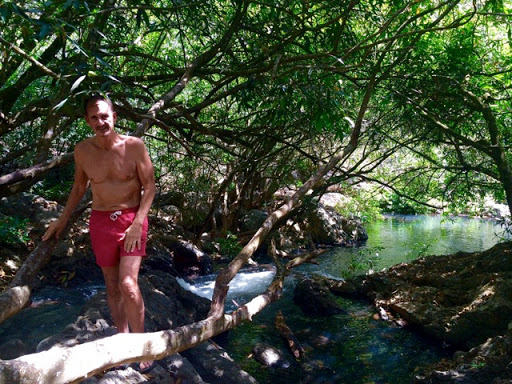
After lunch, we walked around a bit. Rebecca and Rochelle climbed a tree to pose for the cameras.

San Blas  1405

John is also not too camera shy.

IMG 0109

But, to paraphrase the old saying, those who hike down must also hike up. We walked up the trail, some a bit faster than others. But we all finally made it to the top. Along the way we were rewarded with many views of the waterfall.

San Blas  1414

We returned back to El Encanto. John and I share a rooftop with Ellen and Mike. 

San Blas  1416

We have some of the funkiest rooms here, but it’s nice to have the family together. 

On the Road to San Blas

The day did not start out well. Our flight arrived late, the baggage was nearly lost, and when we finally made it to the Budget office to pick up our rental car, we were told that they had released our reservation and had no vehicles at all. Rebecca, John’s niece, managed to get somebody at Avis to give us a car, although it was more four times our previous rate. At least we were not taking a bus. 

Things improved after that. We went off to a not-particularly-attractive part of Guadalajara to pick up Ellen and Mike. My sister and brother-in-law arrived a day before us and they had found an inexpensive hotel to spend the night. I was happy to hear that they had slept well because I was pretty sure that I was not going to be able to drive the whole way on three hours of sleep. 

We were out of Mexico’s second largest city without too much difficulty, and pretty soon the car was on the tollroad climbing up into the Sierra Madre Occidental. I should mention at this time that this vehicle, a Nissan SUV, was packed with six people and way too much luggage. Rochelle, Rebecca’s traveling companion from Berkeley, was stuck in the very back on a tiny little pop-up seat with all the suitcases piled around her. What a trooper! After about an hour, we all decided that we needed a bit too eat and poor Rochelle should get the chance to move her legs again. So we decided it was time for some Tequila!

I am not speaking of the alcoholic beverage right now, but the town which gave its name to that drink. Santiago de Tequila is a small city just to the west of Guadalajara on the arid leeward slopes of the mountain range. It is a charming little city, and has been designated as a World Heritage Site. We stopped at the Casona Antigua for lunch. It was great!

San Blas  1321

Afterwards, we walked around the Casona. It is not only a restaurant, but also one of the larger hotels in the area and I suspect the most expensive. Just off the lobby we walked though this small bar. I was a little surprised in this conservative part of Mexico to see that they had incorporated an old altarpiece into the bar decor.

San Blas  1335

La Casona Antigua has a delightful rooftop bar area with great views of the town.

San Blas  1325

After this, we broke into groups and went shopping. I found the shop for the Rubio distillery and joked to my brother-in-law that he should get something there with the “Marca de Rubio.” He is such a die-hard Democrat that he did not find that at all amusing. But we all did find posing with the phony campesino in the square more humorous. Rochelle, the young lady on the left, seemed to particularly grasp the silliness of the whole thing. 

San Blas  1340

After lunch, I let Mike drive the remaining three hours to the coast. We are staying at El Encanto, a small hotel just off the beach in Santa Cruz de Miramar, a small town about a half hour south of San Blas. John stayed here last January when he came down to Mexico to visit our friend Bob. He was so taken with the place that he decided to get many of our favorite friends and relatives to come join us here for a few days who could take a week off work and were up to a hotel with no room service and a few spiders. Surprisingly, we had all fourteen beds filled within three days of issuing the invitation. All had purchased airplane tickets and wait list was formed. There was no turning back. 

We made it here a in the late afternoon. We greeted everybody—most people arrived before us—and unpacked our stuff. John walked down to the beach just before sunset. 

San Blas  1348

Jim, the owner of El Encanto, often hosts large groups like Yoga retreats, and he has a eating area across the road from the hotel right next to his own house. It is festooned with lots of colorful lights. You can see it in the background behind Ellen. 

San Blas  1354

Once we arrive, we were not surprised to find Sherry in the kitchen helping out with the dinner. 

San Blas  1355

Meanwhile, the rest of us, like Mike, just sat around and chatted with each other. 

Manaus

As we bring our Brazil trip to a close, maybe a map would be helpful. John was actually quite surprised to learn that we were nowhere near the coast when we were paddling up the Rio Negro. Brazil is one B-I-G country.

Brazil Map

Today we left the Ariaú Hotel and began our journey home. But we decided that on our way we wanted to see a bit more of the city of Manaus than its airport. So we made arrangements to spend a day there and see its sights. And, as our flight is not leaving until Wednesday at 3:40 in the morning, we figured we would get a hotel room and sleep in comfortable beds until it was time to get on the plane. 

It did not go according to plan at first. After a long boat ride, we had a long van ride to the Tropical Hotel. We were supposed to me up with a guide there and have a city tour. Unfortunately, he did not show up and we did not have a contact number. So we took a cab into Manaus and checked into our hotel. We asked at the desk there if they could arrange a city tour, and sure enough they did. Our guide was a chain-smoking, obscenity-spouting guy named James. Only 50, though he looked at least a decade older, he had been born in Guyana to a Brazilian mother and an English father. He apparently had lived in Manaus for most of his life. 

He took us first of all to Manaus’s greatest treasure, its opera house. 

20160105 IMG 0591

20160105 IMG 0582

You may wonder why there is an magnificent Beaux-Arts opera house 2000 miles into the Amazon jungle. The answer to that is easy. About a century ago this was one of the richest places on earth. And that was because of Manaus was the rubber capital of the world. 

A little history here. Rubber is native to the Amazon. The Portuguese discovered the Indians playing with balls made from the sap on of the local trees. They were intrigued, but did not see much use for it. Neither did the rest of the world, though the British discovered that it could erase pencil markings. Natural rubber is a somewhat problematic substance. It cracks when the weather is too cold. And when the temperature rises, it begins to melt. 

A number of chemists experimented with adding substances to rubber to make it more useful. Almost by accident, Charles Goodyear discovered that mixing sulphur with rubber and heating it made rubber waterproof and durable. Unfortunately for him, a British chemist made the same discovery about the same time and managed to patent the process first. 

Almost overnight, rubber became one of the most valuable substances in the world and the “rubber barons” of Manaus were the among the richest men in the hemisphere. The Brazilians tried to keep a monopoly on rubber. But British smuggled a rubber tree out of the jungle and set up enormous rubber plantations in Malaysia. The fortunes of Manaus collapsed almost as fast as it arose. 

But fortunately, the opera house and some other grand old buildings remained as a memorial to that era. James told us to go inside of the opera house and sign up for a tour in English. We did so, and had a wonderful young lady guide us through the edifice. She pointed out that the ceiling shows the base of the Eiffel Tower. 

20160105 IMG 0599

Note the “governor’s box.” Brazil had abolished the monarchy about a decade before the opera house was built, but old architectural habits are hard to break. 

20160105 FullSizeRender 8

Like many nineteenth-century opera houses, the boxes have limited sight lines, and today the seats on the floor are those most in demand.

20160105 FullSizeRender 13

The square outside of the opera house is quite charming. There is a monument to the various rivers of the world in the center. The architecturally-uninteresting parish church of São Sebastian is in the rear. 

20160105 FullSizeRender 10

Our guide assured us that the light and dark on the paving stones represented the confluence of the Rio Negro and the Amazon, but we saw the same kinds of designs in Rio. I believe this kind of stonework is called “Portuguese pavement” though I have no idea whether they actually have this in Portugal or not. 

Away from the plaza and the opera house, the rest of Manaus is just pretty ugly. We looked at some of the ships moored in the river.

20160105 IMG 0648

There is a Victorian market place that was in fact build by the British. James, our guide, is on the left. He was taking a short break between cigarettes.

20160105 IMG 0644

20160105 IMG 0647

We walked through the market. John was fascinated by the guys pitching watermelons from the truck to a stall. 

20160105 IMG 0622

Some of the fish looked a little different from the stuff we get at Ralph’s.

20160105 IMG 0637

We returned to the plaza to go to a juice bar. The Brazilians are very fond of “sugo” and there are places to get fruit juices on every corner. Sitting there, we watched the plaza start to come to life for the evening.

20160105 IMG 0657

20160105 IMG 0658

In the late afternoon, once our tour was over, we returned to the hotel. We found a nearby churrascaria for dinner. We’ll be on the plane soon and back home to Los Angeles!

We’ll just be bringing home wonderful memories and a couple odd souvenirs.

20160109 FullSizeRender 7 4

Amazonian Wonders

Today will be our last full day at the Ariaú. And while I do not think I will return here, I have had a wonderful time and will leave with fond memories of this nearly deserted resort. We woke up to heavy rain.

20160104 IMG 0374 2

Globo has a corrugated steel roof, so when it rains you really hear it. But as the porches are well-covered we just opened all the windows and enjoyed the downpour. After all, when you are in the world’s foremost rain forest, how can you complain about the rain?

We had a special excursion planned for this morning. The regular trip was to another, slightly larger, native village. But Anna, the radiologist from Rio and her daughter Maria, really wanted to do one of the optional trips. They had to have four people for it, so we agreed to go. In the end, Josh and the whole Ukrainian family went, too. We had two excursion for the morning:  first, we would swim with the dolphins, and second, we would see an actual indigenous group show us some of their “rituals.”

I had some reservations about the dolphins. John wondered if they were penned in and that is how we would get to swim with them. I I hoped not. And, as it turned out, I need not have worried. They were not imprisoned, but merely bribed.

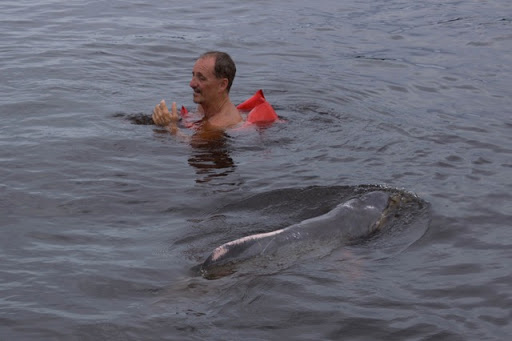
We took the “canoe” out into the middle of the Rio Negro. There was a small platform moored out there. We disembarked. They put life jackets around our waists. The look was not flattering to anybody, particularly me, so I wisely deleted those photographs. We went into the water. One of the guys from the hotel had a cooler filled with fish. He tossed a couple in the river. At first nothing happened. Then we started to see little breaks in the water. At this point, we all went in. 

Pretty soon a whole pod of dolphins, aware that this was a free buffet, were swimming around us. The guide was expert at getting them to jump out of the water to get the fish.

20160104 IMG 0407

One of the unique things about this species of dolphin, besides the fact that they like fresh water, is that they are vaguely pinkish, particularly on their bottom.

20160104 IMG 0410

After a while, they kept checking us out even when we did not have any fish handy. 

20160104 IMG 0414

After a while, the fish were all eaten and the dolphins did not see much point in sticking around. As they left, we did too. 

We traded our canoe for a speed boat here and we headed up the Negro and to the other side. The trip took about forty minutes. Along the way we saw some of the classic blue and white Amazon boats. Larger versions of this craft carry residents from one Amazonian city to another. Small ones, like the one below, carry tourists.

20160104 IMG 0427

We finally pulled up to the shore. We walked up a flight of steps that had been carved into a small sandstone bluff. At the top we found something that looked like a Tlingit long house, but made mostly out of grasses.

20160104 IMG 0439

We went inside where we were greeted by a man who seems to have some kin of leadership role in the group. He explained that they would be sharing the music and dances that they performed when visitors from other tribal communities came. 

20160104 IMG 0458

A group of young men were lined up to perform first.

20160104 IMG 0463

20160104 IMG 0474

20160104 IMG 0475

Some of the women just waited for their turn in other dances.

20160104 FullSizeRender 4

Although the music and dancing were great, John was even more fascinated by the youngest children from the tribe.

20160104 IMG 0444

20160104 IMG 0445

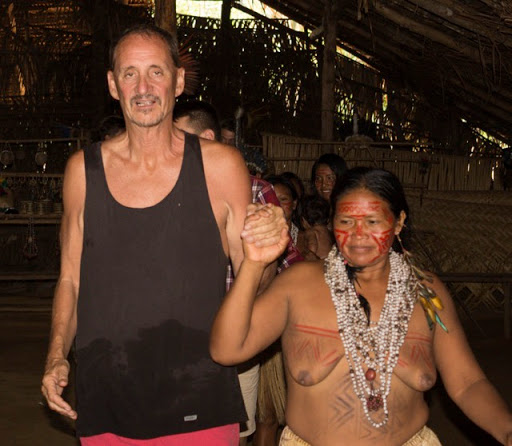
For the last dance, some of the dancers came up and chose some of the visitors to dance with them. Nobody wanted me apparently, but John was picked right away. 

20160104 IMG 0489

They danced around the gathering space and then outside.

20160104 IMG 0494

The tribe makes various handicrafts and we did some shopping at the store they had set up. Here is Anna, the doctor from Rio, in the center, and Francisco, our guide, on the right. 

20160104 IMG 0526

We were allowed to wander about the village. It was obvious from the clothes on the clothesline that they wear western dress most of the time and save this traditional garb only for visitors or ceremonial occasions. We even saw a satellite TV dish. But we were not under any illusions that we had wandered so deep into the Amazon that we were meeting people untouched by Western ways. 

20160104 IMG 0505

We saw some pets in the village including dogs and some birds.

20160104 IMG 0504

Finally, we had our pictures taken with the group before we left. 

20160104 IMG 0507

We returned for the same old stuff for lunch. After that, we thought we would relax in our room. But John brought a roll back with him, and before we knew it, we had visitors. Lots of them.

20160104 IMG 0563

They are pretty insistent on getting anything they can, and somehow they seem to have learned that getting close is sometimes rewarded. 

20160104 IMG 0579

We decided to pass on the afternoon trip and just spent a quiet remainder of the day enjoying our Amazon tree house. We leave early tomorrow for Manaus and from there to home.

Piranhas!

We woke up in our cute little house up in the canopy of the rain forest. I think it is the only room here with satellite TV. Almost all of it is in Portuguese, however, but John loves to channel surf even when he does not understand a word of what is being said. 

20160103 IMG 0279

He also loves all the windows.

20160103 IMG 0267

One of the great things about the Rio Negro is that there are few mosquitos here. The river gets its name from the amount of decaying organic matter it accumulates through the rainy season and spring flooding. This material is sufficiently acidic to make the river a poor breeding grounds for the nasty little pests. 

Today we had a hike through the rain forest. This is still the very beginning of the rainy season, and you can still walk on the forest floor. In a few months, this will be completely flooded with six to ten feet of water. I am sure I would find that interesting, but somehow being able to see all the layers of the forest was great. 

I have to admit that I wanted the Amazon forest to look a little more exotic than it does. I wanted it to be filled with the giant prehistoric looking palms and ferns. Instead, it looks much more like the forests I grew up with in the northeast or the midwest. The tree are different, of course, but not as different as I expected. Francisco, as usual, explained everything to us. 

20160103 IMG 0293

The most important trees are the hardwoods. Because of the pattern of flooding, nutrients are found on at the topmost layer of the soil. The trees therefore have extensive root systems on the surface. And for the tall ones, this increases the risk of falling. And so some create unique methods of buttressing the trunk in order to stay upright. 

20160103 IMG 0294

With kids, we talk about the decomposers in the forest as the FBI:  fungus, bacteria, and insects. We certainly saw a lot of fungus. 

20160103 IMG 0296

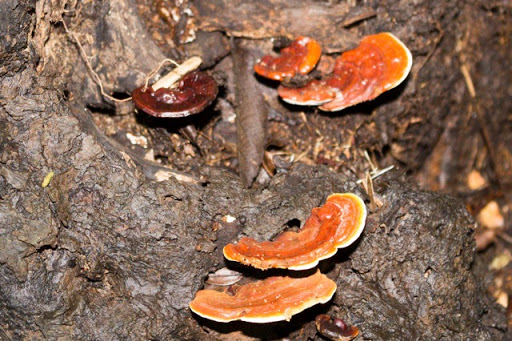
Some of it quite beautiful.

20160103 IMG 0304

And we came across this substantial termite nest.

20160103 IMG 0301

Even though we think of the middle and upper layers of the rainforest as supporting the most life, there is plenty of life

20160103 IMG 0315

and beauty on the forest floor.

20160103 IMG 0314

On our way back, we saw more bird life.

20160103 IMG 0284

Francisco amused us on the boat by making little objects out of fronds. He decided that John must be a great hunter.

20160103 IMG 0335

Not exactly. 

In the afternoon, however, John did prove to be a pretty good fisherman. Our afternoon excision was going fishing. But not just fishing for anything. We were fishing for piranhas!

Once again, Francisco took us out in the canoe. We went a few hundred meters from the dock and then he pulled over to a bank that look just like any other one on the rivulet. We were all given bamboo rods with strings and a hook attached, and everybody was given a handful of what looked like stew beef. We all tossed our rods in the water. And pretty soon we felt something pulling on them. Most of us lost a bunch of beef before we learned when to pull in the rod. John was one of the first to catch one.

20160103 IMG 4540

And not long after he caught another one. 

20160103 IMG 4590

Even I managed to catch a couple, though I think I was better at unhooking them and tossing them back for other people.

20160103 IMG 4594

In fact, all the little ones we did toss in, but kept the big ones for supper. 

In the evening, we walked down to the banks of the Negro. Josh, our companion from Birmingham, England, had found half a dozen alligators sunning themselves there earlier. We were not so lucky, though we did catch glimpses of eyes watching us from the small pond nearby. We marveled at the loveliness of the Amazon sunset

20160103 IMG 4624

and wondered how much longer the Ariaú Towers would be left.

20160103 IMG 4625

Living in the Ruins

We arrived in Manaus well after midnight. I will not bore anybody by discussing why the plane was late. GOL Airlines seems worth avoiding as well. We were met at the airport by some German man — I am not sure I ever heard his name — who drove us to the hotel in a car that fairly reeked of cigarette smoke. But back to the Quality Inn. 

If you are traveling to Brazil for business or pleasure, I have only a few words of sage advice to give. One is to avoid the Quality Inn in Manaus. Or at least avoid room 401. The air-conditioner was placed directly opposite the bed and I froze under the flimsy sheet that was the old bed clothing provided. 

Completely sleep deprived, we had a wake up call at 7:00 for a 7:30 pick up. We slurped some coffee before we were put in a van by some man who looked like one of Santa’s Brazilian elves. They took us to to the Tropical Hotel, a large resort complex a little out of town. By this time it was raining quite hard. We waited a while for the rain to let up, and then more or less raced with our luggage to the boat moored to a sandy beach.

We were crammed pretty tight on the boat. It began to pour again as the boat left the shore, and the two members of the crew put down the thick plastic shade on both sides of the craft. As it rained harder and harder, they were forced to put down the cover in the front as well, This left the boatman completely unable to see where he was going. The woman in front of me put on her life jacket; perhaps she should have pulled out a rosary, too. Periodically the crew would open the shade slightly and try to figure out where they were and if they were headed in the right direction. 

20160102 IMG 0131

Somehow, owing to either sheer luck or the intercession of the Blessed Mother, we actually made it to our destination, the Ariaú Towers Hotel. It was not quite as wonderful as it looked online. 

20160102 IMG 0139

As it continued to pour, we raced up a rickety flight of stairs grasping our luggage. The hotel is actually a cluster of several “towers”, all on stilts, connected with elevated walkways. Almost all the towers looked like they were about to fall down, and the walkways looked just about as solid as the buildings.

We somehow made it to the reception desk where we had to fill out the usual amount of paperwork. It had some interesting decor

20160102 IMG 0151

and views of the complex and the surrounding rain forest. 
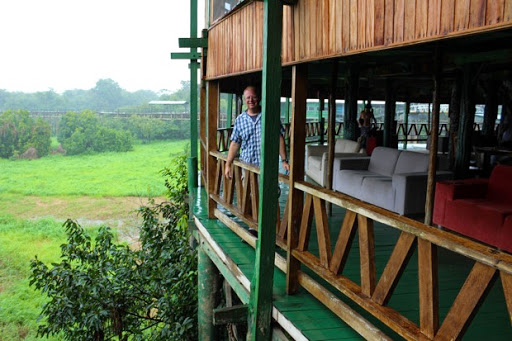
20160102 IMG 0142

Once the rain had begun to subside a bit, we looked around while we waited for our room. There was kind of a bar area

20160102 IMG 0156

But mostly what we noticed were the monkeys everywhere! They were on the floors, on their railings, 

https://farm2.staticflickr.com/1675/23567699263_64c29f290c_z.jpg

20160102 IMG 0168

and sometimes on your shoulder.

20160102 IMG 0175

Some of the mothers carried their babies.

https://farm2.staticflickr.com/1509/24111961661_8f0bd176b1_z.jpg

Can you say, “Aww?” We certainly did for a few minutes. After that, we began to see just how aggressive these creatures were and how dangerous it was to try to walk around with any food. 

20160102 IMG 0173

When we checked in, I asked for a room upgrade. They had Globo, their best little house available, and I decided that if it was going to rain like this for three days — and this is the rainy season — I would much prefer to be up in a tree house with lots of windows and a wraparound deck. In the picture below, you can see it nestled up high in the tree top above the silver roof.

20160102 IMG 0149

Globo was not available right away, so we stuck our stuff in one of the regular rooms while we had lunch and went off on our first expedition.

Our first trip was to see a local settlement. Our guide was named Francisco. He spoke quite good English and seemed quite knowledgeable. On our way to catch our “motorized canoe,” he pointed out a tree with bark that looked vaguely like a sycamore with with a fruit that looked vaguely like a lime.

20160102 IMG 0178

This was a rubber tree, and for a time it was the foundation of the entire economy of Brazil. Today only the fruit has any value, used by local fishermen for bait. This was our “canoe.” We boarded on one of the many creeks that fed into the Rio Negro. The river does indeed look quite black, but the smaller waterways are a muddy brown.

20160102 IMG 0184

Along the way we saw a fair amount of bird life. Herons were everywhere. 
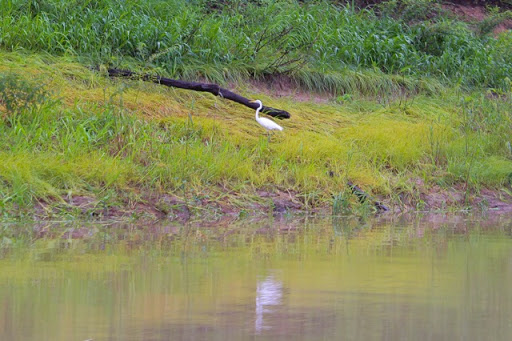
20160102 IMG 0190

20160102 IMG 0261

We left the inlet and entered the wide, slate gray river.

20160102 IMG 0203

We noticed a few people living in houseboats on the river.

20160102 IMG 0207

20160102 IMG 0208

And more birds, too.

20160102 IMG 0211

My new camera is fine, but I miss the magnification of the old one. Unfortunately, there is no amazon.com on the Amazon, so I cannot just order a telephoto lens and have it delivered later on the same day. Surprisingly, however, there is pretty a pretty strong cell phone signal everywhere. 

The “native village” we saw was actually just the residence of one extended family. Francisco explained that in the Amazon people make a distinction between “native” and “indigenous”. Native people are ethnically and culturally a mixture of pre-Columbian and European people. They speak dialects of Portuguese that combine native words and archaic Portuguese. They live in more modern houses, but in small settlements that are similar to to indigenous villages. These people were definitely native in this sense. 

Francisco showed us the root of the cassava plant. Cassava is indigenous to the north of Brazil, but it is now cultivated throughout the world. The root is actually poisonous, but the toxins can be fairly easily removed by soaking after it is crushed into a pulp. 

20160102 IMG 0213

The most common use of the cassava today in the United States is for tapioca, but it is a staple starch in the Amazon and in other places where the Portuguese brought it. Here it was made into a vaguely tasteless pancake which they served to us with far more tasty mango juice.
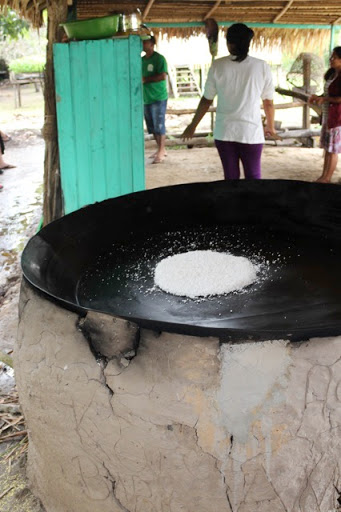
20160102 IMG 0219

There is a huge market I think for cassava, but these villagers have found a cash crop:  açai. Until we came here I just assumed that this was sort of a generic name for a thick sort of Brazilian smoothie. I learned that açai is actually the fruit of a particular palm tree. This family was cultivating several dozen of them, and one of the boys climbed the tree and cut some down for us.

20160102 IMG 0226

One of the Brazilians in our group joked he planned to take it back to São Paolo and open a chain of shops. 
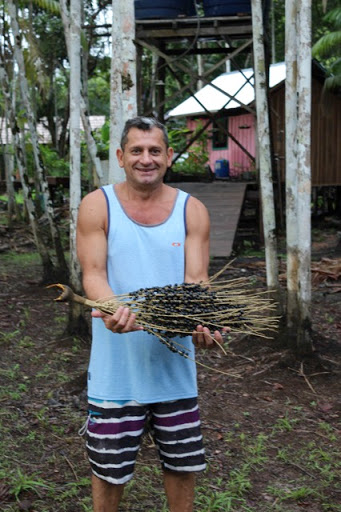
20160102 IMG 0229

20160102 IMG 0235

The family also ran a small “pousada” or guest house for visitors who wanted to live a more native life. I suspect that most of the people staying here were probably German backpacker types.I doubt this would appeal to most Brazilians. 

20160102 IMG 0232

We all watched one of the girls with her dog. The poor animal just seemed to put up with anything this girl did. 

20160102 IMG 4601

After a bit more looking around, we returned to the boat and went back to the Ariaú Towers. 

20160102 IMG 0242

By the time we arrived, Globo was ready. As they moved our luggage over there, we walked down to the shore. We found what had once been the dock for the hotel, but it was now, like so much that was there, pretty much unusable. But it was a lovely evening.

20160102 WMSZ4169

We had a dinner buffet that was pretty much a repeat of what we had had for lunch. I have a feeling that the Ariaú will not be the culinary high point of this trip. There are maybe 25 guests here, and supposedly the hotel once had close to 300 rooms. Francisco told us that most of the towers are not used any more.

After dinner, we went with Francisco in the boat again, this time to look for alligators. We another guide, whose name I never learned, who spotted the alligators and jumped into the mud to pick them up for us. 

20160102 NSRH2986

They had to good sense to avoid the mature specimens and pick up only some of the young ones. 

20160102 QVUV7909

As they walked through the boat with the poor creatures, the little Brazilian girls touched them and shrieked. And a couple minutes, the alligator was returned to the peace and quiet of the riverbank mud. And we likewise went back to the peace and quiet our new little house in the decrepit hotel. 

A Quiet New Year's Day

The celebration on Copacabana Beach continued long after we left. But it was not the only party in the city. There was quite the private party taking place on Ipanema right across from our hotel. It seemed to be a quite upscale crowd, and the tends in the middle apparently covered a stage with live performances. This party also continued quite long into the night, and it made it hard to fall asleep. But it finally broke up and we were able to doze off.

20160101 UOTA0501

We would have liked to have slept in until noon after the long night of celebration. But only the young seem to be able to sleep in like that, and we up not too long after the sun came up. We went up to breakfast, desperate for a some coffee, and were greeted on the front page of Brazil’s largest newspaper with the photograph we wish we could have taken.

20160101 CWQH5227

We will be flying to Manaus tonight to begin the last part of our adventures. We had thought at first about renting bicycles are riding around the lake, perhaps visiting the botanical gardens. But on only a few hours of sleep, and with the weather today supposed to be at least as hot as it was yesterday, we decided to forgo more sightseeing and just rest a bit.

After coffee, we went up on the roof. Even though it was barely nine in the morning, it was already in the eighties, and a dip in the pool seemed like the best thing to start the day.

20160101 EBNA8843

We decided to spend the day on the beach. While Ipanema seemed like an easy choice, we knew it would be crowded. So we decided to catch a cab and go back to São Conrado where we had spent the last part of our favela tour.

It was a good choice. The water is cleaner there and the sand even finer. There were quite a few people on the beach, but it was not absurdly crowded.

20160101 RYFM3623

I like the fact this this woman’s beach towel was the Brazilian flag.

20160101 BWQF6198

We returned to the hotel around five and showed in the fitness center. Carlos, our driver from the first night, met us and took us to the airport, and made sure we were all set for our flight to Manaus. We should arrive there around midnight, and we will spend the night in Manaus before being transferred up the Rio Negro to begin our Amazon adventures!

Réveillon

Today we had no activities preplanned for us. We decided that this would be a good day to explore Rio’s historic center. And, had it been even a tiny bit cooler, that would have been a good plan. But more on that later.

I found what seemed to be a pretty good walking tour of center on National Geographic Traveler. I copied it to my phone and off we went. The eight block tour was to begin at the Palaçio Tiradentes. We explained in simple English where we wanted to go to the taxi cab driver and even pointed to its location on Google Maps. He nodded like he understood.

Apparently he did not. He drove about a half mile past the Palaçio and announced that, “Here is praça.” And we were indeed on your standard Latin American square with the obligatory equestrian statue.

20151231 IMG 0030

It seemed useless to argue, and as we were not all that far and the neighborhood did not look unsafe, we figured we would walk.

One of the first things we saw as we left the square was the sight of the “Presbyterian Cathedral.” This gothic structure seemed almost comically out of place in tropical Rio.

20151231 IMG 0032

The interior was as spare as the name might suggest.

20151231 IMG 0034

But walking only a couple blocks away, we found that the sacred had not displaced the profane in downtown Rio.

20151231 IMG 0036

We saw some of the oldest buildings in Rio, such as the monastery of São Francisco, right next to temples to banking and commerce.

20151231 IMG 0039

We marveled at some of the detail on the older homes and businesses.

20151231 IMG 0038

But it was starting to get pretty miserably hot and Google Maps kept giving us weird directions to get to the Tiradentes Palace and they kept changing every time we moved a few feet. I was getting frustrated and John, who has minimal tolerance for heat, was starting to get really cranky.
We stopped in a church that had once been the chapel royal. After independence from Portugal, Brazil, unlike most South American countries, did not immediately adopt a republican form of government. Instead, they had their own emperor for several decades.

20151231 IMG 4509

We finally asked somebody where exactly the Tiradentes Palace was and he pointed us to a building that we had already passed at least two or three times.

20151231 IMG 0041

By this time, it was pushing 100 degrees and John was just done with wandering around looking at old buildings. He stopped in a little snack shop in the train station and he drank a couple of big glasses of coconut water. That helped a bit, and I agreed that we should just head off somewhere and get a real lunch.

We decided that we would catch a cab to Rio’s trendy Santa Teresa neighborhood, and have lunch at the Santa Teresa Hotel. Both the hotel and its restaurant are on just about everybody’s list of the best places in Rio.

The Santa Teresa neighborhood is on a hill overlooking downtown and the port. It is nowhere close to a decent beach, but the guests have a great pool.

20151231 IMG 0050

The meal there was probably the best we have had on the trip so far. The restaurant was filled with European tourists, and French seemed to be the dominant language I heard.

We had a walking tour of this area in one of our guidebooks, but John did not want to go far in the heat. So instead we just explored a few blocks around the hotel. It reminded me a great deal of San Telmo in Buenos Aires:  gritty but colorful, obviously fashionable yet still quite rough around the edges.

20151231 IMG 0059

20151231 IMG 0063

20151231 IMG 0069

20151231 IMG 0067

On the taxi ride back from the hotel, John kept telling me how hot it was. And, indeed from the dirty window of the taxi, he found proof.

20151231 FullSizeRender 3

For those of you who do not have a calculator handy, that translated to 98.6 degrees Fahrenheit. And that’s pretty hot when it is accompanied by near 100 percent humidity.

The rooftop pool was crammed, so we retreated to our air-conditioned room and napped to get ready for New Year’s Eve. Now, Rio is one of those famous places like New York or Sydney where New Year’s Eve is a big public celebration. Cariocas — that is, if I have not mentioned it before, the name for the residents of this city — hold a huge fireworks display on Copacabana Beach. The hours preceding midnight are filled with local and international musicians playing on two enormous stages on different ends of the long beach. And people traditionally dress all in white for the occasion and rush into the surf at the stroke of midnight. John definitely wanted us to go local.

20151231 IMG 0097

We had read that it can be pretty insane on the holiday and that you should not bring money, jewelry, or cameras to the beach. We followed those directions, but decided that the warnings were completely overblown. It was crowded, but it was overall a pleasant family event. Just about everybody there had cell phones an were busy taking selfies and snapping pictures of their friends. People were drinking, but we saw nobody drunk or aggressive.

Many people had brought flowers with them, generally gladiolas. They walked into the sea and threw them in as a sign of letting go of the old year and asking for good luck in the new. I wish we had brought some, as I spent much of this part of the trip learning to let go of some pretty painful memories of my own. There were half a dozen cruise ships lined up to watch the fireworks. I rather doubt they were throwing glads into the waves.

At midnight, the fireworks began. And while I have seen better displays in the United States, it was a pretty good one. Oh, that I had brought along a camera to take some snapshots of it. But I did not. And when it was over, we walked the two miles back to our hotel.

Slumming

This morning John found this old picture postcard of Ipanema before all the massive and generally unfortunate development that has taken place over the last half century. Ipanema is between a large fresh water lake and the ocean. There is a small opening, as you can see in this picture, that drains the lake into the ocean. Unfortunately, that channel today is lined in cement and frankly smells pretty rank. Our hotel, the Praia Ipanema, is just to the left of the the channel.
20151230 IMG 0616
Behind the lake, not visible in the postcard, are a ring of very high hills. These were deforested quite early, but the representatives of the Portuguese Crown, afraid of the loss of an adequate supply of fresh water, insisted on creating a nature reserve. Early in the last century, however, soldiers returning from service, lacking a place to live, began to squat on some of these public lands. They called them “favelas” after a scrubby tree from Bahia, one of the northern states of the country, where many of them had served. Over the course of the twentieth century, dozens of these settlement have been established. Some are still shanty towns, but others are now fairly substantial and permanent settlements.
When John first proposed the idea of taking a tour of a favela, I thought he was insane. Many of the favela neighborhoods are notoriously dangerous. And if it it was safe, wouldn’t it be really offensive to drive around one of these areas and gawk at people living in poverty. But I agreed to go anyhow. It’s hard turning down John. And I am glad I did.
Our tour was much smaller today. We were in the back of a modified jeep. There were eight of us plus our guide. She is the woman on the left.
20151230 FullSizeRender 26
Because the group was small, we did not spend ninety minutes picking everybody up. Instead, after a couple brief stops, we started climbing up into the hills. As we did, we had some stunning views of the city.
20151230 IMG 4460
Things did not seem quite as beautiful when we arrived.
20151230 IMG 4463
We glanced briefly at some handicrafts, and then we went into a small hostel. We climbed several flights to the roof. From there we could see how Rohcina — that is the name of this favela — seems to spill out of the mountains and down into the city below.
20151230 FullSizeRender 35
And I could see that although none of the development was planned, it all had a certain logic to it. Streets followed the natural curve of the land. From this height, it seemed a little more like an Italian hill town.
20151230 FullSizeRender 19
 We walked from the hostel down through the favela. As we did so, we noticed how bright and colorful the streets were.
20151230 FullSizeRender 23
And the narrow streets are clearly designed for pedestrians and small motorcycles, not for cars.
20151230 IMG 4476
20151230 IMG 4479
There is even a quite unplanned distinction between purely residential neighborhoods and those that are mixed use. There were no areas that appeared purely commercial.
Brazilians seem to both fear and love these neighborhoods. On one hand, they are some of the most violent in the country and drug dealing and gang violence are constant problems. Many wealthy Brazilians see them as a threat to the order and stability of the country. But on the other hand, they are not only some of the most vital areas of the city but much of modern Brazilian art and music finds its roots in the favelas.
One of the more recent expression of the artistic life of the favelas is capoeira. This is a kind of cross between martial arts and dancing. We were given a small demonstration of it in this area which is its birth place.
20151230 IMG 4486
20151230 IMG 4492
20151230 IMG 4500
The young men who were performing tried to teach the graceful moves to awkward tourists with predictably humorous results.
20151230 IMG 4496
And afterwards, everybody posed for group portraits.
20151230 IMG 4502
Our last stop was in one of Rio’s most upscale neighborhoods, the beach community of São Conrado. As just about nothing in Portuguese seems to be pronounced the way you expect, the name is really something like “Sow Ko hah doh”. We sat on this lovely beach for a while and sampled açai.
20151230 IMG 4507
The cliffs above us are famous for hang gliders, but there did not seem to be much action there.
Returning to the hotel, we rested for a bit up on the rooftop bar and then napped some more in our room. John wanted to go to a Brazilian night club and hear traditional Samba and Bossa Nova. A couple people had suggested a place near downtown called the Scenarium. It was a great recommendation.
The Scenarium is located in a neighborhood that was Rio’s red light district until a few years ago. Now the old homes and businesses in the neighborhood are among the trendiest in the city.
We had to wait in line about half an hour before we were allowed in.
20151230 FullSizeRender 10
Once inside, we noticed that it had a kind of Hamburger Mary’s decor:  lots of stuff that had been rescued from junk shops displayed sort of a found art.
20151230 FullSizeRender 9
The club had three floors and there were several rooms on each floor. In the main room of the first floor was a band playing come classic standards from the Brazil 66 era.
20151230 FullSizeRender 2
20151230 FullSizeRender 5
We had dinner, enjoyed the music, and then headed home in a taxi as it started to approach midnight. Tomorrow will be New Year’s Eve!

TOURture

We are usually lucky when we allow our travel agents to set up tours or other activities for us. Today our luck seemed to run out. We found ourselves in what can only be called Gray Line hell. No, Gray Line would have had a better bus with a sound system that worked.

Now John always tells me that stories about travel problems are boring, but spending an hour and a half going to every hotel in Ipanema and Copacabana to pick up people until over sixty were crammed into every seat on an open-air bus, begins to suggest what was going to follow. Our guide was named with Rachel. She somewhere on the other side of sixty with bottle-blond hair, a smoker’s voice, and an attitude normally associated with middle-school teachers two or three years before retirement. Despite all that, we liked her. She was the best thing about this miserable adventure.
We drove past some places where I would have like to have stopped — or at least learned a little more about. For example, we zoomed past the residence of the governor of Rio state

https://farm6.staticflickr.com/5634/23808523180_5be070f3d7_z.jpg

and we only briefly paused by the Sambodrome, the Oscar Niemeyer designed stadium for judging Carnival acts.

https://farm2.staticflickr.com/1673/24078128556_e4688968ef_z.jpg

But we stopped the bus and had to get out at the football stadium

https://farm6.staticflickr.com/5834/24104227515_02375e83b5_z.jpg

and for some reason this was a hit with many of the passengers on the bus.

https://farm2.staticflickr.com/1696/24078190876_2bc102b26b_z.jpg

It is worth noting here that the majority of the people on this tour spoke Spanish and that Rachel delivered more of her narration en español than in English. Unfortunately, the sound system was about as good as the AM radio on a 1962 Buick so I usually could not make out a single word in either language.

Our major stop for the morning was Mount Corcovado, the site of the famous statue of Cristo Redentor, or Christ the Redeemer. This statue was sculpted by Paul Landowski, a French artist, from a local design. It is 30 meters high and is made out of reinforced concrete covered with soapstone. You get to the top by taking a cog railway, the “Trem do Corcovado.” As we were waiting to get on the train, John posed in front of this photograph.

20151229 IMG 4443

Probably the ONLY good thing about the tour was the fact that the tickets had been purchased in advance for a specific time and we could therefore shoot ahead of most of the people in line. Despite that, it was a longer than expected climb up the hill to the top. Once we left the train, we had to continue up several flights of stairs, each with its own gift store. Actually seeing the statue was a bit of a letdown, even if you weren’t expecting much. The Savior’s tunic is pleated like your grandmother’s drapes and if you look closely you will see a heart on the middle of his chest.

https://farm6.staticflickr.com/5829/23704108429_f412895043_z.jpg

Not one of those disturbing-but-vaguely-realistic Sacred Heart images. No, this one looks like Jesus came out of the old Cathy cartoons.

Not surprisingly, most people seemed more interested in taking pictures of themselves with the Rio in the background. And for some odd reason they all thought it was amusing to imitate the statue. John had to get into the act here.

https://farm2.staticflickr.com/1587/23744408849_d57ff61a46_z.jpg

After we went down the hill, we were drive to … another gift shop! “Very, very, very cheap!” Rachel assured us. But most of the passengers decided to stay on the bus despite the alleged fire sale prices. I disembarked just so I could capture a picture of the TOURture instrument itself.

https://farm2.staticflickr.com/1668/24004239922_0aa9ab0d70_z.jpg

We were taken next to a churrasqueria, one of those places where they walk around with meat on a skewer and shave some off for you. Rachel grew somewhat exasperated with her charges as they tried to walk around to find a better place to sit in the small restaurant. “Sit down! Here! Now!” she yelled at us. We obeyed.

The food was pretty good, and we chatted up a couple of the people at the table. There was a couple from Australia. They had been traveling around South America for several weeks and had a number of destinations to go. We were somewhat curious about where they found the money for this as neither of them seemed exactly like they had a Stanford MBA. There were also two women, one from Puerto Rico and the other from Chile, who were apparently traveling together. They kept rushing outside to smoke. In between the nitrates and the nicotine, I was not sure how long these ladies had left.

We ditched the tour at this point. We were supposed to end the day by taking the aerial tram to the top of Sugarloaf, but it was a hazy day and we had enough pictures of Rio and its stunning natural setting. And we did not relish the idea of another hour or so of dropping everybody off at all those hotels. Instead, we took a cab back to our hotel.

We went up to the pool on the 16th floor rooftop. It had a great view of Leblon as you can see here. Behind us was Ipanema.

https://farm2.staticflickr.com/1449/23816773160_2b564bb518_z.jpg

John was fascinated by the plants growing above the pool.

https://farm2.staticflickr.com/1470/24004346502_6098a74325_z.jpg

At least that’s why he told me he was taking this picture.

In the evening we walked over to Shopping Leblon, one of Rio’s malls, to look for a replacement for the camera we lost. We had read that prices for imported electronics were absurdly high in Brazil, but we will be heading off to the Amazon next and it seemed stupid to try to photograph wildlife with your iPhone. The selection was limited, but prices were not particularly inflated. I picked up a Canon T5, the entry-level DSLR for 1,500 reals, about the same price you would expect to pay for it at Best Buy. And really, since that included the tax, it might have even been cheaper.

On the way out, John posed for a picture.

https://farm2.staticflickr.com/1478/23453209944_a8e256ca1d_z.jpg

Indeed, 2015 has been a tough year, so I am hoping 2016 will indeed be happy. And with that, we strolled back to our hotel and to bed.

https://farm2.staticflickr.com/1655/23713650509_0cc094f7b4_z.jpg

Tomorrow we have a tour of one of a favela, one of Rio’s slum neighborhoods, I am not quite sure what that will be like.