Onward and – Gasp – Upward

When we woke up, not only had it rained fairly hard during the night, but it was quite cold in our room. And I suppose because we are somewhere between the Tropic of Cancer and the equator, they decided we did not need a heater in the room. Of course, even if there had been one, the electricity did not really turn on until close to seven o’clock. So we hurried tossed on some warm clothes and went over to have breakfast. As we did, we took another look at our hotel. It is built in a vaguely mid-century alpine style. 

https://i0.wp.com/farm8.staticflickr.com/7397/11829677745_102d48da43_z.jpg

In addition to the main lodge section, which looks sort of like a motel, there are a few “cabañas.” John had thought about asking for one of these, but they did not really have any better views than our room did. 

https://i0.wp.com/farm3.staticflickr.com/2810/11829946353_852e4c8aaa_z.jpg

The main attraction for Tree Tree is its zipline, one of the longest in Central America. We watched tourists get suited up and listen to the safety instructions. 

https://i0.wp.com/farm3.staticflickr.com/2877/11846289154_885a1bb0d1_z.jpg

Breakfast was not that exciting. The hotel room came with the “continental” breakfast, basically a couple pieces of toast, some fruit, orange juice, and coffee. John decided to order some pancakes, too. 

We caught the shuttle from the hotel down to town. It was just the two of us and several large plastic trash bags filled with used linens. They dropped us off right by the stall where we had figured out the day before we could rent the bike. There were a few other stalls here including this place selling fruit. There was also another stall with a man selling a “jungle remedy” that was supposed to cure everything. I wish I had taken a picture of that instead. 

https://i0.wp.com/farm3.staticflickr.com/2870/11830474786_50f29145cd_z.jpg

The bike rental was run by a transplanted Southern Californian named Mike. We talked to him about doing the Baja Mono route. He smiled, told us it was “great,” but did mention that it was “all uphill.” I did not have any idea just how true that would be. 

We adjusted our seats and started riding out of town. We had read in a guidebook about a great garden called, not that creatively, “Mi Jardin es Su Jardin.” We had been told, however, the owner had died and that it was now seldom open to the public. Indeed, when we came there, we discovered that it was “cerrado.”

https://i0.wp.com/farm6.staticflickr.com/5493/11830478546_54a631afeb_z.jpg

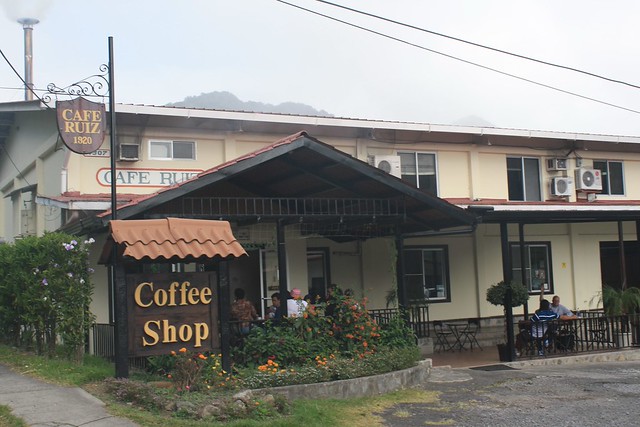
Our next stop was Cafe Ruiz, one of the major producers of high-quality coffee in Panama. I had read in the Moon guide that they had a great tour, but when we arrived we learned that the tours were at nine and at one. Since it was ten thirty at this point, we were too late for the first and far too early for the second. We bought a cup of coffee and a pound of beans and pushed onward. 
https://i0.wp.com/farm8.staticflickr.com/7444/11830103774_4aec79bedf_z.jpg

It had been so cold when we left the hotel that both of us brought along jackets. By this time, we stuffed them in the backpack. We also had a couple guidebooks, bottles of water, and the coffee in the backpack. It was heavy, though I didn’t mind it so much when the road was flat. 

https://i0.wp.com/farm4.staticflickr.com/3776/11845853025_a5a92001fb_z.jpg

But as the road started its relentless incline, I not only felt the weight of 25 pounds or so on my back but I became keenly aware that we are at about 4000 feet above sea level here. I ride a bike nearly every day at home. I walk the dog three or four miles a day. I figure I am in generally pretty good shape. But I could barely make it 250 feet without stopping to gasp for breath. I felt like I had emphysema. 

Sometimes we stopped because there was something interesting. The coffee harvesting season is starting right now, and there were coffee plants growing on the fields by the side of the road. I suspected that most of the labor to harvest the crop was probably provided by the indigenous people. This man, probably from the Ngäbe-Buglé people, kindly allowed us to take his picture.

https://i0.wp.com/farm4.staticflickr.com/3776/11837874896_9b307ece91_z.jpg

One of the main attractions along the Baja Mono route is this “cascada” or “waterfall.” It really was not all that impressive, but we were both so winded that we would have stopped for just about any reason. 

https://i0.wp.com/farm6.staticflickr.com/5515/11837374713_5b58349c13_z.jpg

The other attraction along the route is the “haunted castle” of Boquete. No two accounts of this place are precisely the same, but the story is usually something like this. A wealthy American married a Dutch woman and wanted her to live with him in Boquete. She was not happy about the housing choices here, so she moved back to the Netherlands while he built her a more proper house. He built a huge house in the countryside north of Boquete. But when the house was nearly finished, he died of a heart attack. Neither he nor his wife ever lived there. There were a couple tenants, but they all declared that the house was haunted and moved out. It has been abandoned now for over forty years. 

https://i0.wp.com/farm3.staticflickr.com/2853/11837378353_7cbb0d4fb6_z.jpg

I have no idea how much of this is really true. But we did decide that somebody had already cut a hole in the cyclone fence, we would explore the place. Most of the windows have been smashed, and the inside is creepy enough even if there are no ghosts. 

https://i0.wp.com/farm8.staticflickr.com/7449/11837382743_c2788a82e6_z.jpg

Vandals with spray paint have also been visitors here. 

https://i0.wp.com/farm4.staticflickr.com/3820/11837388903_ca9986782d_z.jpg

We did not finish the whole loop. Another cyclist had told us that the road really started to climb after the castle, and we decided that we had traveled enough of the route. Of course, the return was much easier. We saw some unusual sights along the way including this tree trunk carved to look like a serpent

https://i0.wp.com/farm8.staticflickr.com/7362/11837083735_d8246612f0_z.jpg

and this scarecrow. 

https://i0.wp.com/farm6.staticflickr.com/5483/11837112125_02c7404326_z.jpg

We had a well-deserved cup of ice cream and caught the shuttle back to the hotel. Tree Trek is only seven kilometers from the center of Boquete, but what a difference that short distance makes. It had been warm and sunny in Boquete. At the hotel it was cold and raining! We sat on the little patio outside our room and watched the people on the zip line go through the air in the rain. I was glad I was somewhere dry. 

https://i0.wp.com/farm6.staticflickr.com/5512/11837902896_736d967786_z.jpg

We decided to walk to town for dinner rather than sit in a somewhat chilly hotel room watching television. As we left the hotel grounds, we discovered a small botanical garden. 

https://i0.wp.com/farm6.staticflickr.com/5485/11830480786_40d284ac7c_z.jpg

Despite the drizzle the walk to town was just magical – at least the first three or four kilometers. The most striking thing about this area is the incredible profusion of bromeliads. Just about any tree has a few on them, and some trees are completely covered in a dozen different varieties. 

https://i0.wp.com/farm4.staticflickr.com/3757/11829692595_500e47c152_z.jpg

We also saw “fincas” or small plantations of coffee and bananas on either side of the road along with the occasional pasture. As we turned from the Tree Trek road onto the main highway, the rain stopped. As it approached sunset, the light on the damp landscape was beautiful.

https://i0.wp.com/farm3.staticflickr.com/2855/11830488266_44cc82d3c5_z.jpg

It was dark by the time we arrived in town. Just on the far side of the river, the final preparations for this weekend’s Flower and Coffee Festival continued. The music stages and some of the exhibit spaces were still not finished. 

https://i0.wp.com/farm4.staticflickr.com/3816/11830490106_5c9b370422_z.jpg

The gardens, however, are definitely finished.

https://i0.wp.com/farm4.staticflickr.com/3722/11830491936_8621b18402_z.jpg

John and I split some fried rice for dinner. It was not particularly easy, but we managed to finally convince a taxi to take us back to the hotel.

Under the Volcano

Before recounting what we did today, I noticed that I left out some photographs from yesterday’s account that give a sense of life in the Silico Creek Gnäbe-Buglé community. Education is important to these people. There is a primary school located here. We learned that it has about 90 students. The education here is entirely in Spanish, though the community is concerned about the possible loss of their native language. Students continue to middle school in a nearby town, and then complete secondary education about 25 kilometers away. Some, like our guide, have even completed some university education. 

https://i0.wp.com/farm8.staticflickr.com/7293/11809558014_26bb802ab6_z.jpg

We were often welcomed inside the homes of the people. The conditions no doubt seemed pretty primitive by our American notions, but what struck me was that everybody seemed to be living together in such a small space quite peacefully. The far superior living standards of Americans does not seem to have made us happier. 

https://i0.wp.com/farm4.staticflickr.com/3667/11809555454_5b35e09940_z.jpg

Animals are an important part of this community and the lives of the people. Some animals are clearly raised for food even if they are walking around quite freely as the chickens do. But there are definitely companion animals. There are many pet dogs, and some more unusual pets. This is Cula. She is one of the wild “rabbits” indigenous to northwest Panama. She is called Cula or “Tail” because she does not have one. The long nails make these animals adept at burrowing.

https://i0.wp.com/farm4.staticflickr.com/3756/11809552094_f3c1d9b900_z.jpg

It rained during the night, and in the morning it was still cloudy. Our cabin was not only located at the top of the hill, but at the edge of protected forest. We had a stunning view. We were also able to see some beautiful birds in the morning. I really wished that we had a telephoto lens on the camera so that we could have taken pictures of them. At least we were smart enough to bring along our binoculars. 

https://i0.wp.com/farm4.staticflickr.com/3735/11810869103_d36a63fdc6_z.jpg

John brought a number of gifts for the children of the village, things like pencils, erasers, notebooks, postcards, and simple English books. It was not long before word was out and soon John many fans in Silico Creek.

IMG 6346

 He not only generously shared his “regalitos” with them, but allowed them to use the binoculars and the camera. They liked taking pictures of each other.

IMG 6400

They particularly liked close ups.

IMG 6408

We had another delicious breakfast, and after that we had a couple hours before the taxi came to pick us up to take us to Boquete. So we did a little exploring. But we were not always by ourselves. Our young friends came to show us coconuts 

IMG 6415

and more of their pets.

IMG 6419

As we went through the village we looked at them

IMG 6438

and they looked at us.

IMG 6436

I found the poverty painful, but I had to also remember what Arnold had told me earlier – they do not think of themselves as poor. They have a strong sense of family and of their identity as a people. They feel connected to the land. I wondered if it would be possible to preserve these things even with a higher standard of living. I wish I knew. 

We had one final delicious meal with our Silico Creek friends. This is not the best possible picture, but I did want to show Arnold’s mother who did all the cooking. She is seated between us. And his uncle, serving the chicken soup on the left, also did the beautiful flower arrangement. 

IMG 6460


https://i0.wp.com/farm8.staticflickr.com/7303/11818153576_a57cf813a8_z.jpg

 We asked to take a final picture.

IMG 6469

When our taxi finally arrived to take us to south into the mountains, I felt a little sad leaving.

https://i0.wp.com/farm6.staticflickr.com/5499/11817257385_c3daebe254_z.jpg

Our trip to Boquete took a little over two hours. We had the same driver who took us from Almirante to Silico Creek. The weather was not the best. Not only was it raining, but at times the fog was so dense we could only see a few feet ahead of us. I was glad that our driver seemed to know this windy mountain road well. I could never have driven it in those conditions. The scenery varied as we ascended. Sometimes it was thickly wooded; at other times you could tell that it had been clear cut in the past for lumber. We saw some stunning flowering trees and an occasional waterfall. Along the way we also saw a couple hydroelectric projects. John was taken by the vaguely Soviet-style art at one of them. 

IMG 6489

As we climbed, we became more and more aware of Mount Baru, the volcano that dominates the landscape of western Panama. Not only were we more aware of the mountain, thickly covered with clouds, but we noticed the walls made of basalt boulders. We passed through valleys that must be in the rain shadow of the mountain because the forests were replaced by savannah. 

The town of Boquete, like that of Cuernavaca in Mexico, is not only dominated by a volcano but claims to have a perfect climate of perpetual spring. This has made it popular with Americans seeking to retire more cheaply abroad, and apparently a few years ago lots were selling for near San Francisco prices here. The town itself is not particularly old or beautiful despite the dramatic setting. 

IMG 6502

The “palacio municipal” on the plaza is just an old railroad station. The narrow-gauge line that once connected Boquete with David has been abandoned, but there is still a car left on the square for the amusement of tourists like us.

IMG 6496

There are obviously some indigenous communities around here because we noticed a number of people in traditional clothing.

IMG 6497

We are staying about 7 kilometers out of town at the Hotel Tree Trek. The last three kilometers of this road are in just wretched condition, and taxis charge 15 dollars or more to come there just because of this. It is a rather odd place, and I am sure I will have more pictures of this alpine hideaway tomorrow. But they did try to make us feel welcome when we arrived. There was a bottle champagne on ice and this very odd bit with some towels. I wonder if this isn’t a honeymoon place for Central Americans.

IMG 6505

John and I had some real drama right away. The moment we took our bags to the room he realized that he had left the camera in the cab. We called Amazing Panama Voyages, the local agency that had helped to arrange our travels here. They are in Panama City, but they called Cesar in Bocas del Toro and he in turn knew the name and phone number of the cab driver. The camera was handed off to us as we took the shuttle from the hotel into town. After exploring Boquete and learning where we can rent bicycles tomorrow, we stopped by a little cafeteria and had some Panamanian food “para llevar” – to go. It was not all that great, but who can complain about a complete meal of rice, beans, vegetables, and stewed chicken for only 3 dollars?

Tomorrow we will do some more exploration of the area. 

Silico Creek

We had to leave Playa Bluff fairly early to leave for Silico Creek on the mainland. We packed our things and we a quiet breakfast. I was sorry we had to leave so soon. It had rained during the night, and somehow I imagined that in the damp early morning the forest would be full of life. But almost exactly at 7:30, the taxi, a Toyota pickup truck painted somewhat incongruously in the traditional Yellow Cab style, came to take us to Bocas town. We stopped along the way at the island’s only ATM, and then met Carlos, our local guide, at the pier. It was a bit of a mob scene as you can see. We ended up switching to another company at a different dock in order to get a boat that left at at a reasonable time.

https://i0.wp.com/farm4.staticflickr.com/3811/11809528614_824aa61030_z.jpg

They packed us on the boat pretty tightly. I was grateful i had brought my Kindle so that I could think about something other than how much the boat was bouncing over the bay. By this time it had started to rain again, and all I could see was gray water and gray sky anyhow. We arrived at the little town of Almirante. We were met here by another taxi driver again in the same kind of pickup truck taxi. A rock had damaged much of his windshield, and as we started to bounce around I wondered if the glass was going to collapse and fall on John who was sitting in the front with the driver. The town of Almirante seemed covered in trash from one end to another. Even by Central American standards, it was filthy. We drove on fairly quickly, passing a few containers on the waterfront with the cheery Chiquita Banana logo on them.

The road was decently paved, but it twisted and turned as we headed into the mountains. I was glad that John had gone to the pharmacy while we were waiting for the taxi and had found some kind of generic Dramamine. Our driver seemed to know the road well, but I was still a little nervous as he passed other cars on turns. It took about 45 minutes for us to reach Silico Creek. We were met at the local cooperative office which also housed the town’s small ambulance. We were told that our guide was currently at church and that he would be there to meet us in an hour or so. This made me suspect that the church was not the local Catholic parish. 

We did not just want to wait around, so we asked if we could walk and see the community and the church. They seemed to have no idea why John would want to see the church, but they were only too happy to show us around. This is Arnold who became our main guide. His English was pretty rudimentary, but he had a good sense of how to speak Spanish to foreigners, and he really became our main guide for the day. There are about 500 people living here, and the community is build on a hillside.

https://i0.wp.com/farm8.staticflickr.com/7405/11809122185_edf21c011c_z.jpg

Silico Creek is a settlement of the Ngäbe-Buglé people, one of the three principal indigenous groups in Panama. Many of the houses there are build in the traditional style with stilts and a thatched roof. 

https://i0.wp.com/farm8.staticflickr.com/7380/11809373903_243ba6ef2f_z.jpg

When we arrived at the church my suspicions that this is a Protestant settlement were confirmed. While we could not get a sense of what groups had done missionary work here, Arnold confirmed that the people in the town were “evangelicos” and that the church service would be particularly lengthy today because they were also having the annual meeting to discuss their budget. The pastor was leading this when we entered.

https://i0.wp.com/farm3.staticflickr.com/2858/11809534964_58dc431d6b_z.jpg

While many of the adults were quite engaged in the discussion of how much money they needed for this or that, the children were clearly bored and found the white visitors intriguing. 

https://i0.wp.com/farm3.staticflickr.com/2822/11809128595_9f54846dd2_z.jpg

We were treated to lunch. The community has only recently added housing for visitors, and while probably about 12 people could be accommodated here at one time, John and I were the only visitors today. It was a slightly uncomfortable situation to have four or five people watching the two of us eat. But the food was great! They had rice and friend plantains, of course, and the main dish was a delicious fried fish. Notice the limes next to the fish. This is a local variety with orange flesh and a slight sweetness to the taste. I am surprised they are not found in gin and tonics throughout the world.

https://i0.wp.com/farm3.staticflickr.com/2828/11809873846_77176674fd_z.jpg

We also met other residents of Silico Creek. There are a lot of dogs in this community, but they are not feral. Pets seem quite important to the people here. This is Reina. She is about a year old and as friendly as can be. We were taken with her eyes. 


https://i0.wp.com/farm3.staticflickr.com/2860/11809875726_e4f5cd7db6_z.jpg

After lunch, we were taken on a tour of the local organic cacao production. Along the way John heard some activity from a small cement building. He asked Arnold about it, and was told that this is where the men play dominos. Like good Protestants they did not seem to gambling, but the competition was still vigorous.

https://i0.wp.com/farm8.staticflickr.com/7333/11809134075_8b3343ab1e_z.jpg

As we crossed the highway to the cacao  farm, I noted the emblem of the “comarca” or regional autonomous authority. Notice the use of the term “sostenible” or “sustainable.” This, we learned, is really important to these people whose food production is entirely organic.

https://i0.wp.com/farm4.staticflickr.com/3709/11809544584_1e03056e2a_z.jpg

I had never seen cocoa growing before, so I was little surprised to see that it grows in these large pods in trees. The trees are not shaded, like coffee, but they grow best in extreme humidity so they are typically planted alongside banana and other tropical plants. Five different types of cacao are grown in this little plot. Each kind has a different color, and each apparently a slightly different flavor.

https://i0.wp.com/farm8.staticflickr.com/7392/11809138385_22d114164e_z.jpg

When the fruit is ripe, it is picked. The seeds are in the center covered with a sweet, sticky white fluid. The seeds at this point cannot really be eaten. Instead, they are taken out of the fruit and placed in a dark box and allowed to ferment for about a week.

https://i0.wp.com/farm4.staticflickr.com/3793/11809548424_0c085c3bbc_z.jpg

When the seed have fermented and any remaining fluid has evaporated away, they are then sun dried for three to five days. We saw a couple different kinds of platforms for this, but this one, where the trays slid in and out, seemed to be the largest. 

https://i0.wp.com/farm6.staticflickr.com/5517/11809401533_755bae8087_z.jpg

The dried beans are then quickly roasted rather like coffee. This causes the skin on the outside of the seed to fall off. 

https://i0.wp.com/farm6.staticflickr.com/5550/11809898056_b13a8f5443_z.jpg

The seeds are then ground, and you have this lovely but somewhat bitter chocolate paste. 

https://i0.wp.com/farm8.staticflickr.com/7327/11809406503_6c87c64edd_z.jpg

Grinding the seeds in an old-fashioned meat grinder is frankly hard work! 

https://i0.wp.com/farm8.staticflickr.com/7453/11809159235_c877f0c684_z.jpg

Unfortunately, I was stepping backwards into some mud as I was taking this shot, and this is what happened!

https://i0.wp.com/farm8.staticflickr.com/7438/11809411063_bc3d81ed7a_z.jpg

They took us down to the cooperative office where there was the only shower in town. It was not glamorous and the water was cold! But I cleaned up reasonably well, and they offered to wash our clothes for us for only a nominal amount. We went to our rooms. We are staying in a traditional Ngäbe-Buglé house – though if it were really traditional, probably about 10 people would be living there. There is basically a bed. There is no bathroom, though an outhouse is located about three or four meters away. There is some wiring for electricity, but running the generator is expensive and so we had no electricity. Looking down the hill – our accommodations are at the very top with a magnificent view of the surrounding mountains and rain forest – nobody else in Silico Creek had electricity that night, either.

https://i0.wp.com/farm3.staticflickr.com/2805/11809415533_4139260520_z.jpg

They again fed us a wonderful dinner. I am not completely sure what the main dish was. It was a “guisado” or stew, and neither John nor I could quite identify the meat. But sure was tasty!
 
Sitting on the deck as night fell was pleasant, at least once I had sprayed myself from head to toe with Off. 
 
https://i0.wp.com/farm8.staticflickr.com/7428/11809907616_81bd1da1cb_z.jpg
 
Tomorrow we head further up into the mountains to the Boquete. 

Playa Bluff

After three days, we had become surprisingly fond of Bocas Town. There’s something about the place that charms you despite the all the drunken tourists, all the trash on the street, and all that noise all night. It’s a lively and friendly place. We were particularly sad to leave the wonderful staff at the Bocas del Toro hotel, particularly our favorite, Johayvi at the front desk. We were originally supposed to go today spend two days with a group of Embera people, but at Carlos’ suggestion we decided to spend another day on Isla Colon, this time about a half hour out of Bocas Town on Playa Bluff or Bluff Beach. A taxi came to pick us up a little after ten. There was already another passenger there, a handsome but somewhat taciturn Swede named Adam. He lives in Stockholm and works in mergers and acquisitions. Like us, he had spent some time in Panama City before coming here, but he stayed at the Waldorf Astoria. We move in different circles. 

The road to Bluff Beach turns into mud and ruts only a short way out of town. We were surprised when the cabbie told us that it had once all been paved, but that a large earthquake some years ago had caused the coral reef to drop and that exposed the road to the surf, washing it away. We had always heard that Panama did not get earthquakes. I guess they only get the less frequently than some of their Central American neighbors. 

I am not sure why that call it Bluff Beach because there is nothing that would strike any Californians as anything that even looked passably like a bluff. But it is the longest, loveliest, and emptiest stretch of Caribbean beach you can imagine. The sand in soft and a striking reddish-gold. John and I enjoyed walking up and down it. 

IMG 6195

The waves here are notoriously treacherous and there are deadly riptides. So the only people who go in the water are surfers. It’s one of the best surfing spots in Central America.

IMG 6185

John and I decided to walk through the jungle to see if we could see howler monkeys or sloths. We did not, unfortunately, though we did hear and see some fantastic birds. 

IMG 6210

At the end of one of the trails we found these basalt outcroppings. These began to suggest to us a little of the geological history of this area.

IMG 6200

The hotel is fairly isolated, but it surprised us – and not always in a good way – what are party scene the area is. The Playa Bluff Lodge had a restaurant and bar on the property. There were a steady stream of surfers and other stopping by for a drink – well, we should be honest and admit that most had more than one – and maybe a bit to eat. There was quite a stir when these three showed up. We learned later that the one on the right is Felipe Beloj, a famous Panamanian football star. 

IMG 6212

The bar at our hotel has made some effort to be kid-friendly with a pool in the back. This allows mommy and daddy to get a little sloshed while the kids were relatively safe. 

IMG 6224

There was a second bar located right next to our hotel. It was a much wilder scene and the loud music was still going strong well after sunset. I think the drinks may have been cheaper and stronger because it was filled with surfers. The special tourist police also paid a visit while we were there. 

The rooms at the Lodge are pretty spartan. The best party of the property is the garden behind the hotel. There are a remarkable number of tropical plants. While some are planted like trophies, many others have been artfully combined to create an effect of great tranquility and beautify. 

IMG 6233

IMG 6216

We were assured that a sloth lives in a tree there, but we never managed to see it. Nor did we see any howler monkeys who are also known to pay a visit. We did see the resident alligator. 

IMG 6215

By late afternoon the crowds on the beach began to thin and John could not only find one hammock, but two. He found this a perfect spot for listening to the sound of the waves and his Andrew Byrd playlist. 

IMG 6226

IMG 6227

At dinner we met a young couple from Ontario. They were staying at a nearby hotel. It turned out they had both trained to be PE teachers, so we were able to talk school shop for a bit. We also talked a good deal with Michelle who manages the restaurant and helps with hotel. She moved here recently from Toluca Lake. She really likes living in Panama, but admitted  that the lack of internet service on Bluff Beach is giving her major Facebook withdrawals. 

IMG 6179

We also met the owners of the Lodge, a Dutch couple named Helen and Dieter. Helen has a lot of energy! She speaks Spanish fluently but with what even I could hear as a strong Dutch accent! They have a house in Bocas town and return there at night with their daughter. 

IMG 6241

Tomorrow we have to get up early because we are headed inland to Silico Creek to spend some time in a indigenous community. 

Oh Ye Dolphins … and Frogs, too

We took our second boat tour today. This was was free, an effort by the local tour operator to show how sorry they were for some of the problems with our missed airport connections on New Year’s Day. This was a nice gesture of good will. But as an excursion, it was basically worth every penny we spent for it. The trip today hit three of the main attractions of Bocas:  dolphins, coral, and beach. For us, it also illustrated the environmental perils that tourism can cause. 

I thought our boat yesterday was full, but today we had fourteen people, and from the dock I watched a boat leave ahead of us packed with eighteen. All these boats were trying to see some of the same sights – and that is the problem. The first stop was Boca Toritos or Dolphin Bay, a stretch of water between some of the cays that Atlantic Bottlenose Dolphins use as a feeding and nesting area. Each of the boat operators tried to get his boat closest to where a dolphin can be photographed. While we were out there, John counted 18 boats literally chasing the dolphins. 

https://i0.wp.com/farm4.staticflickr.com/3701/11743339395_8b5e972bba_z.jpg

There is the occasional sighting as the animals do have to come up and breathe. But for the most part this destructive tourist practice simply is helping to destroy the local dolphin population. Like many English majors, bits of poetry come to me at odd times and I thought of the lines from Lycidas:  “Look homeward angel now and melt with ruth, And O ye dolphins, waft the helpless youth.”  It seemed to me that the angel’s pity now should be saved for the dolphins. 

https://i0.wp.com/farm6.staticflickr.com/5540/11743616733_a6ac5c2b9b_z.jpg

There are a number of groups now raising concern for the dolphins and the protection of their habitat such as the Bocas Dolphin Project. Maybe visitors can come to realize that people watching is such a great Bocas pastime that we do not need to harass the poor sea mammals. Look at El Delfin, and leave los defines alone!

https://i0.wp.com/farm3.staticflickr.com/2807/11743359675_a3f277e791_z.jpg

The tour really did not get better after this. They took us to Coral Cay. Here were were let off on a dock with a restaurant and a bar and told we should order lunch. The food would be ready after we finished snorkeling. The restaurant featured the usual long menu – we have learned that generally in Panama this means nothing because most of the items are not available on a given day – and the prices were not cheap. John was really pissed off about attempt to force us to pay 20 dollars for a miserable red snapper fillet and a cup of coconut rice. 

https://i0.wp.com/farm3.staticflickr.com/2857/11743620773_0b01cb6d1d_z.jpg

We declined to order. We did notice as the far end of the dock there was a little store selling provisions to local sailors. We checked it out and noticed that they had some soda for sale. We had also brought he last of our New Year’s Eve crackers. So we figured we could make do on our own.

The snorkeling was almost as depressing as the dolphin hunt. The coral reef here was in bad shape. Is this the result of a dozen tour boats unloading hundreds of people each day? It is hard to say because coral reefs are in decline all over the planet. But the human activity can hardly help. Plus, since the Almirante Bay is fed by a half dozen rivers, it is really an estuary and as you would expect the water if therefore a little murkier with sand and organic sediment. So what coral was still left was not exactly easy to see.

The day would have been a total waste except for the visit to Red Frog Beach. Red Frog, on the Isla Bastimentos, is hardly undiscovered. There is a significant amount of development in the area, mostly vacation homes and rentals. But they have managed to keep most of this away from the beach itself, and it is one of the loveliest stretches of Caribbean coast I have seen. 

https://i0.wp.com/farm6.staticflickr.com/5544/11743388335_f2d75462f9_z.jpg

https://i0.wp.com/farm8.staticflickr.com/7398/11743643663_35579b79ca_z.jpg

The Beach takes its name from the tiny red frogs. These creatures, found from Nicaragua to Panama along the Caribbean coast, are poisonous, but not a danger to humans. In a book John is reading set largely in this area, the author talks about how native children get up in the morning and catch the little frogs on leaves. They then spend the rest of the day charging tourists to photograph them. Well, as John walked down the beach some children came up to him with a frog, and he was only too happy to part with a dollar to get this picture of the tiny creature. 

https://i0.wp.com/farm4.staticflickr.com/3673/11743825434_677f434314_z.jpg

After a couple hours on the beach getting a bit too much sun, we took the boat back to Bocas town. We cleaned up. We met up with our friends Amy and Jolie. They were going to Guari Guari, the most celebrated restaurant in Bocas. We tried to get reservations but could not get in. So we used our free drink pass from the hotel.

https://i0.wp.com/farm6.staticflickr.com/5506/11743814164_2d5b9b4a1b_z.jpg

We ordered our drinks from the bartender known to all simply as “Darling.” I think there is a story there.

https://i0.wp.com/farm3.staticflickr.com/2892/11743403425_64466a6dbc_z.jpg

We did not much feel like sitting down in a restaurant by ourselves. After all, when you have spent the entire day together, there is not that much to say while you wait for the food to arrive. We walked around for a bit and enjoyed the balmy night. We came across a man who had turned gourds into lighting fixtures. I really did not want one, but I still though they were rather cool.

https://i0.wp.com/farm3.staticflickr.com/2830/11743822174_9ec2f63610_z.jpg

After strolling, we picked up some soda at a chino, and we ordered some Chinese food to go from the restaurant right by our hotel. 

Tomorrow we will be spending one more night in Bocas, but this time at a new hotel on Playa Bluff, the surf beach.

Playa Estrella

“All shall be well, and all shall be well, and all manner of thing shall be well,” Julian of Norwich wrote. I am certain that the saint had more important things in mind than our problems with airport transportation and a malfunctioning trackpad, but somehow all of these problems managed to resolve themselves this morning and in Bocas del Toro all is well today. The sun even came out!

So we did what people usually do in Bocas – we found a boat tour and headed off towards the more remote parts of Isla Colon. Our boat stopped in a couple places and picked up passengers until there were ten of us in the boat. Half of the passengers were Panamanians, who brought along an astonishing amount of beer, four of us were Americans, and we had one lone Swede.

https://i0.wp.com/farm4.staticflickr.com/3688/11719007935_11dbc940c8_z.jpg

We cruised along along the riotously colorful Bocas town docks.

https://i0.wp.com/farm3.staticflickr.com/2848/11719777636_3c5c3bdc3c_z.jpg

As the boat bounced over the waves, we learned a little more about our fellow passengers. And they also passed the time taking pictures of each other. Here Megan is taking pictures of Amy and Jolie from New York. 

https://i0.wp.com/farm3.staticflickr.com/2865/11719643776_6270b9bef2_z.jpg

We couldn’t resist taking a few photographs, too.

https://i0.wp.com/farm6.staticflickr.com/5497/11719284543_2a6bbdf725_z.jpg

Our first stop was Playa Estrella, or Starfish Beach. John found a hammock and made himself comfortable right away.

https://i0.wp.com/farm6.staticflickr.com/5531/11719801426_80916de312_z.jpg

Some of the children on the beach found the starfish that give the beach its name.

https://i0.wp.com/farm8.staticflickr.com/7378/11718839355_1275f3e0a2_z.jpg

I do hope, however, that the kids heeded the warnings all over the beach to avoid unnecessarily disturbing the starfish which are diminishing in number in the area.

After a couple hours at Playa Estrella, we all piled into the boat again and headed toward Boca de Drago. We were only supposed to spend a scant half hour here before continuing on to another island, but our boatman explained that the sea was too rough to do this because we would have to go out into open ocean to get to that island. So we ended up spending the rest of the afternoon here. But we still found things to do. The young passengers were delighted to photograph each other and themselves. Here are the Panamanian passengers.

https://i0.wp.com/farm4.staticflickr.com/3713/11719127613_4e92dbcb37_z.jpg

And Richard from Sweden took his turn, too.

https://i0.wp.com/farm8.staticflickr.com/7326/11719222334_93ea4dfae6_z.jpg

John and I were content to photograph instead of being photographed. And we found something a little more languid to do while we waited to eat our lunch at a small restaurant down the beach.

https://i0.wp.com/farm3.staticflickr.com/2886/11719231074_3a0e09aa2f_z.jpg

We had salads there since green salads are not a typical part of the Panamanian diet and we are missing our vegetables. As we did so we chatted with Nick, a young Italian university graduate who is spending a few months here in Panama working for one of his compatriots here. 

https://i0.wp.com/farm4.staticflickr.com/3778/11719900793_61417c04c5_z.jpg

On our way home we passed by some of the last bits of an older Bocas as we saw several groups of local people paddling by us in dugout canoes. I know what hard work it can be to paddle a boat like that, but I thought of how wonderful it must also have been when the sea was free from the deafening sound of outboard motors and the stench of their exhaust. 

https://i0.wp.com/farm4.staticflickr.com/3750/11719646826_febece352f_z.jpg

Concluding a wonderfully lazy day, we had a fantastic meal at El Ultimo Refugio. It is a small restaurant with an eclectic menu and maybe the only fresh vegetables on Bocas. John had the most amazing seared tuna and I had some pork loin with a blue cheese sauce. 

https://i0.wp.com/farm8.staticflickr.com/7447/11721922173_fcfbcf4296_z.jpg

We had some entertainment there, too. Some drunk, but obviously wealthy, Australian was having a dinner with a German couple at the next table. He started on his political opinions, which seemed pretty strongly libertarian, until the German guy could stand it no longer. He took his lighter and tried to set the guy’s leg hair on fire! Oddly enough, the Aussie took it all in good humor. 

And let me finish the day by giving big thank you to Suzie Masters at Mongol Global Tours for sorting out all the problems we had yesterday. You’re the best!


Bocas del Toro

I will not, dear readers, relate the problems we had with getting to and from the airport for the simple reason that I want to forget them. Instead, let me introduce you to Isla Colon, the main town in the Bocas del Torre area of northwest Panama. We are staying at the Hotel Bocas del Torre. It is built in Caribbean style and the back of the hotel is elevated over the water.

https://i0.wp.com/farm3.staticflickr.com/2841/11699212074_162d877592_z.jpg

After we checked in, we had some lunch on the deck. Yoivy – I think that is how she spells her name – was not only solicitous at the front desk but stopped by the restaurant to make sure we were getting served there, too. 

https://i0.wp.com/farm3.staticflickr.com/2878/11699199284_32cba6fd95_z.jpg

As you can see, it was a rainy afternoon here in Bocas. We napped a bit as it rained making up for the sleep we missed last night, and then we went off to explore. We saw the traditional houses.

https://i0.wp.com/farm4.staticflickr.com/3812/11699087193_f2b933b621_z.jpg

And we also saw how tourism will start to change the laid-back Caribbean charm of this place in time.

https://i0.wp.com/farm4.staticflickr.com/3824/11699627576_fae9c3e235_z.jpg

There were reminders that fishing is still an important occupation in this community.

https://i0.wp.com/farm3.staticflickr.com/2806/11698863375_384598a651_z.jpg

And maybe this nativity scene in front of a house here says everything about “peace on earth, good will towards men.” I was touched by the backdrop of the mosques.

https://i0.wp.com/farm6.staticflickr.com/5538/11698855795_601ceced9a_z.jpg

But this is an inclusive community where Jews are welcome, too.

https://i0.wp.com/farm6.staticflickr.com/5510/11699246414_e76bb6f3bb_z.jpg

In fact, just about everybody seems welcome in this friendly little town. John snapped this picture as we were waiting for a downpour to subside. It may be my favorite of the trip so far.

https://i0.wp.com/farm6.staticflickr.com/5507/11699092783_1b99e44bf8_z.jpg

Tomorrow we will be off to explore beaches and reefs of this archipelago. Pray for sun!

Wild Bells and a Wild Sky

Today was not only our last day in Panama City, but also the last day of the year. And some of Tennyson’s lines from In Memoriam seemed to capture the day perfectly: “Ring out, wild bells, to the wild sky … The year is dying in the night; Ring out wild bells, wild bells, and let him die. Ring out the old, ring in the new….” We spent the day observing things old and new, and as the New Year began we listened to wild bells and looked at a wild sky. 

Compared with some parts of Latin America, Casco Viejo is remarkably clean. No doubt the Panama City municipal authorities deserve the credit for this, but they have some unpaid helpers who stop by each morning to see what they can help recycle. I think if we stayed any longer we would start giving these guys names.

https://i0.wp.com/farm6.staticflickr.com/5530/11678978823_e0ee795fe1_z.jpg

Our big plan for the day was to finally use our tickets for the “hop on, hop off” bus and see the parts of Panama City we missed. But before we went, we wanted to take another walk through this oldest section of one of the oldest cities in the Americas. Reading my first entry, John protested that I had been unfair to Casco and had not pointed out all the astonishing restoration that has been done and is being done right now. What is so remarkable to me about this community is how the old and the new, the dilapidated and the restored are literally right next to each other. This is what we saw each morning from the balcony of our room. 

https://i0.wp.com/farm4.staticflickr.com/3750/11678980313_be6d566df1_z.jpg

Not only is the old adjacent to the new, but in Casco rich are right next to the poor. For example, Plaza Herrera is a charming square at the edge of Casco Viejo. But all the guidebook caution visitors to be careful here because Panama City’s most notorious housing projects are only a few blocks away. Yet it is precisely this site that the owners of The Canal House, Casco’s most expensive hotel, chose as the site of their second, larger venture, the American Trade Hotel seen in the picture below. 

https://i0.wp.com/farm4.staticflickr.com/3699/11678983503_bb98f9a460_z.jpg

John loves to look at go into expensive hotels where we could never afford and ask to look at their best rooms. This time he pointed at me, told them I wrote a travel blog, and they were only too accommodating to show us around. 

https://i0.wp.com/farm3.staticflickr.com/2809/11679554774_aa8abb2ee4_z.jpg

The rooms are quite lovely, and the public areas of this beautifully restored place are absolutely elegant. Even though guests are currently staying there, not all the work is completely done. I suppose that is why they give a little break on the prices and the best rooms only go for about 600 a night right now. By the time these people figure out what kind of travel blog I really write I hope I will be safely out of the country!

Our friend Steve’s dad was born in Panama City and grew up here. Steve sent me an email asking me to check on the old house at the end of Calle 6 right by the beach. The last time Steve had been in Casco the place was in shambles. It was surround by cyclone fencing and a snarling dog guarded the yard; the windows covered by concrete blocks to keep out squatters, and the decaying balcony was barely held up a piece of wood. Today someone is pouring thousands and thousands of dollars into restoring it into the elegant home is so clearly once was. 

https://i0.wp.com/farm8.staticflickr.com/7392/11678728075_3228bb5dc3_z.jpg

In fact, everywhere you look in Casco work there is restoration work being done.

https://i0.wp.com/farm6.staticflickr.com/5537/11679105624_a9eacf787e_z.jpg

But maybe this is not a complete surprise. One of the residents of the neighborhood is the President of the Republic of Panama. And there is nothing like a few pushy neighbors to help improve a neighborhood. Here is a shot of Panama’s own White House.

https://i0.wp.com/farm8.staticflickr.com/7412/11678734205_6de772e97b_z.jpg

Everywhere you go in Panama they are selling Panama hats. Despite the protests of the vendors that these are made in Panama, I suspect the they probably are all manufactured in Malaysia or Bangladesh. And I am confident that I could get one far cheaper than the going 35 dollars on Amazon. John convinced them that he was planning to buy one to let him try them on. I am certain that all the vendors were dreaming of what they were planning to do with that money as John tried on one after another. And then, of course, he just walked away with a simple, “Gracias.”

https://i0.wp.com/farm8.staticflickr.com/7395/11679520636_422d46a8fb_z.jpg

Our bus was supposed to arrive at 10:45. We were not sure quite where to watch it, but we finally asked enough people and found the spot. It did not come at 10:45. But at least we did discover some interesting fellow customers. The couple at the right are Norwegians. He works for the Statoil, the Norwegian energy company that has become in a recent years almost as big a Royal Dutch Shell or Exxon/Mobil. She works with mentally ill homeless people. The man in the blue shirt is from the State Department. He is leaving his post in Costa Rica soon to go to some place in China. They were quite impressed when I talked about my friend Ann’s time in Libya. “It’s really scary when that stuff is happening,” his wife said, “but it looks so good on your resume.” The world is filled with people who do more interesting things than talking about how to multiply mixed numbers. 

https://i0.wp.com/farm3.staticflickr.com/2810/11678992483_1bcdeeb316_z.jpg

Even though the 10:45 bus came at 11:20, we managed to get a seat. We went through miserable traffic to MultiCentro, yet another enclosed mall in the heart of Panama City. We changed buses there. We sat around for what seemed like hours. When we finally left, the congestion was so bad that it took us about 15 minutes to to move one block. We finally made it to the ruins of Panama Viejo.

By this time John was not feeling well. We started to walk down towards the ruins, and he announced that he had “seen rubble before” or something to that effect went back to look at the museum which supposedly had a scale model of the old city. I went on.

https://i0.wp.com/farm3.staticflickr.com/2831/11679002743_718b09b22f_z.jpg

When Balboa landed in Panama, he was disappointed that he found no gold or silver. But the natives told him that there were people who lived far to the south who had lots of gold and silver. Those were, of course, the Incas of Peru. After Pizarro had ruthlessly destroyed the Inca empire and enslaved its peoples, Peru’s gold and silver miles provided a seemingly endless supply of precious metal to the Spanish crown. The gold and silver came in vessels from Peru to Panama City where it was carried overland to Portobelo. At Portobello it was loaded on other ships and sent to Madrid. The English were intent on intercepting these shipments, not only because the money helped to fund the Spanish military, but because they frankly wanted the riches for themselves. And so the English Crown commissioned sailors to attack the Spanish ships and to pay themselves out of the stolen riches. Henry Morgan was among the most notorious of these “privateers.”

Morgan landed his men on the Caribbean coast at followed the Chagres River overland to Panama. Even though the city was fortified, the Spanish sent their forces out to meet Morgan in the hills near the city. They were badly routed and fled. Morgan plundered the city and then set it ablaze. A short time later, the Spanish decide when they rebuilt the city a location further west would be more defensible. They salvaged what they could from the ruins of the city and let the jungle begin to overtake it. 

About 20 years ago, the government of Panama and UNESCO decided that it was a major archeological site and work began to preserve the existing ruins and to excavate the site. While not much of the original city is left, the outlines of Panama Viejo, as it came to be called, are fairly clear. Like all Spanish cities established under the Law of the Indies, it had a central plaza with the cathedral and government buildings in the most prominent positions around the squares. Further off, were houses of prominent families and the monasteries of the important religious orders sent to help convert the native population – the Franciscans, Jesuits, and the Dominicans. 

There were also a few religious establishments for women as well such as the Convent of the Immaculate Conception. These women were cloistered and were not involved in any missionary work. Instead, many were placed there by their families when a suitable marriage could not be arranged for some reason. Such women usually provided the order with a generous “dowry” and they entered the order with a servants and were provided with comfortable accommodations. The Convent of the Immaculate Conception was precisely this kind of place. Recently underground vaults, presumably for storage, have been excavated.

https://i0.wp.com/farm4.staticflickr.com/3675/11679531866_73004aa30f_z.jpg

Much of the convent church is also still standing.

https://i0.wp.com/farm8.staticflickr.com/7340/11678739445_c159ac4b76_z.jpg

The real gem of Panama Viejo, however, is the ruins of the Cathedral. The design of the cathedral was unusual, though it was similar to some churches in southern Spain. While the church was on the plaza, main doors were located on a side street. There was only a single bell tower, instead of the usual two, and it was located near the high altar instead of by the doors of the church. The tower also served as a lookout for the community, and it was apparently so solidly built that it survived the fire that destroyed most of the rest of the church. 

https://i0.wp.com/farm4.staticflickr.com/3786/11679537516_9f5e52050a_z.jpg

An old photograph on display shows the condition of the tower a century ago. Today it has been stabilized and a stairs and platforms constructed inside so that visitors can climb to the top and be rewarded with a panoramic vista. No doubt it was from here that the first lookouts spotted Morgan’s forces.

https://i0.wp.com/farm6.staticflickr.com/5492/11679124734_ac7594ef86_z.jpg

I had a fantastic time at Panama Viejo. John unfortunately did not. When he went to check out the museum not only did he discover that it was closed, but an armed police officer was now telling people that they could not enter the ruins. Apparently they should have been doing this when I entered it earlier. John was livid that the bus had dropped us off here on a day when the only real attraction on the route was closed. He would like to send this picture to TripAdvisor, but somehow I am not sure they will use it.

https://i0.wp.com/farm4.staticflickr.com/3763/11679542606_c5929ea5d0_z.jpg

But our troubles with the “hop on, hop off” bus were only  beginning. It soon turned into something straight out of the Twilight Zone. The bus went from Panama Viejo to the Multiplaza Mall. We asked the conductor – who insisted on trying to speak English with me when my Spanish was definitely better than his English – where we changed to the other bus for the attractions nearer the old Canal Zone. He informed me it would be the next stop. And then we proceeded to wait. And wait. And wait. The other people on the bus, mostly Spanish speakers from other parts of Latin America, were furious and started to yell at him. He tried to give them some explanation. We finally began moving and were nearly to the final stop when the bus abruptly turned around and went back to the mall. There we were met by a large group. They seemed to have tickets of some kind for some other tour, and they were initially allowed to get on the bus – and then told they all had to leave! I have had some decent experiences with this kind of tourist transit in other places, but here in Panama City has been a nightmare. 

Once we finally made it to the transfer point, we took a seat on the upper deck of the bus. We never really “hopped off,” but John did step inside Albrook Mall long enough to take a picture. This is where ordinary Panamanians like to come to shop because it has over 700 stores and actually employs more people than the canal does. 

https://i0.wp.com/farm8.staticflickr.com/7394/11678753715_0d6cb51a55_z.jpg

One of the projects that running years behind schedule here is the biodiversity museum designed by Frank Gehry. It’s not finished and already starting to fall apart!

https://i0.wp.com/farm4.staticflickr.com/3756/11679545546_4a7f8a35b5_z.jpg

In the evening when we got off the bus we decided we would go to the fish market and have a quick ceviche. It apparently was closing early for New Year’s Eve, and only one stall was left selling food and the line there was too long.

https://i0.wp.com/farm6.staticflickr.com/5541/11679131094_c8058d7712_z.jpg

So we just walked around a bit. We went up Avenida Central a local shopping area now closed to automobile traffic. We passed through Santa Ana plaza where some young ladies called out, “Mi amor, ¿por qué no me visitas?” We also came across some of the police, who looked an awful lot more like the army, getting ready for a night of crowd control.

https://i0.wp.com/farm8.staticflickr.com/7386/11679548976_a9dcb21863_z.jpg

We went back to the room and regrouped for a bit. We showered and decided to go out and see if we could get anything to eat. As we left the hostel, we heard half a dozen bells ringing and ringing from the nearby church of La Merced. I had to check out the “wild bells” for Lord Tennyson. They were having a mass that evening, presumably for the Solemnity of Mary, Mother on God, on January 1. They were doing it quite properly with a vested deacon and a thurifer. John snapped a picture from the inside of the church that seemed to capture the moment perfectly. 

https://i0.wp.com/farm8.staticflickr.com/7352/11678760255_51ac6f2fd7_z.jpg

We walked around some more. There were only a few restaurants open, and those were full. Panamanians like to spend the New Year at home with their families. So we finally just went to the the local market – what the Panamanians call a  “chino” since they are usually run by the Chinese – and picked up some crackers and peanut butter. From our balcony we could see the young Americans and Europeans at Tantalo celebrating. 

https://i0.wp.com/farm4.staticflickr.com/3743/11679018013_267571430d_z.jpg

As we grew close to midnight, we had a “wild sky” that Tennyson could not have imagined.

https://i0.wp.com/farm6.staticflickr.com/5478/11691120045_ec8f1f4bdc_z.jpg

So Happy New Year, near readers. Even better, as they say down here, “Prospero año nuevo” – have a prosperous new year. And thank you all for your comments and we take our journey. It is nice to hear from all of you.

New Locks, Old Forts, and a Black Jesus

We had to get up early this morning because we had a train to catch. But it was not just any train. It was the celebrated Panama Canal Railway. This railroad is older than the canal itself, and it is certainly historically important! Not only did it carry miners to California but the gold it carried from California to Washington probably provided the Union with the funds needed to defeat the Confederacy. The route of the rail line was moved with the creation of the Panama Canal in the early part of the twentieth century, and it now runs directly adjacent to the canal. This gives travelers the sensation of going through the canal without spending eight to ten hours doing so on a ship.

All the guidebooks suggest trying to get to the train early and finding a seat in the observation car. We were not early enough for that and we told that it was full. We consoled ourselves by just taking a picture.

https://i0.wp.com/farm8.staticflickr.com/7411/11659608673_97001bbfc8_z.jpg

Not that the other cars are particularly shabby! They had lovely dark wood furnishings and old-fashioned lights. And the view out of these windows is not bad, either. 

https://i0.wp.com/farm8.staticflickr.com/7336/11659245756_a2a27d40c6_z.jpg

But we heeded the advice of our guidebooks to find a place on the open air platforms between the trains. These had the best views of all as we went through the jungle and past the ships in the canal. 

https://i0.wp.com/farm4.staticflickr.com/3782/11658556745_f49a22eee4_z.jpg

We met up with Karloz, our driver, in Colon. He was driving his little red Mercedes. Karloz has quite a history with cars … but more on that later. 

https://i0.wp.com/farm4.staticflickr.com/3718/11658595615_52131bd1c7_z.jpg

The Caribbean terminus of the line is the city of Colon. Even politically-correct guidebooks like Moon or Lonely Planet cannot find a single redeeming feature about Colon, and Karloz told us it was barely safe to drive through the city, much less to walk around in it. So we went on to see the Gatun Locks. There are two sets of locks on the Pacific side and this one on the Caribbean. This helps to adjust the elevation between Gatun Lake, a reservoir created by damming the Chagres River as part of the construction of the canal, and sea level. 

https://i0.wp.com/farm6.staticflickr.com/5539/11658624995_3b2e4bce0d_z.jpg

Watching ships go through locks is really not interesting, but having come this far you do it. And somehow after waiting around for 45 minutes, watching sluice gates open almost seems exciting. 

https://i0.wp.com/farm6.staticflickr.com/5504/11659646266_4c638e8fe1_z.jpg

It is remarkable to see just how close these ships come to the edge of the locks. There is less than 8 inches of distance on each side. The enormous ships are pulled through the locks by electric locomotives. 

https://i0.wp.com/farm4.staticflickr.com/3773/11659253426_d7f8c1c58e_z.jpg

They had one by the entrance so that silly tourists like me could pretend they are guiding container vessels across a continental divide. 

https://i0.wp.com/farm4.staticflickr.com/3762/11659254876_c297f5634a_z.jpg

From the Gatun Locks, we drove north to towards San Lorenzo. On the way, Karloz stopped the car and pointed out a Capuchin monkey. It was off in the trees by the time John found the camera, so this photo from Google gives the best idea of what we saw. 

https://i0.wp.com/farm4.staticflickr.com/3833/11659107484_c212a1af15_z.jpg

Monkeys were not the only ones ready for some food, so we stopped by yacht club in Shelter Bay for lunch. This was once an American military facility and parts of it are still used by the Panamanian navy. There were sailboats moored there with the flags of half a dozen countries. I had a local specialty, stewed octopus in a very spicy sauce served with coconut-flavored rice.

As we ate, Karloz gave us more details about his life. He was born and raised in Columbia. He started a successful car dealership Bogota. He soon started a new and lucrative service, adding armor and bulletproofing to cars. Karloz made a small fortune doing this, but at a terrible cost: his brother was kidnapped by guerrillas and Karloz was given 48 hours to raise 600,000 dollars if he wanted to see his brother alive again. Karloz sold everything and put the cash in an old Ford Ranger and drove to the rebel strongholds in the mountains near Medellin. Once there one of the people he saw was his former maid who apparently had passed information on his finances on to the guerrillas. Being Angelenos, of course, all we could think about when we heard this was what a great movie it could be. Maybe we’d change it a bit to make the cleaning lady the hero, call is C. I. Maid, and cast Jennifer Lopez in the lead….

At San Lorenzo we came on to the ruins of Spanish fort. The Spanish transported gold from Peru across Panama to take it to Spain. This made Panama an target for the English pirates, and this fortress was attacked and destroyed by the notorious Henry Morgan. I am fairly certain that Morgan kept his shirt on when he was looting and burning, however. 

https://i0.wp.com/farm6.staticflickr.com/5491/11658730953_b49224903c_z.jpg

https://i0.wp.com/farm8.staticflickr.com/7302/11658726483_5b49d332d3_z.jpg

We retraced our route back to the Canal to get a look at its expansion. When the canal was first built by the French and the Americans, ships were far smaller and nobody had even thought of container shipping. Today there are many “post-Panamax” vessels sailing around the world. This means that they are too long and wide for the Panama Canal locks. The Panamanians are understandable nervous about this development, particularly when they hear that Nicaragua is negotiating with the Chinese for the development of an alternate canal through their country. So a few years ago the Panamanians in a plebiscite authorized the widening of the Pacific and Caribbean channels and the building of new locks on both sides of the canal. The size of the chambers is staggering. Each one – there are three on each side – is larger than an Empire State building laid sideways.The project is running behind schedule, but still should be completed in two years.

https://i0.wp.com/farm3.staticflickr.com/2886/11658733803_156a645630_z.jpg

The new construction is worth seeing, but the 15 dollar admission charge seemed a little steep. So when we learned we had to wait 35 minutes until the next showing of the in the visitors center, we decided to wait get everything we paid for. There was a little cafe there shaped like a ship’s bow. We had some coffee and Karloz had some soup.

https://i0.wp.com/farm3.static.flickr.com/2881/11659714773_bf4ffe32ea.jpg

We learned a little more about his life. Karloz had emigrated illegally to the United States when he was young. He learned English, saved money, started a taxi business, and found a nice house in the Long Island suburbs. He also fell in love with a woman and married her. Unfortunately, he learned later that she was already married to somebody else and had five children with her other husband. She told him that he had to pay her or she would report him to the IRS for failing to pay taxes. He not only agreed to be deported, but gave all of his assets to the government so that his “wife” would get nothing. Karloz returned to Columbia and started over.

After the kidnapping, Karloz worked closely with the army to hunt down and kill some of the guerrillas responsible for the abduction. Some of them survived the fire fight with government forces, and Karloz and his family were clearly targets for revenge killings. Karloz’s brother requested and received asylum in the United States. Since Karloz had been deported previously, he was not eligible despite the obvious danger to his life. So, with only seven dollars in his pocket, he landed in Panama and started over one again. It was here that he decided he needed something to help people remember him, so he changed his name from Carlos to Karloz. There are dozens of guides called Carlos, but only one Karloz.

These are the new gate for the locks. They will roll in and out of the chambers like ten-story pocket doors. We learned that they had been built in Italy. This was the first time I began to have my doubts about the new expansion project….

https://i0.wp.com/farm8.staticflickr.com/7421/11659135463_a15e78d3ee_z.jpg

We had to backtrack through Colon. The traffic was even worse which made the city seem even more hellish. We continued east toward a final destination, the small city of Portobelo. Once again we saw the ruins of another Spanish fort.

https://i0.wp.com/farm6.staticflickr.com/5529/11658902705_c7e36e4f95_z.jpg

But the big attraction in Portobelo is the parish church here. It is not a particularly remarkable piece of architecture, even with clouds straight out of a Flemish painting by Jacob van Ruisdael.

https://i0.wp.com/farm8.staticflickr.com/7333/11658921555_cee27ee1e1_z.jpg

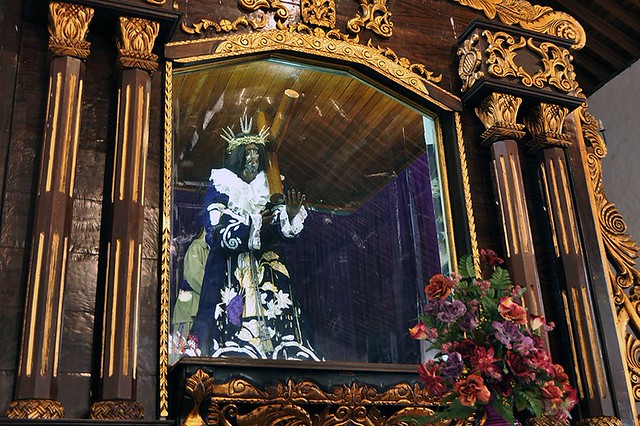
The real attraction here is the shrine of the “Black Jesus.” Supposedly the arrival of this statue in Portobelo ended an outbreak of Yellow Fever. But even more important than this is the belief that the “Nazareno” is the patron saint of thieves and other petty criminals. Since Panama has more than its share of these, the shrine is popular throughout the year, but there is a celebration each October when thousands of pilgrims come to Portobelo, many dressed just like the statue. 

Portobelo - Black Jesus

You can read more about this in this article from Atlantic Cities. To be honest, I found all this more interesting to learn about than to actually see. The town of Portobelo, like so many poor Latin American communities, is strewn with trash. There are mangy, emaciated dogs running around everywhere foraging for something to eat. And it is probably my own racism, but I feel a sense of hostility towards outside visitors in Afro-Caribbean communities. I could not wait to get out of Portobelo. 

We had a long and boring car ride back to Panama City. We stopped by Niko’s cafeteria, a local Panama City chain, to pick up dinner to eat in the hotel room. As we did so, we watched Joan Rivers trashing celebrities for bad fashion choices on satellite television. I wondered what she and her guests would make of the Black Jesus’s robes….

Trumps and Trunks

Despite music blaring from nearby bars and discos until the early hours of the morning, we both slept quite well! We spent more time with our new best friend Uri at the desk of the hotel trying to figure out how our voucher for the “jump on, jump off” bus was supposed to work. We finally learned that we could not actually redeem it on Sundays. That was certainly annoying because suddenly we had to rethink our whole plans for the day. We went off to a nearby deli for a bit of lunch and pulled out our guide books to make some other plans. John decided he really wanted to see Trump Tower here, so we haggled with a couple cabbies until we found somebody who was willing to take us there for a reasonable amount. 

Despite its status as a five star hotel, Trump Tower has minimal and unimpressive public areas. The lobby is less interesting than your average Hilton. The only part that dazzles in any way is the pool.

https://i0.wp.com/farm6.staticflickr.com/5503/11633311894_dd9b357b7f_z.jpg

John was interested in stopping here because he liked the curve of the building. 

https://i0.wp.com/farm8.staticflickr.com/7440/11633166163_067547f823_z.jpg

We did not think we were going to spent much time at Trump Tower, but we were finished with it even more quickly than we expected. The only even remotely close to it that merited a mention in the guidebooks was the Metroplaza Mall, supposedly “…the most upscale shopping center in Central America.” The Trump Tower concierge told us that there was a shuttle between the two attractions, but the bellhops at the entrance told us we would have to wait over an hour to catch it. We decided to walk.

One of our guidebooks described the architecture of this area as “pedestrian, but not pedestrian-friendly.” It is an apt description. Despite the Manhattan-like profusion of high rises, there is no effort to create an interesting or even tolerable street environment. All of these buildings are designed for cars. No wonder the traffic is so horrific. Part of that may be that when you are out of the towers you discover that they were largely built on what had been housing for the poor, and many of the poor are still there. 

https://i0.wp.com/farm8.staticflickr.com/7454/11633169093_e5bde30d89_z.jpg

If the Multiplaza Center Mall is Central America’s most upscale shopping, then the economy of this part of the world still has a way to go. All of the usual kinds of shops are there and a multiplex, but it looks like every mall in every small town in America.

https://i0.wp.com/farm6.staticflickr.com/5504/11633307204_ded65cfd36_z.jpg

In fact, it is really depressing to travel this far and to feel like you have never left your own country. It made me wonder, was it like this for the ancient Romans? Did they have the depressing feeling of traveling through the Empire from Aegyptus to Britannia Inferior only to see the same damn aqueducts, theaters, and forums? I wonder. The only thing not straight out of the United States were the huge displays sponsored by Samsung like this one. 

https://i0.wp.com/farm6.staticflickr.com/5525/11633699536_7f14baec26_z.jpg

From here we needed something more upbeat. We negotiated a fare with a cabbie and in about fifteen minutes found ourselves in the Metropolitan National Park. Covering nearly 700 acres, this park provides Panama City residents with a bit of tropical rain forest in the heart of the city. There several different trails through the park. We took them all. There are also several “miradores” or view points where you can see either the city or look further west toward the canal. It was a warm afternoon, and as you can see, John has staged a superb recovery from his surgery. His instinct to pose, however, is incurable. 

https://i0.wp.com/farm4.staticflickr.com/3723/11633175613_cb7cdd62e4_z.jpg

Amid the dense tropical foliage, we saw some beautiful flowers. 

https://i0.wp.com/farm8.staticflickr.com/7409/11633329664_3c48cb1694_z.jpg

We saw these nests throughout the park. I think they are probably for some kind of wasp, but I am not sure. Gentle readers, if you know anything about this, let me know. 

https://i0.wp.com/farm8.staticflickr.com/7409/11632939195_9d444ce1cf_z.jpg

We did see some leaf cutter ants. I was quite excited to see them because there is a little section about them in our fourth grade science book. They do not eat the leaves, but carry them to underground nests where mold grows on them. The ants actually feed on the mold. It is one of only a few instances of agriculture among insects. 

https://i0.wp.com/farm6.staticflickr.com/5520/11633715326_ff5284ea63_z.jpg

The most impressive things I saw was a quetzal. I am sure I would have missed it, but a Panamanian man just ahead of me on the trail pointed it out. I had seen one years ago in Costa Rica. This one was smaller and not quite as brilliant in color, so I think it was a female. I could never have taken a proper picture, so this one is shamelessly stolen from Google images.
 
Resplendent Quetzal (female) - 01
 
We took a cab back to the hotel to enjoy the air-conditioning for a bit. Since the Magnolia Inn calls itself a “luxury hostel” we figured that we probably would come back to the same mess we left. To our surprise, the beds were made and the room was spotless. John wanted to make it perfectly clear that we are not staying in a hostel. Our room is billed, perhaps a little too grandly, as a penthouse.
 
https://i0.wp.com/farm4.staticflickr.com/3740/11633190393_8a00650f35_z.jpg
 
In the evening, we went out in search of a bit of dinner. We ate at a place called Diablo whose specialty is Panamanian cuisine. The service was a little confused – we ordered ceviche for a starter but ended up with some delicious empanadas served with a pineapple-infused butter sauce – but sitting on the street in the right next to the Beaux Arts National Theater building was pleasant. We strolled around Casco a bit more on our way back to our room.
 
https://i0.wp.com/farm8.staticflickr.com/7444/11637973513_00330a36f3_z.jpg
 
Tomorrow, it’s off to see the canal zone.