We were in the Azores today, our first stop in Portugal. We nearly missed going there, and we had a couple near disasters while we were there. Yet despite all this, we had some glimpses of what a paradise these Portuguese islands can be.

We had really rough sea days on Saturday and Sunday. We had swells of up to 15 feet and we had gusts of up to 90 miles per hour. The captain warned that the harbor in Ponta Delgada was not well protected from storms, and that we might not be able to dock there safely. When we went to bed, I expected to wake up to a disappointing announcement.
Instead, I woke up to find us looking out at the old center of the largest town in the Azores. It looked a bit like the illustration in an old children’s book.

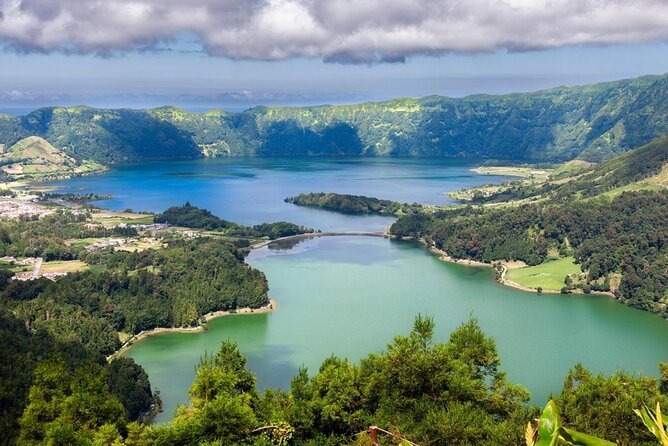
The Azores are a volcanic island chain, and Sao Miguel, where Ponta Delgada is located, is famous for an enormous ancient crater now filled with small villages and a number of lakes, particularly the famous blue and green lakes. This is what it looks like in the Portugal travel books:
So, even though I knew that hiking around this area would be pushing John a bit, I really wanted to do it, and the nature walk I found on Viator called it “moderate.”
John was nervous about how difficult it might be, but he was willing to give it a try. We disembarked and walked about 10 minutes to where we found our group and our guide.

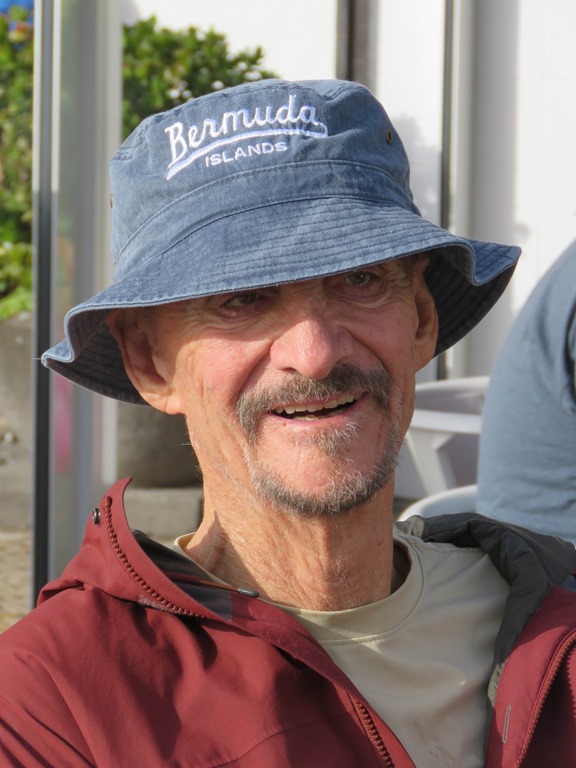
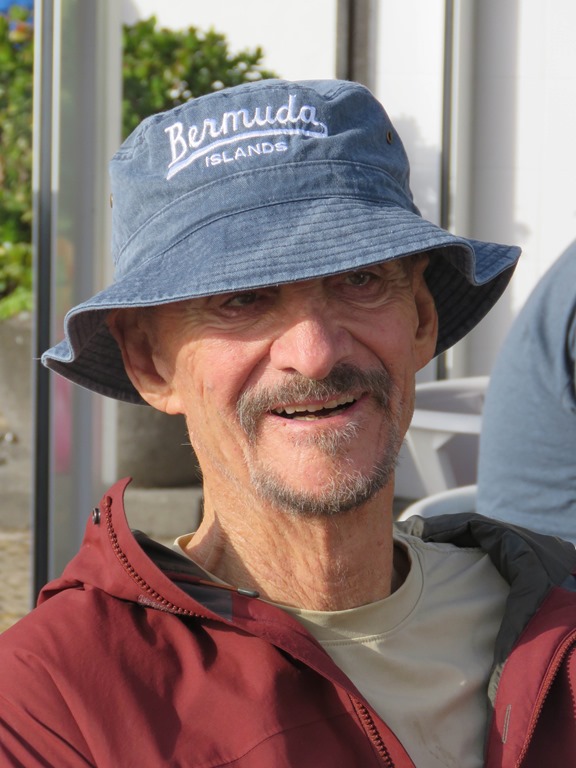
He was in good spirits as we started out.
The group was fairly large, so we were divided into three groups and each piled into a minivan. I chatted with an English gentleman who had retired to Picton, Ontario. As our van drove up the mountain, the lovely sunny day down in the town turned into cold, heavy fog, vaguely reminiscent of Mendocino County.
We had a discussion with our guides about which of two trails to take, and the entire group decided to skip the hike they had signed up and to take a shorter and easier hike that would give us a better view of the two lakes. I had the feeling that in the cold and the fog not even the guides, quite fit young men in their twenties, felt like a longer hike.
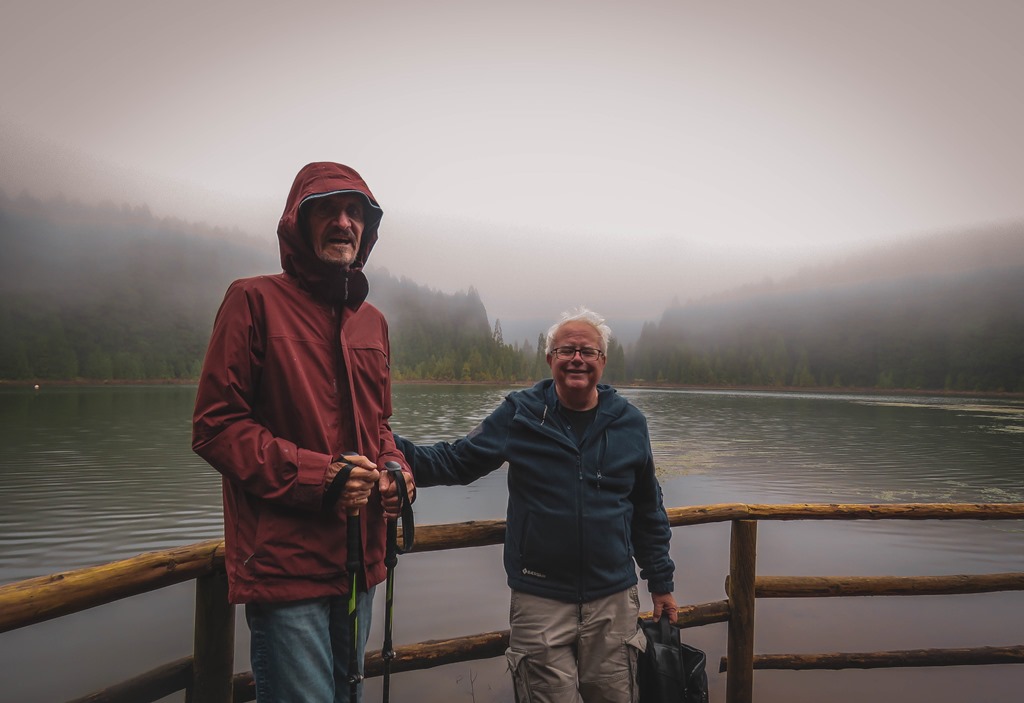
It started out pretty well. We went down an easy path until we came to a turn off for a small lake. John was willing to try the stairs down to the shore although they were not particularly well-maintained. At the bottom, our guide–sadly, I never did learn his name–took a picture of the two of us.
And I took one of the lake itself.
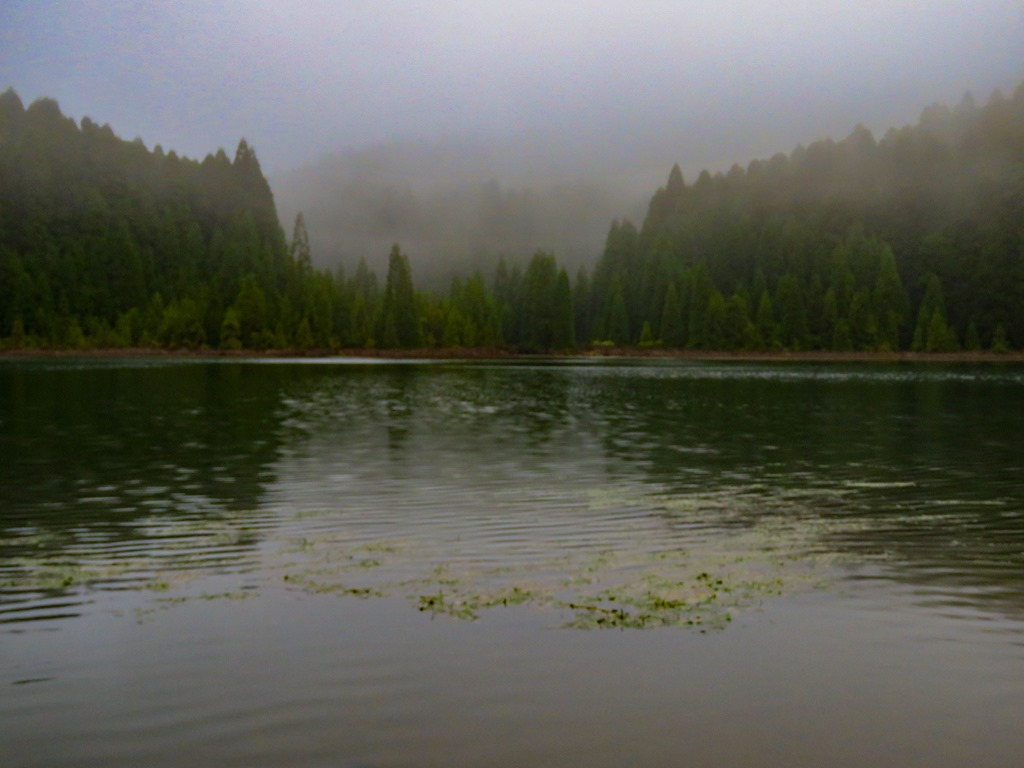
We continued along the main trail. This island had once been heavily forested, and there were still large wooded areas left. The most common tree were saw was the Japanese red cedar. The forests were thick and in the foggy weather they looked almost ominously dark.
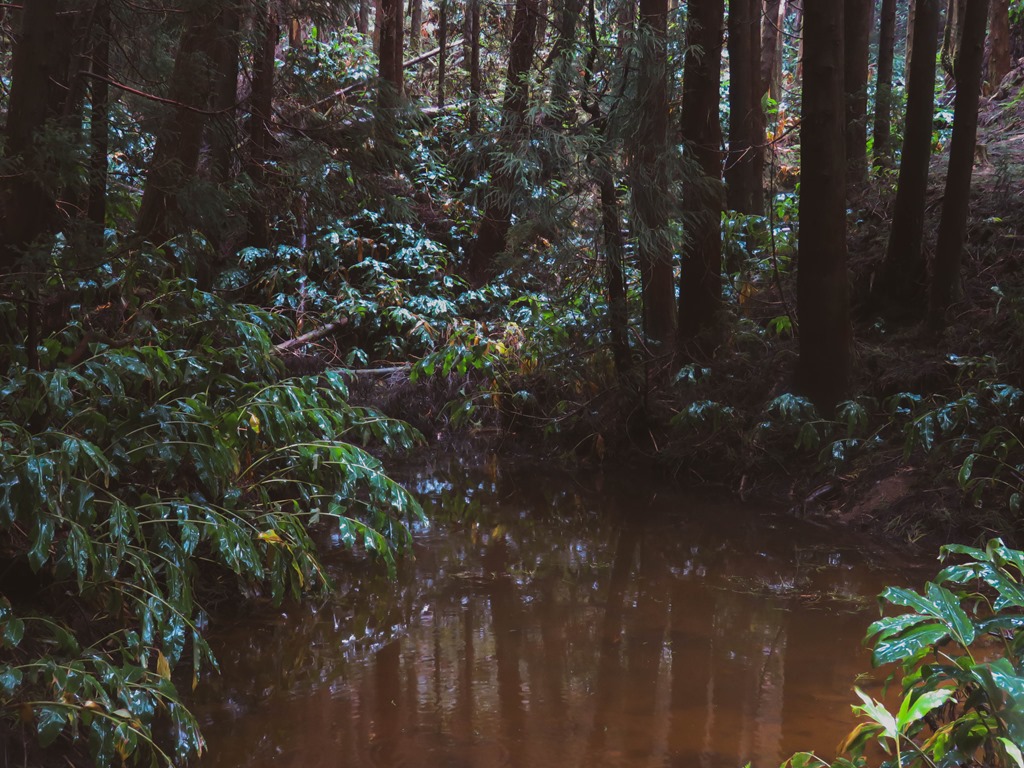
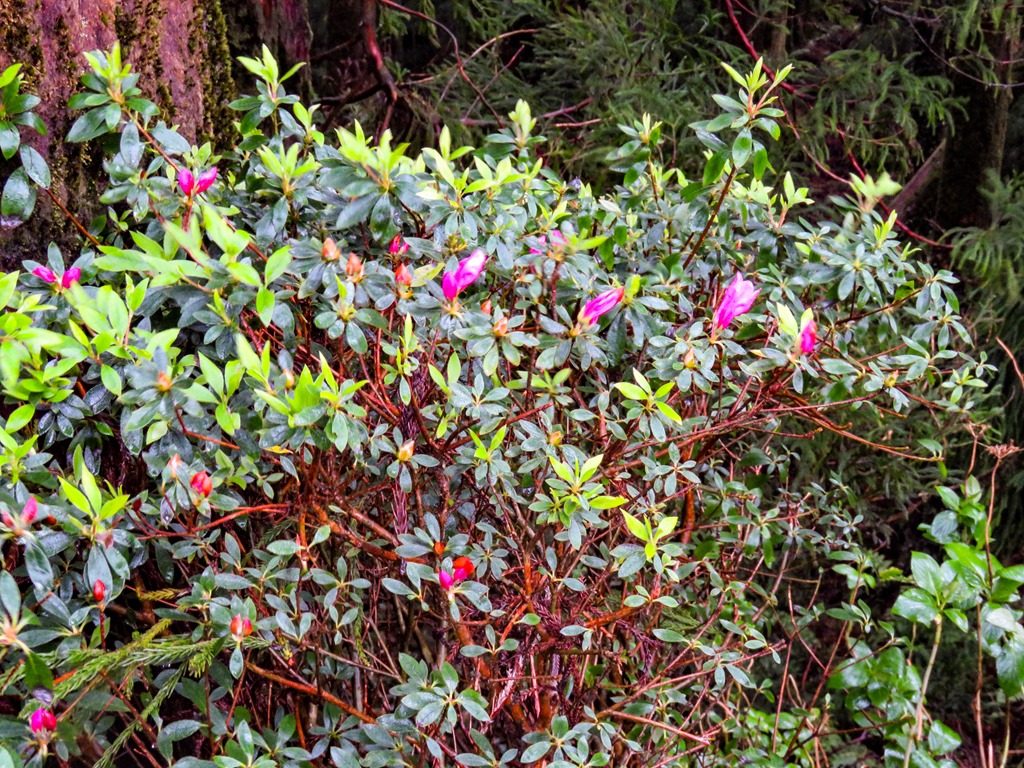
In this temperate rain forest, all kinds of nonnative plants seem to flourish. There were azaleas everywhere, though the heavy blooming season, our guide told us, had been in February.
After about 40 minutes of hiking, the trail began to relentlessly go uphill. John’s blood pressure can drop precipitously when he climbs stairs or goes up long ramps. He really wanted to make it to the vista point on top, but after seriously pushing himself he knew he had reached his limit. Our guide was understanding and told us that in the current condition we might not see anything from the top, and that where we were we could see the larger lake if the fog cleared. And sure enough, after about 10 minutes, for a few fleeting seconds, it did.

We walked back to the parking lot to meet up with the minivan driver. Because we had taken the shorter trail, he had not returned yet and that meant we had to stand around waiting. The worst thing of all for John’s orthostatic hypotension is standing. I tried to keep him pacing back and forth in the parking lot, but after a while I saw the unmistakable signs of a possible syncope. I knew that if he passed out the guides would have to call and ambulance and take him to the hospital. I wanted to avoid that at any cost. I made him take a midodrine and I held him upright to make it look like he was standing on his own. I prayed for the van to come. When it finally did, a fellow tourist, a guy with a Texas baseball hat and a body that looked like he had once played football for the Longhorns, said, “I’ve got him” and lifted John into the van.
By the time we reached the dock, the midodrine had done its job and John was feeling pretty decent. So our plan was to go back to the ship briefly, change clothes, and then return to town. I rustled around in my backpack for his wallet—we needed both our ship’s card and photo ID—and I noticed an orange at the bottom that I had stashed there at breakfast. I knew I would have to toss it out at security, so I peeled it and gave half to John. A minute or so later I looked over and realized that he was choking.
We pushed to the front of the line. People looked initially angry until they saw that there was an obvious medical problem. The Portuguese customs officials did not want to deal with this, so they immediately called Norwegian to come and get John. By this time, he had successfully spit out most of the orange and was able to talk, though he was coughing like he had tuberculosis. The poor Filipino kid who had come with the wheelchair had no idea what to do, so he took us to the ship’s medical center on deck 13. As we left the elevator I wondered why they had picked 13 as the location for the sick bay.
After a male nurse went over his medical history, the doctor came to see John. Our physician was Dr. Harold Castellanos, a Texan originally from Guatemala. He was quite competent and I liked him instantly. He was clear that John had probably aspirated some of the orange, and prescribed Augmentin just to make sure that no infection developed from inhaling the orange.
By this time, the ship was readying to leave Ponta Delgada. I was sad that I had missed seeing the town and buying a few souvenirs for a couple friends whose families had come from the Azores. But I was profoundly happy that John was not dead or in a hospital. One day I may return to the Azores. What matters for now is that I still have the person I love most in this world.













































 Traveling Johns