Sailing by Staffa

This morning, right after breakfast, a couple of us went out in the tender and checked the lobster traps. Unfortunately, there was nothing there but a a small brown crab. 

Since it was not going to provide any decent meal for 8 people, Ted put it back. 

We set sail shortly after that. It was a cold, gray, windy day and the seas were somewhat rough. We moored for lunch among the Treshnish Isles, one of many small island groups that along the west coast of Mull. Ted told us that there is a large colony of puffins here earlier in the summer, but now by the end of August most of them have left. I suppose that they use this remote area for mating and breeding, and once the young are old enough to be independent, they take off for other places. Despite everybody looking for them, no puffins were spotted. 

We sailed past Staffa and saw Fingal’s Cave. In the late 18th century, a Scotsman named James MacPherson published Ossian, an epic poem he claimed was translated from ancient Celtic sources. It was a huge success, perhaps the greatest literary event of the era, and acclaimed as a masterpiece by many. Not everyone was convinced, however, that this was truly an authentic ancient work particularly because MacPherson refused to produce the ancient manuscripts from which he had originally translated it. 

Samuel Johnson, never a fan of anything Scottish other than his secretary, James Boswell, particularly hated it. He was asked, “Sir, could any mere man have written this.” 

“Yes,” he retorted, “Many men. Many women. And many children, too.”

But Johnson’s was a minority view, and it remained popular throughout the 19th century inspiring many to come to the Hebrides to see the places mentioned in the poem. And none were most interesting than the sea cave on Staffa where Fingal had lived. Felix Mendelssohn was one of those tourists, and the sight of the cave inspired is his Hebridean Overture.

Today, although there are a few who still defend the authenticity of the poem, the prevailing consensus is that MacPherson basically produced an original work loosely based on some Irish legends. 

Ted said that the seas around Staffa were too rough to take a boat in today to see the Cave. But he did take us close enough to see the island and the Cave from a distance. One of the most striking features of Staffa are the basalt columns, almost identical to those found in Northern Ireland at The Giant’s Causeway. 
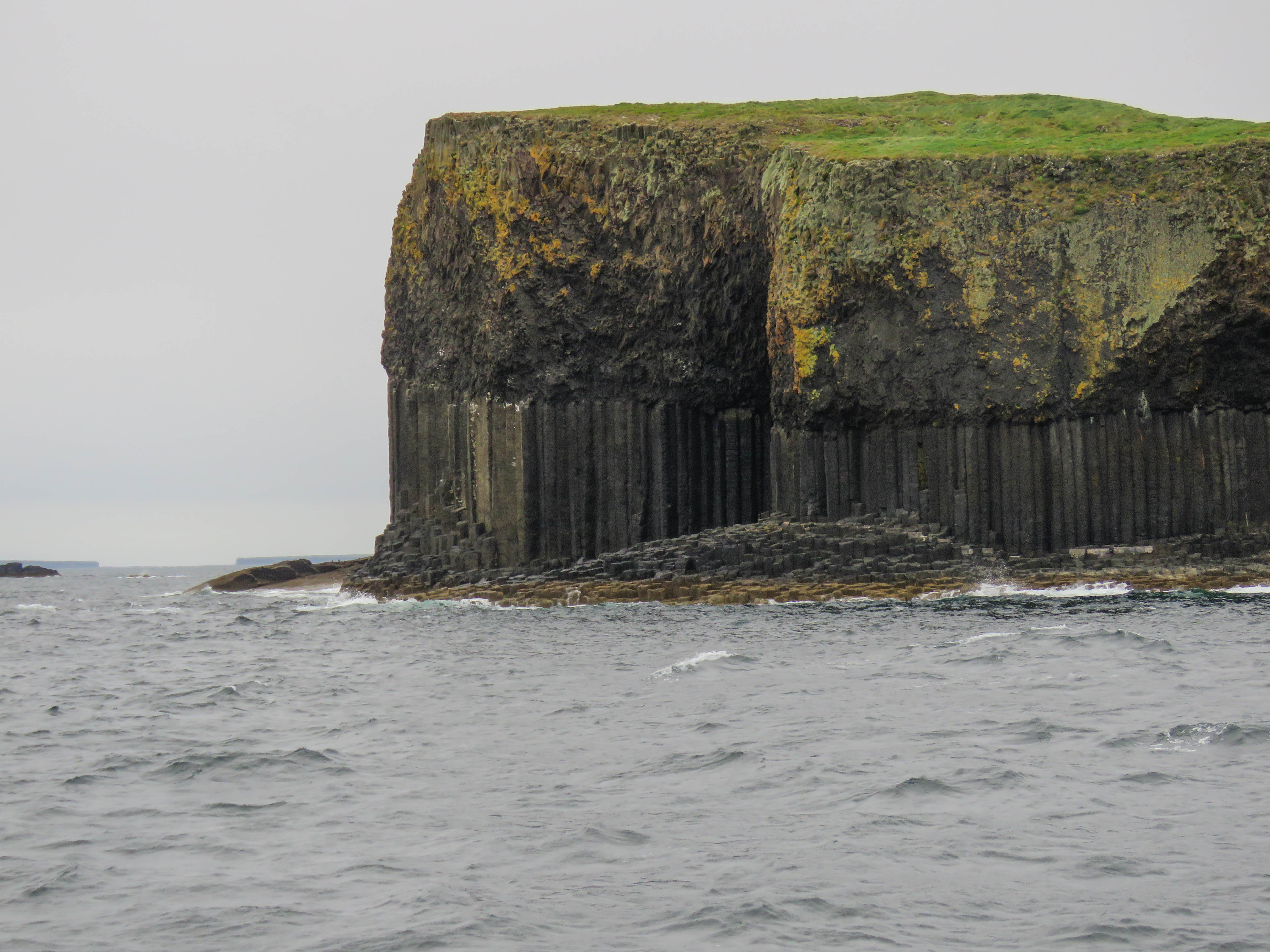
The Cave is a giant indentation in this feature. 

Ted hopes to take us back tomorrow, if possible, to actually get on the island and to see the Cave from the tender. I hope so. 

We finally made it to the area call the Ross of Mull. I was intrigued to see this area because the MacGillivray clan originally came from here. They are particularly associated with the village of Pennyghael, far down the Ross, near the end of Loch Scridain. We are moored at the other end, near the village of Bunessan. We took a short walk there before dinner. It’s a pretty typical Hebridean village.

There was a pub and a couple shops on the small high street. Maybe it was the time of day and the mist, but it all seemed pretty romantic to me. 

There was a parish church of the Church of Scotland. I once think that this had been the center of community life, but the signboard indicated that it was yoked with several other village churches and that services were held there only a couple times a month. 

I am not sure why, but I was a little surprised to see sheep grazing right by the end of the water there.  

The sheep seemed vaguely curious about us for some reason. And since they were staring at me, I figured I would just snap a picture or two. 

I was fascinated by the large truck parked in the center of the village. I learned from my fellow passengers that this is a mobile movie theater, one of several that travel across Scotland in the summer bringing first-run movies to small towns unable to support a cinema. 

Apparently the Scottish government subsidizes this service. I think a mobile movie theater is a terrific idea, but I am not sure it is the best use of scarce state funds. 

We had another amazing dinner. Tomorrow we set sail early for Iona, the birthplace of Scottish Christianity. 

First Day at Sea

 I slept extremely well. We had a pleasant breakfast at 8:30 with our fellow passengers. I’ll take a moment to introduce them. 

Shirene is from Devon. She is an experienced traveler here in the Hebrides. This is the fourth time she has taken a boat trip here, and her third time with Argyll Cruises. She is wonderfully friendly and helpful.

Marie is from Martinique. Although French, her English is astonishingly good. She is deeply curious to learn as much as she can about everything here in Scotland. She spent some time here, in Glasgow, I think, when she was younger. 

Roger and Sandra hail from the borough of Richmond in London, though they also have a house on the island of Arran. Roger is a big guy with a beard. He is funny and incredibly friendly. Sandra is a little quieter, but the moment you meet her you can tell that she is really smart. 

David and Anne-Marie are our resident Scots, coming from a smaller city near Aberdeen. Anne-Marie just retired as a special education teacher, and I can tell that she was a superb one. I think Roger worked in the oil industry, but I’m not sure.

And, that’s all the passengers, other than John and me, of course. I was a little nervous about possible personality conflicts on a small boat. When we took our barge trip through the south of France there was an American woman on board I absolutely hated. But I like all of these people and I am looking forward to getting to know all of them better. 

After breakfast we sailed to Ardnamurchan. This is a peninsula on the mainland that juts out into the Sea of the Hebrides. I think, though I am not completely sure, that it might be the easternmost part of the mainland. John came with us this time. Ted, our skipper, took us ashore by the remnants of a failed tidal energy project.

The group wandered up the road to see what we could see. John and I were always a little slower than the rest of the group. 

We passed by new, fairly large distillery run by the Ardnmurchan Estate. I have been a little surprised to learn that many of these large old estates in Scotland are still functioning, but have been sold to Danish and Dutch investors who appear to have much keener entrepreneurial instincts.

I found some of the small things fascinating. For example, there was like an old post box by the distillery

and a little wooden carving hidden among the brambles along the road.

In the afternoon, Ted took some of the group ashore for a hike. Marie fished off the starboard deck. Sandra and Roger tried their hand at kayaking. 

John and I just relaxed and watched. 

Later, we sailed across the Sound of Mull to anchor for the night in a quiet inlet. We set out some lobster traps. If we find any lobster in them tomorrow morning, we will have a special dinner. David put the traps down for the group. No pressure David, but I hope you picked the right place!

One of the real pleasures of this cruise has been how good the food is. I am astonished by how Iggy, our cook, can turn out astonishingly good meals in a small kitchen. 

Aweigh we go!

 We packed up our things this morning, and while we both felt that we had more or less seen the sights of Oban, we had both enjoyed our hotel and particularly the wonderful view. When we were young we usually stayed in fairly cheap, and sometimes rather depressing, places when we traveled, and we always tried to get up and get out as soon as we could to take in a full day of sightseeing. Now that we are older and less inclined to see everything and do everything, part of the joy of travel is staying in nice places and enjoying them. 

Today we begin our cruise of the Inner Hebrides. It is a small boat, only eight passengers. We had been asked to show up at the dock ready to board promptly at three o’clock and not earlier. But that left us with some time in between having to leave our room at Dungallan House and getting on the boat. I was not particularly hungry, but when I saw MacGillivray’s Fish Grill I knew I had to stop and order something. My mother was a MacGillivray, and the clan comes originally from the island of Mull. So I figured that if I ordered some scallops and chips I would be supporting one of my distant relatives. 

We found the Oban War and Peace Museum in a shop front on the Esplanade. It was a small place which proudly announced that it was staffed by volunteers and funded by donations. Despite the odd name, the focus of the museum is about more than just the war, although it does boast a large amount of World War II memorabilia. There was a great deal of informative material about the early history of the town, the coming of the railway and the ferry, and some of the odd characters who lived there. For example, I learned that what I had thought was an abandoned coal gas storage tank high above the town had was actually a unfinished family monument. 

John was a little anxious about catching the boat, and he did not want to be late. So we took a cab back to the hotel, grabbed our luggage, and had the driver take us to the pier. We were about a half hour early at this point, and that also seemed to make John nervous. There were a few other people standing around waiting as well. Finally, a little before three, a young man with a scruffy beard came up with a luggage cart. “You must be Ted,” I smiled, remembering his name from the email. 

He gave me a handshake. “And you two must be John and John.” Almost immediately a couple other groups of people came up and our whole group was ready to board the ship. 

Our boat is called “Splendour” and while it is a good, clean, well-equipped vessel I think its name may be a bit of hyperbole. On the main deck there is a small kitchen and a dining area with two tables and booths upholstered in a tartan plaid. John and I are in one of the four downstairs cabins. As you would expect, there is not a whole lot of room in it. We have our bed, an extra bunk, and a small closet. There is space to store luggage under the bed. We is a small combination bathroom, the kind where there is no dedicated shower, but just a grate in the floor to drain off the water. 

We had a brief safety orientation before we pulled out. It was, as you might suspect on a small boat, a great deal more information than the muster drills you have to endure the first day on a typical big cruise ship. And after that we set sail. 

We watch as the landmarks of Oban slowly faded away like Saint Columba’s Cathedral

and DonOllie Castle.

We sailed past the Isle of Kerrera and across the Firth of Lorn. We sailed past the ominous Ardtornish Castle, built by the Lord of the Isles to guard the entrance to the Sound of Mull.

We sailed past a small shoal with a navigation signal on it and a nearby small island with a lighthouse on it. 

Ted told us that supposedly one of the chiefs of the MacDonald clan had discovered that his wife had been unfaithful to him, having an affair with a stable boy. The chief tied her to the small shoal where he was sure she would drown as the tide came in. He tied the stable boy to a post on the larger island so he would have to watch her die. However, a passing fisherman rescued the woman and helped her to safety. She took refuge with her brother, the Duke of Argyle. The Duke then invited MacDonald to his castle for dinner where he came face to face with the woman he had tried to kill. I gathered that things did not turn out well for MacDonald. 

We are staying the night in Loch Aline, a narrow inset off of the Sound. 

A Glimpse of Ancient Scotland

 It was rainy and blustery this morning, and neither of us particularly wanted to jump out of bed and rush off to be tourists. Instead, we just enjoyed our room, which was, from the name on the door, once the bedroom of the Duke of Argyle himself. The hotel served a wonderful breakfast, though, as John pointed out, it was impossible to top the Hotel du Vin for a morning meal. 

By afternoon, the sun had come out and we were ready to walk into town and see what we could in Oban. We stopped into various shops, and in Oban’s equivalent of Big Lots John found a rather nice warm jacket for only about 20 pounds. We then caught a taxi to DunOllie Castle, Oban’s biggest local tourist attraction. 

We had a very funny young man as our guide. He began by telling us, “People ask me all the time questions about how this place is funded and things like that. I have no idea. Don’t even ask. When I’m not doing tours I’m making sandwiches.” But he did prove to be remarkably well informed about the history of the site. DunOllie – it is pronounced exactly the same as the mountain in Alaska – was the ancestral home of the Clan MacDougal. For many centuries, the MacDougals were one of the most powerful families in Argyle, and the area around Oban was the center of that power. They had a number of castles up and down the coast, but DunOllie was the largest and most important. 

Not that much is left of the castle now except parts of the central tower. 

Scottish castles were built in a similar manner to those in Ireland and both featured a multi-story square central tower. This would serve as a storehouse, armory, and residence for the clan laird and his family. On the roof there would be a platform and a small guardhouse. Today the upper floors of the castle are gone, and some of the bottom floors had are now underground as well. The major remnant visible is the old kitchen.

As Scotland became a more settled kingdom with central authority in Edinburgh, there was little need for clans to have traditional castles, and the chiefs of MacDougal clan in the seventeenth and eighteenth centuries built a more traditional house. Unfortunately, the so-called “frugal MacDougals” saved money by tearing down much of the old castle and recycling the stone into this new building. 

While part of this house has been turned into a museum, the house is still used as a MacDougal residence today and they maintain a small farm as well.

We had a late afternoon meal at the snack shop there, and we were just about the last people to leave DunOllie in the afternoon. We walked back along the beach road towards Oban. It was a gloriously lovely evening.

Tomorrow we start on out boat trip of Mull and the Inner Hebrides. 

On to Oban

I have no idea how many times I have had heard, “Life is a journey, not a destination.” The point of this particular bromide, as far as I can tell, is that we should not be concerned with where we are going but only enjoy how we are getting there. I doubt if people who say things like that have ever flown on Frontier Airlines. And I cannot imagine that they have ever had to deal with Scottish CityLink buses. But more on all of that a bit.

The day, miserable as it would later be, began wonderfully enough at the Hotel du Vin. John and I had a fabulous breakfast and then, as we went back to the room to pack, took some valedictory photos of this well-preserved Victorian building. We particularly loved the stained glass

and the entryway tile floors,

perhaps because the renovations to our Ashland home will have both of these features, although in a different form and style.
Now, back to the misery of travel. We will be catching our of cruise of the Inner Hebrides in Oban, about two hours north of Glasgow, and my original plan was for us to take the train there. All the guidebooks agree that it is a particularly scenic train ride. But the guidebooks fail to mention that here in the UK rail workers seem to strike constantly. And about two days ago we were all warned that effective today there would be a four-day work stoppage. I had to find some other way to get to Oban.
And there was only one other way, and that was the bus. Now you may be thinking, “Oh, it can’t be that bad.” You have probably been deceived by all those Rick Steves shows where he steps on a shiny, uncrowded coach, the camera crew carefully hidden, and says some happy little thing like, “When I’m in Scotland I love to take the bus. It is inexpensive and you meet so many wonderful local people.”  Rick Steves did not take bus 975 to Oban. 
Unlike the spanking brand-new Hannon coach next to us, headed toward Belfast, equipped with reclining seats and Wi-Fi, our bus probably dated to when John Major was still Prime Minister, and its only amenity was a bathroom in the back that I noticed absolutely no one even attempted to use. And poor John – there was less legroom here than in United Basic Economy class. Our fellow passengers all had the sullen look of people who have been forced to go to the DMV without an appointment. Not at all Rick Steve’s happy locals telling you about how much they love where they live. 
The day was overcast, and the scenery disappointingly dull. We passed by Loch Lomond on our way, and far from the romantic spot I had imagined singing the song as a child, I discovered that it looked like just about any hydroelectric project in California. 

“Yon bonnie banks,” indeed. In fact, one of the things I noticed as we went through this area is that there is a surprising amount of logging going on. The forested areas are not natural, but all feature the same kind of conifers planted in neat little rows, all waiting until they are tall enough to be cut. 
It was just after Loch Lomond that things turned really bad for us. The bus pulled over and the driver announced a stop for a quick break. It was right by a little café, and presumably people would be using the restroom there. I am not quite sure why, but I decided to stay on the bus. John needed to go to the bathroom and he walked off along with about half of the passengers. About seven or eight minutes later, I noticed them all coming back. They all seemed in a hurry. I did not see John. I tried calling him, but he did not answer. A moment later, the bus took off, leaving John behind.
I rushed to the front to talk to the driver. “My partner’s still back there,” I told him. 
He obviously did not care. In a thick Glasgow accent I could not possibly write phonetically, he said, “Well, that’s too bad. He’ll have to catch the next bus. I just said long enough for a pee or a smoke.” 
I told him that John had disabilities, knowing that in the US this could turn into an entire legal incident. He obviously did not care. “He’ll have to take the next bus.” 
“Well,” I said, “then I will take the next bus too. Let me off.”
At this point, my fellow passengers, far from the charming locals that Rick Steves deals with, became hostile to me. “I’ve got to catch a ferry,” one old bitch snapped. But I think that the driver had to let me off if I demanded that, so he opened the door and luggage bay.
I saw John as I started to take our bags out as slowly as I could. “He’s almost here,” I called to the driver. 
For whatever reason, the driver softened. “Just put your bags back and get on board.” But as we found our way back to our seats all I could focus on was the hateful look on that on the shrew’s face. I hope to hell she missed her ferry. 
We finally pulled into Oban, about 30 minutes later. Most of that lost time had nothing to do with me, however, and a lot more with heavy traffic on a route originally designed for horses. I should pause here, dear reader, in case you come to Scotland, so you can pronounce town correctly. You have probably been reading it as “Oh-bahn.” This will get you immediately corrected. Instead, purse your lips as if you were going to kiss your dog. Hold out a long o for a long time. It should sound sort of like a German vowel at this point. Immediately add a “b” and an “n” with no vowel in between them. “OHHH-b-n.” Now you’re talking like a Scot. 
Oban was apparently just an ordinary little fishing village until Caledonian MacBrayne ferries — just “CalMac” to most Scots — decided to make it a hub of their operations. A rail line from Edinburgh and Glasgow allowed thousands of Scots to take the train and the ferry and to have a holiday in the Hebrides. Dozens of small hotels were built along the shore to house them on their way to or from the islands. Most of them are still working hotels, though the deteriorating late Victorian buildings all have a kind of ominous quality about them to me, and I thought of all those illustrations in “Series of Unfortunate Events” novels my students used to like to read. 
But the waterfront is lovely,
and there are a few of the building left from a pre-Victorian Oban.

John and I are staying at the edge of town in a hotel that was once the summer cottage of the Duke of Argyll. It’s not quite as grand as that may sound, I suspect that the Duke was perhaps pretty minor nobility, despite the impressive title. But it’s a nice house, probably dating, I would guess, from about 1910. 

We have a really nice view of the town and Oban harbor from our room.


Even though it’s late in the season, the town is still quite full and we were advised by our innkeeper that all the decent restaurants were booked solid. So we walked into town and had some mediocre pub fare. But we did enjoy seeing and talking to the locals here. Maybe Rick Steves is occasionally right. 

Eminent Victorians

We have only one day to really be tourists in Glasgow, so I had to make some choices among the many possibilities. I settled on two, both grand relics of Glasgow’s Victorian heyday, and both also located here in the West End. The first of these was the Glasgow Botanical Gardens. This famed institution was founded in 1817 under the sponsorship of the University of Glasgow. One of its first staff members was David Douglas who soon took off around the world to identify new plants and bring them back to the gardens. In Monterey, California he discovered a wildflower we today call the Douglas Iris. And, for those of us in Oregon, he is best known for identifying Pseudotsuga menziesii, better known as the Douglas Fir. 

Perhaps because there has always been so much interest in collecting specimens of exotic plants, the outdoor area of the gardens, though pleasant, are not terribly interesting or informative. There are lovely grassy lawns, gloriously irrigated by rainfall, and beds of attractively arranged annuals. 
There are benches everywhere, not a homeless person in sight, and not a speck of trash. But these gardens are really about what takes place in the greenhouses.

The largest of the greenhouses is the Kibble Palace, named after an entrepreneur who tried to establish a combination restaurant, concert hall, and greenhouse. It is filled with glorious Victorian kitsch like this statue of Mary and Martha.
And there are equally wonderful period architectural details like those spiral staircases that the Victorians seems to adore.

For me, I find it amusing that many of these British greenhouses are devoted to plants that happily grew in my backyard in Los Angeles.

I was a little intrigued by a whole section in the Kibble greenhouse devoted to carnivorous plants. 

The snapdragons growing outside, however, were a little friendlier towards insects and I managed to snap a picture of one of the many bees that swirled around them.

After our trip to the garden, John and I returned to the hotel. He had a pedicure, and I went off to see if I could find a USB charger with the 3 prongs that they use here in Britain. I never did find one as I wandered through the West End, but I was delighted by the beautifully restored Victorian row houses, each slightly different from the one adjacent. 
In the early afternoon, John and I caught an Uber to our other “eminent Victorian” attraction, the Kelvingrove Museum. Glasgow hosted an international science and industry exhibition in 1888, held in Kelvingrove Park near the university. It was such as success that the proceeds helped pay for a second exhibition in 1901. The current building was constructed for that fair as the Palace of Fine Arts. It is constructed in a Spanish Baroque style, because, I suppose, the first thing you think of when you see Spanish Baroque is Scotland, right?

The central hall as you enter is dominated by a grand pipe organ. Alas, we were a little late for the daily recital. 

The collection is a complete hodgepodge of science, history, and art. Most, but hardly all of it, has something to do with Scotland. We concentrated on those rooms. They have a great collection of works by Charles Rennie MacIntosh, Scotland’s greatest twentieth century designer. We found this part so fascinating that neither of us even took pictures. 
We did remember to take pictures in the Scottish painting rooms. For Scots, one of the most famous paintings is the Massacre at Glencoe, James Hamilton’s depiction of the slaughter of 38 members of the MacDonald clan by government troops. The MacDonalds, like many Highland clans, did not accept the legitimacy of William and Mary’s accession to the throne, and the slaughter, which actually took place mostly in their homes, was intended to intimidate the Highlanders. Yet in the Victorian period, when this picture was painted, the massacre was no longer about the brutal repression of Jacobites, hostile to the English crown, but the internecine warfare between the clans that was now but a distant memory thanks to the union of Scotland and England.
Slightly later, Horatio McCulloch, painted the same area where Hamilton had depicted the massacre as having taken place, now a Romantic fantasy. 
Neither of these painting, as interesting as they are for studying Scottish history, is particularly memorable artistically. But the Kelvingrove also has a phenomenal exhibition of four Scottish painters who were quite talented. This is a group of artists who are known today simply as “The Glasgow Boys.”
Probably the most famous work by these artists is The Druids:  Bringing in the Mistletoe, a collaboration between George Henry and Edward Hornel.

When this painting was exhibited, it caused a sensation both because of its technique of layering paint and its romantic celebration of native British pagan rituals, however imaginary they were. 
John had a wonderful time at the Kelvingrove taking pictures with his iPhone, and then pausing to edit them. 

One of his favorites was a picture of a young woman with her two suitors, one rich, the other poor but handsome.

He also loved this one showing the visit of Queen Victoria to Glasgow for the 1888 exhibition. 

He also adored this statue of Elvis.

After we finished at the museum, we wandered through some of the surrounding area looking at shops. We found the “Hidden Alley,” a small area, perhaps originally for stables, that now housed arts and handicrafts shops.

In the evening, we went downtown to a Scottish restaurant. I had some venison for dinner. Since moving to Ashland I have lost so many plants to deer that eating one of them seems like sweet revenge. I started, though, with that most Scottish of dishes, haggis, accompanied here by tatties and neeps. That, if you need a translation, means potatoes and turnip. 

Tomorrow we leave Glasgow and take off for Oban. 

And I'll be in Scotland

 Like most days devoted to getting from one place to another, today was not especially memorable. We had a mid-morning flight, but we had to get out to the airport, about 45 minutes outside of Reykjavik, return the car, and then do all the check-in and security stuff. None of this was particularly interesting, and dealing with the car, and the insurance claim for the scrape and crack to the bumper, was irritating and depressing. Keflavik airport is basically pleasant and compact, but it is handling more travelers than it was ever designed to handle. And, rather strangely for such a cold country, all the gates are at ground level so that you have to go outside and walk up a flight of stairs to get to your plane. There are no jet bridges as you find in almost any other airport, even Medford. This makes it difficult for people like John who have mobility issues, and the workarounds are rather cumbersome. 

Our flight slightly delayed while they fixed a minor problem with the plane, but it was otherwise quite smooth. It’s about two hours from Iceland to Scotland, three after you add in the one hour time difference. So we arrived in Glasgow mid-afternoon. It was overcast and there was the slightest hint of drizzle. For anyone from the Pacific Northwest, it seemed pretty much like a typical spring day. We took a cab from the airport so we would not have to wait around for an Uber. The cabbie was a garrulous native Glaswegian, probably in his mid-to-late fifties. He regaled us with stories about growing up in a row house with the “loo” in the alley, and how when he was a  “wee bairn” all the buildings were still black with the soot from the coal fires. John understood almost none of it, even though I knew we had not yet heard the real Clydeside dialect. 

We are staying at the Hotel du Vin in the West End. The West End is rather like the Back Bay of Boston, an affluent, mostly residential area just adjacent to the downtown center. I was interested to learn that the du Vin, a small chain of boutique hotels found largely in university and cathedral towns, was founded by a Gerald Bassett, Perhaps a distant relative? The Glasgow du Vin had originally been five nineteenth century row houses. These have been reconfigured so that they now form one building, although most of the features of the original houses are still intact. I had requested a room that was mobility accessible for John. We were given a wonderful suite on the ground floor. It had probably originally been one of the parlors. As such, it was quite large. 

John particularly liked the bathroom.

He has always love Zuber wallpaper and their exotic scenes.

We are both pretty tired and will devote ourselves to proper sightseeing tomorrow. 

Finding the Ice in Iceland

This morning I asked John what he wanted to do today. “I want to see the volcano,” he insisted. “People will say to me, ‘You went to Iceland when there was an active eruption of a volcano and you didn’t go?’” I agreed that the pictures look pretty spectacular.

But I had no idea how to get there, so I suggested that we go to the nearby tourist office and ask them. The young man there was extremely helpful and drew us a little map of where to park and walk. “Just how long does it take?” John asked him. 
In perfect English he responded, “Oh, it is at least two hours each way, scrambling over very rugged terrain. There is no path.”
We decided, dear readers, to just content ourselves with looking at the pictures of the eruption on the television. Our days of scrambling over rocks and shimmying down cliffs are over. 
So what should we do instead? The guidebooks all suggest doing the Golden Circle first and then, if you have another day, driving up and down the south coast of the country to look at waterfalls and a black sand beach. This seemed like a day trip for elderly people to us, and since we are, sad to say, getting pretty old ourselves, we decided that it would be perfect. And, in fact, it was really rather wonderful. 
The first hour of driving was pleasant but dull. We passed by lovely little farms, all of which seemed to have sheep or cows or horses peacefully grazing in the meadows. We went through a number of small towns, all of which seemed to have a large number of fairly new single family houses and small shopping centers with a large parking lots. They seemed clean, safe, and boring. I started to think I was in Central Point, Oregon. 
But after that first hour, the landscape became more rugged, and the glaciers came into view. And that’s why it stopped seeming like suburbia and started to feel a bit more like Lord of the Rings. The southern ice field, the smallest of the country’s three major glacial areas, seems to brood over the farms and ranches below it.

As we drove further along, heading toward the town of Vik, the farms disappeared as the mountains loomed closer and closer over the highway, the ice so close at times I thought I could feel the wind blowing over it.

It was here that John and I made our only bad decision of the day. As we drove down, we saw a parking lot filled with cars and a tour bus or two on the ocean side. I thought, “If everybody is stopping here this must be a major attraction.” So we started to walk towards to water. And then, we walked some more. And then some more. And then we walked more, the terrain flat yet surprisingly rocky. And the ocean seemed to get farther and farther away with every step we took.
Both of us started to think of that famous scene in Lawrence of Arabia when Peter O’Toole scans the horizon endlessly until he sees a tiny movement. And, as he watches, that speck on the horizon slowly grows larger and larger until it becomes a regiment of soldiers on camels rushing towards him. 
Except for us, Omar Sharif never arrived. Instead, as we despaired of ever reaching the water, a tour bus, the kind of bus you can drive through a river, with five foot tires and a suspension strong enough for a small bridge, came rumbling past us, headed towards the parking lot. John, tired of this endless march to the sea, stuck out his thumb. And the driver mercifully stopped and picked us up! 
I learned later that the payoff for this miserable hike was to look at the remains of a World War II plane that had crashed just off the coast. Had I known that, or taken the time to ask people what we are all going to see, I would never had bother leaving the parking lot. 
We finally make it to the black sand beach. Having seen several of these around the world, I did not expect to be particularly impressed … and I wasn’t. But it was a pleasant enough spot, and I was delighted to see how a young child, holding on to his father’s hand, was excited to see the unusual color on the beach. 

I was also amused to see a caravan of tourist crossing the beach on horses. These poor old mares had done this trip so many times you could sense from 500 feet away how bored they were with the whole thing. 

And as sorry as I felt for the horses, all I could think of was another classic movie, George Cukor’s David Copperfield, and that great scene where Edna Mae Oliver grabs a cudgel as the tourists cross her yard in Dover, crying “Donkeys! Donkeys!”
On our way back, we saw dozens of waterfalls, the glacial melt cascading down the mossy green cliffs. We stopped a couple of them. The largest and famous of these is Seljalandsfoss. The water does not fall as far as it does in the Columbia Gorge, but what it lacks in height it seems to make up in sheer volume. 

John was wearing a waterproof jacket, and he decided to get closer to the water for a good picture. 

It was about five o’clock at this point, and we knew we had a couple hours of driving ahead of us to get back to Reykjavik. But we could not resist stopping at another waterfall or two along the way.

And that pretty much brings our little tour of Iceland to a close. There is a lot more to be seen in this island nation, and if we were forty years younger I think we might be up for the adventure of crossing ice fields or running to keep just ahead of a flow of lava. When William Butler Years wrote, “This is no country for old men,” was he was thinking of Iceland? Probably not, of course, but it still fits. But even for those of us well past our prime, it is still an intriguing and beautiful place to visit. I am glad we stopped here. 

A Golden Circle, an Almost Golden Day

John and I are staying at the Ekra Reykjavik apartment hotel. It is a small place with only six rooms. Ours has a kitchenette, so I guess that is why it can be considered an apartment, even though it is pretty tiny. But there are a lot of things I like about it, and one is the deck outside our room.

It has a lovely view of the city and the green roof of the building behind us.

We are on the fifth floor and the door next to John leads to a small elevator. It’s almost a perfect place to stay. Why almost? Well, we are in the liveliest neighborhood in Iceland and the party did not stop last night until about three in the morning! Fortunately, we were both incredibly tired so we slept through most of it. In fact, we were so tired we both slept until mid-morning. And for those of you who know me well, you know I am usually up even before the sunrise. 

It was just after noon before we were ready to get started on today’s activities. We decided to do the quintessential Iceland tourist experience today, The Golden Circle. This is a driving loop that starts and ends in Reykjavik and takes in several of Iceland’s most iconic or historically important sights. I’ll explain the “golden” part of it later on. 

The first stop, after about forty minutes of driving, is Pingvellir National Park. The place is pronounced “THING-vell-eer” and it means “Assembly Fields” in Icelandic. I have to admit that if I were just driving through the area and saw this area, I would probably not have stopped. It is a flat valley between two ranges of small hills. There is one large lake here and several other smaller ones. At first, it is hard to see what is so special about this area.

But there are two special things about Pingvellir. One of them is in the picture below.
This is no ordinary gully. The split in between the two ridges of rock is perhaps the only place on earth where you can see the mid-Atlantic ridge, the rift between the North American and Eurasian plates. For those of you who have not been thinking about geology for a while, in most places on earth tectonic plates scrape past each other or crash under each other. But in the middle of the Atlantic, the plates are actually pulling apart at an average rate of two centimeters a year. And as the plates move apart, magma begins to spurt up from below the crust. There is an enormous mountain range on the bottom of the Atlantic and Iceland is one of few places where the mountains are rise above the level of the sea. So, when you come to Pingvellir you can walk in between the two plates. Pretty neat, isn’t it?
But if you’re an Icelander, there’s way more than simple geology here. It’s called the “Assembly Fields” because for a thousand years the people of Iceland sent their representatives here to solve disputes and enact laws. It was here that the decision was made to accept the Christian religion from Norwegian missionaries. (The Icelanders were deeply divided on this, so those who objected were still given permission to sacrifice to the old gods, drown unwanted babies, and eat horses.) During the independence movement of the nineteenth century, as Iceland sought freedom from the Danish crown, Pingvellir became an almost sacred national site.

From here, we headed to Geysir. If that sounds like a word you know in English, well, that is no accident. Long before Europeans had seen the gushing water in Yellowstone or in Rotorua, they had seen geysers in Iceland. And none were quite as spectacular as the one here. So, in time the name for a specific place became the name for a geological phenomenon. And now you know a neat little bit of etymology and one word in Icelandic!

However, the great geyser here, the one that dazzled Europeans for centuries by shooting water 200 feet into the air every three hours or so, lost its mojo after some earthquakes in the area in the nineteenth century. So the center of attention now is the Strokkur geyser. About every ten minutes or so, it shoots water about 50 to 65 feet into the air. If you had your camera ready, it would look something like this picture I found on Google.


I was not expecting the eruption, so this is what I got:


Strokkur is fun, but it is not anything special if you have spent time in Yellowstone. But it dazzled the Europeans who were standing around us.

We ended up spending more time in the gift shop here. John has been continually complaining about how cold he is since we arrived in Iceland, even I who wear shorts in the middle of a Rogue Valley winter, found it a bit chilly. So John was delighted to find long underwear for sale there, and somewhat to the consternation of the salesgirl, he insisted on wearing them out of the store instead of putting them back in the box. She insisted we keep the receipt handy in case the alarm went off. It didn’t.

We pushed on to the third stop on the tour, the Gullfoss waterfall. Remember when I said earlier that I would explain why the circle is “golden?” Well, in Icelandic Gullfoss means “Golden Falls.” And that inspired somebody in the state tourist office to call the whole thing “The Golden Circle.” I am not sure why the Icelanders called the waterfall golden, but it is nevertheless an impressive sight, particularly the rainbow that is visible most of the year.

Since we had a pretty late start, it was close to eight o’clock by this point and it was time to head back to Reykjavik. We went home through some of Iceland’s most pastoral countryside. One thing I noted, as we went past farm after farm, was that whatever baling machine they use here seals the hay in plastic.


I am sure that if you are farmer this is hugely practical and efficient. But it’s impossible for me to imagine Monet painting any of these giant garbage bags.

We stopped in the village of Skaholt towards nightfall. This was a major settlement in Norse times and the church there was the seat of one of the most important bishops in medieval Iceland. Today, there are only a few farming families in Skaholt. But there is still a church here, though not the original one.

The new church was built in the 1960s and the surrounding dormitories, a retreat center for members of Iceland’s state Lutheran church, suggest the monastic close that once surrounded the ancient cathedral. The interior of the church is a little dull, even by the low standards of contemporary ecclesiastical architecture.

We came back to Reykjavik as the sun was setting. That sounds wonderful, but I had to drive for miles with the sun in my eye no matter how well I adjusted the visor. And when we came back to the center of town there was no parking to be found on the street. So I found a parking garage not too far from where we are staying. And that was where the day turned less golden. Probably because I was tired, I did not turn quite sharply enough and I put a scratch and a crack in the plastic bumper. I bought insurance when I rented it, and even if I hadn’t the damage is not all that significant, but it will still be a hassle on Tuesday when I return it before our trip to Scotland.

Reykjavik

We landed in Iceland this morning about at 5:30, and my eyes were as red as they have ever been on a red-eye flight. I did manage to get a couple hours of sleep in after an unimpressive airline dinner, but I do not think that Mr. Pratt had any sleep at all. Instead, he watched Lamb, perhaps not the best thing to do before exploring the countryside of Iceland. 

Our first glance of Iceland looked exactly like I thought it would, rocky and barren.

Immigration and customs was a breeze. We had to wait a while before somebody showed up to took us to get our rental car. They gave us a Subaru, so at least I know all the controls on the steering wheel. And this one is not quite so much a nanny car as our Forester at home. So far, I have been told to keep both hands on the steering wheel and stay in a lane, but not yet “Pay attention!”

We knew that we could not could not check into our hotel until three in the afternoon, and it was not quite yet eight in the morning. So we had to fill a day with some sightseeing until we could crash in a bed in central Reykjavik. All the guidebooks suggested a trip to the nearby Blue Lagoon. This is one of Iceland’s most famous tourist attractions. And that is a little odd because it is neither natural nor ancient. It is, rather, the waste water generated by the nearby Svartsengi geothermal plant. Nobody paid much attention to the pools of water deposited on a volcanic lava flow until a man with psoriasis decided to bathe in them and then announced to the world that it had healed his disease. It was the modern equivalent of the apparition of the Virgin at Lourdes. Almost overnight, it was rechristened “The Blue Lagoon” and turned into a sought-after high-priced spa. 

The water is a lovely gray blue, the result of a high silicate content. 

The spa facilities are quite impressive, and it features one of Iceland’s priciest restaurants.

There were lots of advertisements for this on Icelandair, and all of these featured young men with muscular bodies and lithe young women, all, I somehow remember, blonde. The reality is not quite as glamorous. It appears that every tour bus trip of Iceland includes a stop here. Overweight Germans and elderly Japanese were most of the people who I saw wading into the pools. 

John and I decided to just have a coffee there and to not bother paying nearly 75 dollars each to get into the water. I know you find it hard to believe, dear readers, but we do sometimes exercise some fiscal restraint. 
Instead we pushed on to do some sightseeing on the Reykjanes Peninsula before heading into the capital. We drove to the Seltun geothermal field. 

If you have ever been to Yellowstone, all of this will look pretty familiar. There are lots of little bubbling bits of mud and sulphureous steam shoots out of the earth. 

John found it mildly interesting, although he is already complaining about the cold here in Iceland, barely 24 hours after complaining about the heat in Ashland. 

I was amazed that a fair number of plants grew in this toxic environment. 

I wonder if deer eat them. Probabaly….

We drove on to nearby Kelifarvaratn Lake. Geologically, this lake is interesting as it is both fed and drained by underground streams.  The whole area is dramatic with lots of volcanic features.

There is a black sand beach there, but nobody wanted to spread out a towel and lie in the 52 degree weather.

We went on to the town of Grindavik where we had lunch at a restaurant located inside a facility for manufacturing and repairing fishing nets and lines.

I had a traditional Icelandic dish of salt cod, potatoes, and cheese served with brown bread. It was actually pretty good. 
By this time, we were ready to drive in Reykjavik. Our small hotel – actually more furnished apartments – is in the historic center. It’s a lively colorful neighbor hood. I kept thinking that it seemed like Astoria on steroids.

And the residents have a sense of humor about the place they choose to call home.

We made it to the hotel and miraculously found a parking stop right across the street from it. We went up to our top floor room, threw ourselves on the bed, and we both slept for about three hours! I’ll post a little more about our hotel tomorrow. For today, as I close, here is the view from our window.