Sunday at the Theatre with John

It was another difficult morning for John, and we simply spent most of it looking out the window at the drizzle while we waited until it was safe for him to get up and about. I confess to being a little disappointed as I wanted to go to the Solemn Latin Mass at the Brompton Road Oratory. But the most important thing to me is to be with him and make sure that he is doing as well as he can. 

By early afternoon, John was feeling strong enough for us to go out. I had promised John yesterday a trip to the National Gallery, and that was the first stop of the afternoon. 

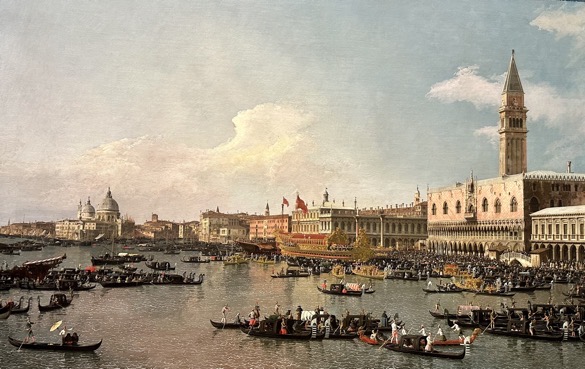
I have been to this museum at least a half dozen times, and walking through the wonderful collection was like seeing old friends. There is one gallery devoted only to pictures of Venice, and Canaletto’s Basin of San Marco on Ascension Day is a favorite. On this day each year the Doge would toss a gold ring from his enormous barge into the sea. It was a symbol of the “marriage” of this seafaring city state with the ocean. 
I have always been enchanted with Turner’s Rain, Steam, and Speed – The Great Western Railway since high school when it was the cover of my Norton Anthology of English Poetry. I have to admit, though, my deep disappointment when I took the actual railroad some years ago. It was scarcely more romantic than Metrolink. 

John was a big fan of Georges Seurat even before Sondheim wrote Sunday in the Park with George. While the famous painting that is the subject of that musical hangs in the Art Institute of Chicago, the National Gallery has the Bathers at Asnières. 
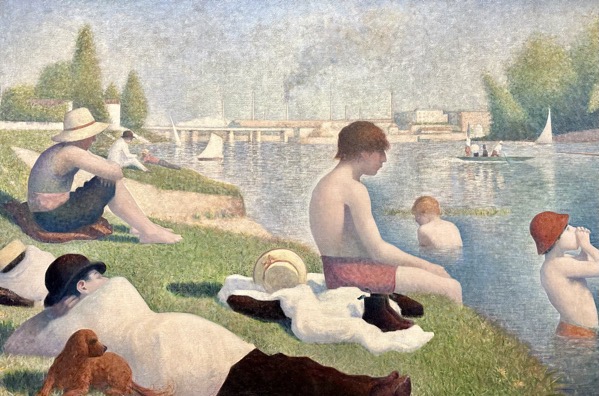
This summer, hearing all about how dangerous it still is to swim in the Seine, I wanted to yell at them, “Get out! Get out!”

Not that long ago all London theaters were dark on Sundays. I suppose it was the last vestiges of the Victorian Sabbath. So John was quite surprised when I showed him an extensive list of shows that we could go to today. Again, he rather surprised me. He picked Back to the Future: The Musical. It is playing at the Adelphi Theatre on The Strand, so it was easy to walk from the National Gallery to the play.

A little to my surprise, I really liked the show. It’s just a lot of fun. The show generally follows the plot of the 1985 movie, but a few plot points have been changed to make it work better on the stage. Some of the dialogue is almost the same, though they have added a lot of jokes about the eighties. The songs are not all that memorable, though I did like Doc’s dream sequence about “Living in the Twenty-First Century.” But the writers and composers know better than to tinker with the important stuff like the DeLorean. 

Back to Future.

There are all kind of special lighting and sound effects that extend from beyond the proscenium into the auditorium including having the car fly over the audience at the end. 

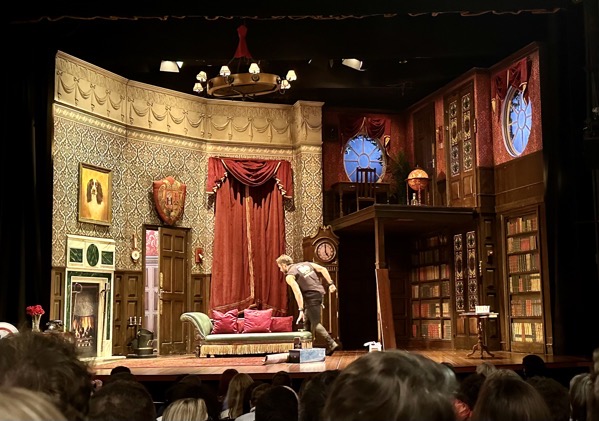
But the night was still young, as they say, and John was up for final piece of theater before we leave London tomorrow. We picked The Play that Goes Wrong. I saw this play at the Cabaret in Ashland. It was one of the best performances I had ever seen there, and Sandra King and I laughed our heads off. I cannot quite remember why John could not come that day, and he was always curious to see it after I told him what a good time I’d had. The piece had started here in London at the Duchess Theatre ten years ago, and I figured we might as well see it right where it started. 

So we strolled down The Strand until we reached Catherine Street. The Duchess Theatre is a modest place, just steps from the very grand Theatre Royal Drury Lane. We asked about tickets at the box office as I had not bothered to buy any online. The very helpful people there offer John a wheelchair spot and said that I would only be charged for my companion seat. I was not about to turn down that offer. They did tell us that while the stalls were not accessible by life—they are on the basement level—they did have a machine.that would safely get him to his seat. 
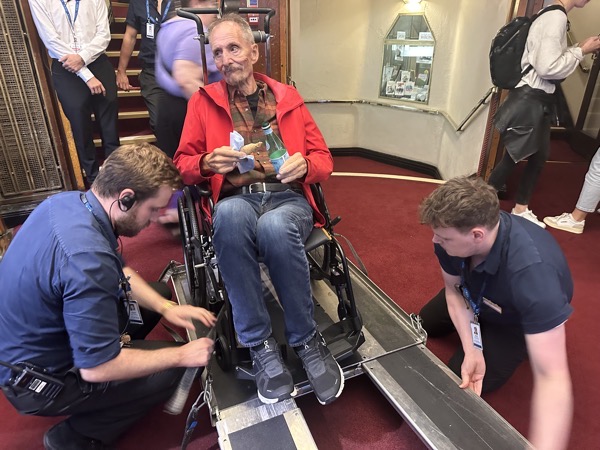
This thing was amazing. It had belts and rollers underneath it like a tank, and it slowly and quite smoothly took him down the stairs. 

I am surprised yet happy to report, Ashlanders, that I think our local production was better. The cast was good, but you could tell that they had been doing it for a long time and it was just missing the manic edge I loved at the Cabaret. The set here in London was great, but in a way it was almost too elegant. The play is supposed to be the work of. fourth-rate community theater, after all. 
So tomorrow morning we pack up and leave for Southampton where we will start our Norway cruise. Despite a few rough patches, we had a great time in London as we usually do. And despite all the time we have been here there are still many things we still need to see and do. “When a man is tired of London, he is tired of life,” Doctor Johnson famously said. Well, I am not tired of London, and I give thanks to God that John is not tired of life. 
South Bank Explorations

I am not sure why, when I am planning a trip to London, I never think about staying south of the Thames. And yet, every time I find myself in Southwark I think, ‘This is an interesting area. I should spend more time here.’ Today was one of those days. 

But it took us a while to get to the South Bank today. In fact, it took us quite a long time to even get out of our room. I suppose I could be slightly dishonest and say, “Oh, we just had a quiet morning.” But the reality was that John had another bout of extremely low blood pressure. And he had another fall, though this time he did not cut himself. He went back to bed and slept for several hours.

By early afternoon, after a lot of coffee and a couple doses of Midodrine, he was feeling better and ready to go. I had already made plans for a dinner and a play later in the evening, but I thought we could go a museum for a bit. I was pushing for some place we had never been before, like the Imperial War Museum, but he insisted he wanted to go back to the British Museum. Since it was close, I figured we would walk. 

Leaving the Cleveland Residences, you should turn right to head to Russell Square and the Museum, but John wanted to go left. So we started walking a little aimlessly. It was sort of interesting, but after a while I decided it was time to make tracks to the museum. So I simply set the directions in Apple Maps, stuck the phone in my pocket, and trusted that my watch would give me the appropriate step by step directions complete with those haptics. 

“Put not your trust in princes,” warns the Psalter, and I would add, “And don’t trust in technology, either.” The damn thing would work for a few minutes and then apparently just decide to quit on me. This happened a couple of times, and once I realized what was going on we were about a mile from the Museum. I changed tactics. I used Google Maps this time and stuck the phone in John’s hand so I could see every turn.

The walk was not a total waste of time. For most of it, we were wandering through the area that is home to the University of London. It is a part of the city I have never explored and there was that pleasant sense of lively street life that you also find in Berkeley. The University is justly famous for its academic programs, but not for its architecture. There are a couple of interesting buildings, but most of the campus is composed of drab brick and concrete structures, the worst of institutional architecture from the sixties and seventies. 

We finally made it to the museum with about a hour to spend there before it closed, I started wandering through some of the galleries we had missed on our first day. John was clearly annoyed. 

“I wanted to go to the British Museum.”

“We are at the British Museum.”

“No, the one on Leicester Square.”

“There’s no museum on Leicester Square, just an ugly Swiss glockenspiel.”

I finally figured out that he wanted to go to the National Gallery, just off Trafalgar Square. There was not time for that today, so I promised him that we would do it tomorrow. 

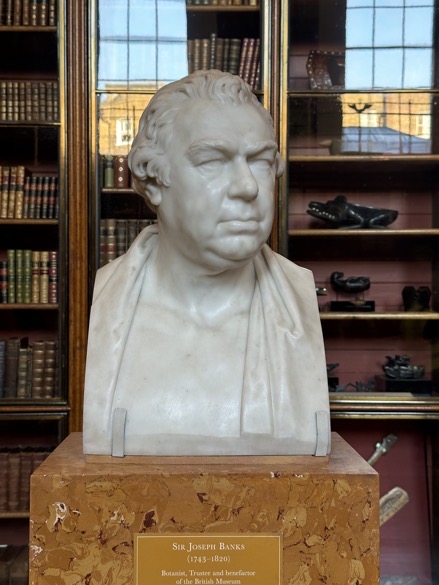
We spent most of our time in the weirdly wonderful Enlightenment Gallery. This is the largest and easily the loveliest room in the Museum. It is designed to evoke the collections of the wealthy eighteenth century explorers and scientists like Hans Sloane or Joseph Banks, whose bust, dressed as if he were a friend of Demosthenes, is shown below. 

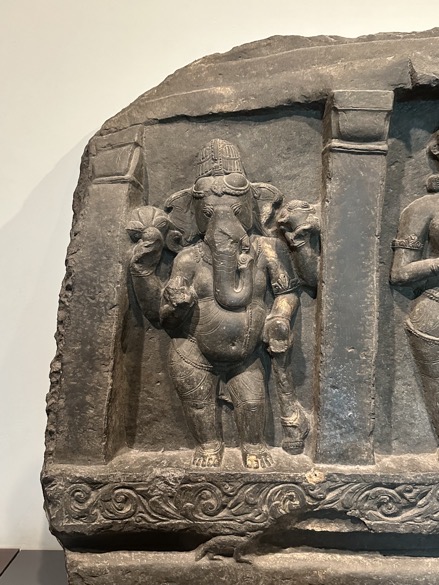
While everything is carefully labeled, there is a sense that these men like crows simply collected whatever appealed to them. So you can find a huge Roman foot

or a bas relief of Ganesha. 

The staff at the British Museum stands around bored for most of the day. But about 15 minutes before the official closing, they come to life, herding the tourists out as if they we were sheep and they Shetland sheepdogs. It is as marvelously efficient as it is annoying. So about ten minutes before five, John and I were out of the street, standing at the corner of Great Russell and Montague waiting for our Bolt to arrive. There was a large poster on the other side of the street advertising some listed Georgian house that was being converted into luxury offices. He became part of the picture. 

The driver dropped us off at a street simply called The Cut. It is just a few blocks from Waterloo Station. The area was a fruit and vegetable market for most of the nineteenth and early twentieth centuries. The costermongers were long gone in the post-war period, and a combination of German bombs and English city planners left the area fairly desolate for a couple decades. But now it is a lively district of theaters, galleries, and restaurants. I figured we would eat here before seeing a play down the street. I picked a Tas, a Turkish restaurant specializing in Anatolian regional cuisine, for our dinner. 

Tas restaurant the cut.

The food was not has amazing as I remembered eating in Turkey, but it was still quite good. We had a selection of mezze with some chewy bread. It is not a spot for people who have gluten issues. The mains—I had the mixed grill and John had the lamb meatballs—were good, but not all that memorable.

Tas was one of many restaurants on The Cut, and all those restaurants are here because of the theaters. The most important of these theaters is The Old Vic. Built in 1818 as the Royal Coburg Theatre, it was rechristened The Royal Victoria Theatre when the young queen acceded to the throne in 1833. After a few decades, it was just “The Old Vic.” In 1955, when Laurence Olivier was appointed as the head of the newly created National Theatre, The Old Vic was home for its productions until the until the new theatre, possibly the worst example of Brutalist architecture outside of Newcastle and Sunderland, was constructed in 1977. The National Theater moved out of the Old Vic, but converted a butcher shop down the street into a center for experimental theater. People started calling it “The Young Vic.” 

The Cut exterior e1565206404455.

We had come to The Cut tonight to see a production of A Face in the Crowd at the Young Vic. This is a new musical based on the 1957 film with music composed by Elvis Costello. John used to play Costello endlessly, particularly the CD he did with Bert Bacharach, and that’s one of the reasons I picked the show. 

The show sticks fairly closely to the movie, and few changes made to the story largely do not improve it. Though A Face in the Crowd is now considered an important political film, its reception in 1957 was fairly mixed, largely, I think, because both writer Budd Schulberg and director Elia Kazan had been “friendly witnesses” before HUAC and both had named names. 

For those of you who do not obsessively watch TCM, here is the plot of the movie. Larry “Lonesome” Rhoades, a drifter brilliantly played by a young Andy Griffith, is befriended by Marcia, a radio producer portrayed by Patricia Neal. She discovers that he is a natural performer and he rapidly becomes a local celebrity famous for saying whatever he thinks. Lonesome moves to New York where he soon has a hit national TV show. He is such a natural for television that he is enlisted to help support the presidential candidate of California senator Worthington Fuller. As his fame and influence grows, Lonesome becomes an egomaniacal monster. Marcia comes to hate him and she exposes his underlying contempt for his audience by putting turning his mike on when he is insulting Fuller and his fans. 

The show is written by Sarah Ruhl, and in her efforts to somehow make the play about Donald Trump she manages to mangle the real issues and concerns of the 1950s, something that the movie definitely understood. The references to international issues confuse incidents that happened at various times between 1947 and 1961. Art direction and set decoration feature some real howlers from flags with 50 stars to postcards showing palm trees in New Jersey. The landscapes of Texas and southern Utah are similarly confused. Fortunately, the leads are pretty solid. Ramin Karimloo, the very talented Iranian-Canadian singer and actor, is particularly exceptional. And while the score is not the best thing Elvis Costello has written, I think many of the songs are quite good. 

Ruhl’s problem with creating the Lonesome Rhoades-Donald Trump equivalence is that Trump is an actual candidate in an election while Lonesome was simply a celebrity who wanted to influence an election. The people who most fit that description this year, however, are all Democrats—Robert DiNero or Whoopi Goldberg. Rulh presumably is not keen on insulting them. It will be interesting if the A Face in the Crowd has legs and moves on from the Young Vic to other venues and if it still seems to grab attention after this November.