
The next stop in our itinerary was Coimbra, famous as the site of Portugal’s most prestigious universities. It was not that far from Nazaré, but I still wanted to see anything interesting along the way. Looking at the map, I saw that Fátima was not far at at all away off the main route.
Despite my general fascination with old churches and monasteries, I am not attracted to the big Marian shrines. There is something about the way that all the sincere devotion attractions hucksters and brings out the greed in the clergy—I am sure that this was precisely why Jesus made a whip and attacked the moneychangers in the Jerusalem temple. But, since we were so close…I figured, what the hell, let’s go to Fátima.
For those of you who are not Catholic, let me give you the background. In 1917, in a small mountain village named Fátima, about 70 miles from Lisbon, three children, Lucia dos Santos, and her two cousins, Francisco and Jacinda Marto, ages 9, 8, and 6, said that they saw “a lady dressed in white” who spoke to them. She told them that she had come from heaven and that they should return each month for the following few months. Initially, the children’s story was met with indifference and outright hostility from their families and the community. But gradually more and more people started to accept that they had indeed seen the Blessed Mother. Her last appearance was accompanied by the so-called Miracle of the Sun where 70,000 people claimed to have seen the sun appearing as though it were falling to earth.
Fátima soon became a center of pilgrimage for Portuguese and Spanish Catholics, and construction soon started on a large church on the site.
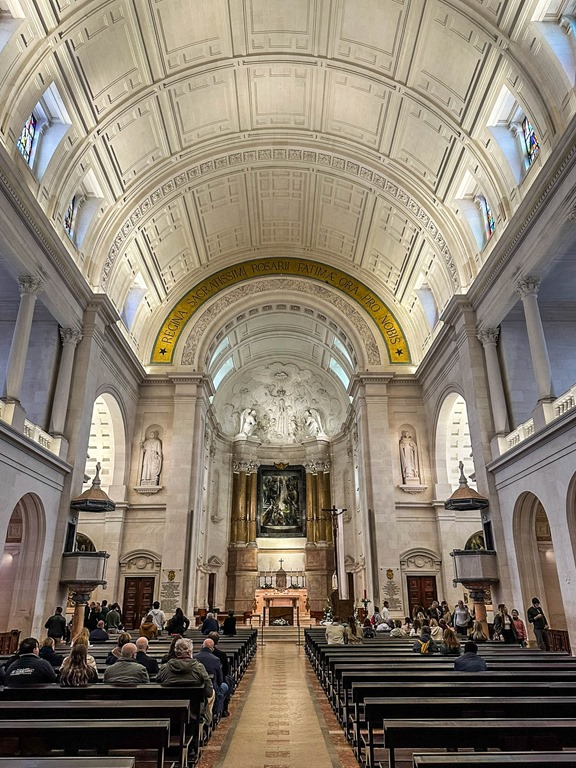
John and I walked around. This is a real center for devotion that casual tourists like us notice and respect.
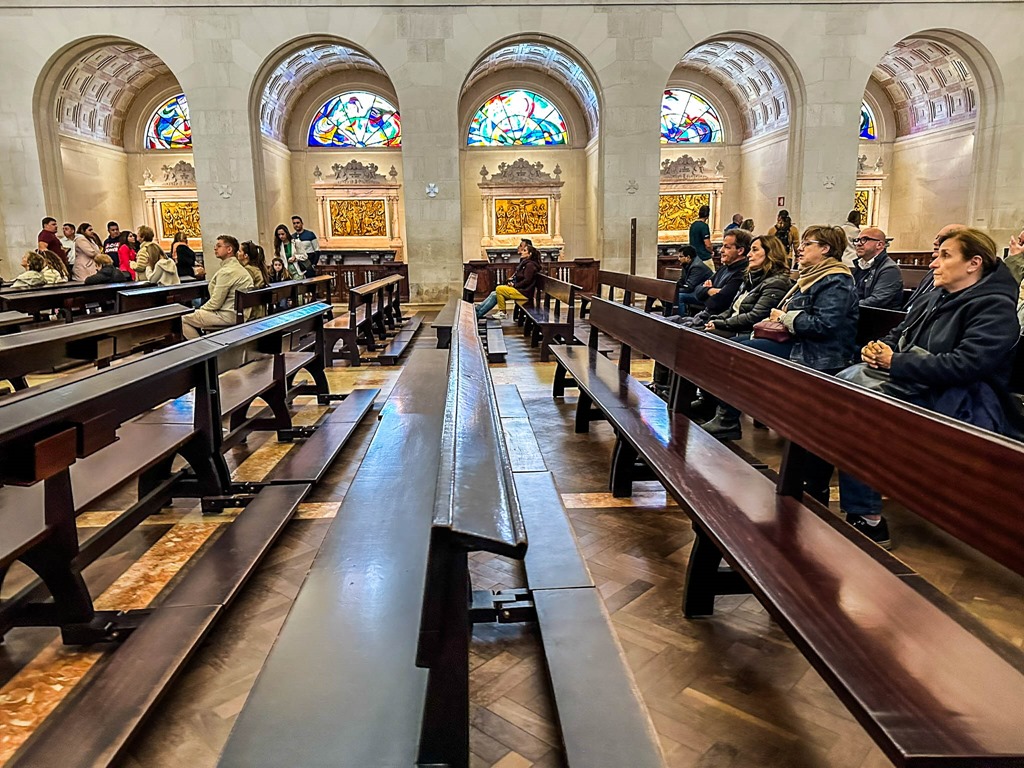
Construction on the church began in the 1920s, but it was not completed until the early 1950s. The architecture and decoration reflect a largely conservative style, but it is definitely a twentieth century building, not a faux Baroque basilica.

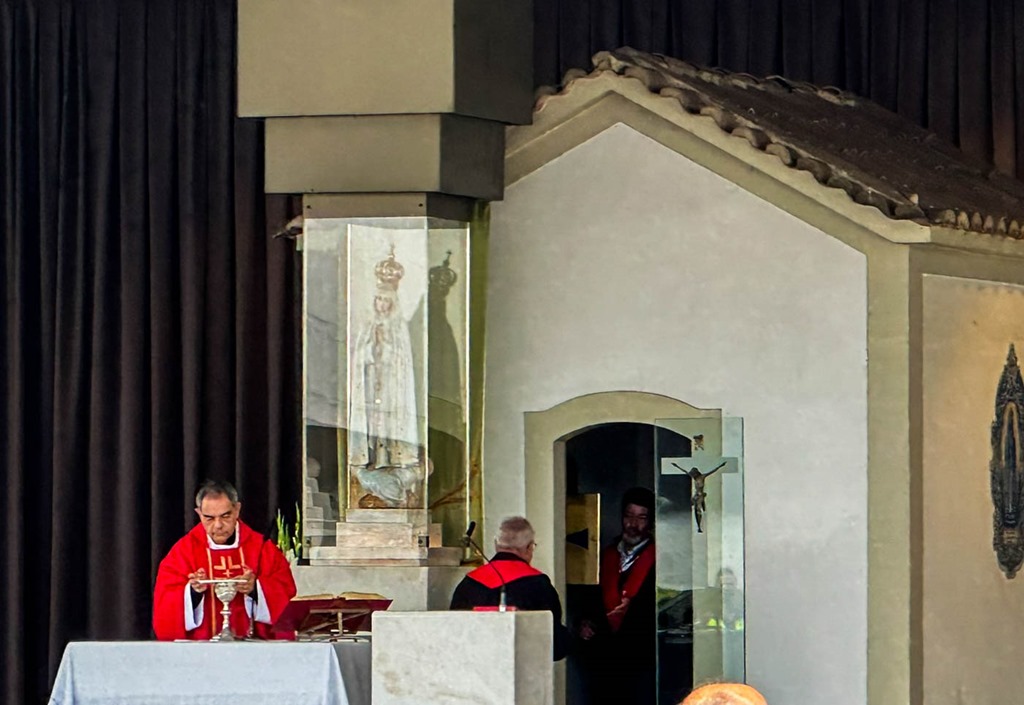
A small little house was built on the spot where the three children actually said they saw the Virgin. An semi-open-air chapel was built over the house. This chapel was the center of attention while we were there as Mass was being celebrated.
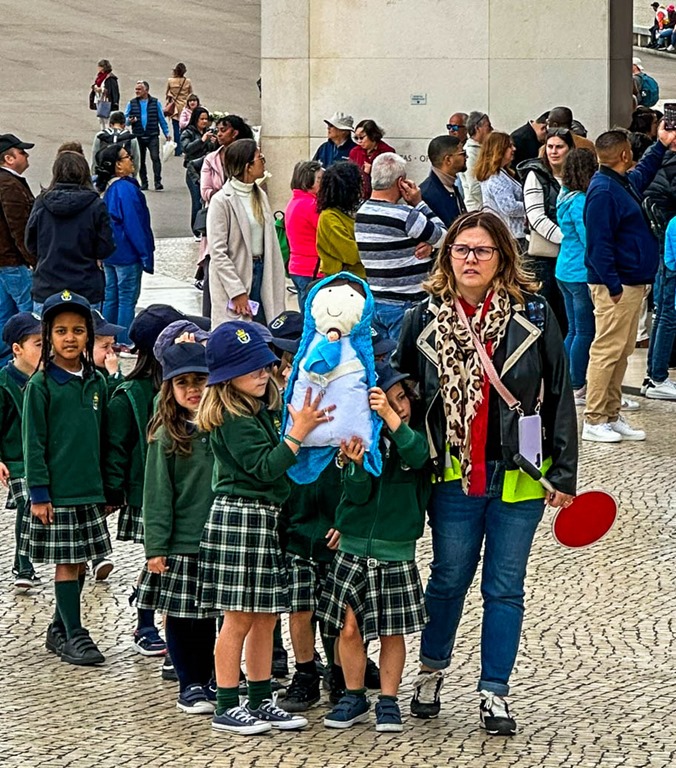
Quite a number of school groups came while we were there. All wore uniforms similar to those of American parochial school students. Each group seemed to bring along a banner or some other item as they processed towards the main church.
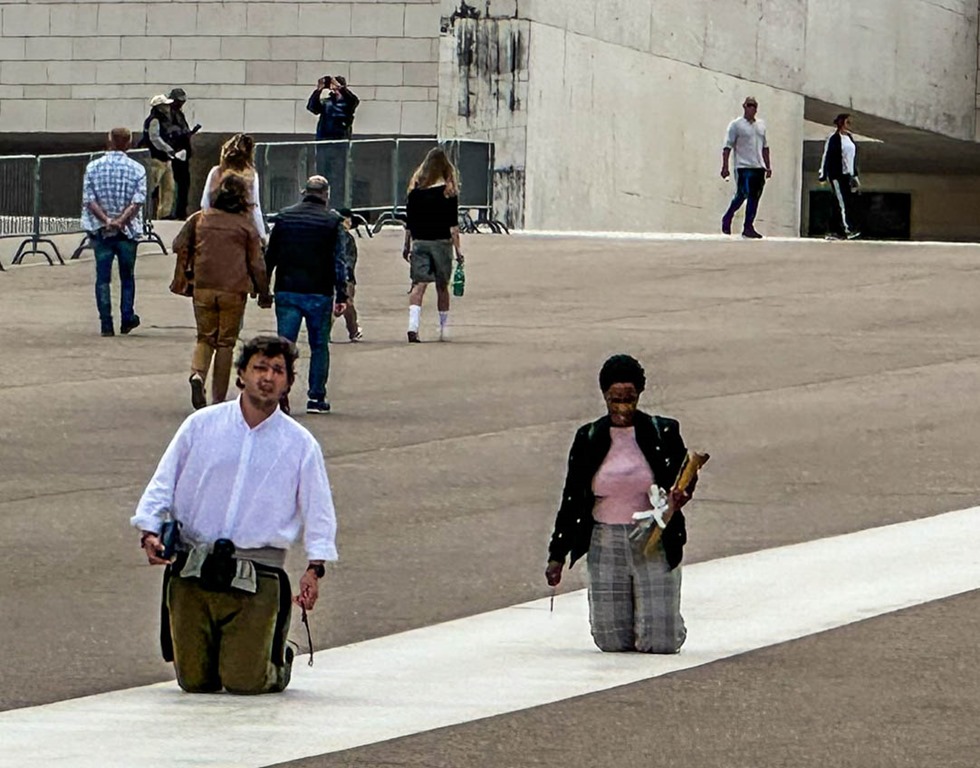
More touching was the devotion of individual pilgrims, many of whom made the last few meters towards the chapel on their knees.
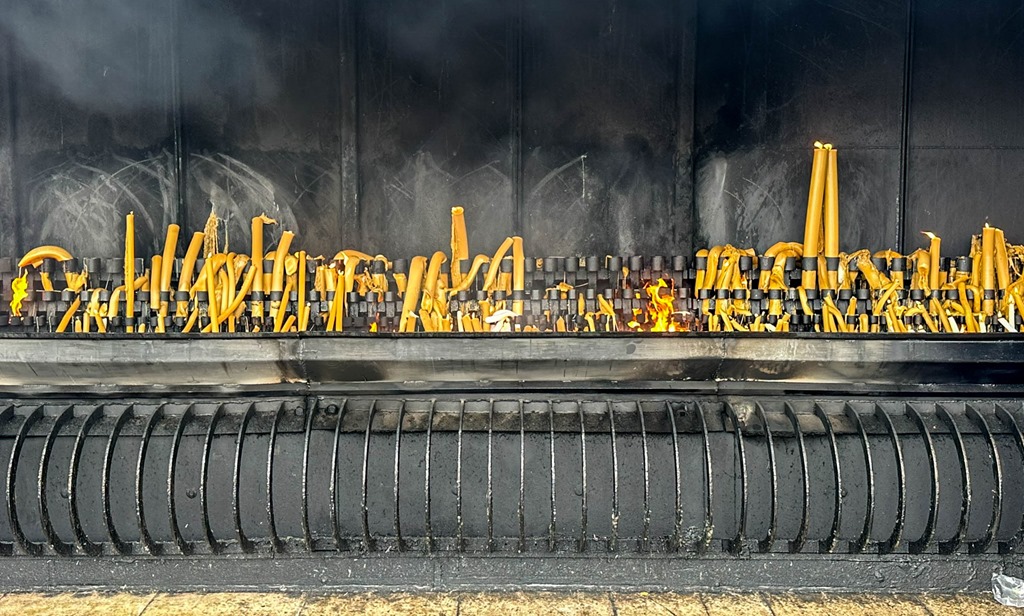
Many visitors to Fátima bring candles, often quite large, many clearly made of beeswax. There is a large area where the candles are placed after a prayer is said. Since beeswax melts easily and can also burn easily, there were frequent smoky fires in the candle area. I found it both fascinating and slightly disturbing.
By the time the church at Fátima had been completed and consecrated, it was already far too small. A large open-air plaza was created so that the faithful could attend outdoor Masses. And a new church, seating many times more than the old church, was constructed on the far side of the plaza. John liked the almost abstract crucifix that stands in front of the new church.
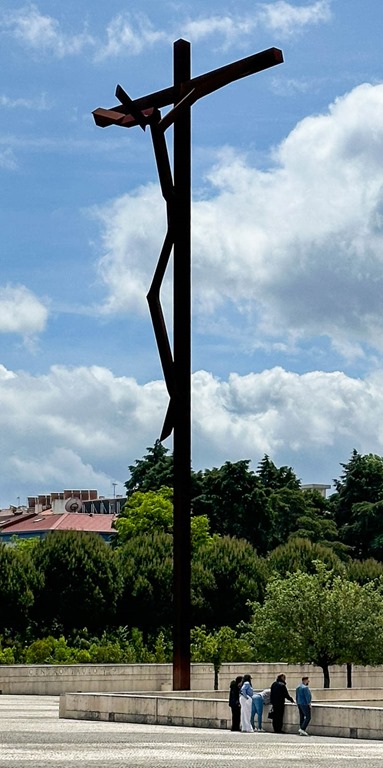
If it were not for that cross, you might easily assume that the new church was some kind of sports arena. It is a cheap, squat bit of brutalist architecture. The inside is slightly better.

After snapping a picture in the new church, we headed out into the plaza and from there to the parking lot.

We arrived in Coimbra not long after leaving Fátima. After splurging on a couple hotels, I had been looking for a couple cheap ones to balance out the budget. I found a place called the JR Suites for only 75 dollars a night. Well-reviewed on Booking and TripAdvisor, it promised a balcony with a view and parking. What was not clear from any of this, was that the hotel was not easy to find. Despite Google Maps, we had to go up and down busy streets several times until we found it. And then we discovered that parking was almost impossible in the area. We parked half and mile away, leaving our luggage in the car, and walked.
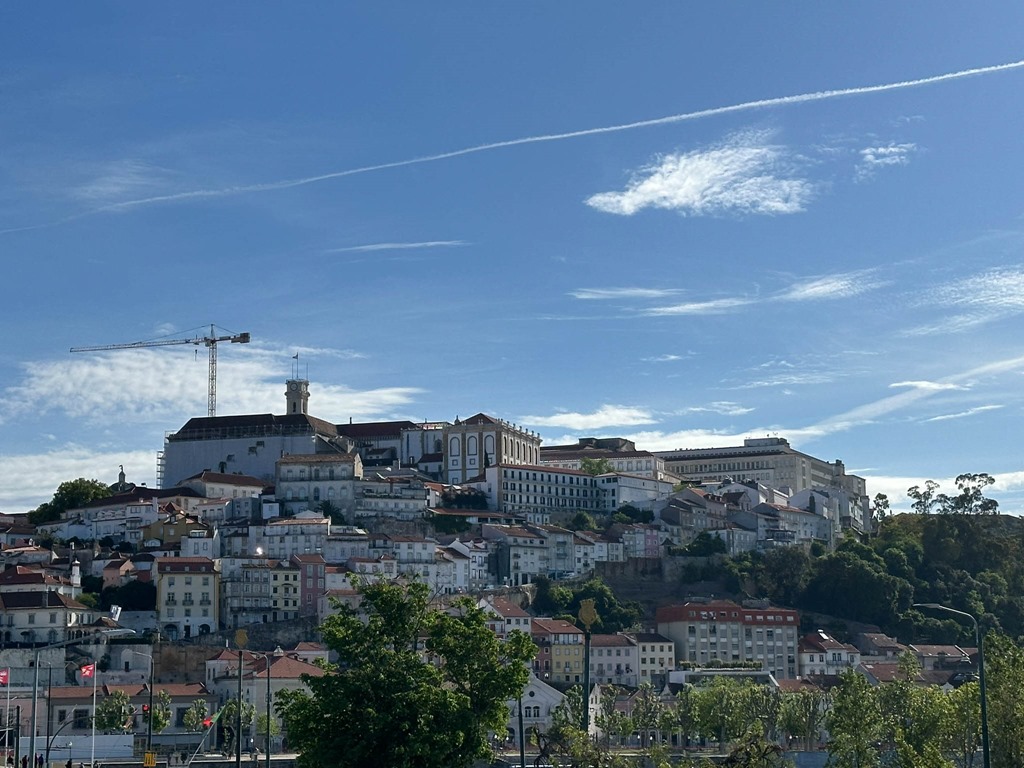
Once in our room, we discovered that it did indeed have a nice view of the old city just across the river.
The room itself was small. There was a bed and a small desk along with a couch that looked like it might fold out into an extremely uncomfortable bed. The bathroom would have seemed cramped even on a ship. But it was spotlessly clean.
When we checked in, the girl at the desk told us that parking was available in a nearby parking lot or on the street in front of the hotel. John was not keep on leaving our stuff in the car—he had bad memories of our car being ransacked in Seville 35 years before—and he wanted me to move it to the parking lot. I could not see a single empty space there, but I agreed to try. By some miracle, a spot opened up on the street just in front of hotel and I grabbed it. I told John that we would be taking rideshare until it was time to leave town. I was not giving up that parking spot.
It was about five thirty and we did not want to just sit in the small hotel room. So we looked to see what was open, and our best option was the university’s botanical garden. I used the Bolt app to order a car, and about 15 minutes later we were there.
Like all the great European universities, Coimbra, established in 1290, was under the control of the church, and its focus was mostly on topics like theology and canon law. But in 1770, the Marquês de Pombal, first minister to the crown, pushed through some aggressive reforms to make the university more modern. An admirer of the Scottish Enlightenment, de Pombal suppressed the Jesuit order and established new programs of study focusing primarily on the natural sciences. A botanical garden was created in part to focus on the medicinal properties of certain plants. It has been a feature of the campus for over 200 years.
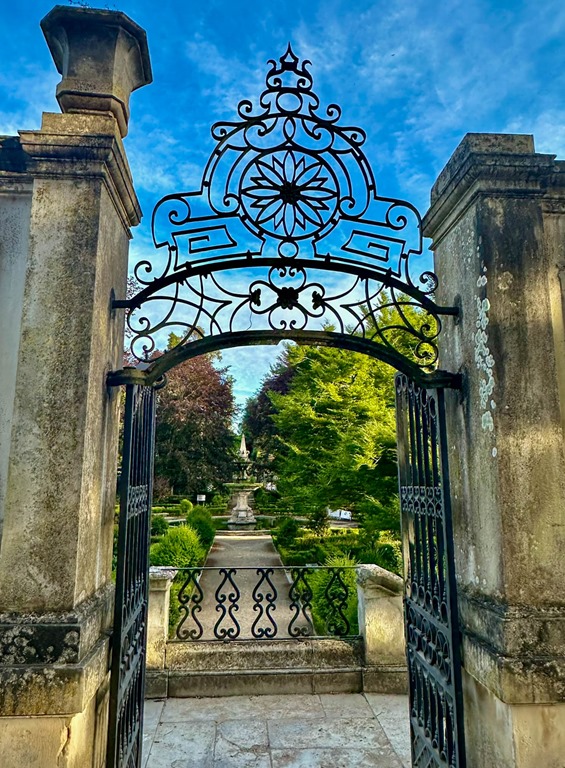
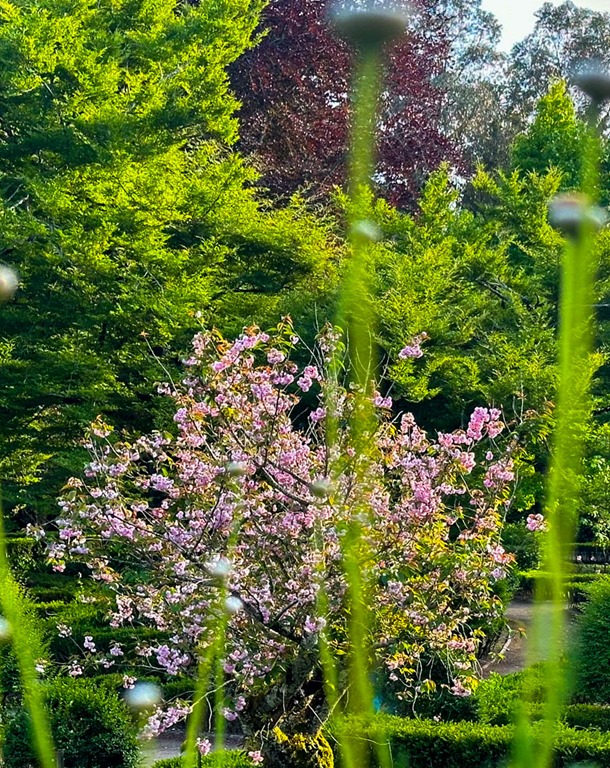
Knowing something of that history, we both were eager to explore the garden. But we did not get far. The greenhouses are open only by advance request for researchers. The gardens make little attempt to be accessible for people with mobility issues, and even the relatively flat areas are not well-maintained. The only person we saw there was a security guard, and his main focus seemed to be making sure that people were out well before closing. So we took a couple of pictures and left.

We needed to get something to eat before we went back and I found a place called Couraça a few yards from the entrance to the gardens. It was basically a bar catering to students, but it had a limited menu as well. I often like to try local specialties, so I ordered the Francesinha sandwich. It consists of several different kinds of meat between two slices of white bread. Melted cheese and a mildly spicy tomato sauce are poured over it, and it is topped with a friend egg. French fries are serve on the side or on top.

It is not the worst thing I have ever eaten. It is definitely better than poutine. But I would never order it again.
This morning we had a couple hours to do some sightseeing before we pushed on to the Duoro Valley. My first choice was the old university library, considered an architectural masterpiece, but online reviews commented on how it was completely inaccessible it was for people with disabilities. So I chose the Museu Nacional de Machado de Castro. Named after a famous Portuguese sculptor, it has an extensive collection of Portuguese art mostly from the sixteenth through eighteenth centuries. Given that time frame, it was not surprising that much of the material was religious in nature.

At least eight feet tall, this was the largest monstrance I have ever seen.

But there were a few items that had a more secular theme. There was a collection of wall tiles that had been used to teach the basics of Euclidian geometry.

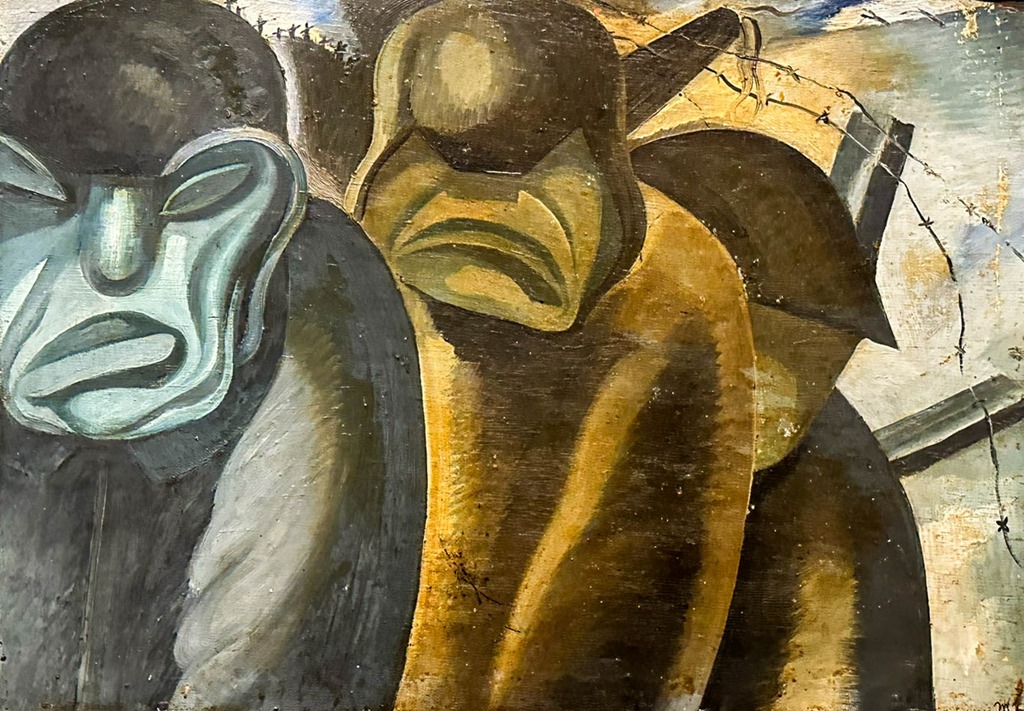
There was one small gallery devoted to the work of Manuel Felipe. He was a fierce critic of the authoritarian Salazar regime. This was a piece call War.
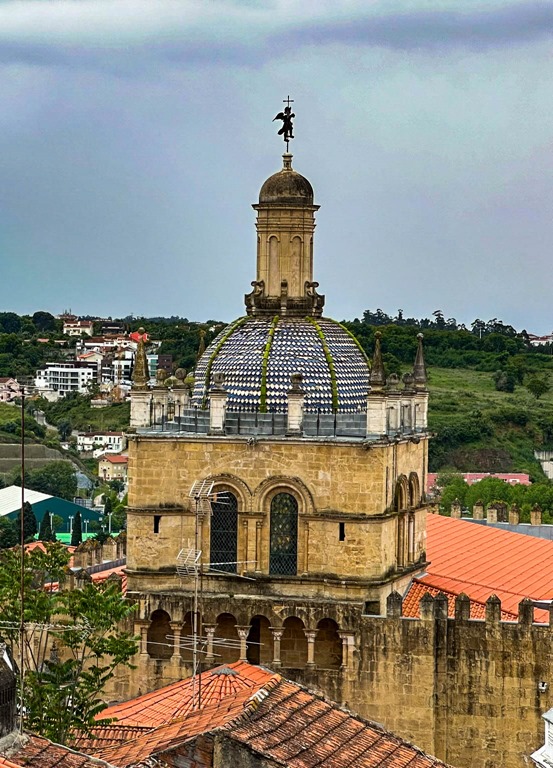
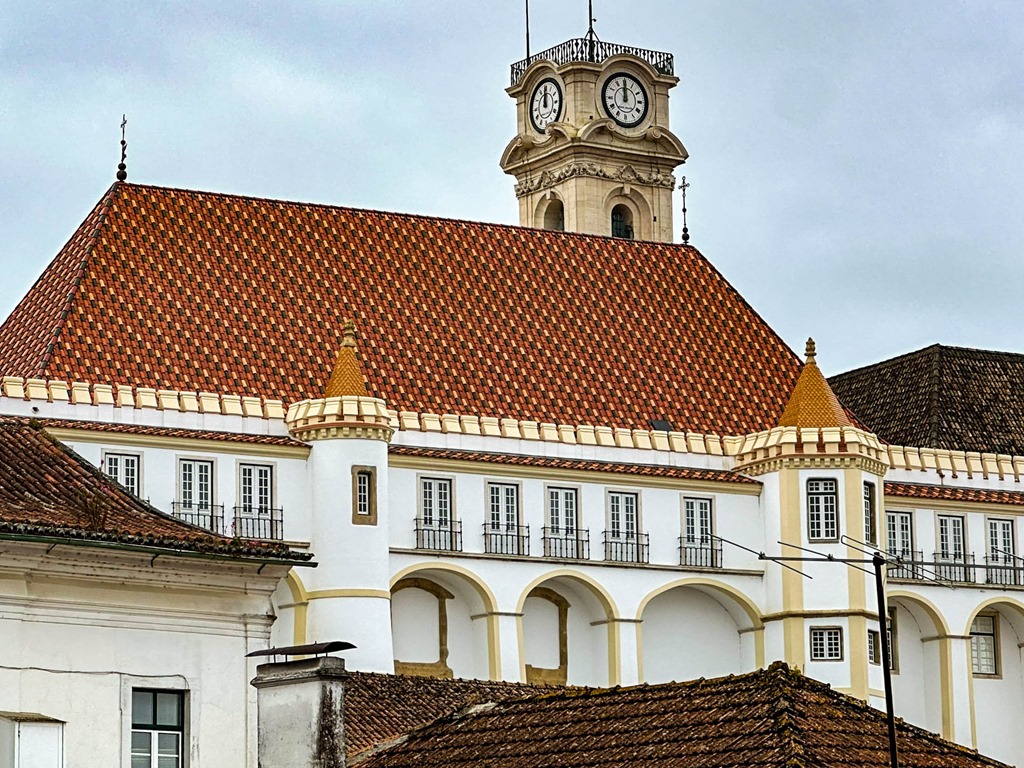
The museum consists of two buildings. The older one is the old bishop’s palace. The new, larger one is a typical example of museum architecture from the 1990s. The plaza in between the building provides a nice view of historic Coimbra.
 Traveling Johns