
We pulled out of Coimbra around noon. By the time we left, both John and I had really warmed to the city and wanted to see more of it. But we had a ways to go before we reached our next destination in the wine country of northern Portugal.
I have to admit that I had never heard of the Duoro River before I started to plan this trip. But it is the largest river in the Iberian peninsula. The area around the river has famous for centuries as the home of Port wine. Now, John does not drink at all, and wine is not my favorite beverage. But vineyards are usually attractive, and I had read that the vineyards of the Duoro Valley are particularly beautiful. So I decided that we would spend one night, our almost last night in Portugal in a winery. I picked the Quinta do Pégo in Tabuaço. It was a great choice.
Getting there was a bit of a chore. Once again, I had to drive in the rain. And the rain here does not fall as steadily as it usually does in Oregon: it drizzles for a bit, stops, and then starts coming down in sheets. It is miserable for driving. You are always changing the speed of the wipers and when the rain is really coming down you can barely see five feet in front of you. And when we finally made it to Quinta do Pégo there was an incredibly narrow drive with sharp switchbacks cutting up a steep hillside covered in vines.
But once we got there…oh, what a view!
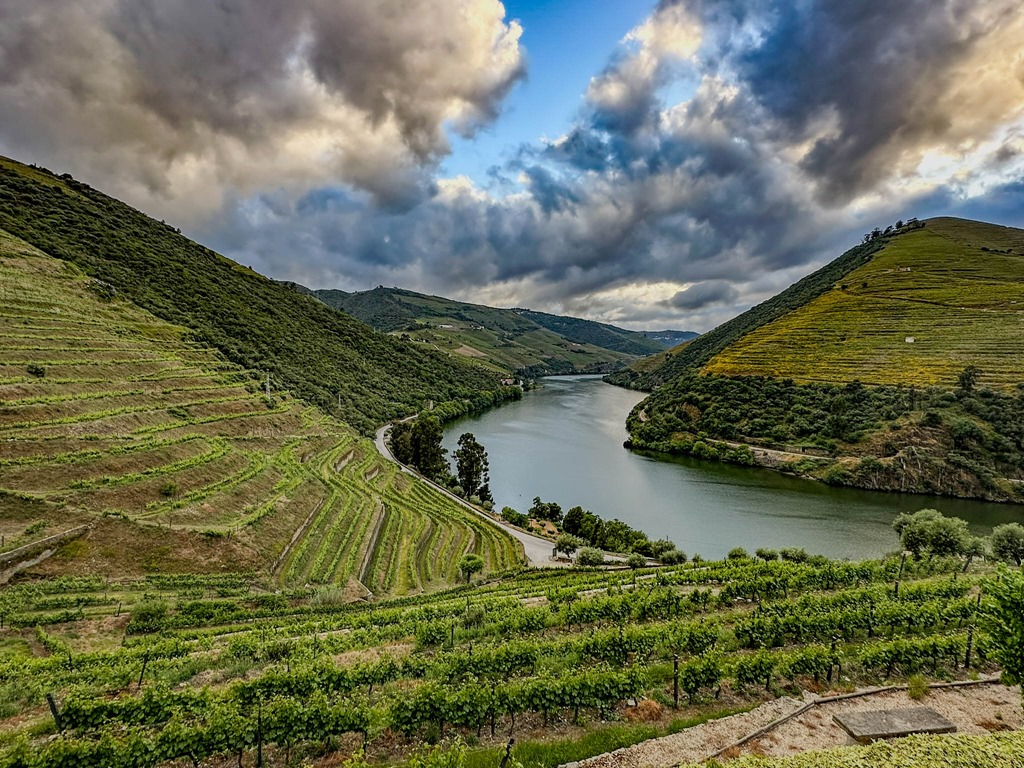
The hotel at the winery is small, with space for only about 20 guests. It is largely done in a modern style that would not look at all out of place in Sonoma. It has red clay tiles on the roof with off-white stucco walls. The interior features lots of red oak. There furnishings are largely modern with a handful of antique pieces mixed in.
We had a room with a small patio.

It was never warm enough, or quite dry enough, to sit out there. Instead, we just popped out occasionally to enjoy our view of the vineyard.
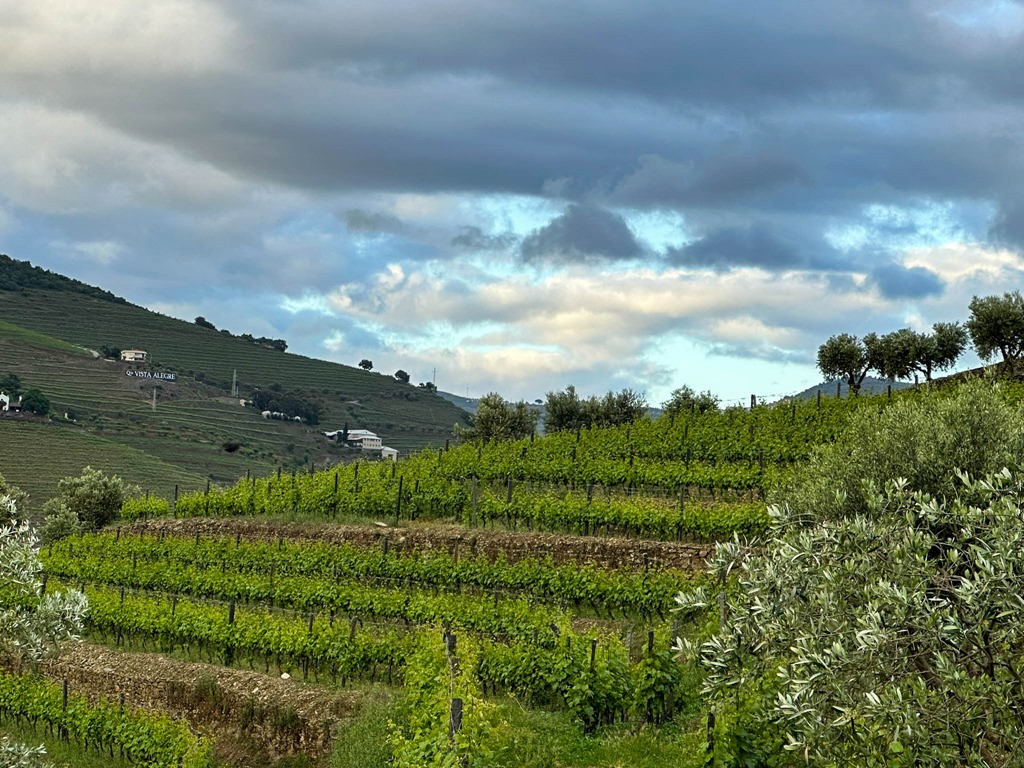
We had a small decanter in our room of the port from the estate. I do not particularly like sweet wines, but I thought I would try some just because we are here. After a few sips, I turned to John. “You know what the difference is between Port wine and cough syrup? Cough syrup makes you stop coughing.”
We had a wonderful dinner at the hotel, and the this morning, a pretty good breakfast. I was raised to think that Europeans only had a small pastry and a coffee for breakfast. That is true in Italy and parts of France, but most Europeans seem to like cold cuts and cheese for breakfast. No matter how many times I have that, I still think, why are we having lunch already? I think I may be ready to come back to America.
While we were finishing breakfast, I looked out the window and saw a bike race.

We were not planning to leave for another couple hours, so I figured that the race would be over by that time. We packed about and checked out about noon.
I was wrong. The cyclists, having started out riding east, at some point turned around and headed back to where they had started. So for twenty kilometers I had to carefully maneuver the car around packs of cyclists. To make matters worse, it was starting to rain heavily. Bike tires do not have the best grip on wet surfaces, and I was afraid that one might slip down and I would hit him before I could stop.
We finally reached a fork in the road where cars were directed one way, cyclists another. The rain continued. I pushed on towards on Porto. After another ninety minutes of driving in heavy rain, we came into Portugal’s second largest city. We are staying at the OCA Oriental Hotel. It’s called “oriental”—“eastern” in Portuguese—because it is on the east side of the historic center. There are no red lanterns. It’s your basic inexpensive business hotel, similar to the the Marriott in Medford.
We leave tomorrow morning at six. That means we need to return the car and be at the airport by about four. That means we will have to get up at three. It is not easy getting John up at seven or eight in the morning some days, but I know he will rise to the occasion.
But we had a few hours to explore Porto. Like Glasgow or Manchester, Porto has the reputation of being run-down and even slightly dangerous. But like both of those cities, it now has a bit of a reputation as an cheap-rent artistic haven.
With only a short time, I figured another tuk tuk tour would give us an overview of the city. I looked on Viator and found one for six in the evening. That was perfect. I booked it.
We were supposed to meet our driver in a parking area not far from the cathedral. So I ordered a Bolt and we were dropped off a few minutes later in the heart of the medieval part of Porto. Like Lisbon, the Porto Cathedral is ominously Romanesque, though a slightly incongruous baroque portal was added later to the front.

I was curious to look inside, but access was possible only by buying a tour ticket to look at the cloister, the treasury, and so on. We did not have enough time for that, and I did not need to see another faded fiddleback chasuble.
The plaza in front of the Cathedral is dominated by this pillar.
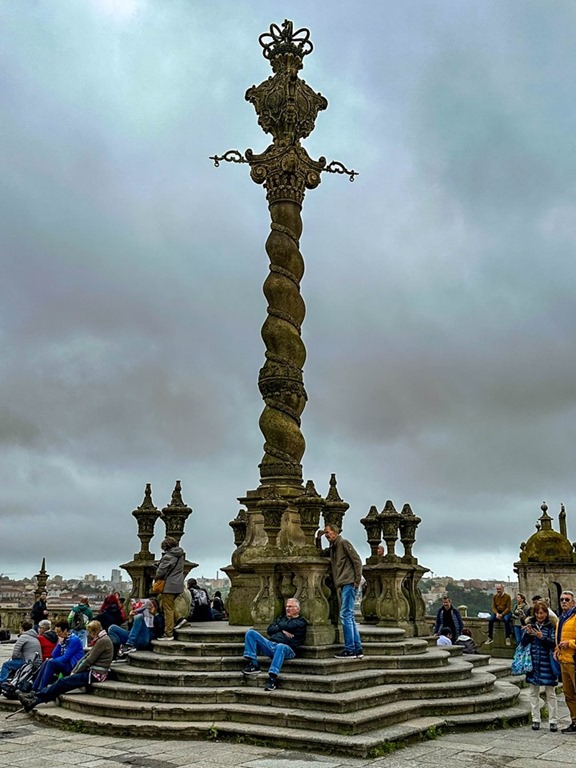
The guidebooks refer to it as a gallows, though it seems completely unsuited for this purpose. I learned later from our driver that it was erected during the Salazar era when Portugal’s right-wing authoritarian government wanted to remind the residents of Porto that something like those medieval punishments could occur again if they did not comply with the junta.
Also nearby was a stained glass museum. This commemorated the work of João Antunes, Portugal’s most celebrated stained glass artist. He worked in a variety of styles for public, private, and ecclesiastical clients. This piece was a kind of homage to Louis Comfort Tiffany.
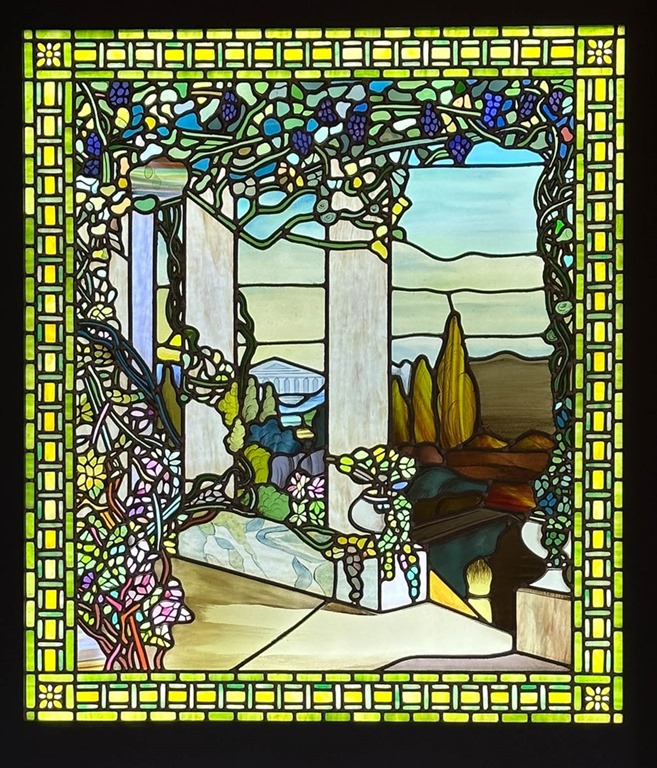
Here was one of the church pieces.

I actually like the abstract pieces the best, but they were large and hard to photograph.
We walked down and found our tuk tuk. After having such a fantastic guide in Lisbon, our driver here was a disappointment. He spoke very little English. He had some kind of app on his phone which translated what he said in Spanish—I figured out later that he was from Chile—and an female British voice announced it over a Bluetooth speaker he had given us.
We zoomed by many buildings quite quickly. It was hard to get decent photographs, and some of the places that looked most interesting were the hardest to snap pictures of. This is Lisbon’s city hall.
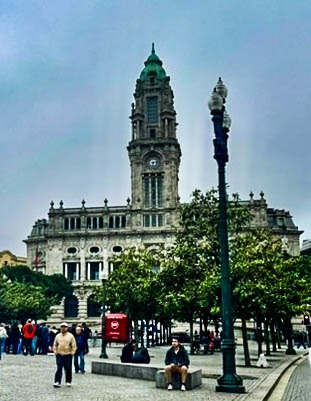
We did stop near one of Porto’s most famous buildings, the Carmelite churches.
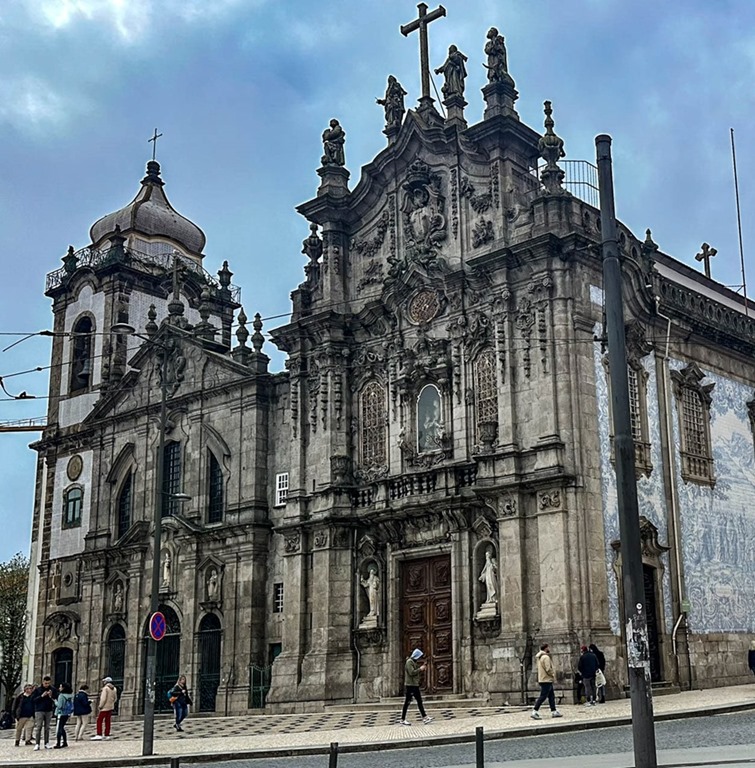
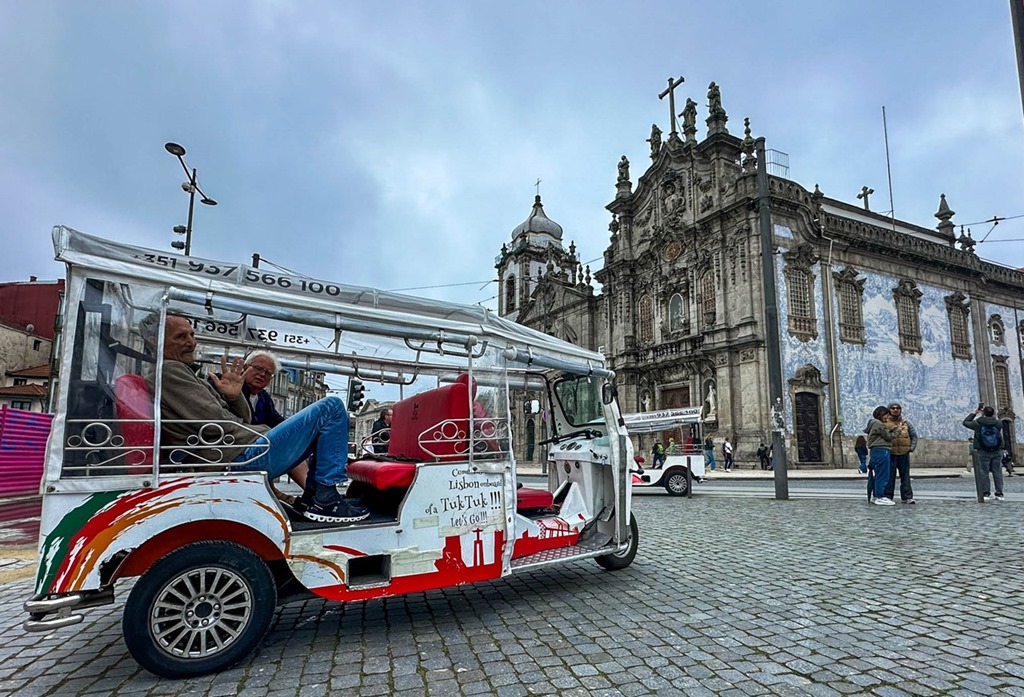
There are actually two churches here with a tiny “house” build in between them. They are all that remain of two Carmelite monasteries, one for me, the other for women. The interior of the women’s church is supposed to be an extraordinary example of Portuguese Baroque, but we did not have time for that. Our driver did snap a picture of us in his tuk tuk.
We also saw the Clerigos tower, probably the most famous site in Lisbon.

The tower, which houses Portugal’s largest carillon, was built by a fraternity of priests whose mission was to provide health and hospice care to sick and elderly priests.
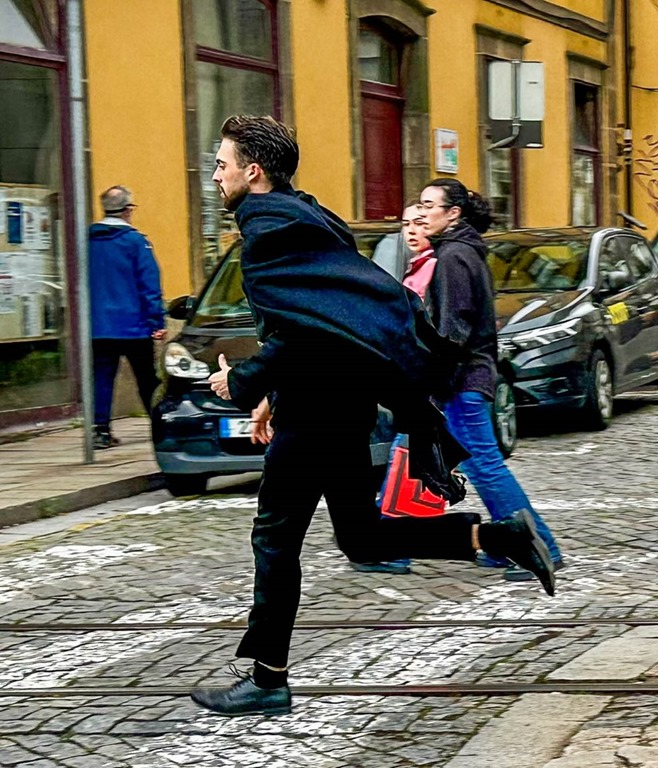
Porto has its own eponymous university, though this was not established until the eighteenth century. Portuguese university students were supposed to wear distinctive capes in public. Now they are only worn on ceremonial occasions. Apparently a number of graduations were happening today, and we saw some students wearing their capes. This guy was in a hurry to get somewhere: maybe the ceremony, maybe meeting up with his friends for a drink.
The Ribeira District is the cutest section of Porto.


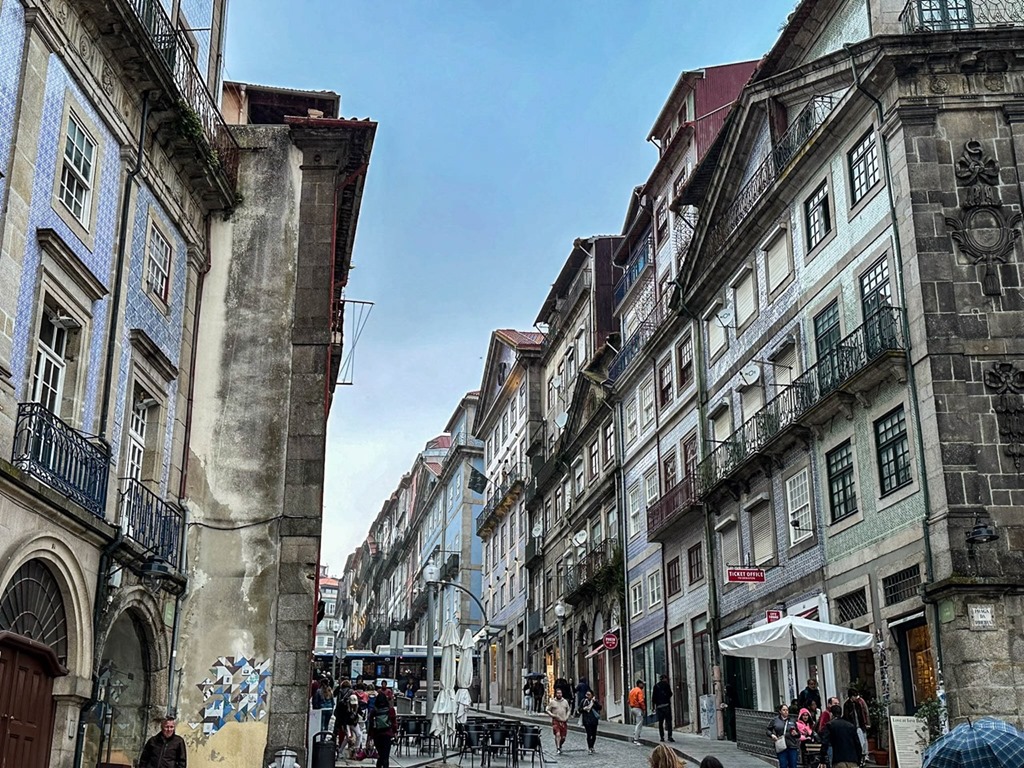
We had dinner here in a restaurant right on the river, close to the pedestrian bridge connecting Porto with Gaia, its sister city on the other side of the Duoro River. For a tourist spot, the food was surprisingly good.
We called our ride right by this monument.

It’s not easy to see from this photograph, but the statue that had obviously once been in the middle alcove had been replaced by this somewhat whimsical figure wearing some kind of strange costume. There’s a story there, but not one I could learn.
Tomorrow we are up at three in the morning to start our trip back to Oregon. Both of wish our vacation could go on for longer. But there are things to do, including important medical appointments, when we get back to Ashland. And so, Traveling Johns signs off until our next trip!

