Waiting for a Bed

As trips go, it could have been much worse. John and I left early Wednesday morning from Medford.

We flew first to Denver, then to Chicago, and finally to London. We left at five in the morning yesterday and arrived at just before six today. Adjusting for the time changes, that meant 17 hours of travel. I knew it would be a difficult day for John, but I was surprised at how determined and resilient he was. 

We cleared customs in record time at Heathrow. I had arranged a ride from the airport, not wanting to deal with finding our way to the train and then having to change trains or get a cab at Paddington. But our driver was not there when we arrived at the meeting place, and John’s determination to be good-humored began to fade. The lack of sleep was clearly catching up with him. The driver finally arrived almost 45 minutes late and hustled us off into his Kia, obviously annoyed at John’s wheelchair. 

The trip into London took over 90 minutes. I wondered if the route had partly been chosen to avoid the congestion pricing and ULEZ (Ultra Low Emission Zone) charges. Perhaps GPS was actually helping him just avoid traffic. Either way, it was a long, boring ride and on a gray, drizzly morning, London looked particularly bleak. John’s mood did not improve. 

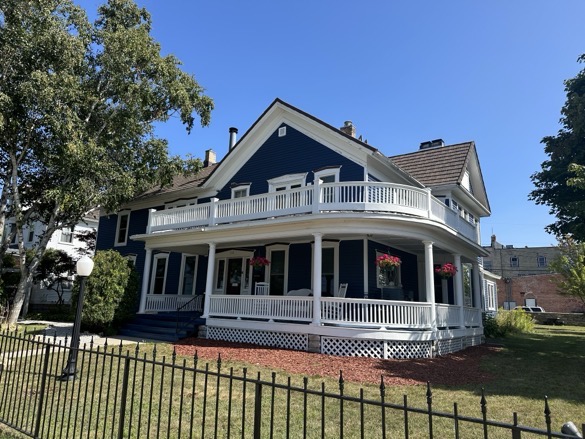
We finally arrive at our London accommodation, the Cleveland Residences Russell Square. I had picked it partly on the basis of this picture on Booking. 
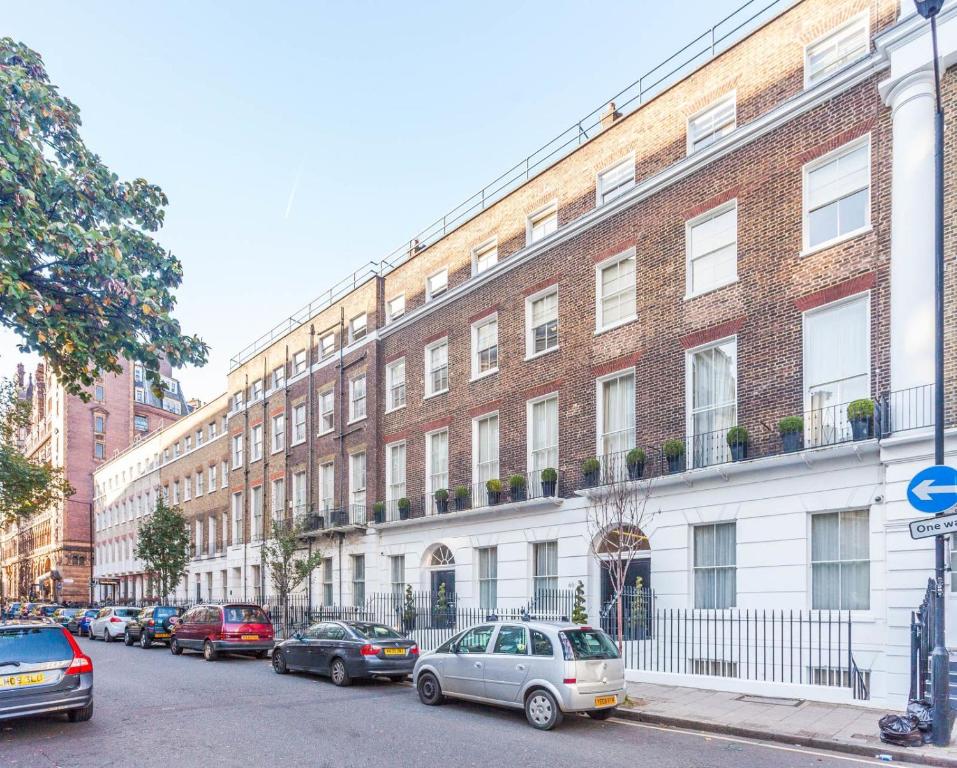
Cleveland Residences Russell Square, London (updated prices 2024)

The price, about £680 for four nights, was also appealing. I had been warned, of course, by the management that they could not guarantee that our room would be ready before mid-afternoon. And, indeed, the room was not ready. A cheerful lad who looked like a young James Corden, took our luggage for storage. He told us that the room would definitely be ready by four, but if it was ready earlier he would try to send us a message. John was not happy. He wanted to take a nap. 

We went off to explore the neighborhood. By this time, the clouds were breaking up, and things were looking a little better. Russell Square, the heart of the Bloomsbury district, was at the end of the street. 
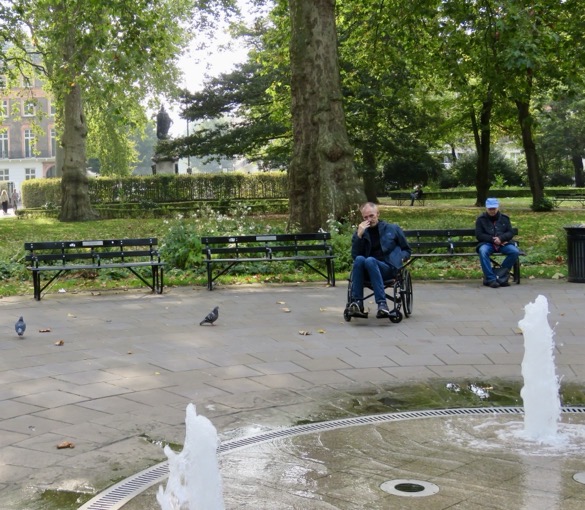
I read John some of the signage about the history of the park and noted how old the plane trees were. I was faking cheerfulness and John knew it. We left the park and wandered about Fitzrovia. It’s still classic London. 
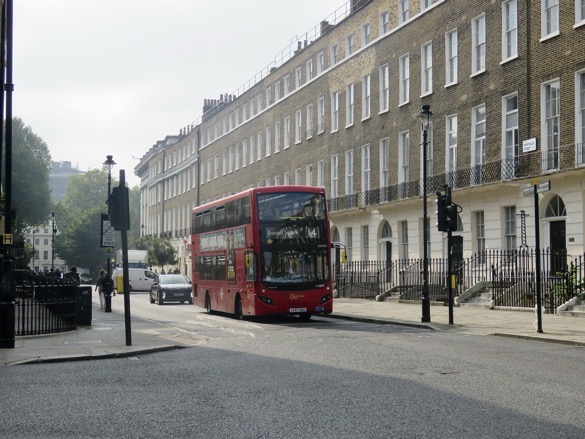
I knew that the British Museum was right off the square, and John was quite amenable to going there. We decided to go straight for the Egyptian stuff on the third floor. When you’re dead tired, why not spend time with the mummies?
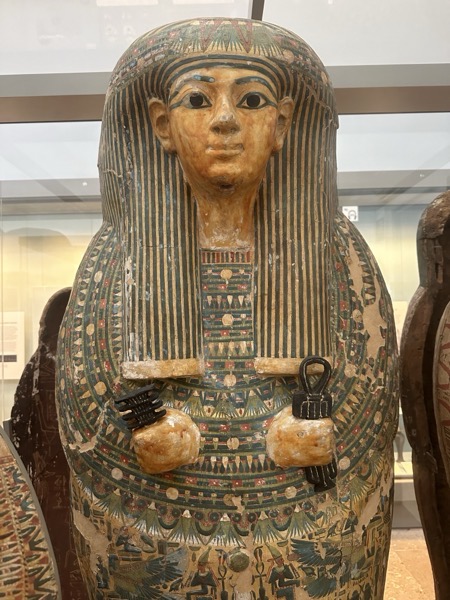
I was surprised by how cheery these dead people seemed, but maybe that was just because I was not feeling that way. 

I was surprised to discover this buxom girl sarcophagus. 

John was even more fascinated by the real exposed mummy. 
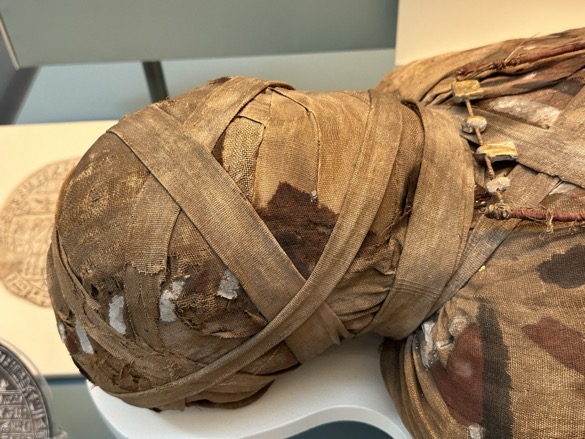
\

The more I thought about it, lying down with an eyeshade did not seem like a bad thing at all. 

We pushed on through the Persian rooms.
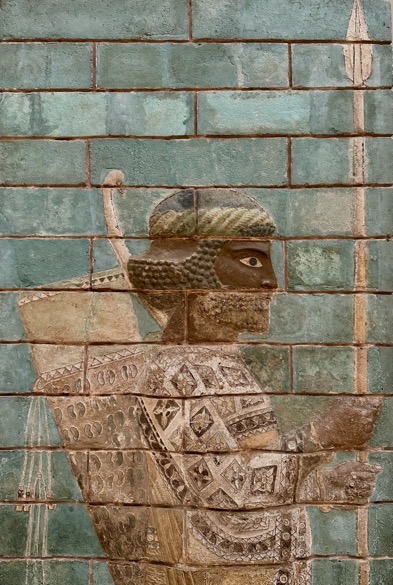
and took the lift up to the small Japanese exhibit on the top floor. John liked this elegant boddhisatva. 
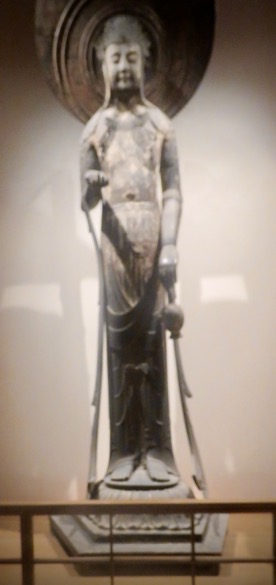
I noticed this portrait of Dosho, the founder of Japanese Zen Buddhism.

Maybe I was just projecting my own feelings, but he seemed more irritated than enlightened. 

After a little over an hour in the museum, John was feeling bored. We went down to the ground floor and into the impressive courtyard. I think the museum largely makes up for free admission with the extremely overpriced food sold at the cafeteria here. The gift shop is wonderful, but £14 for a refrigerator magnet? We did break down and buy a Coke Zero for £3 because John needed to take his medication, and we shared the soda looking at some Haida totems. 
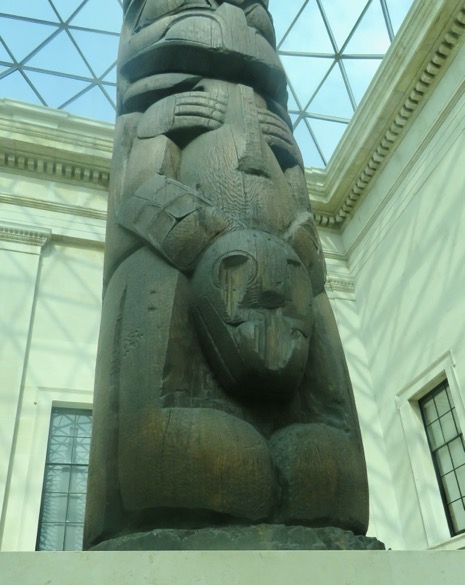
In the center of the courtyard is the early 19th century reading room. It is not nearly as impressive at the main reading room in Washington. Of course I am a little biased: the best teacher training I ever had was at the Library of Congress. But the British room is still beautiful. 

From the Great Courtyard, we left through the main entrance onto Great Russell Street. The British do want you to know that certain things are big and important, despite their reputation for understatement. 
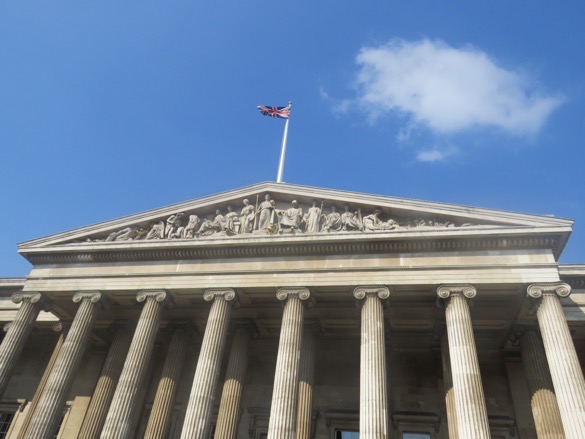
A group of children was lined up for a visit. 
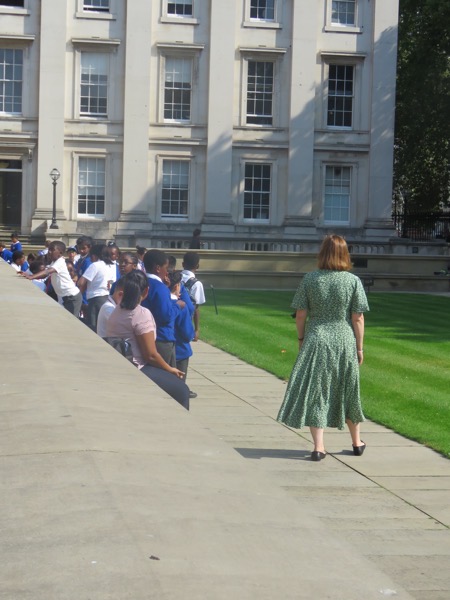
I thought about all the field trips I had led. I was always glad I had given the children the experience, but I never enjoyed them while they were happening. I suspect this woman felt the same. 

By this time, both of us were ready to fall into bed, but it was still not even noon. We started walking towards the theater district about a mile away. I caught sight to the old Postal Tower, once the biggest eyesore in the capital until the erection of some of the newer ones like “the Gherkin” or “the Shard.” I like the way that the French have isolated their modernist atrocities in La Defence and wish the English had done something similar. 

In Soho square John had me posed with a silly sculpture. 
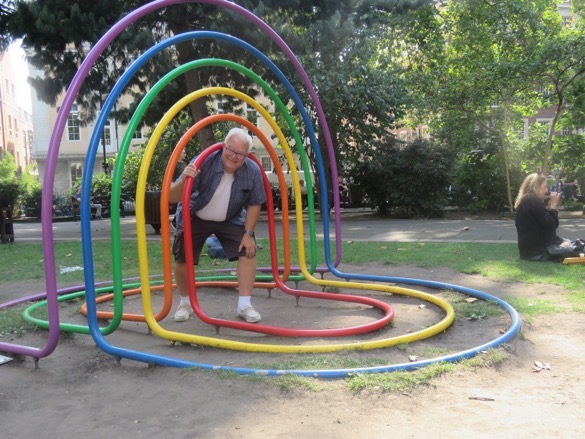
I had figured that John wanted to go all the way to Leicester Square, but after a brief stop on Old Compton Street, once the center of gay life in London, he wanted to go back. It was actually pretty warm by this time and I pushed him up Charing Cross and Shaftesbury towards our accommodations. I was tired and he was testy by the time we reached Russell Square. He was sure that there was a Japanese restaurant just by our place, but the only thing I could find was a takeout sushi spot. It looked exactly like the stuff they sell at Safeway, and we decided to pass on it. Instead, I took him to the restaurant at the hotel a block from our place, the Kimpton Fitzrovia where rooms go for about £800 a night. 

We had a great meal of extremely well-prepared British food. John had Shepherd’s Pie, and I had a perfectly fried piece of haddock swimming in a sea of lightly crushed minty peas. I thought about taking pictures, but that just seems too Instagramy for me. 

Unfortunately, John’s blood pressure often craters after he has had a big meal, and we had a bad episode of post-prandial hypotension. I managed to get him into his chair and back to the Cleveland Residences. A young lady who seemed to be the manager helped me with the wheelchair as I walked John up to five steps to the foyer. She showed us to our room, and as soon as she had left John fell onto the bed and did not wake up for about three hours. 

We are going to try to catch up on sleep tonight so that tomorrow we are more cheerful and might even be able to catch a play. 
Marvelous Mackinac

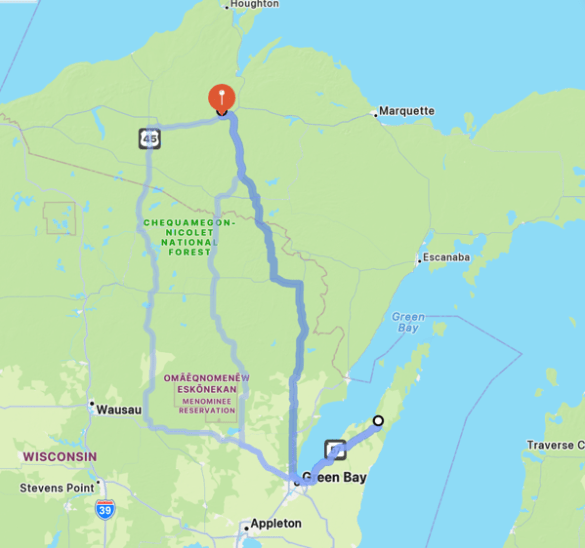
The attractions of the Upper Peninsula are not particularly close together. There are hours of driving to get from one to another, and since we are using Jason’s house in Covington Township as our home base that often means a little extra driving back and forth. But I knew from the moment that we planned this trip that I wanted John to see Mackinac Island, so I figured we would have one night spend “on the road” as it is a four hour drive from where we are staying to the Straits of Mackinac.

I looked into spending the night at the famed Grand Hotel on this island, but the price was utterly absurd. And while there are some other less expensive accomodations on the island, few of them are particularly cheap and none of them really appealed to me. I decided that we could just stay at an inexpensive place on the beach in Saint Ignace and take the ferry across as a day trip. I think it was a pretty good call. 

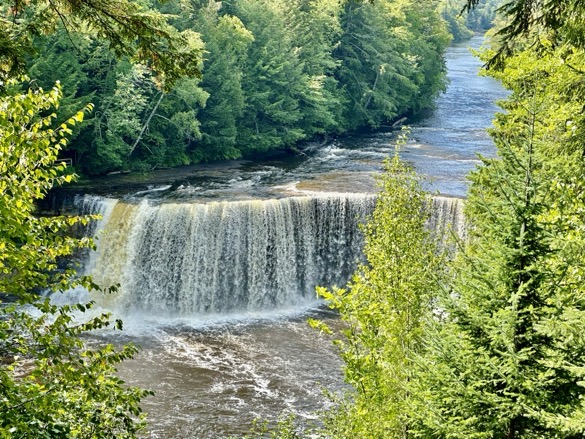
John gets restless with long car rides, so whenever I can I try to stop along the way so we can see or do something. And I figured that Tahquamenon Falls fit that bill quite well. Though it is not nearly as impressive as the waterfalls in the Sierras or the Cascades, Tahquamenon is the biggest in Michigan and it is still a fairly impressive sight. 


This is a popular state park and it was the only one where we had to pay an entrance fee. There was a long walk from the parking lot to the falls and since John was running low blood pressures this morning, it seemed safer to take him there in a wheelchair.

That wise choice did, however rule out getting close to the waterfalls, something that could be done only be walked up and down flights of stairs to the viewing platform. Nevertheless, I think we had a pretty good sense of the amount of water flowing over the rocks even if we did not get splashed. 

About another forty five minutes of  driving toook us to Saint Ignace, an old French fur trading settlement that has the distinction of being the third oldest city in the United States. But despite its historic pedigree, the town is not particularly impressive, and Breakers Resort, as our hotel rather grandly christened itself, was even less impressive. Our room was not that large and rather cheaply furnished. It had a more than slightly musty odor. But it did have a balcony with a view of Lake Huron. 

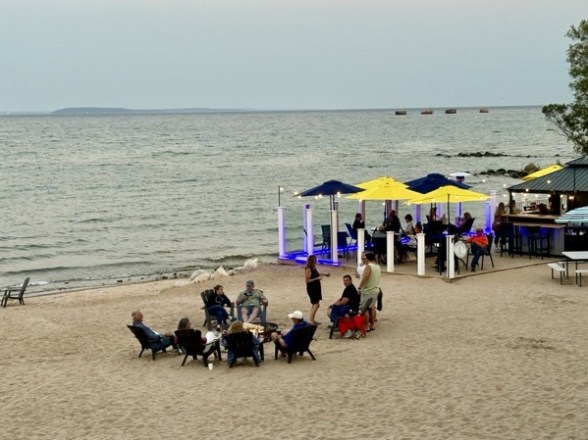
The bar on the beach, the spot in the picture with the yellow and black umbrellas, served pizza as well as drinks. John and I ate there. He surprised me by ordering BBQ pizza. It was better than I expected, though it would no doubt have sent any Italian over the edge. 

We had breakfast the next morning at the resort’s resataurant, and I packed the car up and drove to the ferry dock. I had hoped that we would be able to catch the 10AM boat that detoured under the Mackinac Bridge. But there was already a long line of people waiting, and we had to take the 10:15 passage straight over to the island. 

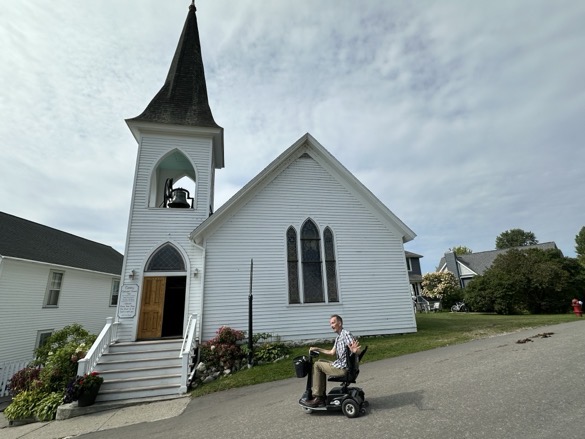
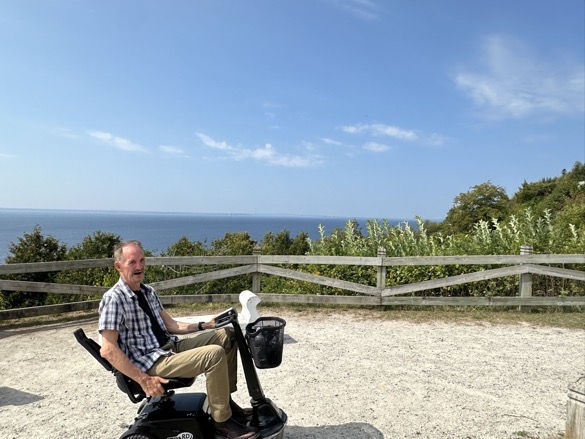
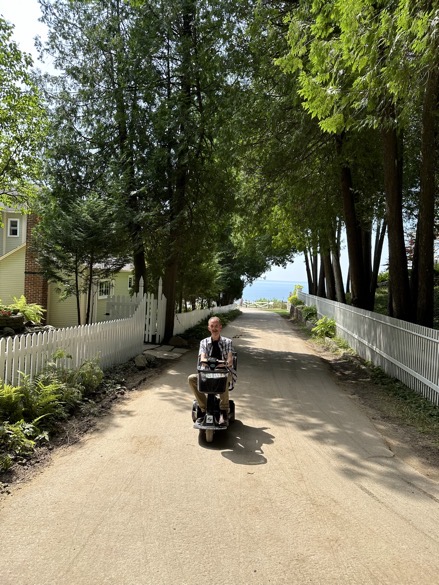
Rather like landing at Edgartown in Nantucket, the ferry on Mackinaw disembarks passengers onto a street filled mostly with tacky gift shops. Mackinac Island has always been famous for its fudge—tourists here were the first to be referred to unaffectionately as “fudgies”—so a large number of them hawk any number of flavors of this and llines of fat midwesterners are lined up to buy it. But there are also a number of bike rental places on the street and all of them also rented small electric wheelchairs or “mobility carts.” I was not really eager to push John around for four or five hours, so I asked him if he was willing to try one. I have no idea why it even occurred to me that he might not be delighted to have one. And before we knew it, he was off and running on them with me struggling to keep up with my bad foot. 

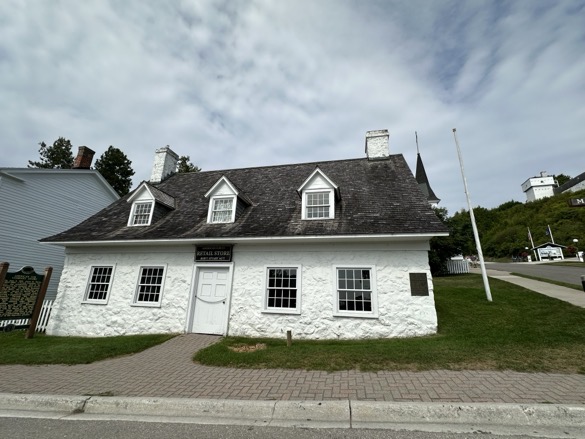
We passed by the old fort, the heart of the state park on the island, but chose not to go in for a visit. Even before European settlement, the strategic value of this area for controlling access to the upper Great Lakes was clear.

The French built a fort on the mainland near by what is today Mackinaw City. When the British took control of the area, just before the American Revolution, they decided that putting their fort on Mackinac Island made it more defensible. When the area passed from British to American control, the fort was essential for American domination of this area and for supporting American interests in the fur trade. 

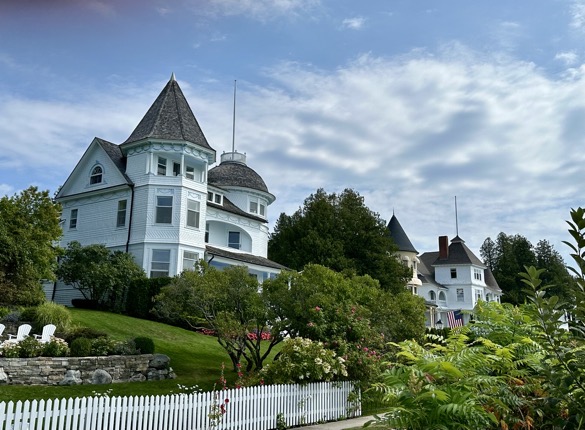
Most people do not know that Mackinac Island was America’s second national park. But when the Army closed the fort in 1985, the federal government turned the island and the park over to the control of the State of Michigan. Most of the island is still park today, though there are limited area of residential development from an earlier period. Most of the homes are quite impressive. 

A few have been converted into bed and breakfasts. 

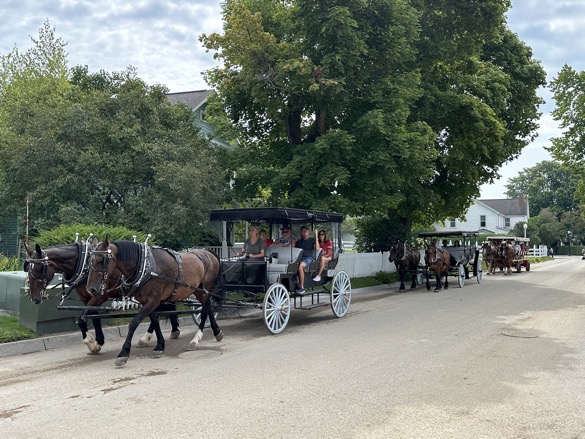
At the beginning of the twentieth century, the residents of Mackinac Island voted to ban those pesky new horseless carriages. Detroit becoming the center of the automotive industry only seemed to harden their resolve. Today there are only a few motorized vehicles on the island, almost all owned by the town or the state. Otherwise, horses are used for transportation and for drayage. 

No doubt the horses get tired of the tourists after a while. 

The tourists need to be careful of the little presents the horses leave them. 

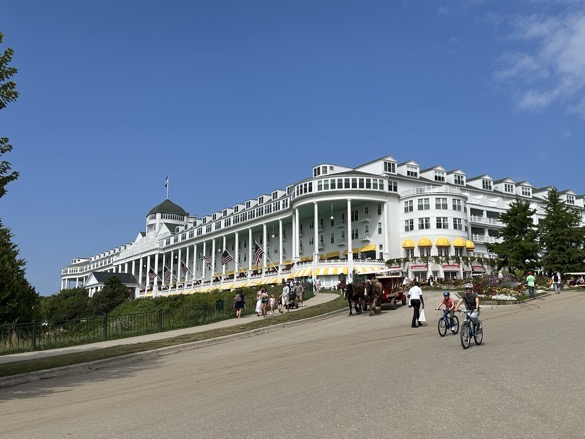
The most famous building on the Island, and perhaps its biggest tourist attraction, is the Grand Hotel.

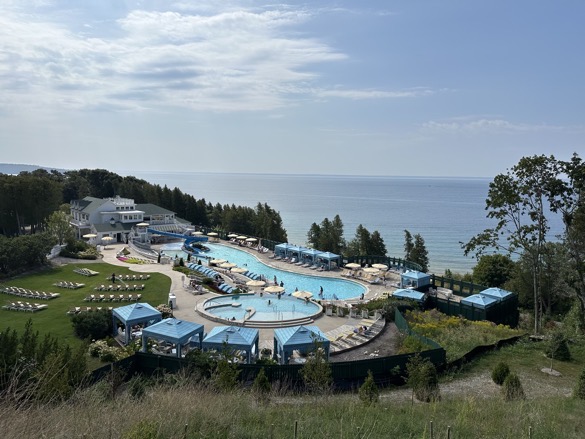
Its wraparound porch is supposedly the biggest in the world. I think its pool could be equally celebrated.

John seemed a little hurt that I had not opted to stay there until I told him that the cheapest room I could find was over 1200 dollars a night. Even for my big spender husband, there are limits!

We also passed on doing a full tour of the hotel, and just looked at a few public areas. We had some coffee instead of the 80 dollar lunch special. 

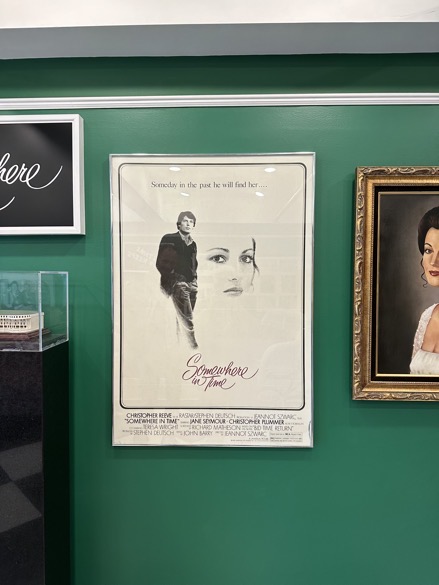
We did take some time to look at a couple pictures that had been filmed here, most famously Somewhere in Time


After perusing the Grand Hotel, we a little further on and explored the West Bluff neighborhoods. Some of these homes had amazing views of the bridge, though the weather was a little hazy today and it was hard to see it. 

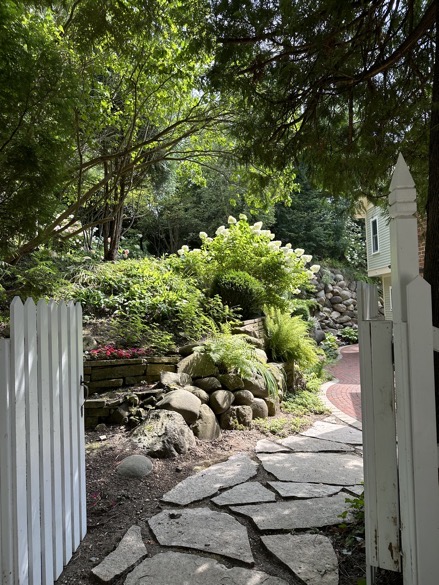
Riding down the streets, John could sometimes see amazing gardens hidden behind the mansions. 

We could have spent hours more exploring, but we knew that we had a long drive back to Jason’s house. So we caught the ferry back to St Ignace and started driving. 

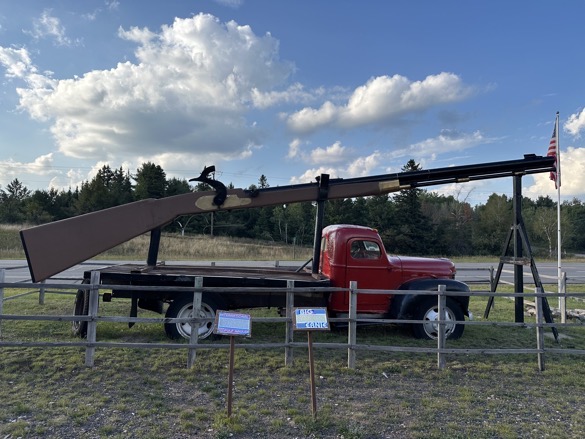
Just outside of Marquette, I pulled over so John could see this place:

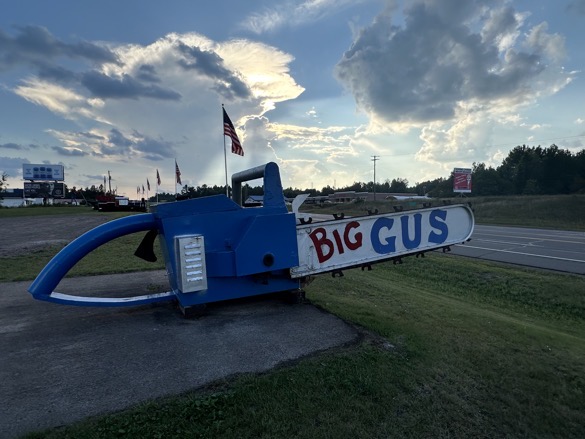
Folks from the UP are affectionately called “Yoopers.” This place was a hoot. It featured the world largest hunting rifle

and the world’s largest chainsaw,

The Grinch and his dog Max have made their home here. 

John made friends—well, sort of—with this old fisherman. 

Tomorrow we pack up early and head back to Wisconsin on our way home. 

Pictured Rocks

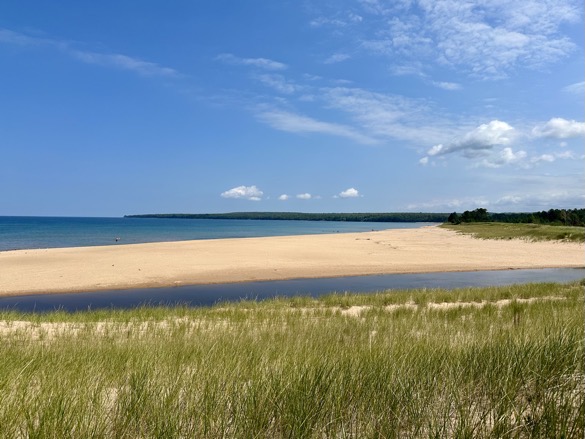
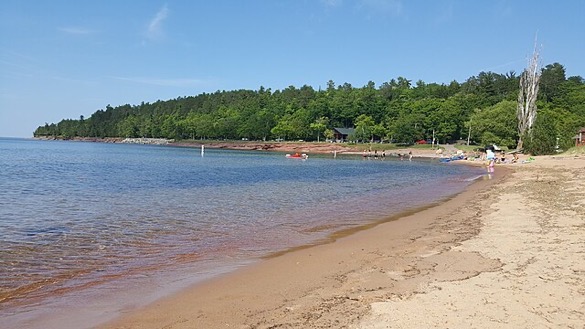
After yesterday’s overcast drive up to Houghton, John was not eager to take another long drive. But I had a pretty good idea that he would really like today’s adventure, so I coaxed him into the car and we started the long drive to Munising. Not long after we passed Marquette, we stopped along the way to admire some of the lovely Lake Superior beaches.

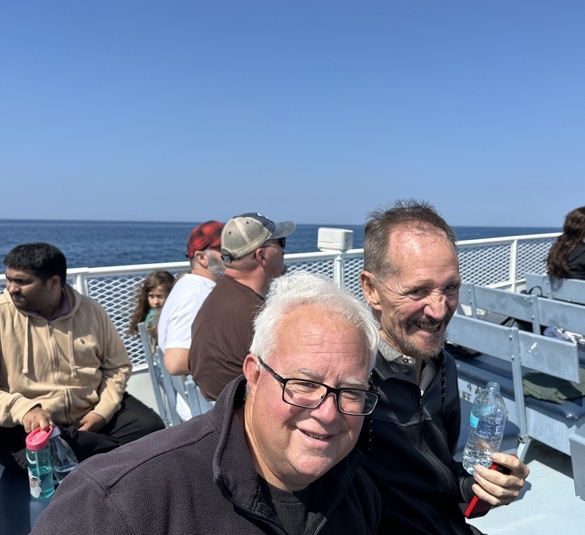
Our destination was Pictured Rocks National Lakeshore. I had arranged a cruise to look at the rock formations. It was a beautiful day for a boat ride. We were sitting next to a Korean family, and the the youngest of the group, who was not all that young, offered to take a picture of me and John.

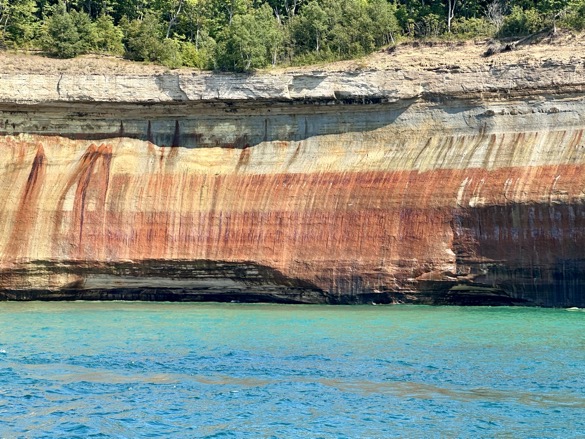
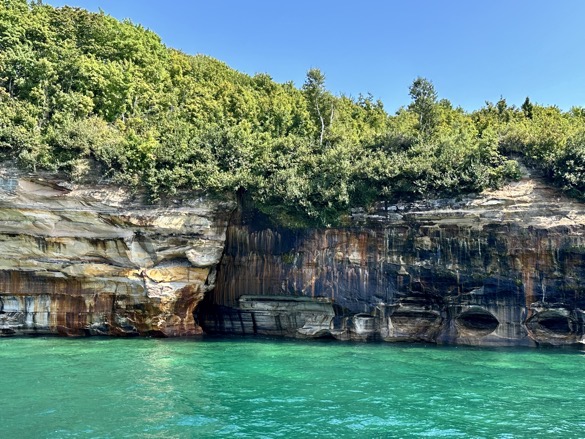
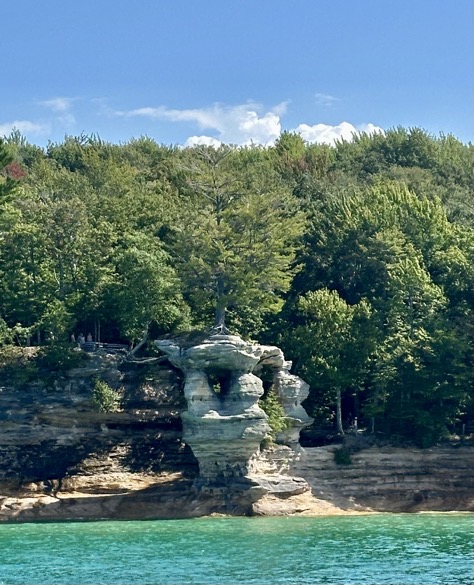
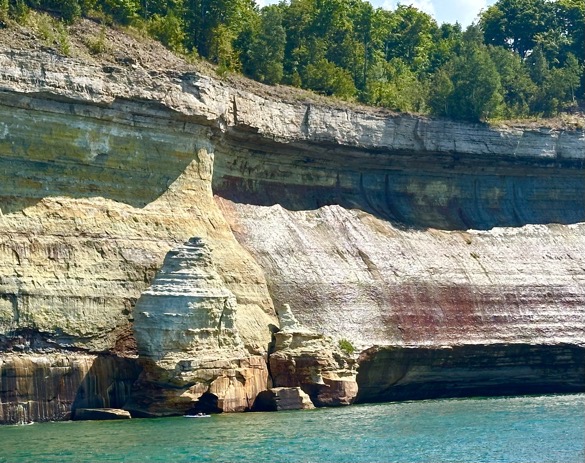
Picture Rocks Lakeshore comprises 42 miles of shoreline along Lake Superior between Musining and Grand Marais. The name of the area comes from 13 of those 42 miles where the erodes sandstone cliffs are brightly discolored by mineral deposits and leaching groundwater.

Erosion has also caved many of the cliffs into odd shaped figures. The guides have names for all of them.

At one point the captain brought the boat into a cove so we could get a close up of the rocks.

At the cruise, we had good dinner in Marquette at Cajun restaurant.

Tomorrow, we’ll start on our overnight trip to Mackinac Island.

Back in Michigan

Yesterday, we packed up and left the Wanderlust Hotel. I am not sorry we stayed there. Most of the other choices in Sturgeon Bay were chain hotels located mostly outside of the central city. But by the time we left the Wanderlust, I realized that I had never seen or talked to another person there. I saw some evidence other guests like a cell phone charger left in a small sitting room at the end of the corridor. Nobody had greeted me when I came or wished me a pleasant trip while I left. I seemed like we were still in the dark days of COVID travel when people believed that any chance encounter could lead to death.

Both of us had been sneezing and coughing since we arrived in the green lands of the Midwest, so we stopped at Walgreens to pick up some Claritin. I recalled that one of the things I liked best about California when I moved to San Francisco in 1983 was that I no longer had hay fever. Back home in the Midwest, I had returned, nothing having changed in my eyes and nose apparently in the last 40 years.

And then we started driving. I knew today was going to be a long day of driving, but I was surprised by how much Wisconsin there is even when you get north of Green Bay. The lovely lake views disappeared shortly after we left Door County and all we saw were scrubby forests of white pine and birch interspersed with occasional small lakes. John drifted off to sleep. I had enough coffee in me to stay awake.

Not long after we entered Michigan, the time on my phone jumped ahead one hour. All of Michigan had originally been placed on Central Time, but a group called the More Daylight Club petitioned Congress to move the state to Eastern time in 1931. The four counties directly adjacent to Wisconsin counter-petitioned to remain on Central time. Both requests were granted.

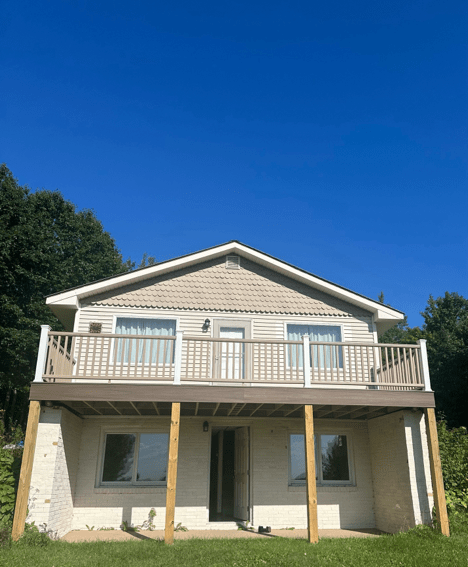
Our destination for the day was Covington Township in Baraga County. Our friend Jason bought a house there a couple years ago. It’s his escape from the urban insanity of Southern California. He has thirty odd acres of forest land and not a single neighbor in sight. 
Jason and his wife Heather are in the process of renovating the house. It has a sweet view of the surrounding area from the deck.

Inside, there are some nice details. John loves those mid-century built-in knick-knack shelves. 

John has been in Michigan a couple times in the past. We drove through Michigan on a cross country adventure shortly after we met. We also came out to Michigan for my sister’s wedding. She was teaching at Michigan State back then. I spent my high school and college years in this state, and perhaps because of that I have more complex emotional reactions to being here. I am aware of how pretty much of the state is, at least once you are away from the Detroit metropolitan area. But I also spent some of the unhappiest times of my life here. Being back in Michigan brings back a lot of feelings and memories, good and bad. 

Today I wanted to do a lot less driving than we did yesterday, so I decided to take John to Marquette, about an hour away. Marquette is the largest city in the Upper Peninsula, but with a population of roughly 20,000 it is still smaller than Ashland. As the largest city, Marquette is home to the Upper Peninsula’s commercial airport and its only real medical center. It is also the home to Northern Michigan University. While college enrollments are down significantly in Michigan over the last couple decades, for some reason Northern and its archrival Michgan Tech over Houghton have actually posted increases. 
Marquette has a thriving downtown area. The shops along Washington Street, the main thoroughfare, are filled with a nice mixture of different kinds of small businesses. The post office, which at one point was also the federal courthouse for this area, is a great example of Depression arechitecture. 

640px-US Post Office and Federal Building (Marquette, Michigan).

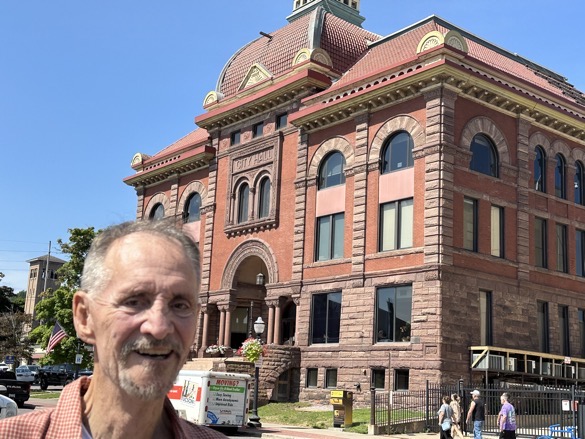
And there were several wonderful bits of nineteenth century building lett as well, such as the old City Hall.

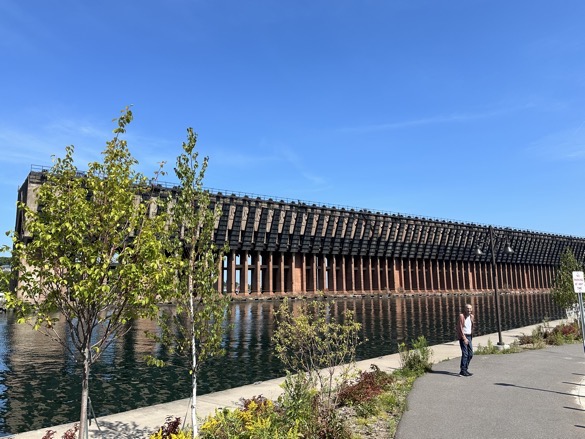
John was quite intrigued by the abandoned ore dock downtown. 

The Upper Peninsula was once ta major source of iton ore for the factories of the Midwest and Pennyslvannia. Train cars would have been pushed to the top of the dock and through the shutes on the side would have dumped the ore into barges waiting below. There is still one ore dock operating just to the west of downtown Marquette. This one remains as a historical curiosity, rather like a Roman aqueduct in a French village.

We had lunch at Vierling’s, one of downtown oldest and most famous restaurants. It looks rather like a San Frnacisco fern bar from the Seventies inside. John and I went regional with Lake Superior whitefish in both a chowder and as fish and chips. John was underwhelmed.  

We drove over to Presque Isle Park. This is a large city part the juts out into Lake Superior. It has some nice beaches for those couple montsh when it is possible to go to the beach in norhtern Michigan. 

640px-Presque Isle, Marquette, MI - 2016.

There are some good hiking trails in the park as well, but John was having some low blood pressure issues so we just looked at the park from the car. 

Tomorrow we will explore a bit of Michigan’s copper country. 

On Wisconsin

Though a journey of a thousand miles begins with a single step, our travels today, roughly twice the distance of the Chinese proverb, began with getting out of bed at three in the morning, a more difficult start than merely putting one foot forward, particularly for two old men like us. Still, somehow we managed to make it to the airport in time, have United check our luggage, get scanned and patted down by security, and find our seats just minutes beford they closed the cabin door.

Seven hours later, we were at Milwaukee airport. Our real destination for this trip is the Upper Peninsula of Michigan where our friend Jason bought a house a couple years ago. While I went to high school and college in Michigan and know the state fairly well, John has had little chance to explore some of the more picturesque parts of the state. I gave him a tour of the urban desolation of Detroit shortly after we met. I am not sure he has ever recovered. But before we make it to “The UP,”  as Michiganders call the Upper Peninsula, I wanted him to see a bit of Wisconsin, too. And there are few parts of the Badger State as charming as Door County.

For those of you not from the Upper Midwest, Door County is a peninsula that sticks out into Lake Michigan. It is both a rich agricultural area and a summer escape for residents of Chicago and Milwaukee. The shoreline is dotted with both old summer fishing camps with tiny cottages and some enormous homes for the Great Lakes gentry. The largest town in Door County is Sturgeon Bay, and that was our destination for the day.

We drove along the shore of Lake Michigan whenever we could. John has laways been fascinated by the size of the Great Lakes. He is sure that if you look hard enough you should be able to see the other side because it’s a lake, not the ocean.. But you never can.

We passed through lots of cute towns like Twin Rivers abd Altima. John described the ride as one of the most beautiful he could remember. He is always surprised by how pretty the sandy beaches on the shores of the Great Lakes can be.

We finally pulled into Sturgeon Bay. Our lodging for the night is a place called the Wanderlust Hotel. Sturgeon Bay has most of the usual chain accommodations on its outskirts, but i wanted some place that was more unique and located in the historic center of time. The Wanderlust checked both boxes.

But for all the famed hospitality of the Midwest, the Wanderlust Hotel felt more like River City, Iowa at its least friendly. I rang the doorbell to announce that we were there, and the voice on the intercom chastised me for not reading an email and a text that had been sent to me earlier in the day explaining the protocol for a “contact-free” check-in. After playing around with the codes for a bit I did manage to open the door and the door to the room as well. I think in 1982 I would have found our room charming. When this had been. single family house this had probably been the dining room or the second parlor. There were many original features still left along with some faux Victorian furniture. The dominant feature in the room was one of those enormous jacuzzi tubs which were popular thirty years ago. Although clean, it did not look like anybody had used this one in a long time.

John and I had dinner at a very pleasant Italian restaurant. After after eating, we walked about the center of the town. There are lots and lots of cute shops, just like Ashland, probably catering the same upper-middle-class female clientele.

Like entirely too many cities. Sturgeon Bay has fallen for the idea that having various people paint the same fiberglass animal mold constitutes public art. Given the name of the settlement, it was no surprise that a fish was the chosen animal here.

Despite all this carping—a bad word around here where the Asian Carp is an invasive species—I liked Sturgeon Bay a lot. And I wish we had more time to explore Door County and to push further up the peninsula towards Ephraim. But we have a lot of territory to cover tomorrow on our way to our vacation home for the next week in the woods of northern Michigan.

Down by the Riverside

We pulled out of Coimbra around noon. By the time we left, both John and I had really warmed to the city and wanted to see more of it. But we had a ways to go before we reached our next destination in the wine country of northern Portugal.

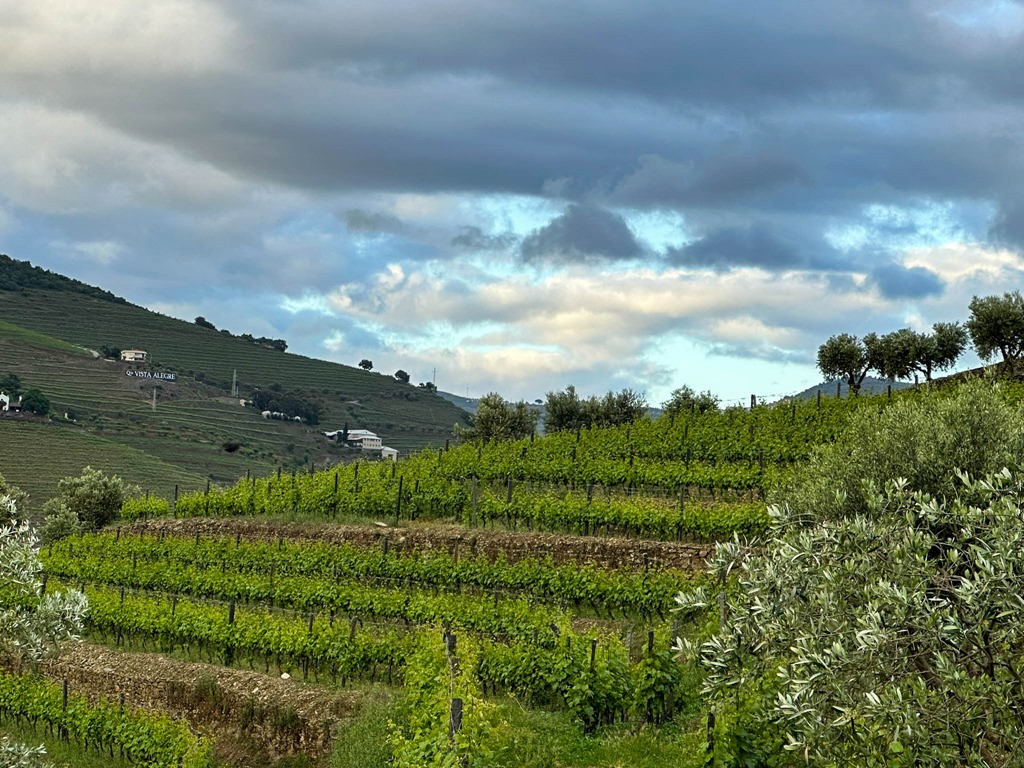
I have to admit that I had never heard of the Duoro River before I started to plan this trip. But it is the largest river in the Iberian peninsula. The area around the river has famous for centuries as the home of Port wine. Now, John does not drink at all, and wine is not my favorite beverage. But vineyards are usually attractive, and I had read that the vineyards of the Duoro Valley are particularly beautiful. So I decided that we would spend one night, our almost last night in Portugal in a winery. I picked the Quinta do Pégo in Tabuaço. It was a great choice.

Getting there was a bit of a chore. Once again, I had to drive in the rain. And the rain here does not fall as steadily as it usually does in Oregon: it drizzles for a bit, stops, and then starts coming down in sheets. It is miserable for driving. You are always changing the speed of the wipers and when the rain is really coming down you can barely see five feet in front of you. And when we finally made it to Quinta do Pégo there was an incredibly narrow drive with sharp switchbacks cutting up a steep hillside covered in vines.

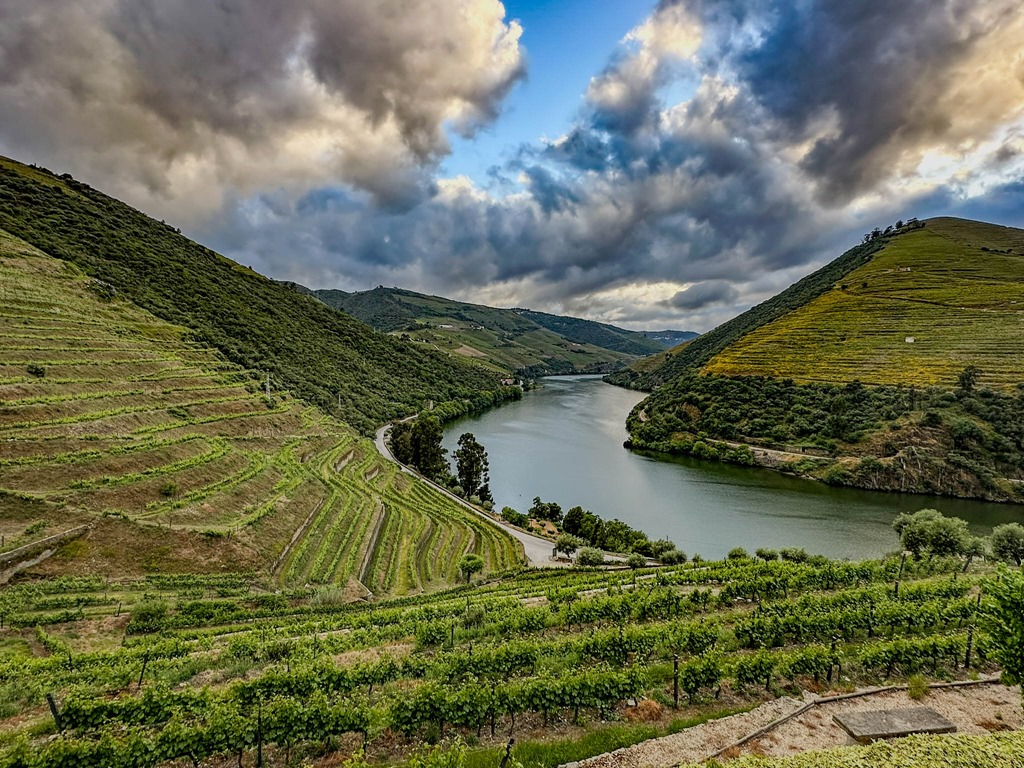
But once we got there…oh, what a view!

IMG_1001

The hotel at the winery is small, with space for only about 20 guests. It is largely done in a modern style that would not look at all out of place in Sonoma. It has red clay tiles on the roof with off-white stucco walls. The interior features lots of red oak. There furnishings are largely modern with a handful of antique pieces mixed in. 

We had a room with a small patio.

IMG_0999

It was never warm enough, or quite dry enough, to sit out there. Instead, we just popped out occasionally to enjoy our view of the vineyard.

IMG_0996

We had a small decanter in our room of the port from the estate. I do not particularly like sweet wines, but I thought I would try some just because we are here. After a few sips, I turned to John. “You know what the difference is between Port wine and cough syrup? Cough syrup makes you stop coughing.”

We had a wonderful dinner at the hotel, and the this morning, a pretty good breakfast. I was raised to think that Europeans only had a small pastry and a coffee for breakfast. That is true in Italy and parts of France, but most Europeans seem to like cold cuts and cheese for breakfast. No matter how many times I have that, I still think, why are we having lunch already? I think I may be ready to come back to America.

While we were finishing breakfast, I looked out the window and saw a bike race.

IMG_1006

We were not planning to leave for another couple hours, so I figured that the race would be over by that time. We packed about and checked out about noon.

I was wrong. The cyclists, having started out riding east, at some point turned around and headed back to where they had started. So for twenty kilometers I had to carefully maneuver the car around packs of cyclists. To make matters worse, it was starting to rain heavily. Bike tires do not have the best grip on wet surfaces, and I was afraid that one might slip down and I would hit him before I could stop.

We finally reached a fork in the road where cars were directed one way, cyclists another. The rain continued. I pushed on towards on Porto. After another ninety minutes of driving in heavy rain, we came into Portugal’s second largest city. We are staying at the OCA Oriental Hotel. It’s called “oriental”—“eastern” in Portuguese—because it is on the east side of the historic center. There are no red lanterns. It’s your basic inexpensive business hotel, similar to the the Marriott in Medford.

We leave tomorrow morning at six. That means we need to return the car and be at the airport by about four. That means we will have to get up at three. It is not easy getting John up at seven or eight in the morning some days, but I know he will rise to the occasion.

But we had a few hours to explore Porto. Like Glasgow or Manchester, Porto has the reputation of being run-down and even slightly dangerous. But like both of those cities, it now has a bit of a reputation as an cheap-rent artistic haven.

With only a short time, I figured another tuk tuk tour would give us an overview of the city. I looked on Viator and found one for six in the evening. That was perfect. I booked it. 

We were supposed to meet our driver in a parking area not far from the cathedral. So I ordered a Bolt and we were dropped off a few minutes later in the heart of the medieval part of Porto. Like Lisbon, the Porto Cathedral is ominously Romanesque, though a slightly incongruous baroque portal was added later to the front.

IMG_1020

I was curious to look inside, but access was possible only by buying a tour ticket to look at the cloister, the treasury, and so on. We did not have enough time for that, and I did not need to see another faded fiddleback chasuble.

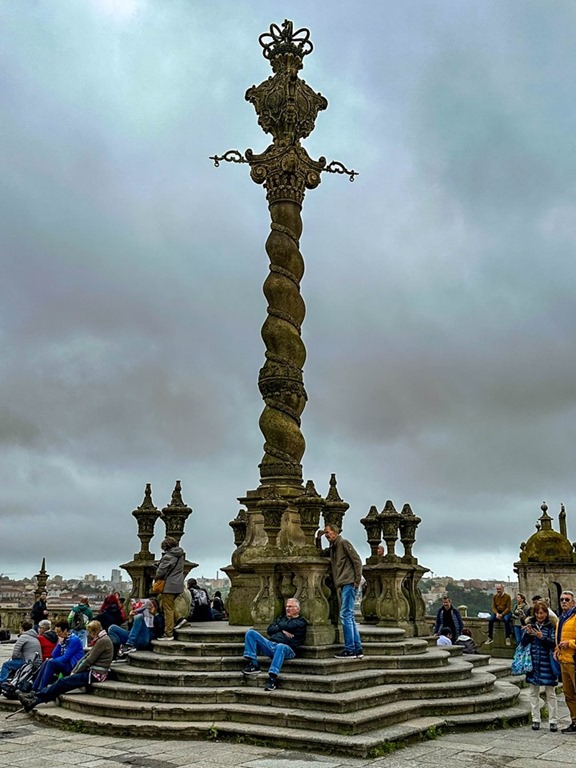
The plaza in front of the Cathedral is dominated by this pillar.

IMG_1019

The guidebooks refer to it as a gallows, though it seems completely unsuited for this purpose. I learned later from our driver that it was erected during the Salazar era when Portugal’s right-wing authoritarian government wanted to remind the residents of Porto that something like those medieval punishments could occur again if they did not comply with the junta.

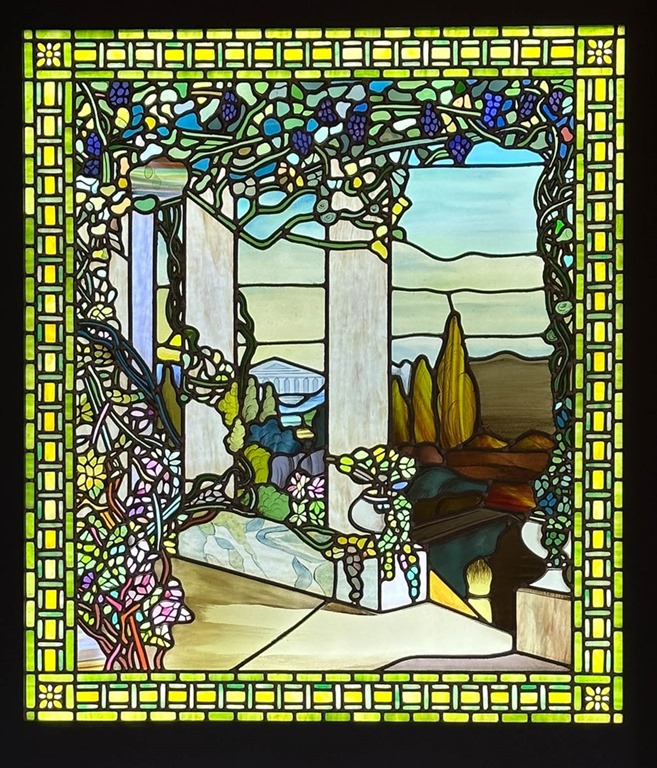
Also nearby was a stained glass museum. This commemorated the work of João Antunes, Portugal’s most celebrated stained glass artist. He worked in a variety of styles for public, private, and ecclesiastical clients. This piece was a kind of homage to Louis Comfort Tiffany.

IMG_1021

Here was one of the church pieces.

IMG_1022

I actually like the abstract pieces the best, but they were large and hard to photograph.

We walked down and found our tuk tuk. After having such a fantastic guide in Lisbon, our driver here was a disappointment. He spoke very little English. He had some kind of app on his phone which translated what he said in Spanish—I figured out later that he was from Chile—and an female British voice announced it over a Bluetooth speaker he had given us.

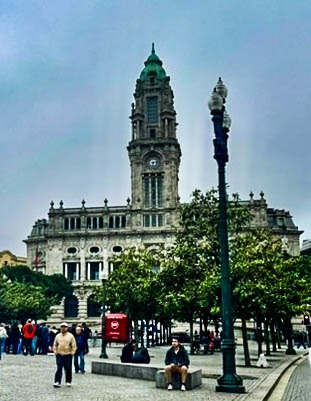
We zoomed by many buildings quite quickly. It was hard to get decent photographs, and some of the places that looked most interesting were the hardest to snap pictures of. This is Lisbon’s city hall.

IMG_1026

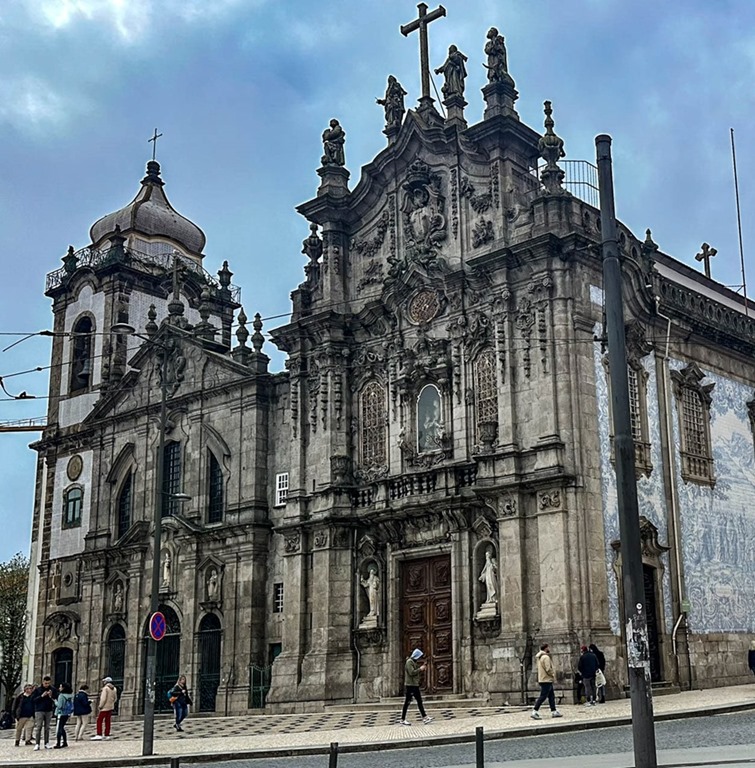
We did stop near one of Porto’s most famous buildings, the Carmelite churches.

IMG_1042

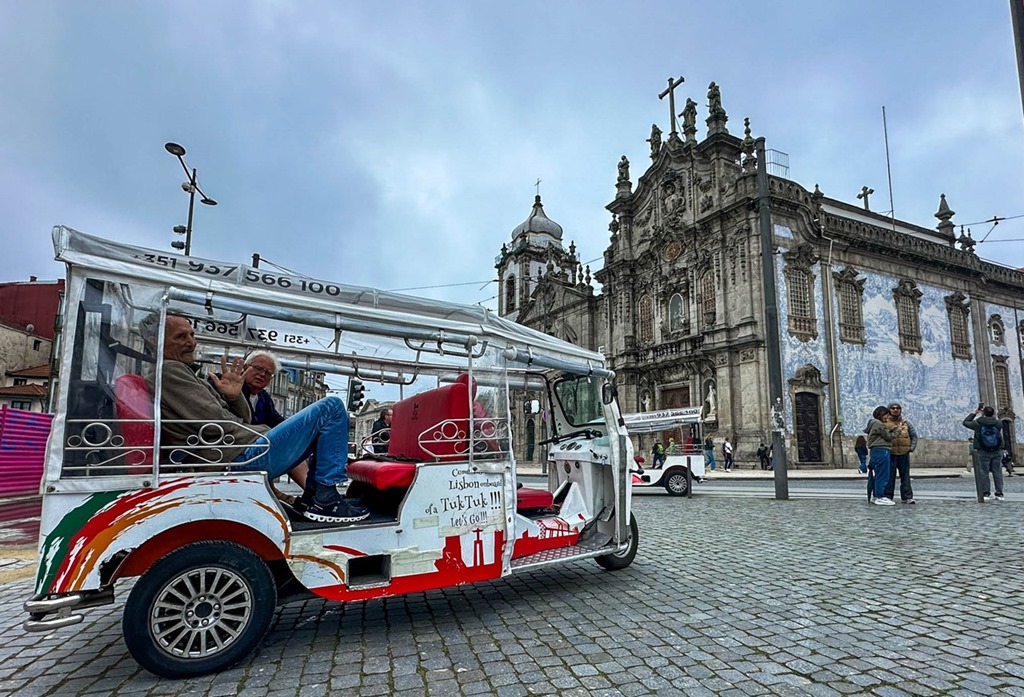
There are actually two churches here with a tiny “house” build in between them. They are all that remain of two Carmelite monasteries, one for me, the other for women. The interior of the women’s church is supposed to be an extraordinary example of Portuguese Baroque, but we did not have time for that. Our driver did snap a picture of us in his tuk tuk.

IMG_1044

We also saw the Clerigos tower, probably the most famous site in Lisbon.

IMG_1050

The tower, which houses Portugal’s largest carillon, was built by a fraternity of priests whose mission was to provide health and hospice care to sick and elderly priests.

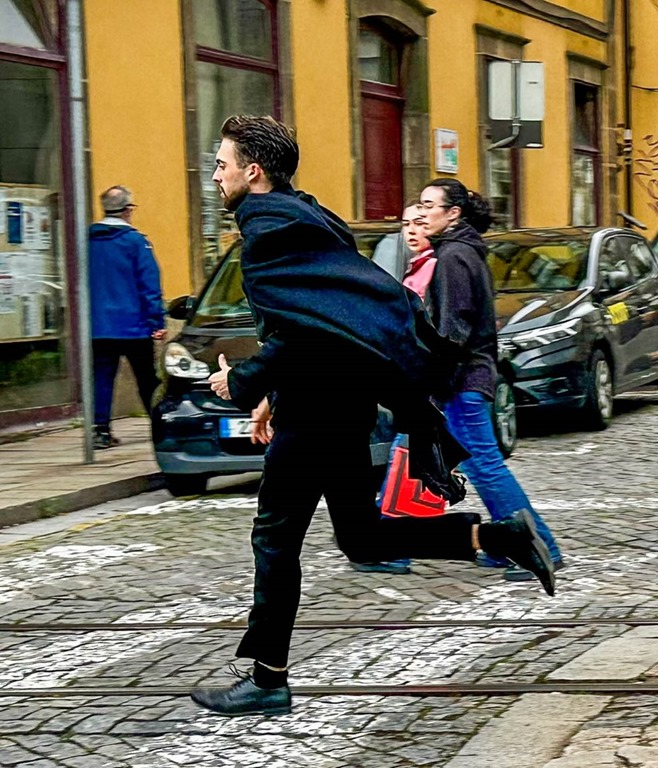
Porto has its own eponymous university, though this was not established until the eighteenth century. Portuguese university students were supposed to wear distinctive capes in public. Now they are only worn on ceremonial occasions. Apparently a number of graduations were happening today, and we saw some students wearing their capes. This guy was in a hurry to get somewhere: maybe the ceremony, maybe meeting up with his friends for a drink.

IMG_1060

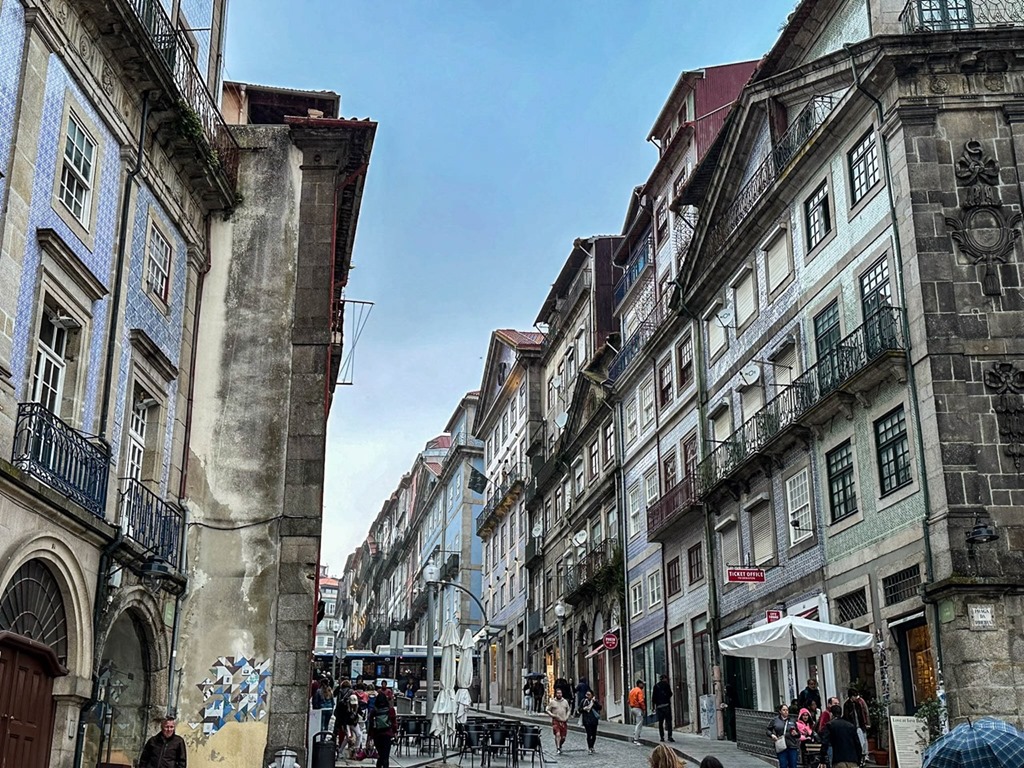
The Ribeira District is the cutest section of Porto.

IMG_1055

IMG_1063

IMG_1070

We had dinner here in a restaurant right on the river, close to the pedestrian bridge connecting Porto with Gaia, its sister city on the other side of the Duoro River. For a tourist spot, the food was surprisingly good.

We called our ride right by this monument.

IMG_1071

It’s not easy to see from this photograph, but the statue that had obviously once been in the middle alcove had been replaced by this somewhat whimsical figure wearing some kind of strange costume. There’s a story there, but not one I could learn.

Tomorrow we are up at three in the morning to start our trip back to Oregon. Both of wish our vacation could go on for longer. But there are things to do, including important medical appointments, when we get back to Ashland. And so, Traveling Johns signs off until our next trip!

Sacred and Secular

The next stop in our itinerary was Coimbra, famous as the site of Portugal’s most prestigious universities. It was not that far from Nazaré, but I still wanted to see anything interesting along the way. Looking at the map, I saw that Fátima was not far at at all away off the main route.

Despite my general fascination with old churches and monasteries, I am not attracted to the big Marian shrines. There is something about the way that all the sincere devotion attractions hucksters and brings out the greed in the clergy—I am sure that this was precisely why Jesus made a whip and attacked the moneychangers in the Jerusalem temple. But, since we were so close…I figured, what the hell, let’s go to Fátima.

For those of you who are not Catholic, let me give you the background. In 1917, in a small mountain village named Fátima, about 70 miles from Lisbon, three children, Lucia dos Santos, and her two cousins, Francisco and Jacinda Marto, ages 9, 8, and 6, said that they saw “a lady dressed in white” who spoke to them. She told them that she had come from heaven and that they should return each month for the following few months. Initially, the children’s story was met with indifference and outright hostility from their families and the community. But gradually more and more people started to accept that they had indeed seen the Blessed Mother. Her last appearance was accompanied by the so-called Miracle of the Sun where 70,000 people claimed to have seen the sun appearing as though it were falling to earth.

Fátima soon became a center of pilgrimage for Portuguese and Spanish Catholics, and construction soon started on a large church on the site.

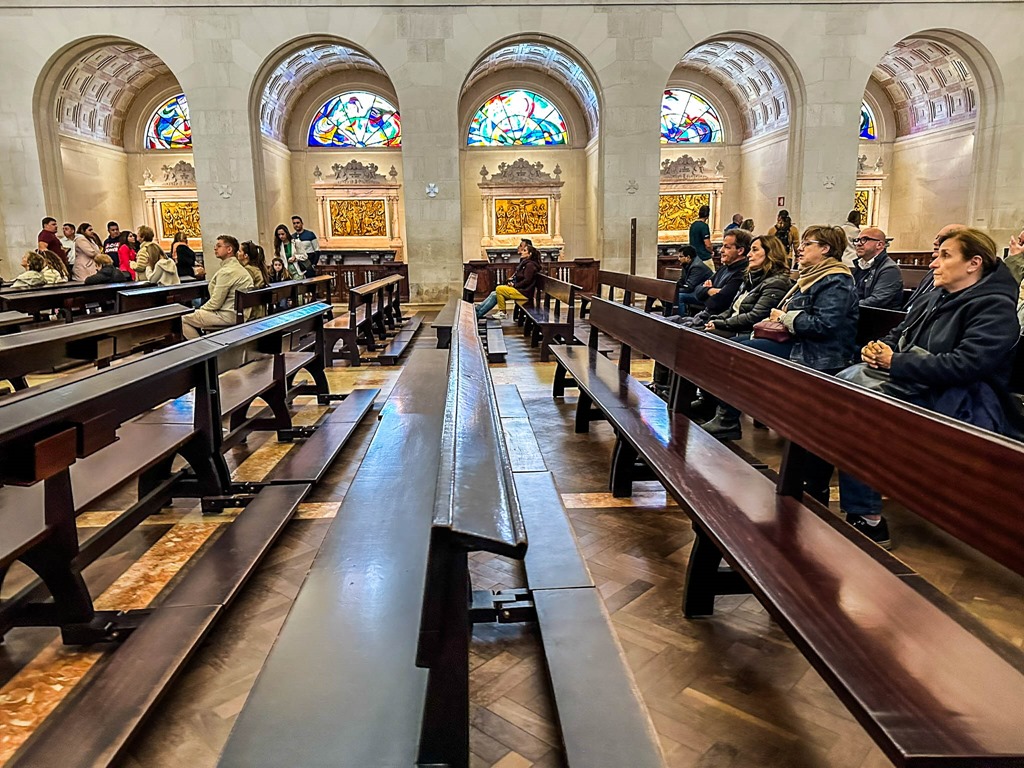
IMG_0940

John and I walked around. This is a real center for devotion that casual tourists like us notice and respect.

IMG_0944

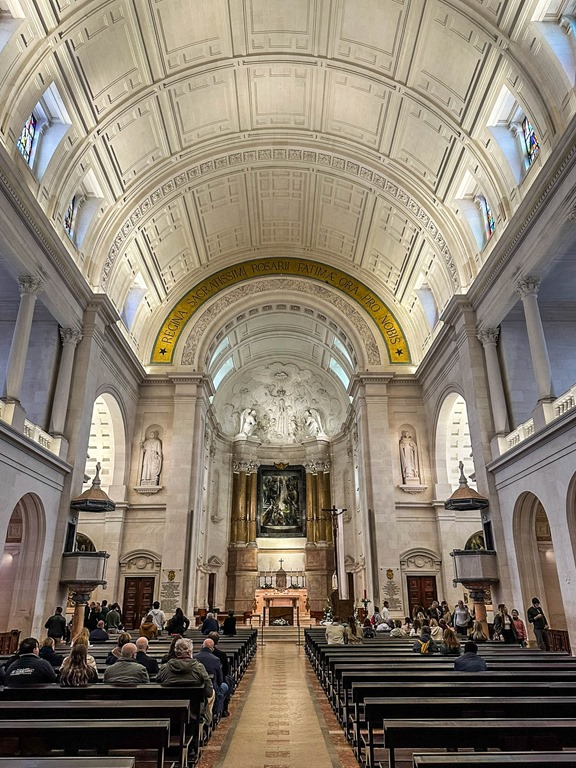
Construction on the church began in the 1920s, but it was not completed until the early 1950s. The architecture and decoration reflect a largely conservative style, but it is definitely a twentieth century building, not a faux Baroque basilica.

IMG_0946

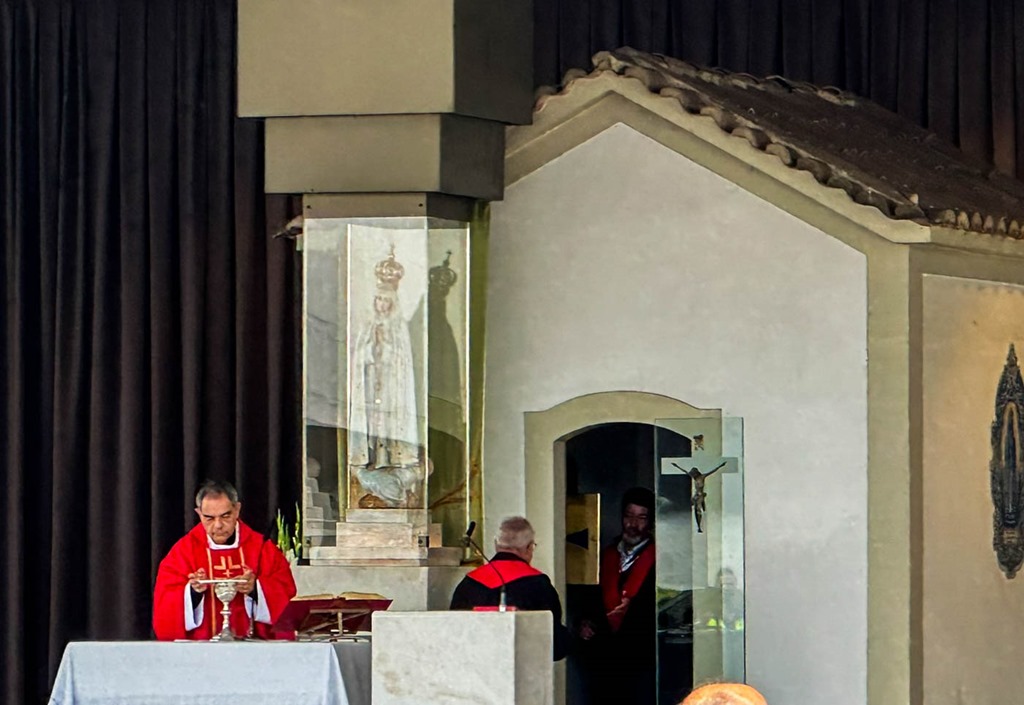
A small little house was built on the spot where the three children actually said they saw the Virgin. An semi-open-air chapel was built over the house. This chapel was the center of attention while we were there as Mass was being celebrated.

IMG_0962

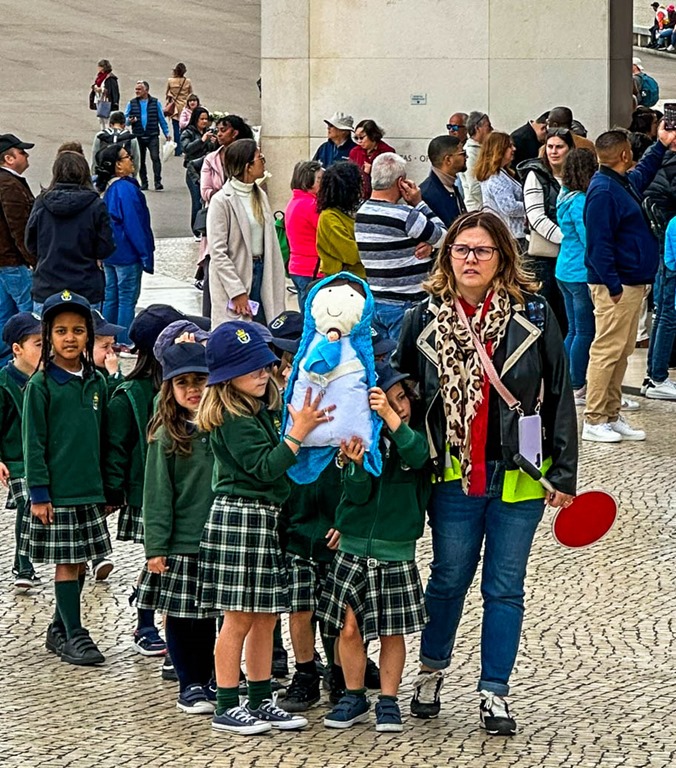
Quite a number of school groups came while we were there. All wore uniforms similar to those of American parochial school students. Each group seemed to bring along a banner or some other item as they processed towards the main church.

IMG_0960

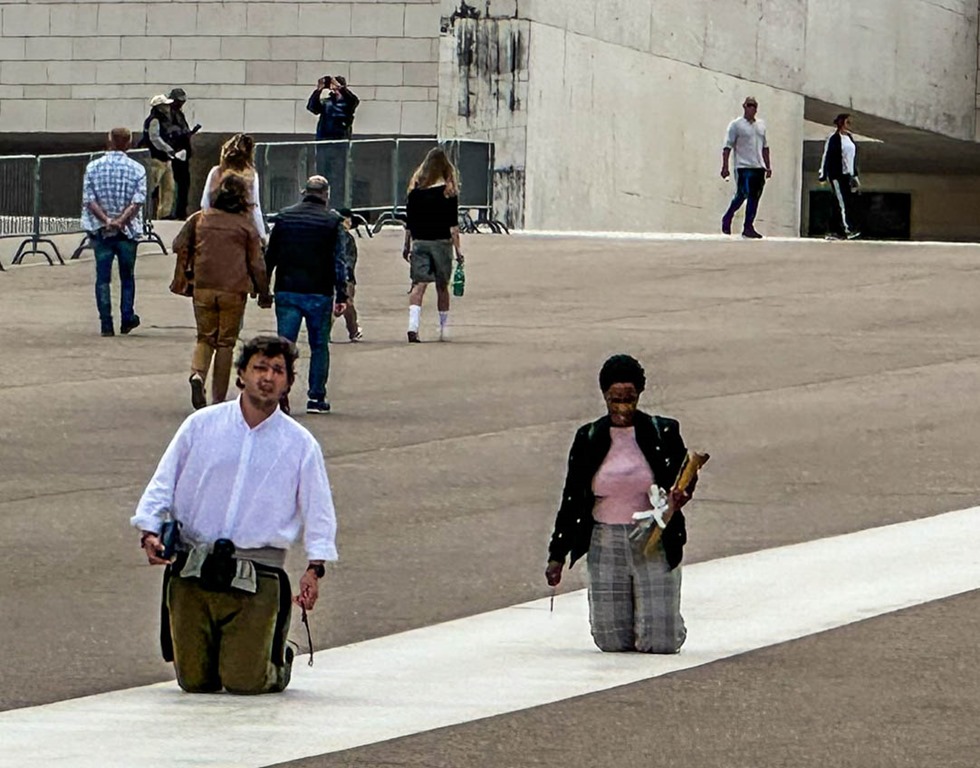
More touching was the devotion of individual pilgrims, many of whom made the last few meters towards the chapel on their knees.

IMG_0964

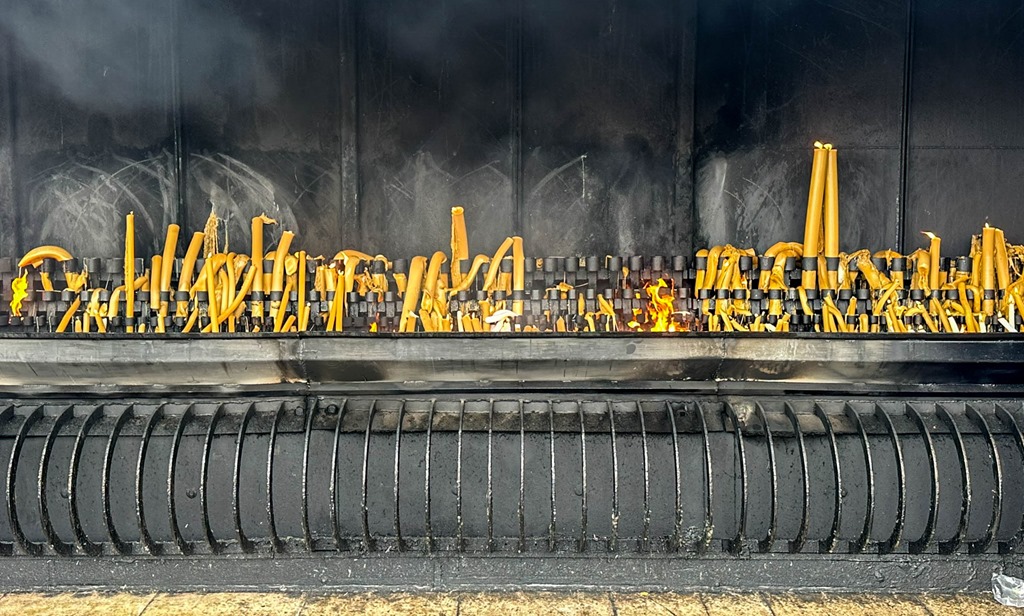
Many visitors to Fátima bring candles, often quite large, many clearly made of beeswax. There is a large area where the candles are placed after a prayer is said. Since beeswax melts easily and can also burn easily, there were frequent smoky fires in the candle area. I found it both fascinating and slightly disturbing.

IMG_0963

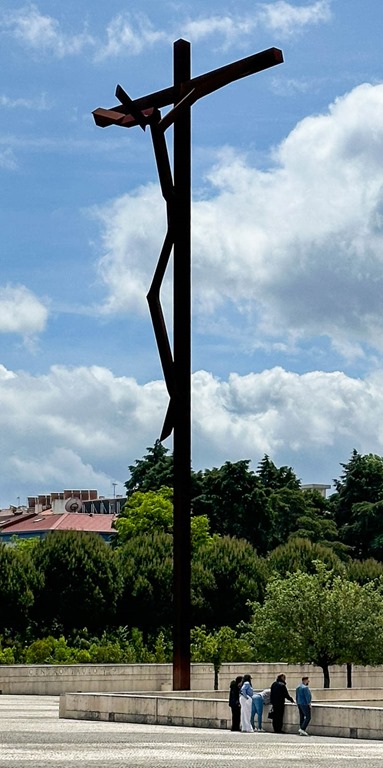
By the time the church at Fátima had been completed and consecrated, it was already far too small. A large open-air plaza was created so that the faithful could attend outdoor Masses. And a new church, seating many times more than the old church, was constructed on the far side of the plaza. John liked the almost abstract crucifix that stands in front of the new church.

IMG_0967

If it were not for that cross, you might easily assume that the new church was some kind of sports arena. It is a cheap, squat bit of brutalist architecture. The inside is slightly better.

IMG_0969

After snapping a picture in the new church, we headed out into the plaza and from there to the parking lot.

IMG_0971

We arrived in Coimbra not long after leaving Fátima. After splurging on a couple hotels, I had been looking for a couple cheap ones to balance out the budget. I found a place called the JR Suites for only 75 dollars a night. Well-reviewed on Booking and TripAdvisor, it promised a balcony with a view and parking. What was not clear from any of this, was that the hotel was not easy to find. Despite Google Maps, we had to go up and down busy streets several times until we found it. And then we discovered that parking was almost impossible in the area. We parked half and mile away, leaving our luggage in the car, and walked.

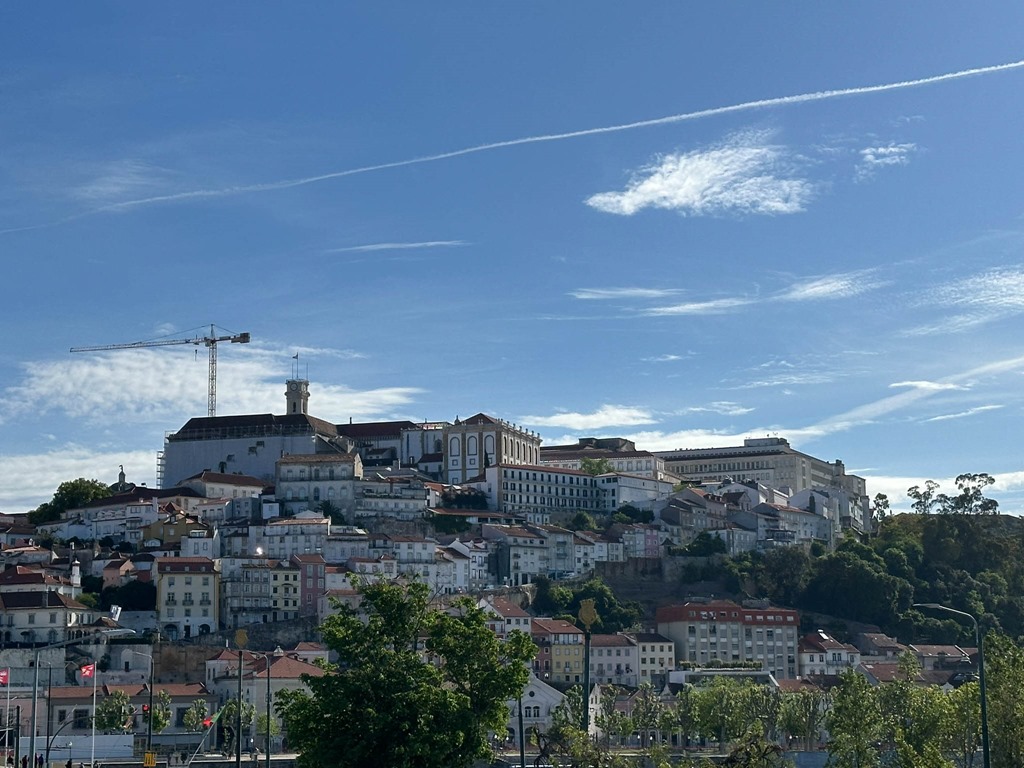
Once in our room, we discovered that it did indeed have a nice view of the old city just across the river.

IMG_0983

The room itself was small. There was a bed and a small desk along with a couch that looked like it might fold out into an extremely uncomfortable bed. The bathroom would have seemed cramped even on a ship. But it was spotlessly clean.

When we checked in, the girl at the desk told us that parking was available in a nearby parking lot or on the street in front of the hotel. John was not keep on leaving our stuff in the car—he had bad memories of our car being ransacked in Seville 35 years before—and he wanted me to move it to the parking lot. I could not see a single empty space there, but I agreed to try. By some miracle, a spot opened up on the street just in front of  hotel and I grabbed it. I told John that we would be taking rideshare until it was time to leave town. I was not giving up that parking spot.

It was about five thirty and we did not want to just sit in the small hotel room. So we looked to see what was open, and our best option was the university’s botanical garden. I used the Bolt app to order a car, and about 15 minutes later we were there.

Like all the great European universities, Coimbra, established in 1290, was under the control of the church, and its focus was mostly on topics like theology and canon law. But in 1770, the Marquês de Pombal, first minister to the crown, pushed through some aggressive reforms to make the university more modern. An admirer of the Scottish Enlightenment, de Pombal suppressed the Jesuit order and established new programs of study focusing primarily on the natural sciences. A botanical garden was created in part to focus on the medicinal properties of certain plants. It has been a feature of the campus for over 200 years.

IMG_0980

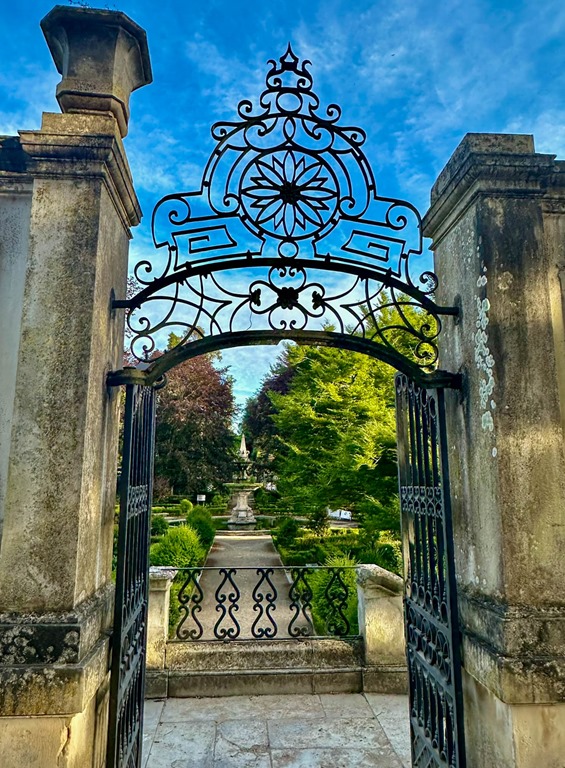
Knowing something of that history, we both were eager to explore the garden. But we did not get far. The greenhouses are open only by advance request for researchers. The gardens make little attempt to be accessible for people with mobility issues, and even the relatively flat areas are not well-maintained. The only person we saw there was a security guard, and his main focus seemed to be making sure that people were out well before closing. So we took a couple of pictures and left.

IMG_0979

IMG_0976

We needed to get something to eat before we went back and I found a place called Couraça a few yards from the entrance to the gardens. It was basically a bar catering to students, but it had a limited menu as well. I often like to try local specialties, so I ordered the Francesinha sandwich. It consists of several different kinds of meat between two slices of white bread. Melted cheese and a mildly spicy tomato sauce are poured over it, and it is topped with a friend egg. French fries are serve on the side or on top.

IMG_0982

It is not the worst thing I have ever eaten. It is definitely better than poutine. But I would never order it again.

This morning we had a couple hours to do some sightseeing before we pushed on to the Duoro Valley. My first choice was the old university library, considered an architectural masterpiece, but online reviews commented on how it was completely inaccessible it was for people with disabilities. So I chose the Museu Nacional de Machado de Castro. Named after a famous Portuguese sculptor, it has an extensive collection of Portuguese art mostly from the sixteenth through eighteenth centuries. Given that time frame, it was not surprising that much of the material was religious in nature.

IMG_0985

At least eight feet tall, this was the largest monstrance I have ever seen.

IMG_0986

But there were a few items that had a more secular theme. There was a collection of wall tiles that had been used to teach the basics of Euclidian geometry.

IMG_0987

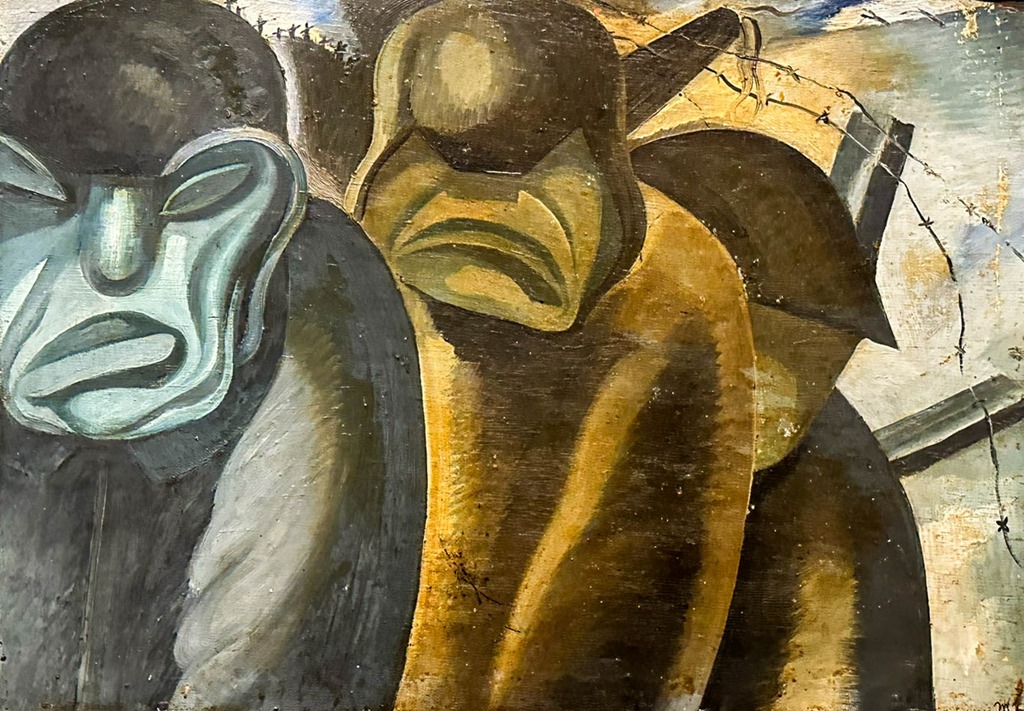
There was one small gallery devoted to the work of Manuel Felipe. He was a fierce critic of the authoritarian Salazar regime. This was a piece call War.

IMG_0989

The museum consists of two buildings. The older one is the old bishop’s palace. The new, larger one is a typical example of museum architecture from the 1990s. The plaza in between the building provides a nice view of historic Coimbra.

IMG_0991

IMG_0992

Waves, Monks, and Dead Queens

After leaving Évora, we went straight to Nazaré. Our itinerary, adapted from one we found in one of the guidebooks, balances cultural destinations with those that involve less sightseeing and more relaxation. Our two days in Nazaré was mostly just enjoying ourselves.

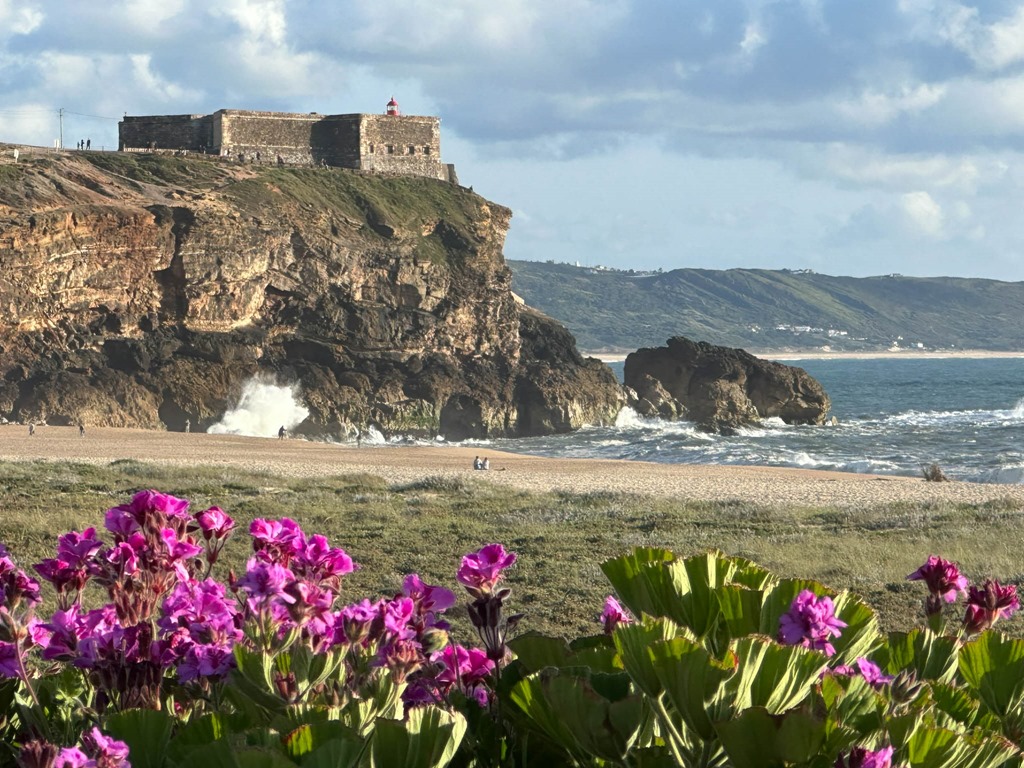
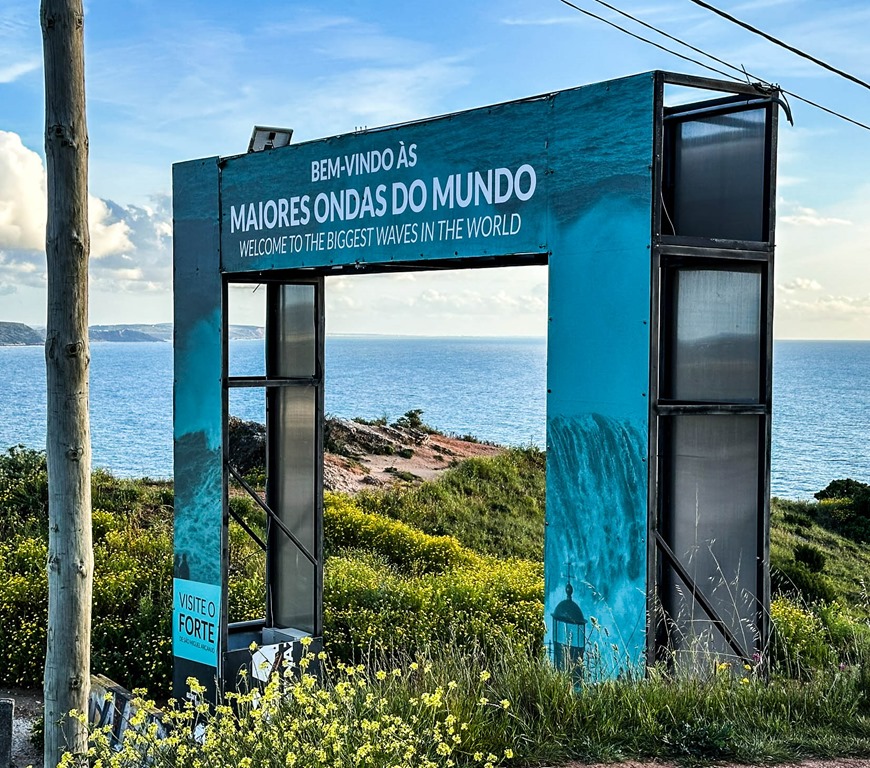
Nazaré is a beach town. It is one of Europe’s premiere surfing destinations. Yes, Californians—there are a few of them! In the winter, the waves are particularly intense, and many people come there just to see enormous waves crash against the cliff. That was not happening while we were there, but here is a picture, swiped from some website or other, of what it can look like.

IMG_0939

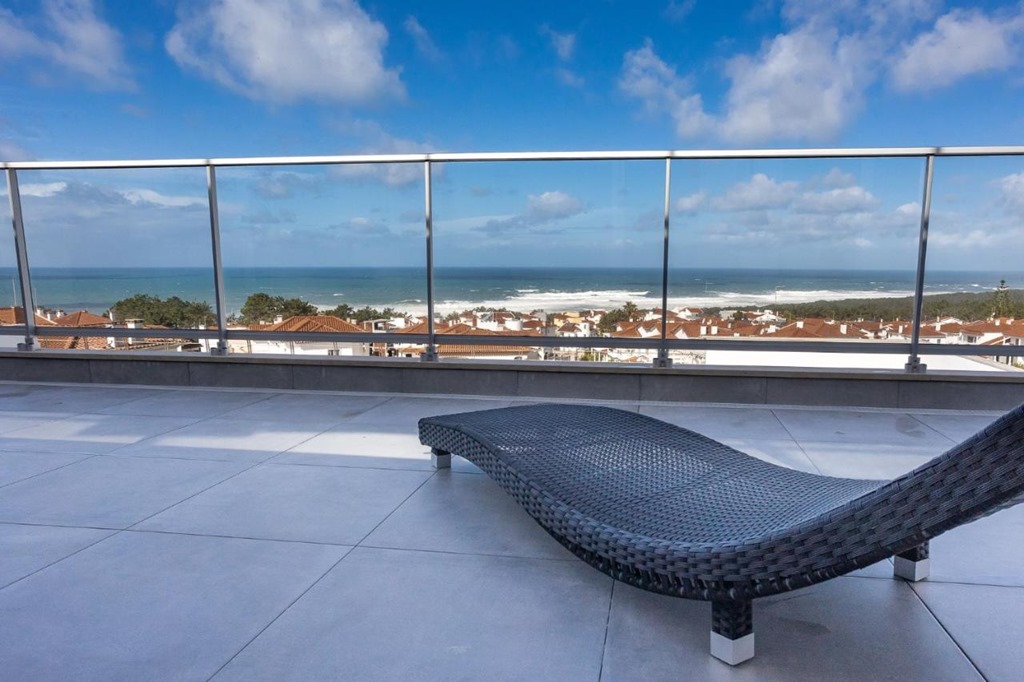
We are staying at a particularly wonderful bed and breakfast called Océane. Our innkeeper is a charming Frenchwoman named Cathy. Océane is located away from the beach, but from the room and the pool you have a wonderful blue water view.

535789480

We arrive late on Wednesday, and John was feeling pretty tired. We just unpacked and took a nap. In the evening, Cathy recommended a nearby restaurant. We were just about the only customers in it. I know that this is early in the season, but somehow it seems eerie to have a restaurant all to yourself. Even though it was close to Océane, John insisted I drive. As we went to go home, I backed up and started to turn. Immediately a police car that had just been sitting there flashed its blue lights at me. I left that car and faced a local constable who seemed really pissed off at me. As near as I could figure out with hand gestures and Spanish cognates, I was about to head the wrong was on a one-way street. I did not see the usual one way sign—a red circle with a white rectangle in it—but apparently I was just supposed to know this. I did not argue, but profusely thanked the officer, in simple English with a few Spanish words tossed in, for keeping me safe. He softened and let me go.

Today, the weather was clear but cool. This may be a beach town, but my days of sitting on a cold, windy beach pretending to enjoy it ended when I moved to Southern California. But we wanted to do…something. So we broke down and decided to see yet another church. And it was actually really worth it.

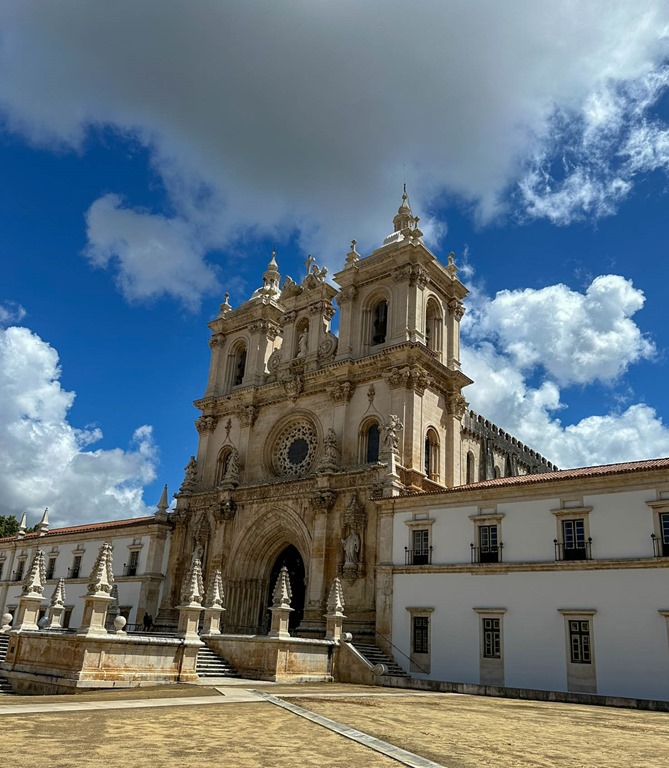
The Mosteiro de Santa Maria de Alcobaça is located in a nearby town.

IMG_0914

It was established by Alfonso Henriques, the first king of Portugal, shortly after Alcobaça was taken from Arab control. The king felt that establishing a strong monastic presence here would help consolidate his power. He approached Bernard, the famous abbot of the monastery of Clairvaux in France. Bernard had led a monastic reform movement by establishing the Cistercians, a new monastic order. It is hard to think of abbots as having rock-star popularity, but that was the kind of guy Bernard was. Thousands of men were flocking to join the new, austere Cistercian order. With funding from the king, the new monastery was soon the largest in Portugal with over one thousand monks.

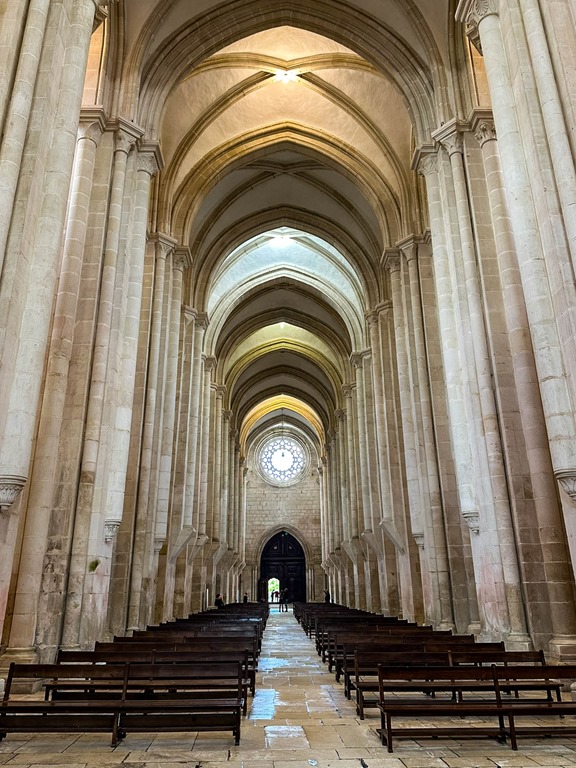
The monastery church, in its simplicity, embodies the entire austere ethos of the Cistercians.

IMG_0924

A fair amount of the old cloister is still intact.

IMG_0920

Copying manuscripts was a large part of the monk’s daily life. Copies of the kinds of desks the monks would have used have been placed in the old scriptorium.

IMG_0921

The monastery retained for many centuries a close connection to the Portuguese crown. There are statues of many of the famous king-patrons of the monastery in one of the rooms.

IMG_0918

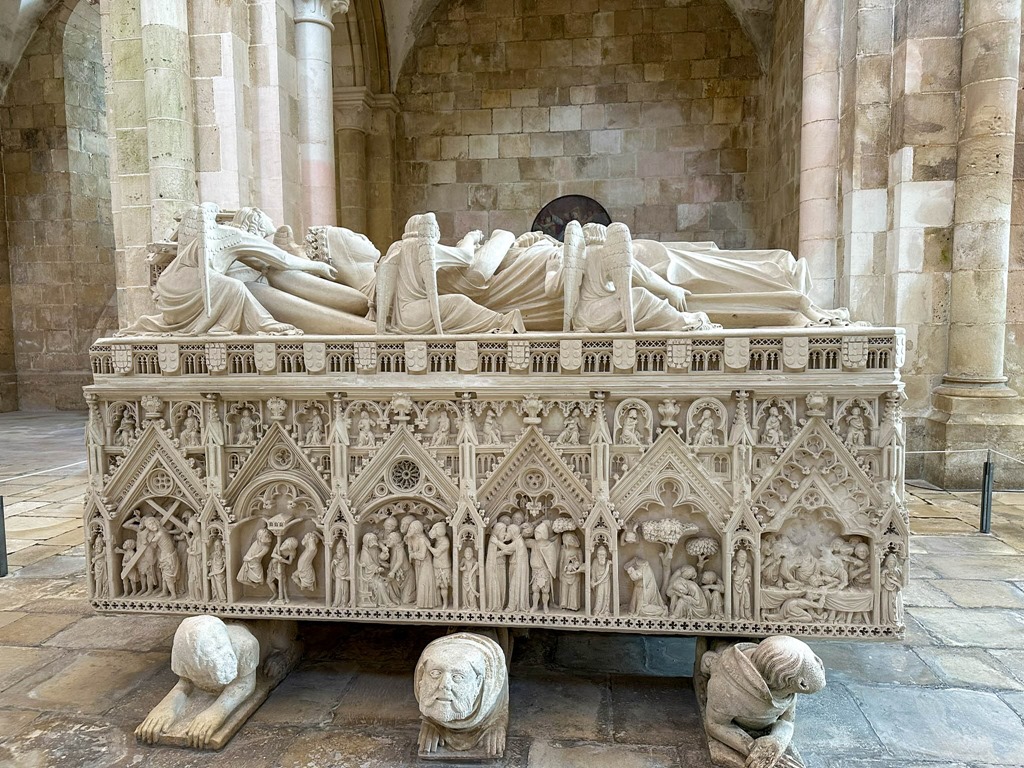
One of the favorite spots for tourists is the tomb of Inês de Castro.

IMG_0922

Guides relish telling this story. Inês de Castro was a beautiful Galician noblewoman. She became the lover of crown prince Pedro who was, at the time, married. When Pedro’s wife died, he wanted to marry Inês , but his father wanted a better match. When Prince Pedro did not follow his father’s orders, King Alfonso had her murdered, in front of her son, who was also Alfronso’s grandchild. When Pedro ascended the throne on his father’s death, he had her assassins murdered by ripping out their hearts while they were still alive. He then exhumed her body and had it buried in this elaborate sarcophagus placed in this royal abbey, calling her a Queen of Portugal. His own tomb, similarly decorated, is nearby.

John is tiring of Portuguese cuisine—there is a reason why there is not a Portuguese restaurant in every American town—so he made me take him to Burger King. Sadly, the “Whoppa” in the Iberian Peninsula does not taste any better than the “Whopper” in North America.

In the evening, we went out for a final Nazaré adventure.

IMG_0926

In search of the famous “O Sitio,” the place where those pictures of enormous waves are taken, we first found ourselves on the beach.

IMG_0932

It was pretty cold, and here was not much to see there. But we did notice how the surfer aesthetic is not much different here than it would be in northern California.

IMG_0934

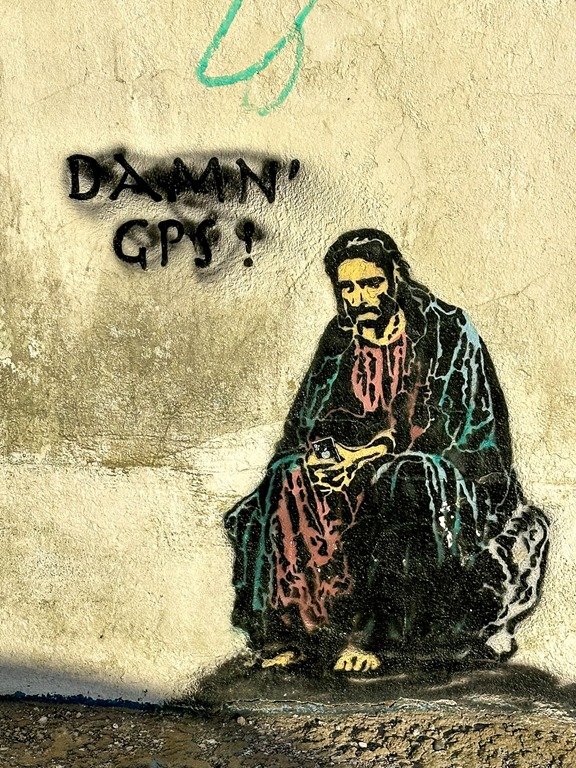
We finally located the famous site. Apparently, we were not the first to find that the phone was not the most reliable way of getting there.

IMG_0935

From the top of the bluff, we had a great view of Nazaré’s upper and lower towns. We are staying in the upper town.

IMG_0936

There was quite a scene of young adults eating and drinking. It reminded me a lot of Huntington Beach. A sign point the way to the famous photo point.

IMG_0938

It was a little bit of a rough trail, and John was feeling ready to go back by this time. Plus, there were no big photogenic waves that night. So we went back to the bed and breakfast, ready for new adventures tomorrow.

Things Are Getting a Little Weird

Looking back on the past couple days, we have done a number of different things. Yet there is one thing that links all these different activities—in each place I had a sense that things were a little off, a little weird.

We had a long drive, much longer than I had initially planned, from Salema to Évora. I decided at the last minute to add a couple of stops along the way as John does not like endless hours in the car. It was not too far out of the way to go by Parque Natural do Vale do Guadiana. The guidebooks spoke about the dramatic scenery as the Guadiana River cuts its way through the dry scrub of the highlands of southeast Portugal. In the summer, this area often has some of the highest temperatures in Europe. But the weather yesterday was anything except summery. It was raining on and off for most of the route and by the time we arrived at the park it was raining torrentially. So we simply passed on the park and kept driving.

We did make our second stop, the Paço Ducal de Vila Viçosa. I did not know much about this place other than one of my guidebooks had called it a “must see.” We pulled up to find this Palladian palazzo in a small village.

IMG_0847

I unpacked the wheelchair and John had a bumpy ride over the cobblestones to the main entrance. I went to the small ticket counter. A man there told me, in perfect English, that a tour was about to begin, but that it was going to be in Portuguese and we could not visit the galleries on our own. I agreed and we joined the group as they went up the stairs to the second floor.

The guide rattled away quickly in Portuguese. If you understand Spanish, you can usually get the gist of what is written in Portuguese. But the cognates are pronounced so differently that I had no idea what she was saying. Portuguese has a seemingly endless number of “sh”, “zh”, “ch”, and “j” sounds. Spoken quickly, as the guide did, it always reminds me of air escaping from a bicycle tire.

I just looked around as she talked and snapped a picture.

IMG_0844

Big mistake! Another woman rushed up to me and told me sternly that no photos were allowed. Not simply no flash, like in the Vatican museums, but no photos at all. I was afraid for a moment she was going to seize my iPhone.

As we went from room to room, I noticed something else odd. Not only were we not allowed to take pictures, but clearly questions were not welcome, either. The guide was discussing the furnishings of the room—I assume that was what she was talking about—with a solemnity that seemed odd for what seemed to me to be pretty mediocre pieces from the seventeenth and eighteenth centuries. When the tour was concluded after a visit to the kitchen, which did, I must admit, have a truly staggering number of copper pots, people departed as quietly as if it had been the end of the Good Friday Liturgy.

Only later, thanks to a little research, did I get some background on all of this. The Paço Ducal de Vila Viçosa is the family home of the Dukes of Braganza. In 1581, the Spanish Hapsburgs successfully claimed the throne of Portugal and united the two countries under the crown of Spain. But in 1640 the Portuguese rebelled and won independence. The Duke of Braganza and his successors became the Portuguese royal family. Some of Portugal’s most celebrated monarch were from the Braganza dynasty. But dissatisfaction with the monarchy grew throughout the nineteenth century, particularly as Portugal began to lose control of Brazil and its many of its colonies in Africa and Asia. In 1908, the King of Portugal and his son, the heir apparent, were assassinated in Lisbon. A younger son became King Manuel II, but he fled to London after the 1910 Revolution.

Not all the Braganzas were content to accept the Portuguese Republic, and the current Duke is quite serious about his claim to be the rightful King of Portugal. All European countries have a small number of monarchists. Were the guides true believers in this Braganza fantasy? Or were they just paid to act is if they took it seriously? What about my fellow tourists? Did they support a renewed Portuguese monarchy? Or were they just curious about the building?

We drove on about another hour until we came to our hotel on the outskirts of Évora. I found our accommodation, as  I usually do, on Booking. It had the odd name of the eCork Hotel, but it sounded really interesting. As we approached the hotel, the “cork” part of this was obvious. We were driving through several acres of cork trees. We stopped to take a look. We could see the bare boughs where the bark had been scraped away to become wine stoppers.

IMG_0855

The “e” part, I learned at the reception, was its aim to be an “eco” resort. I am not sure what exactly makes something an “eco” resort, but it usually means that it aspires to charge the guests as much as possible. And yet…the place was not that expensive.

When we saw our room, I figured out that this “eco” stuff was at best a work in progress. Our “suite” was a cinderblock building, once painted bright white, but now stained and chipped. The interior was furnished with a some odd furniture that looked like they had been unloaded from IKEA at some ninety-percent-off sale. The closets and bathroom were a kind of cheap bead board. I’d seen nicer showers in a KOA.

And yet…parts of the resort were truly upscale. There was a spa and a well-equipped fitness center. There was a very fine restaurant, though John and I only saw one other customer there.

IMG_0849

Just like the Braganza palace, it was all a little weird.

This morning, after an superb breakfast in the eCork restaurant where we again were the only customers, we packed up and headed to the town of Évora. A sign on the outskirts of the city proclaimed it to be a UNESCO World Heritage Site. I have grown a little cynical about this honor, but in this case it seemed deserved. It is an amazing little town.

Sadly, John was not feeling his best and the rainy weather seemed to put him off.

IMG_0862

As it started to sprinkle, I cursed myself for not bringing the umbrella from the car. John pointed to a church at the end of the square and we went in to stay dry.

IMG_0864

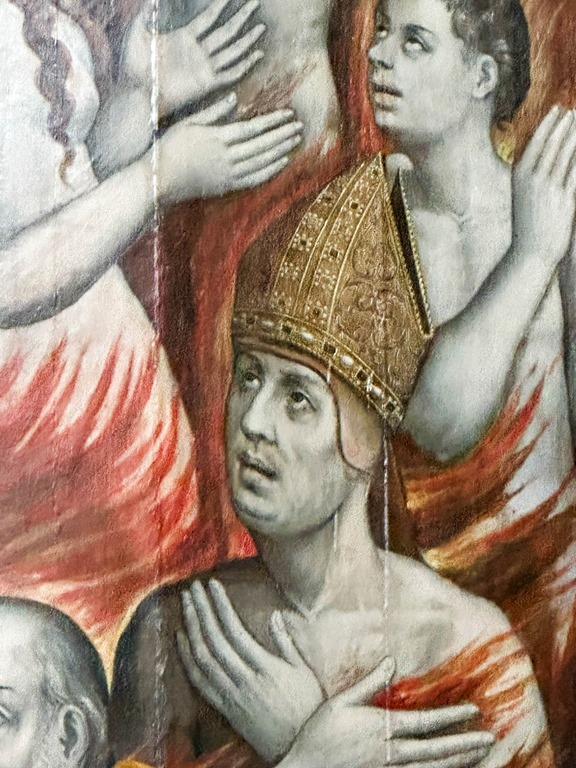
It was a fairly drab and dull bit of eighteenth century architecture and ecclesiastical  furnishing. Except this altar piece dedicated to Saint Michael caught my eye

IMG_0856

particularly with depictions of a bishop

IMG_0857

and even a pope in hell!

IMG_0859

That is a little weird, too.

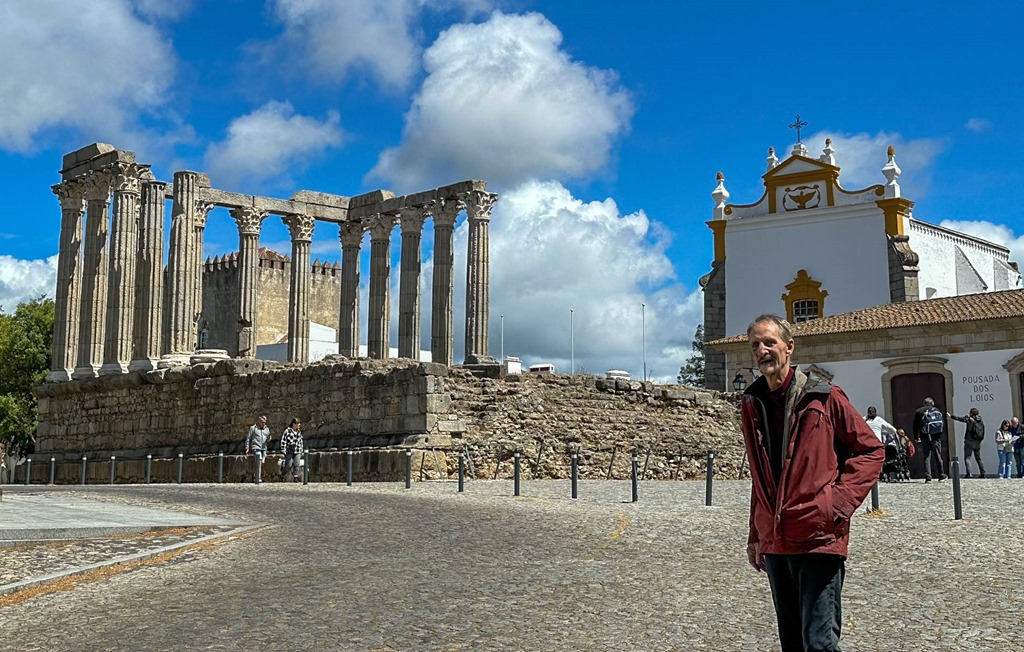
By this time, the rain was over and we even had some blue sky. With the sun out, John’s mood grew sunnier too. We pushed on to look at the cathedral whose treasury is considered the real treasure of this town. But there was a long line and a lot of steps involved and I just did not want to push it. So we walked on a couple blocks until we came to the ruins of the Roman temple of the goddess Diana.

IMG_0866

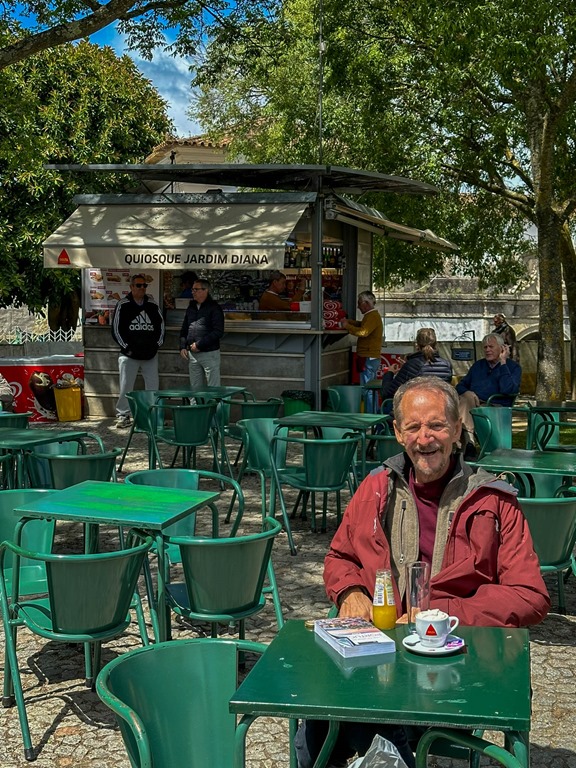
There was a coffee kiosk nearby and we stopped to get a cup.

IMG_0871

Our next destination was the coastal city of Nazaré. But that was almost three hours away, and I wanted some kind of stop along the way. There were a couple very famous monasteries that all the guidebooks told me were “must sees.” But even I had reached the point where I did not want to see another golden reredos with the Virgin ascending into heaven. So, almost as an aside one of the books mentioned the Bacalhôa Buddha Eden, the Buddha Eden Garden. It was on the way. I had plants. There was a train to whisk us around. Google, plot me a course!

This is a truly weird place. It bills itself as the largest Asian garden in Europe. But what exactly is an makes this an “Asian” garden? Mainly the hundreds or reproductions of classic sculptures found in east Asia and the Indian subcontinent.

IMG_0895

While such statues in their original sites were objects of devotion within a shared cultural context, here they are simply decorative kitsch.  So, why are they here? Why was this built?

The official answer is quite high-minded. The gardens were created by José Manuel Rodrigues Berardo, a wealthy philanthopist and art collector, who was outraged by the Taliban’s destruction of the Bamiyan Buddha statues and wished to create peaceful spot celebrating the diversity of cultures and fostering international harmony. But when you look more closely at the man who paid for all this, well, things are a little murkier.

Joe Berardo, as he prefers to be called, grew up in Madeira. He left school at the age of 13 to work in a winery. When he was 18, he emigrated to South Africa. He started a successful wine business there, and soon diversified into gold and diamond mining. He had close connections to to Pik Botha, the apartheid-era South African foreign minister. With the advent of international sanctions against the South African regime in the 1986, the 42 year old Berardo returned to Portugal, now possibly the wealthiest man in the country. Berardo was a controversial figure Portuguese business, often operating much as Carl Icahn did in the United States, buying underperforming companies cheaply and then selling their assets at a profit. Much of his money was then invested in art. While Berardo portrayed himself as a great art collector, he actually used his art as collateral, possibly inflating its value, to obtain loans for other business ventures.

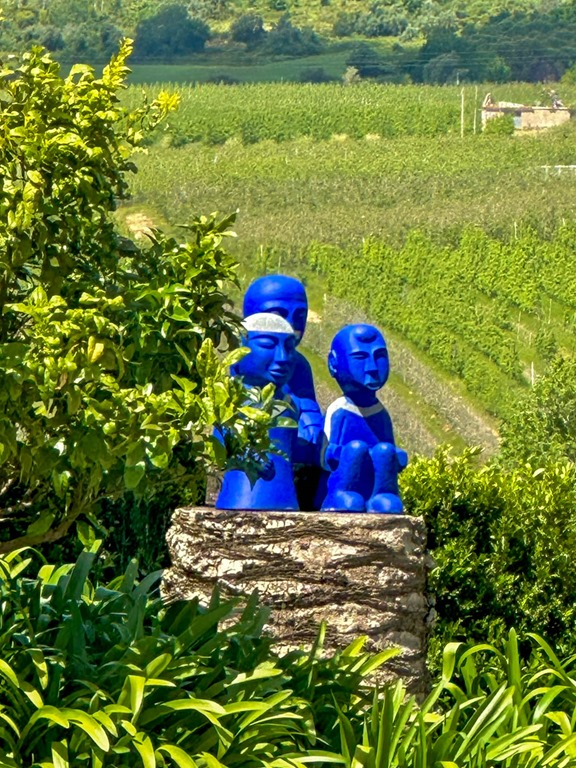
So, it is hard to escape the cynical feeling that this is just another one of Berardo’s business ventures, and that the Buddha statues are not a tribute to the ancient cultures of the Hindu Kush but a clever way to extract tribute from tourists. After all, what exactly do the Qin Dynasty terracotta soldiers have to do with Buddhism—or peace, for that matter? And why paint them all cobalt blue?

IMG_0893

In fact, quite a few things in the garden are painted cobalt blue. You see these statues just as you enter the garden. They seem more Teletubbies than bodhisattvas.

IMG_0872

It is possible to walk around the 50 or so acres of the gardens, but most visitors take a motorized train ride. Rather like the Disneyland railroad, there are three stops along the route and the faux trains come by every twenty minutes or so. Given John’s limited mobility, it was definitely the best choice for us. Our driver was quite helpful, and he suggested we get off at the third stop—Africa.

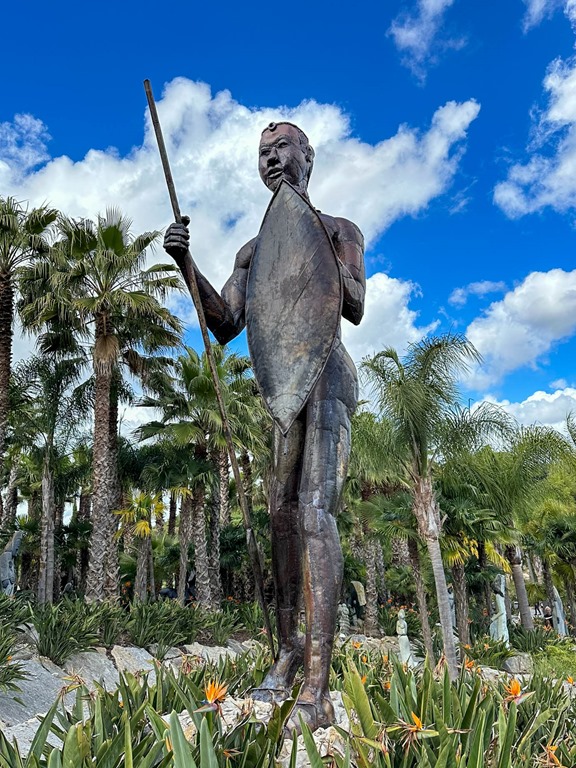
Africa? Wait, you say, I thought this was an Asian garden? Well, for some reason there is a whole section devoted to African art. The website explains it like this:

The African Sculpture Garden is dedicated to the Shona people of Zimbabwe who have been hand-sculpting stone into works of art for nearly a thousand years. The Shona believes in ancestral spirits known as “Vadzimu”. In their sculptures they demonstrate the unity between these two worlds, the physical and the spiritual.

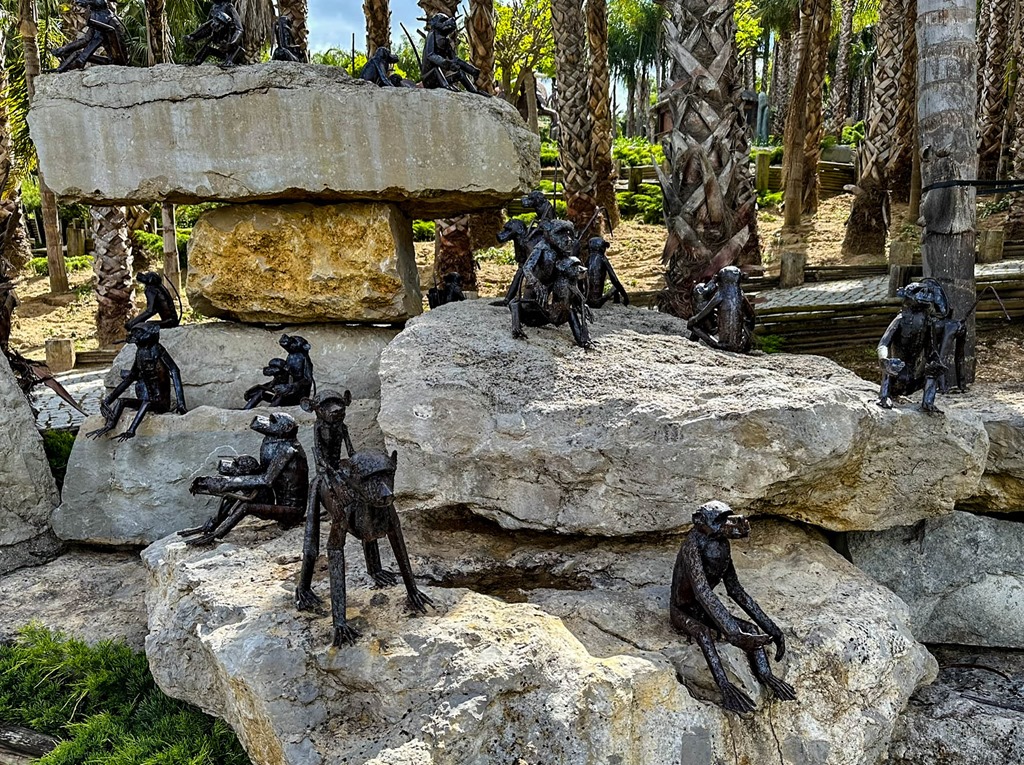
Given Berardo’s connection to the white South African regime, this seems a little lacking in sincerity. And none of the art in this section, as far as I figure out, is actually by the Shona people themselves. It is all done by modern artists of African heritage who presumably find it both fulfilling and profitable to create works in neo-native styles.

IMG_0901

IMG_0902

IMG_0904

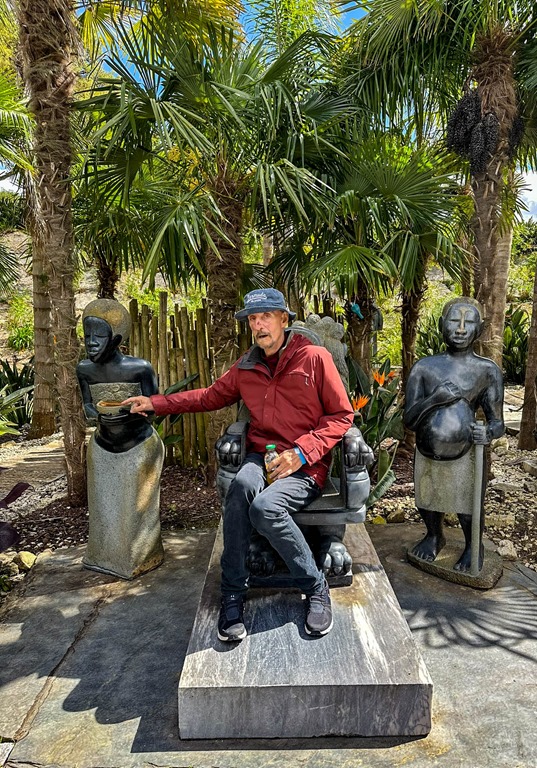
A couple of the exhibits were clearly designed to let the tourists take silly photos.

IMG_0898

IMG_0903

We had to exit, as you might expect, through the gift shop. Except this gift shop sold only wines. Remember the Bacalhôa at the beginning of of the name? Well, the Bacalhôa  Group is a huge wine consortium that dominates growing and distributing Portuguese wines. Is Joe Berardo involved in this business? I could not find out for certain, but I feel confident that the answer is yes.

Tonight we are in lovely bed and breakfast in Nazaré. It is not weird at all. So I will write about it in our next installment.

Seaside

Yesterday morning, John was feeling a little better but looking a little worse. He was not bleeding any more, but he now had bruising all over his face, particularly under his eyes. His nose was still bandaged up, and the gauze underneath the bandages was caked with dried blood. No surprise, he did not want to go down to breakfast, and I brought him some food to the room.

I packed up, and one of the bellhops helped bring the luggage down to the lobby. I should have taken a picture of the slightly ridiculous outfits that these young men were wearing—green blazers, bowler hats, and tartan slacks cut too high. They seemed to accept these absurd costumes gracefully and went ahead to simply helping the guests in any way that they could. When the Bolt came to take us to the Avis office, they happily put all the things in the back for me.

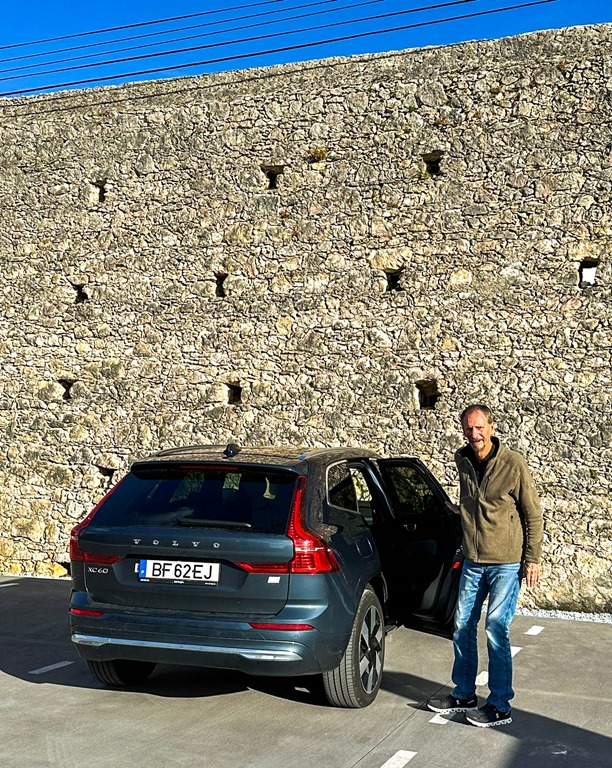
I have never rented a car outside the United States where there was not some problem either at the beginning or at the end. And sure enough, even though I had arranged the rental in advance through Expedia, when we arrived at the rental office on Liberdade there were problems. First of all, there was a huge line of people already waiting, and the line was barely moving. We waited, and waited, and waited some more. Finally, I was called up to the desk, an hour after the time I was supposed to pick up the car. I had reserved a mid-sized SUV because John needs a vehicle with plenty of legroom. And, of course, when I was presented with my keys, I did not have a midsized SUV. No, the only vehicle “in my class” was a BMW roadster. And the rental agent knew damned well that there was no way that I could fit three suitcases and a wheelchair in the trunk of that car. And in the passenger seat of that vehicle, John would have been sitting with his knees just under his chin. Of course, I could upgrade. They had a full-size SUV, a monster plug-in hybrid Volvo. And it was, of course, three times more expensive. I went ahead and took it. Did I really have a choice?

Our plan for the day was to drive south to the Algarve. This is Portugal’s southern coast. It is on the Atlantic, not the Mediterranean, but the sea is calmer and the water is warmer than it is on the west coast of Portugal. Our tuk tuk driver is Lisbon had suggested that we take the old national roads instead of the modern highways. The older roads would take us through many small towns and we would get a feel for Portuguese rural life. I decided to take his advice.

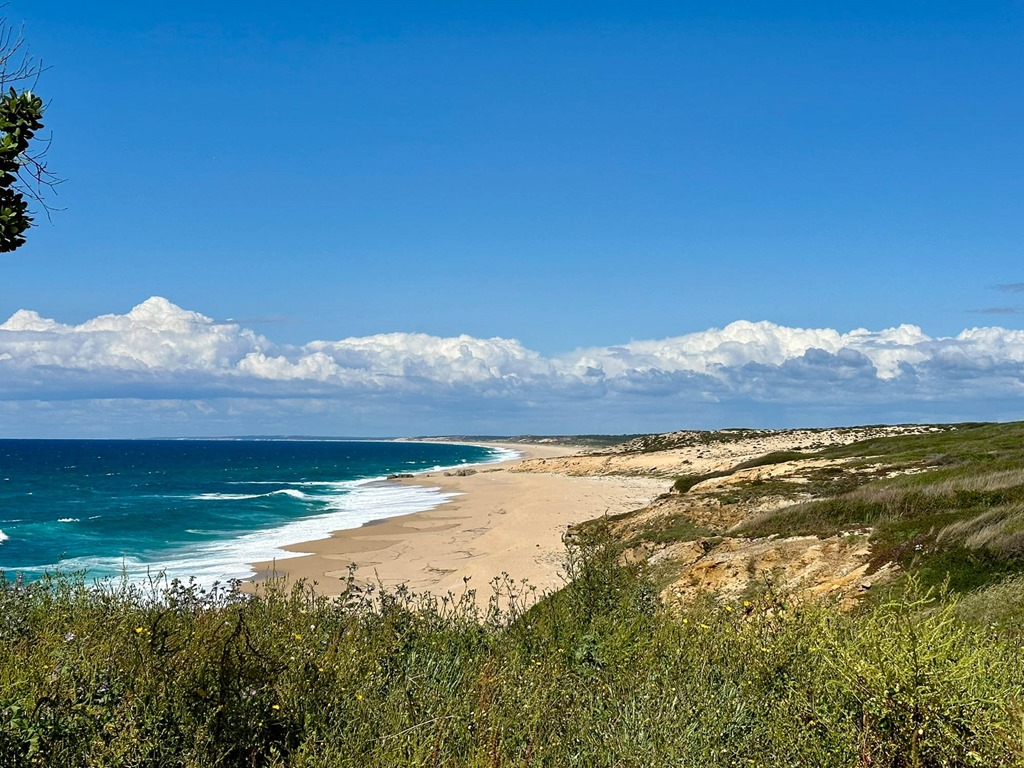
I wish it were possible to take pictures and drive at the same time. Once we were out of the Lisbon area, the scenery became quite pretty indeed. We went through many towns with clusters of whitewashed houses with red tile roofs. The countryside was gently undulating. We saw orchards and vineyards, pastures green with the spring grass and dotted with wildflowers, ewes with lambs following behind, cattle languidly gazing at the passing traffic. At one point I pulled off the road so we could take a call from California, and I saw this stunning beach.

IMG_0819

There was a small café right there, so we had a late lunch.

We continued on another hour until we found our destination for the next two nights, the town of Salema. Highly recommended by a couple guidebooks, Salema is one of the smaller towns in the Algarve. When John and I had spent three weeks in Seville in 1989 studying Spanish, we had taken one of our weekends and explored a bit of the Algarve. It did not seem as congested as Spain’s coast, but I recalled quite a few condominium developments, all, I am sure, built for British or German retirees. A smaller town appealed. And Salema proved to be just that, a charming cluster of houses and small hotels right on a lovely beach.

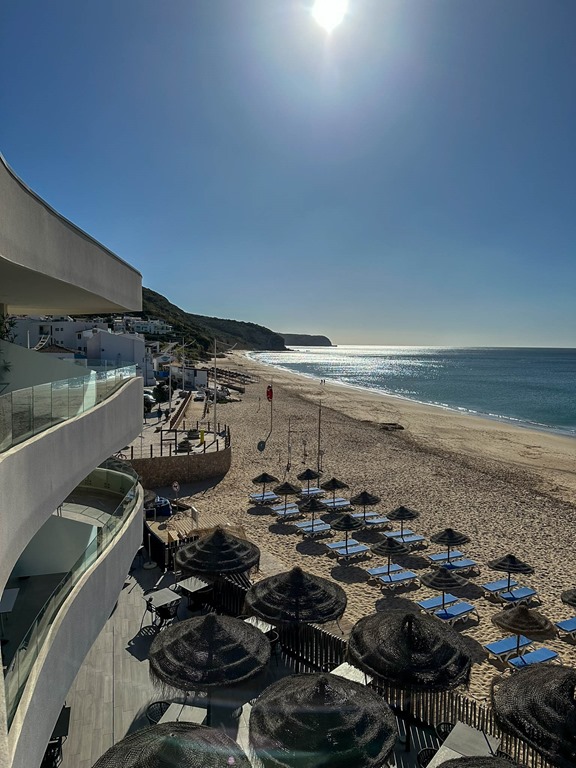
Our hotel, the Vila Mar, is a modern building right on the beach. It is not particularly attractive. But the views from our balcony were exceptional.

IMG_0824

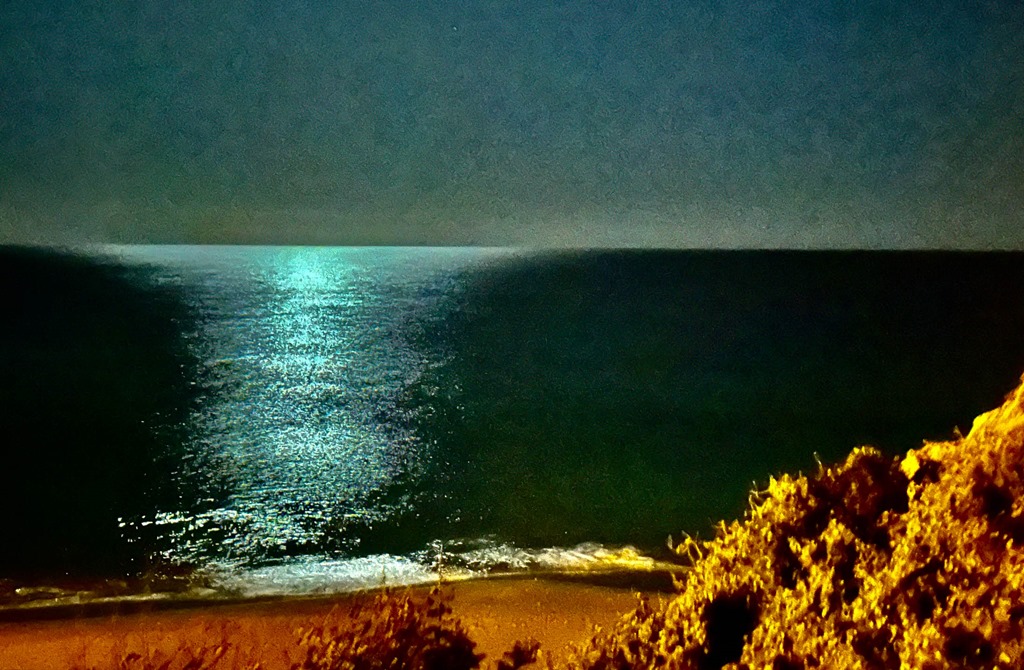
I particularly liked it at night when the moonlight reflected off the still water.

IMG_0822

This morning, John announced that he wanted to go to see Lagos. We had some laundry to do, and I found a place in Lagos that did wash and fold. I figured we would drop it off today and pick it up tomorrow as we left for Evora.

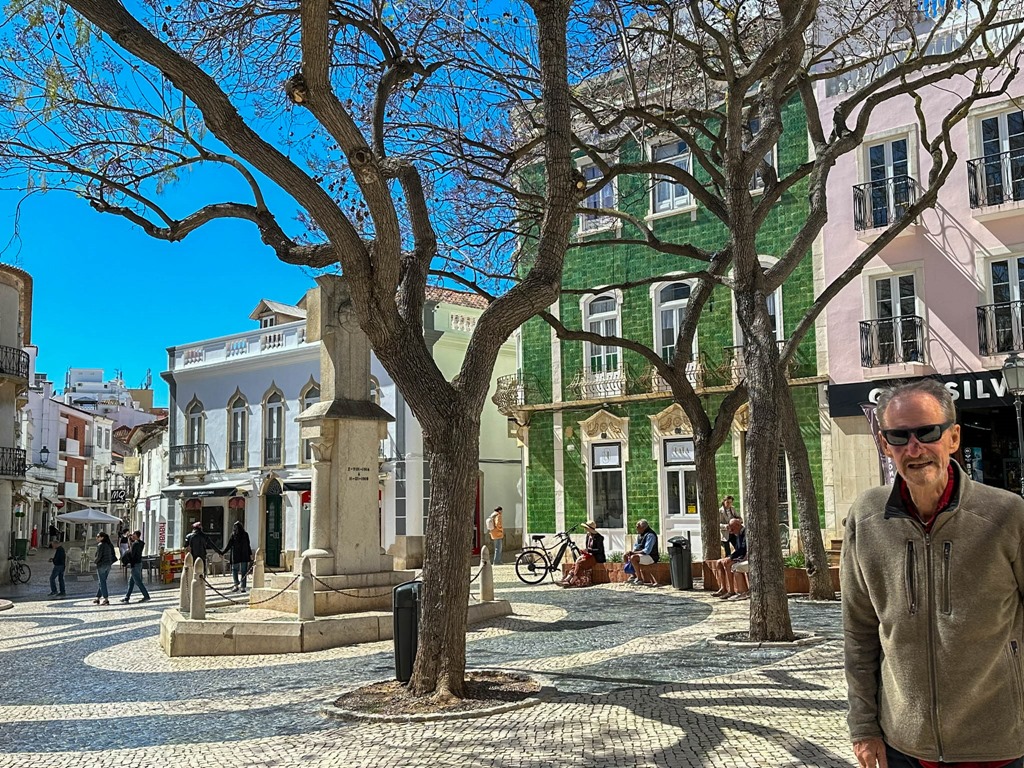
Lagos was cuter than I remembered it. The old town some remaining fortifications, and the behind the walls there is a maze of narrow cobblestone streets opening up to small squares.

IMG_0827

All the shops and restaurants cater to tourists, but they were not a tacky as they could have been. John finds walking on the uneven pavement a little scary, and riding on them in a wheelchair is absolute misery. So, we did not stay in Lagos all that long. On our way out we stopped by a little church whose only interesting feature was this baptistry with a distinct Moorish influence.

IMG_0828

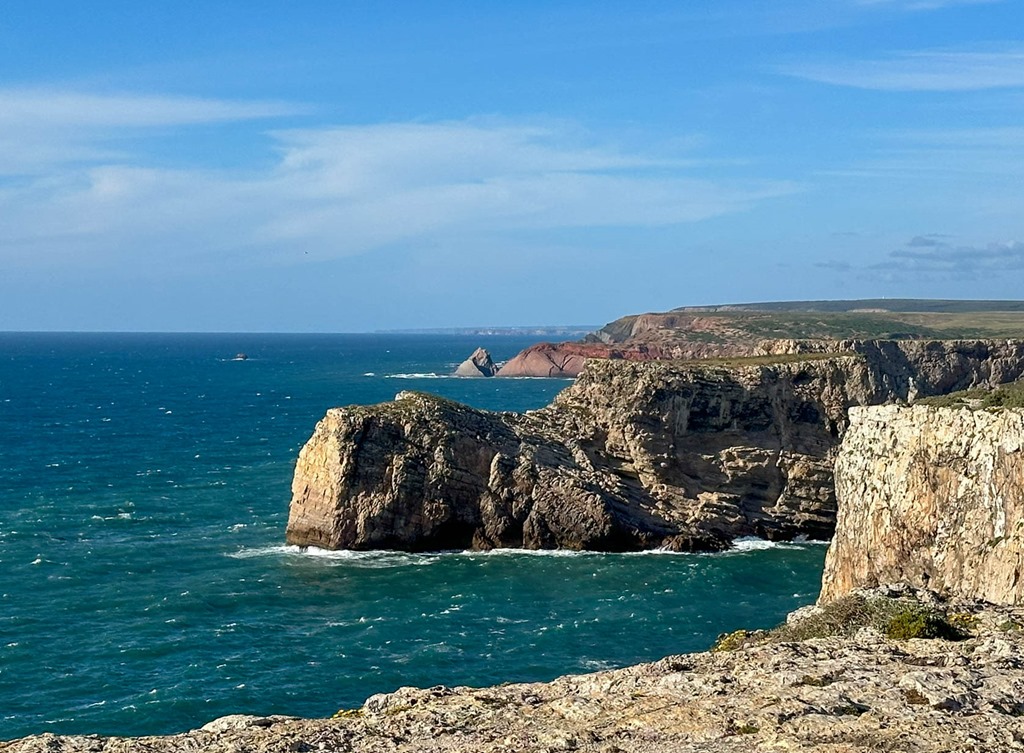
John slept for much of the afternoon, but in the early evening he was ready to go somewhere. So, we headed towards Cabo de São Vicente, Cape Saint Vincent, at the far tip of southwest Portugal. The Romans called this point “the end of the known world.”

IMG_0843

It was here that King Henry the Navigator established his sailing school that launched the age of European discoveries. That buildings are long gone, replaced by an eighteenth-century fort.

IMG_0834

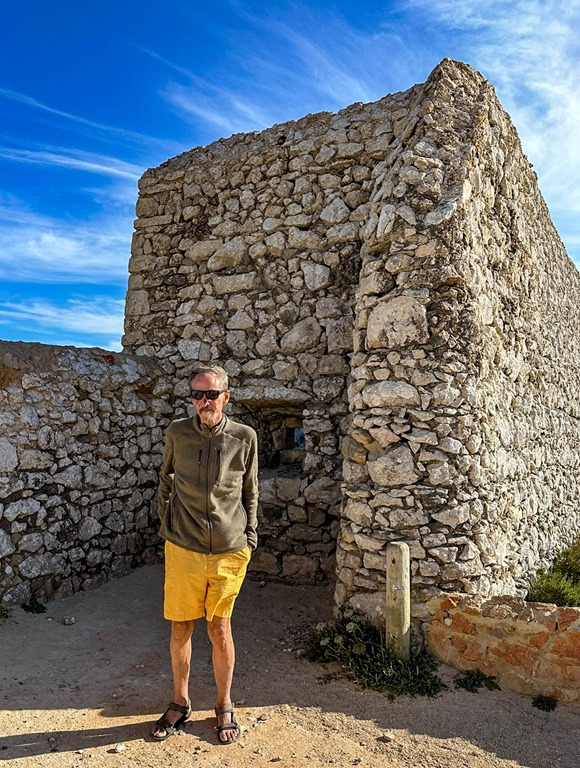
The fort had just closed by the time we arrived, and the wind was intense and almost bitingly cold. We pushed on a bit further north towards the lighthouse. Along the way we stopped to look at some smaller fortifications.

IMG_0838

The lighthouse was also closed, but that was not a big disappointment. We drove through the small city of Sagres, but it seemed almost deserted. Just by the fort we had noticed a restaurant that looked a little better than the average tourist fare. We were the only customers there, but we had a nice meal.

Tomorrow, we leave Salema to head back north to the historic city of Evora.